


Introduction
Methodology
Major evaluation items for the FRI
Analysis of the relative importance
Result
Survey 1: Risk factors vs fire extinguishing facilities
Survey 2-1: Construction information
Survey 2-2: Risk factors
Survey 2-3: Fire extinguishing facilities
Comprehensive Results
Conclusions
Introduction
Amid accelerated economic growth, numerous buildings have been built every year since the 1980s, and deteriorated buildings that have not been destroyed or demolished account for more than one-third of all buildings. This is because intensive urban development projects were carried out around the 1980s, but subsequently, the redevelopment, reconstruction, and construction of new buildings were regulated to prevent indiscriminate construction projects and pursue balanced development [1].
These deteriorated buildings are causing serious social problems in terms of fire safety [1, 2]. This is because the deteriorated buildings are aged, and they were constructed at a time when safety standards were low, and during the process of use, many buildings were illegally changed or expanded during the process of use, making them highly vulnerable to fire. In addition, deteriorated buildings are concentrated in certain areas, which in the event of fire means that the fire is likely to spread and due to narrow road networks and illegal parking there are many difficulties in extinguishing fires [1, 3].
Meanwhile, the fire risk in buildings is managed using the fire risk index (FRI) [4, 5]. which refers to the representation of the evaluation result in numbers in which potential fire risk, spread, and ease of fire suppression are evaluated in advance from the perspective of a building or building district. Representative examples of FRIs include the US Fire Safety Evaluation System (FSES), FireCast, the UK Fire Risk Assessments (FRA), and the Swiss Fire Risk Evaluation Model (FREM) With these indices, the risks of fire outbreak and spread and the stability of all buildings are evaluated in the phases of construction, design and maintenance, and the results of evaluation are actively utilized in preemptive responses for buildings vulnerable to fire risk and determination of the fire insurance premium rate [6, 7, 8]. The examples of FRI in Korea include the FRI of the Korea Fire Protection Association, the publicly-used facilities fire risk assessment of the National Fire Agency, and the Korea Safety Map of the National Disaster Management Research Institute [9, 10, 11, 12, 13]. In the case of the fire risk assessment of publicly-used facilities, each uses more than 30 detailed evaluation items for detailed evaluation of the fire risk level of buildings. However, as these evaluations are conducted through on-site visits and direct manual checking of evaluation items consisting of factors inducing or suppressing fire in a building, although the direct evaluation has the merit of enabling relatively accurate evaluation of FRI, this method has practical limitations of having to invest significant professional manpower and time in the evaluation [11, 12]. In addition, the method that uses statistical data presenting the types and levels of fire events has the limitation that although the method facilitates fast FRI evaluation, it is unable to reflect the current level and status of a building. Therefore, for the fire safety management of deteriorated buildings, it is necessary to take a technical approach that can improve vulnerabilities and manage them efficiently by periodically and quickly evaluating the FRI reflecting their characteristics [14, 15, 16, 17, 18, 19, 20].
This study aims to analyze the relative importance of FRI evaluation items in deteriorated building districts using the analytic hierarchy process (AHP) for the development of an FRI evaluation platform for deteriorated building districts. The relative importance of FRI evaluation items derived in this study can be utilized as weighting factors of an FRI evaluation platform for deteriorated building districts.
Methodology
Major evaluation items for the FRI
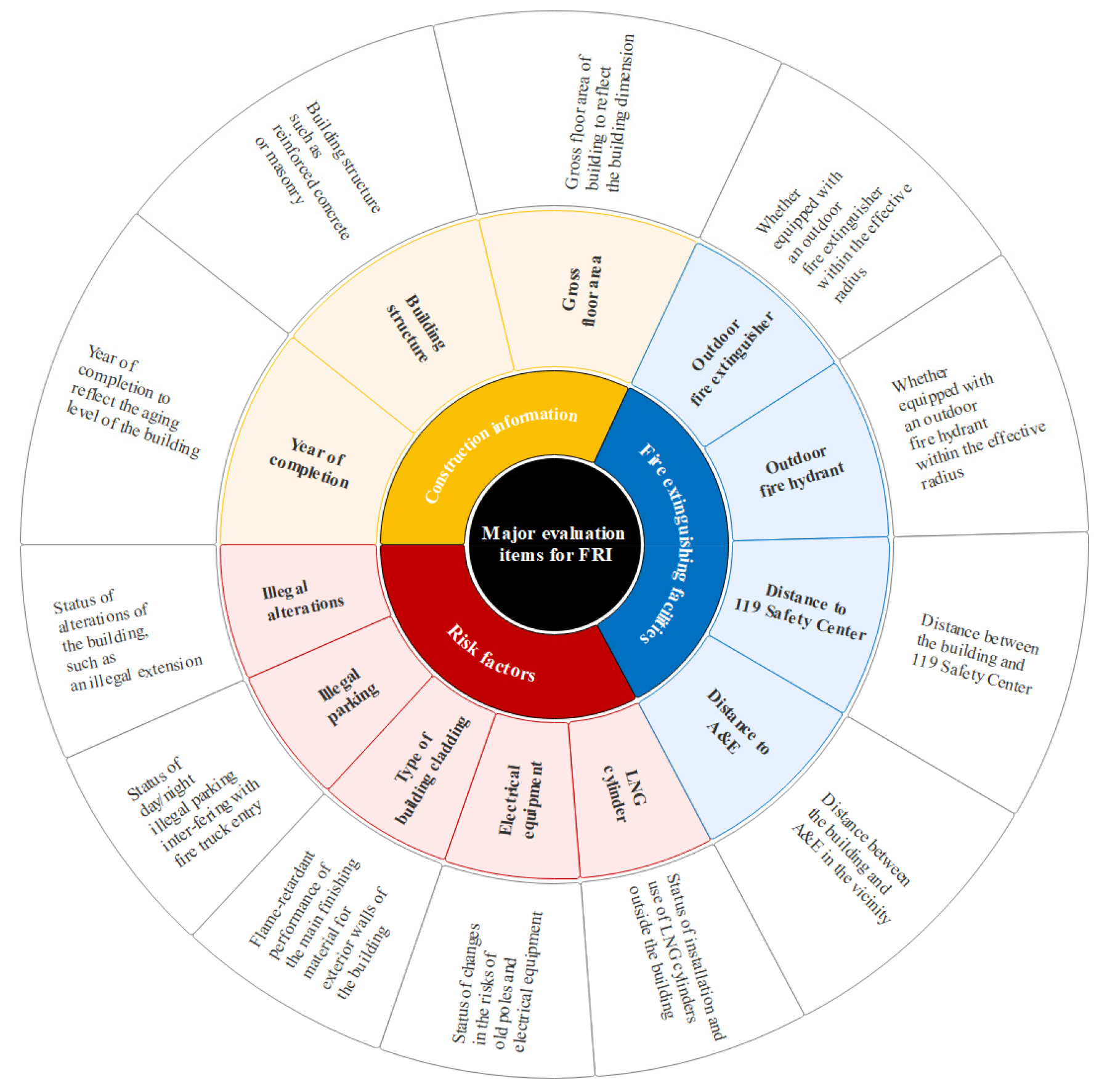
In this study, a total of 12 major evaluation items were identified based on a field survey for areas with a high density of deteriorated buildings, analysis of the existing FRI evaluation items, and survey of 181 fire experts, who included fire officers, university professors & researchers, and fire-related industry experts [21, 22].
The major FRI evaluation items were divided into construction information, risk factors, and fire extinguishing facilities according to their characteristics, consisting of a total of 12 evaluation items that included year of completion, building structure, gross floor area, type of building cladding, illegal alterations, illegal parking, electrical equipment, LNG cylinder, outdoor fire extinguisher and outdoor fire hydrant, distance to 119 safety centers, outdoor distance to accident and emergency (A&E). Figure 1 shows the major evaluation items for FRI in this study.
Analysis of the relative importance
The AHP model was designed to analyze the relative importance of the FRI evaluation section and major fire risk evaluation items, and their weights were derived through expert surveys. AHP analysis was developed by Satty in the 1970s [23], and is a hierarchical analysis technique for deriving the relative importance as a quantified value by comparing the components or items of a complex problem situation one-to-one in decision making [24]. Data for AHP analysis is mainly collected from experts in the field, so it has the characteristic that reliable and professional results can be derived even with a small number of samples. Figure 2 shows the hierarchy of evaluation items that was constructed for the questionnaire that was prepared in this study for the expert opinion survey for AHP analysis. That is, in “Survey 1” regarding the evaluation sector, the relative importance of the risk factors that cause the occurrence of fire and the spread of damage and the fire extinguishing facilities to suppress them were calculated. In “Survey 2-1”, “Survey 2-2”, and “Survey 2-3”, each evaluation sector derived the importance of each constituent evaluation item. The survey was conducted directly by method and e-mail to a total of 81 fire experts, including 47 fire officers, 17 university professors & researchers, and 17 fire-related industrial experts. Table 1 presents examples of the survey items for risk factors (Survey 2-2) conducted in this study.
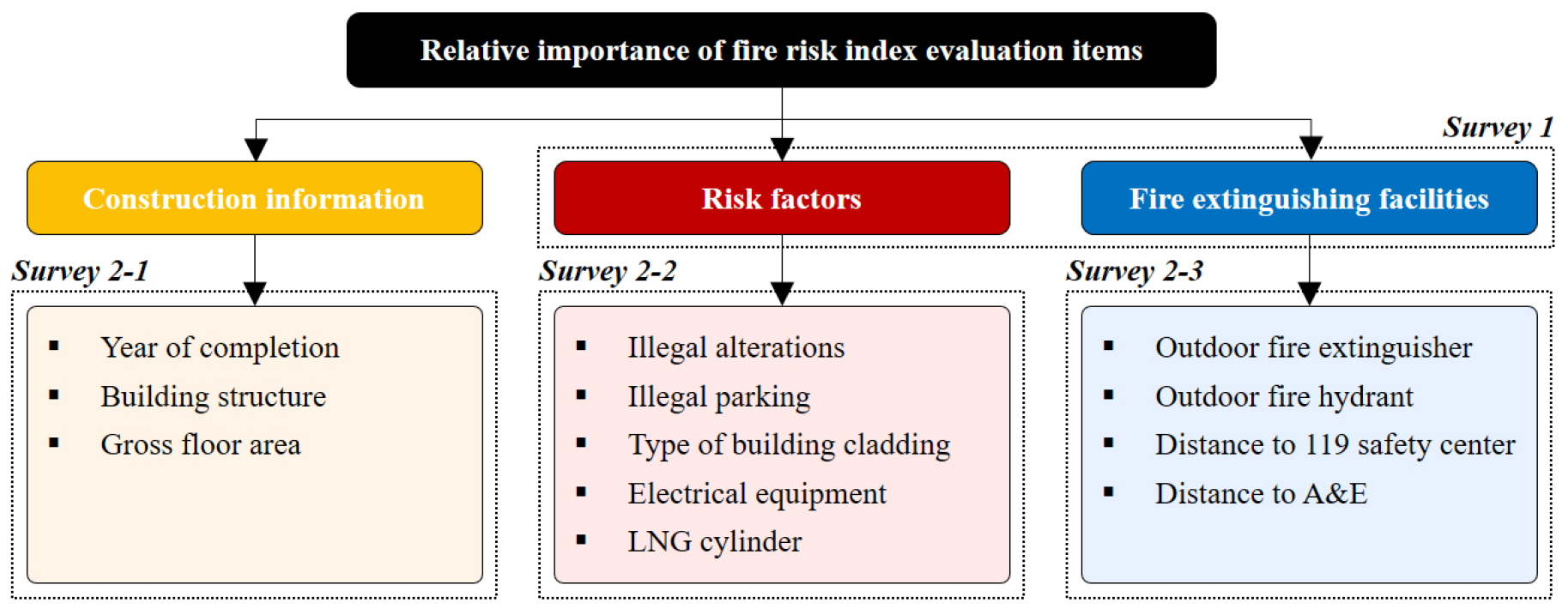
Table 1.
Example of an AHP questionnaire (Survey 2-2)
On the other hand, it is very important to determine the trustworthiness of the survey respondents in the AHP analysis. This is to confirm the logical point that, of course, if A > B and B > C, A > C must be satisfied based on the respondent’s answer. The consistency of these answer results is mainly judged through the consistency ratio (CR). CR (CR = CI / RI × 100) is the ratio of consistency index (CI) to random index (RI), and when this value is 0, it can be determined that the answer is completely consistent [24]. Generally, if the CR is within 0.1, it is judged that there is consistency suitable for the judgment made by the evaluator on the items, and if it is 0.1~0.2, it is judged as a tolerable level. In the case of strict AHP, CR < 0.1 is recommended as the consistency criterion [24], but in this study, a somewhat relaxed CR < 0.2 was applied as the criterion and the questionnaire results that did not pass this were excluded from the analysis.
Result
Survey 1: Risk factors vs fire extinguishing facilities
Figure 3 shows the results of the importance analysis (Survey 1) between the risk factors and the fire extinguishing facilities. According to Figure 3, the fire officers and; university professors & researchers answered that the risk factors had a higher effect than the fire extinguishing facilities on the occurrence of fire and the spread of damage in the deteriorated building district.
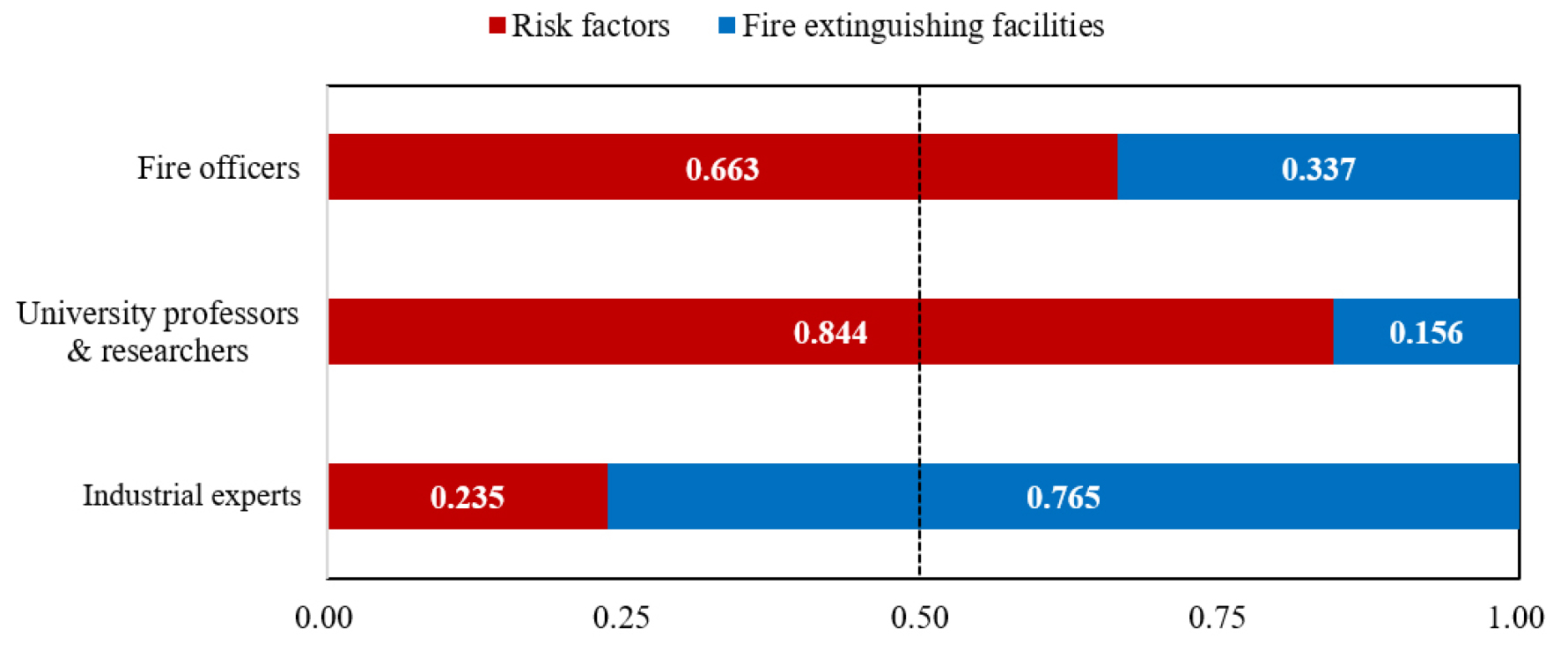
In particular, the risk factors for fire officers and the relative importance of the fire extinguishing facilities were derived as 0.663 and 0.337, respectively, indicating a relatively balanced relative importance, but the relative importance of the risk factors of university professors & researchers was analyzed as 0.844, showed an overwhelmingly large value compared with the fire extinguishing facilities that were derived with a relative importance of 0.156. Meanwhile, the industrial experts were the only category where fire extinguishing facilities were regarded as more important than the risk factors. The relative importance they responded with was analyzed to be 0.765 and 0.235, respectively.
Survey 2-1: Construction information
Figure 4 shows the results of the analysis of the importance of evaluation items constituting construction information (Survey 2-1). According to Figure 4, fire officer, and university professor, & researcher assigned relatively similar relative importance to the three evaluation items of construction information, and both groups selected building structure as the most important item (fire officer: 0.458, university professor & researcher: 0.494).
On the other hand, the survey result of industrial experts, assigned the relative importance of gross floor area as 0.417, which was analyzed to have the greatest importance. However the building structure which was previously selected as the most important evaluation item by the fire officers, and the university professors & researchers, was assigned the lowest value (0.271).
The relative importance for the year of completion indicating a relatively similar trend according to the order of fire officers, university professors & researchers, and industrial experts was analyzed as
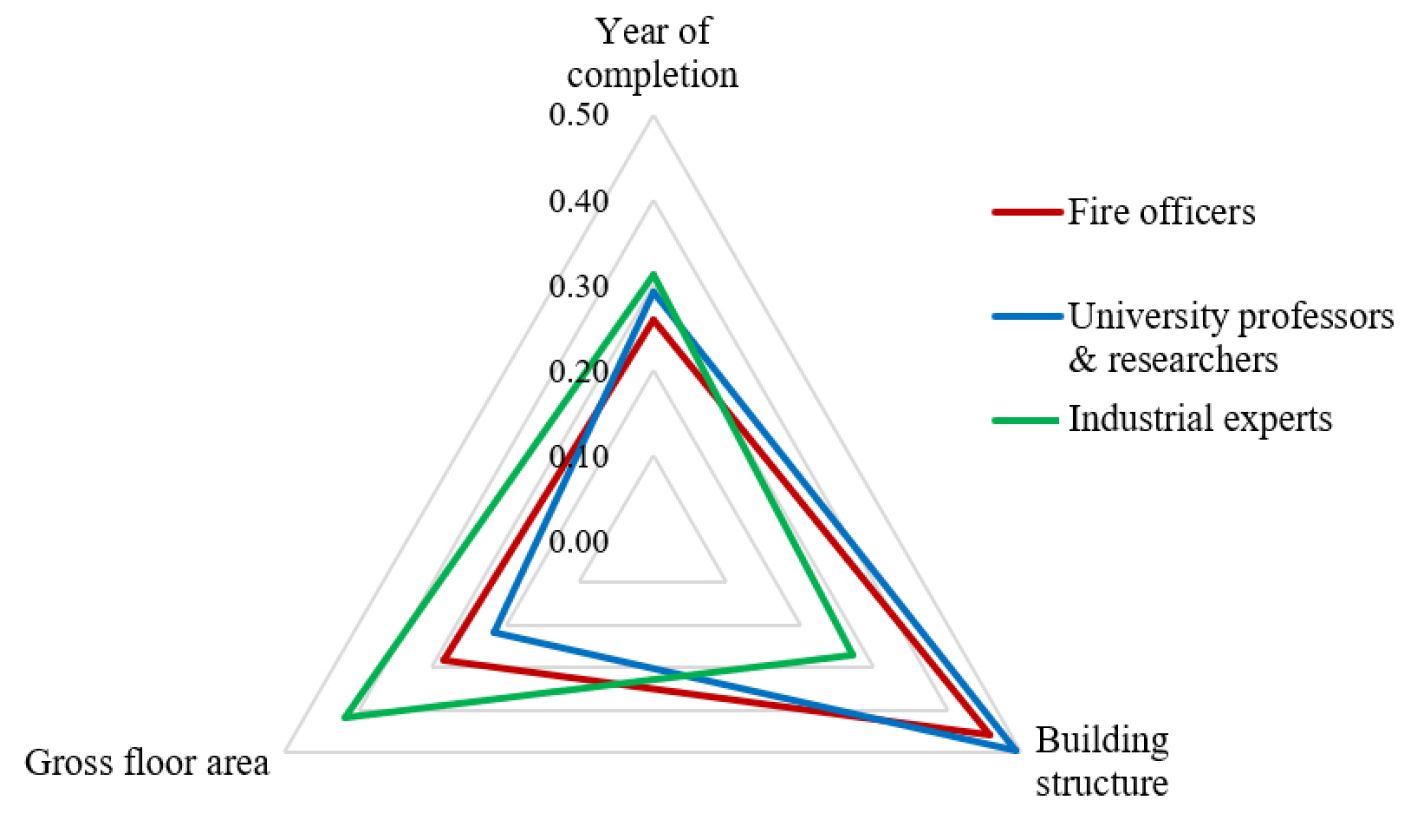
(0.259, 0.291, and 0.312), respectively.
Survey 2-2: Risk factors
Figure 5 shows the results of the importance analysis (Survey 2-2) of the evaluation items constituting the risk factors. According to Figure 5, fire officers, and university professors & researchers assigned relatively similar relative importance to the five evaluation items of risk factors, and both groups ranked the type of building cladding as the most important item (fire officers: 0.287, university professors & researchers: 0.322).
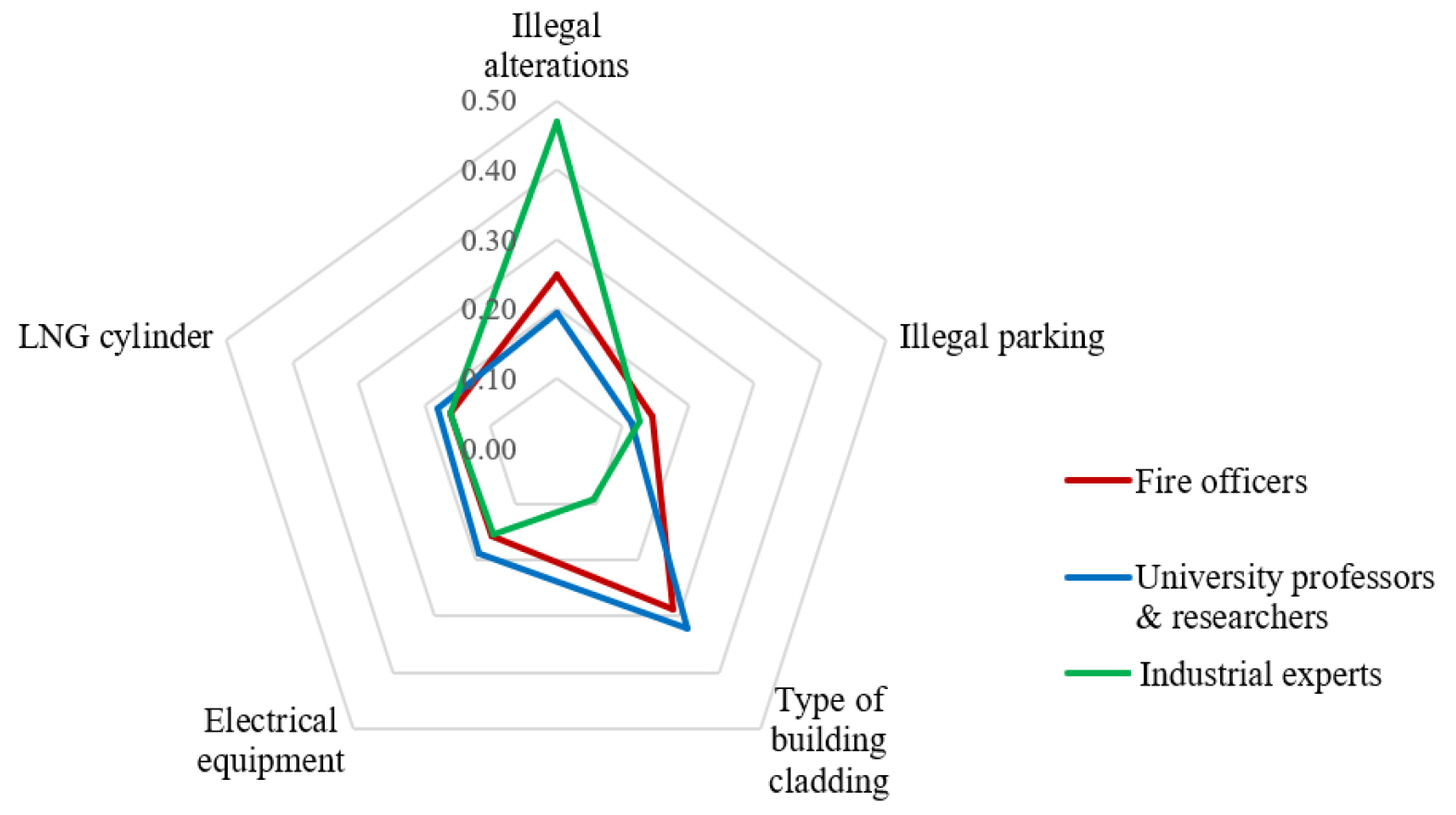
On the other hand, in the survey result of the industrial experts, assigned the relative importance of illegal alterations of 0.469, which was analyzed to have the greatest importance. However, the type of building cladding, which was previously selected as the most important evaluation item by fire officers, university professors & researchers, was assigned the lowest value (0.092).
The relative importance of illegal parking, electrical equipment, and LNG cylinder for all groups showed relatively similar trends.
Survey 2-3: Fire extinguishing facilities
Figure 6 shows the results of the analysis of importance (Survey 2-3) of the evaluation items constituting the fire extinguishing facilities. According to Figure 6, the fire officers and industrial experts assigned very similar relative importance to the four evaluation items of fire extinguishing facilities, and both groups ranked distance to 119 safety centers as the most important item (Fire officers: 0.279, Industrial experts: 0.280).
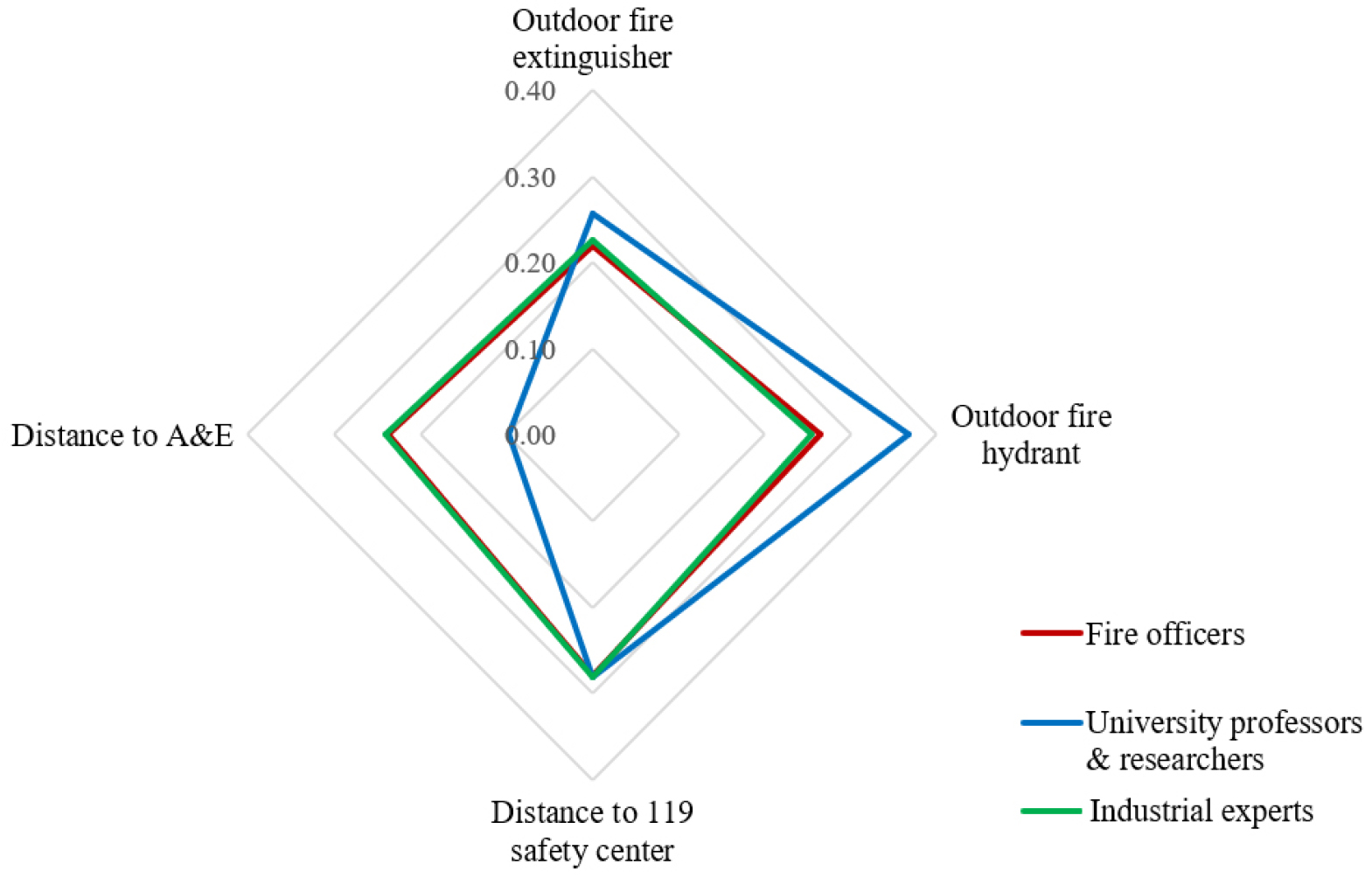
On the other hand, the results of “Survey 2-3” for University professors & researchers who all presented similar opinions to fire officers in the previous “Survey 1”, “Survey2-1”, and “Survey 2-2” were somewhat different. University professors & researchers selected Outdoor fire hydrant as the most important evaluation item and suggested that the importance of distance to A&E was insignificant.
The relative importance of Outdoor fire extinguishers and distance to 119 safety centers for all groups showed relatively similar trends.
Comprehensive Results
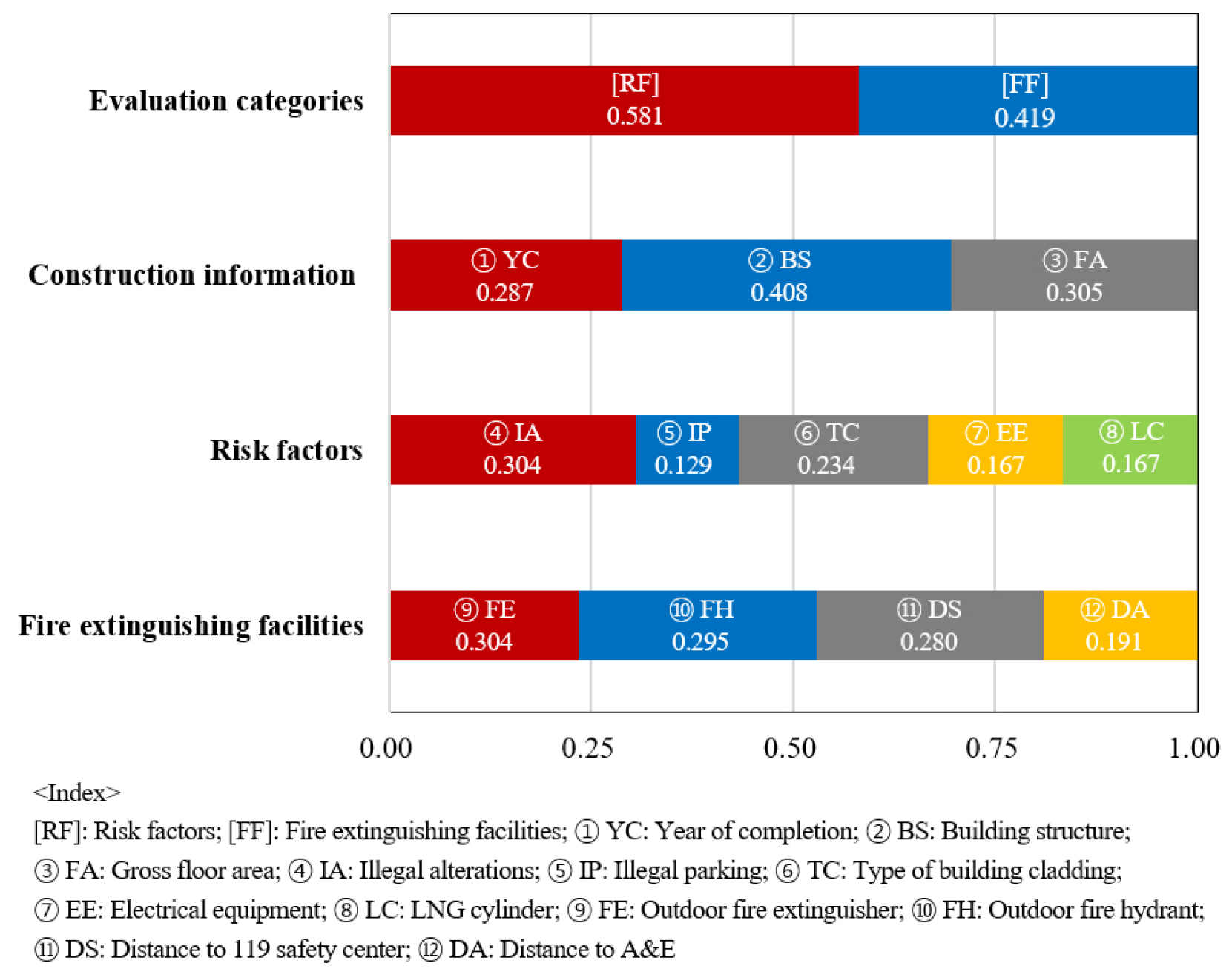
Table 2 and Figure 7 show the overall results of the importance analysis performed in this study and the average value of the relative importance, respectively. According to the average values in Table 2 and Figure 7, the relative importance between risk factors and fire extinguishing facilities was derived as (0.581 and 0.419), respectively, and the analysis showed that the fire experts considered risk factors more important than fire extinguishing facilities within the scope of this study. The relative importance of each evaluation item in the construction information category was in the order building structure (0.408) > gross floor area (0.305) > year of completion (0.287), and the risk factors category was in the order: illegal alterations (0.304) > type of building cladding (0.234) > electrical equipment and LNG cylinder (0.167) > illegal parking (0.129). The relative importance of each evaluation item in the fire extinguishing facilities category was analyzed in the order of outdoor fire hydrant (0.295) > distance to 119 safety centers (0.280) > outdoor fire extinguisher (0.234) > distance to A&E (0.191).
Table 2.
Results of the AHP questionnaire
Conclusions
The purpose of this study was to analyze the relative importance of FRI evaluation items in deteriorated building districts using the analytic hierarchy process (AHP) for the development of an FRI evaluation platform for deteriorated building districts. The main conclusions are outlined as follows.
1. The relative importance of evaluation categories with risk factors and fire extinguishing facilities, and the relative importance of each evaluation item constituting the categories of construction information, risk factors, and fire extinguishing facilities were analyzed for fire experts including fire officers, university professors & researchers, and industrial experts.
2. The average relative importance between risk factors and fire extinguishing facilities was assigned as 0.581 and 0.419, respectively, and analysis showed that those fire experts considered risk factors more important than fire extinguishing facilities in the scope of this study.
3. The relative importance of each evaluation item in the construction information category was in the order of building structure (0.408) > gross floor area (0.305) > year of completion (0.287).
4. The risk factors category was assigned in the order: (0.304) > type of building cladding (0.234) > electrical equipment and LNG cylinder (0.167) > illegal parking (0.129).
5. The relative importance of each evaluation item in the fire extinguishing facilities category was assigned in the order: outdoor fire hydrant (0.295) > distance to 119 safety centers (0.280) > outdoor fire extinguishers (0.234) > distance to A&E (0.191).
This study has the significance of analyzing the relative importance by reflecting the opinions of various fire experts to evaluate the FRI of deteriorated building districts. In the future, based on the relative importance of each evaluation item derived from this study, we plan to develop the FRI evaluation platform for deteriorated building districts.

