


Introduction
The City of Recife and Basic Sanitation
Use of Biodigester Systems in Rural and Urban Areas
Methodology
Exploratory Study in a ZEIS of Recife
Definition of Guidelins for the Prepartion of Projects and Layout Proposal for Urban Biodigesters
Conclusions
Introduction
In large Brazilian cities, innumerable informal dwellings, also known as needy communities, lack basic sanitation, safety, transportation, decent housing, and the means to enable the development of infrastructure that could improve the quality of life for the population. According to Fantinatti et al. (2015), informal dwellings arise spontaneously, as in the cases of invasions or irregular settlement in difficult-to-access areas that are established because of proximity to work or availability of open land. Faced with this problem, the need to apply engineering knowledge in support of low-income communities with projects that bring sanitation, leisure, education, sustainable housing, and generation of energy to the population becomes evident.
In Brazil, basic sanitation is defined by Law 11.445/2007 as the set of services, infrastructure, and operational installations for drinking water supply, sewage, street cleaning, solid waste management, floodwater management, and urban drainage. According to etymology, sanitation is the act or effect of sanitizing, disinfecting, deodorizing; it refers to the application of measures to improve hygienic conditions of a place or region, especially drainage, making it suitable for habitation and bringing improvements to health. (Weiszflog, 2016).
Therefore, sanitation implies a determining factor and condition for public health, and must be regarded as of interest to social policy for the protection of the population. According to Embrapa (2010), 75% of hospital admissions in Brazil are associated with the lack of basic sanitation, often related to informal housing combined with the absence of three basic services: running water in at least one room, sewage network or septic tank, and trash collection. (Observatório das Metrópolis, 2010)
Faced with these sanitation problems, the objective of this article is to bring alternatives through project guidelines and a proposed layout for biodigesters, considering economic viability and ease of installation and maintenance, that can be used to channel sewage and solid waste in needy communities, improving the local basic sanitation and public health, as well as contributing to the improvement of sewage spilled into bodies of water.
The City of Recife and Basic Sanitation
In middle- and upper-class neighborhoods of large Brazilian cities, it is not common for the populace to stop and think about how many times they turn on faucets or the shower, or flush the toilet. It is not a habit to analyze the consumption of water by families, the neighborhood, the city, or the state where one lives, much less to think about the collection, treatment, and maintenance of its sewer systems. (Revista Proteção, 2012).
According to the Municipal Sanitation Department of Recife (SANEAR), in the most recent census conducted by the Brazilian Institute of Geography and Statistics, the city of Recife had a population of approximately 1.5 million. Due to problems of extreme income inequality, territorial settlement occurred through a series of invasions, occurring especially in hazardous areas such as steep hillsides, floodplains, riverbanks, and along canals. These areas are often surrounded by and constrained between central and upper-class neighborhoods of the city, and are known as “pockets of poverty.” “This disorderly occupation adds up to a total of more than 500 favelas deprived of even the minimum of urban infrastructure, demanding urgent action from the government.” (Prefeitura da Cidade do Recife, 2016a)
The municipality of Recife covers 220 km²of area and is divided into six (6) Politico-Administrative Regions (RPA’s) for the purposes of forming, executing, and evaluating the policies and plans of the government. Each RPA is subdivided into three(3)micro-regions, which define local-level municipal interventions and coordination with the populace. These micro-regions are subdivided into neighborhoods, and within them can be found the Special Zones of Social Interest (ZEIS), which are “portions of territory to be given priority in urban recovery, land regularization, and social housing projects, including the recuperation of degraded properties, the provision of social and cultural amenities, public spaces, services, and locally-based businesses.” (Fonseca et al., 2014, p.1).
The ZEIS were integrated in the City Master Plan in 2008. Today, Recife has 66 ZEIS distributed throughout 94 neighborhoods. Such neighborhoods show symptoms of urban land use exhaustion. Many of these neighborhoods are located in riparian áreas, near drainage canals, or in sensitive hillside areas highly restrained from expanding and installing urban infrastructure, resulting in a wide range of structural and socio-environmental problems for their low-income residents, who have no other housing options. (Secretaria da Cidade do Recife, 1997).
According to the National Basic Sanitation Plan (PLANSAB) 2013, the release of primary sewage (human waste - feces and urine) and secondary sewage (other residential wastewater) cannot be performed in places such as rudimentary pits (wells, excavation holes), open ditches, drainage systems, storm sewers, rivers, lakes, or the sea without proper treatment according to the parameters established by CONAMA Resolution 430 of 2011. However, the Brazilian reality is that 35% of the population (reaching over 60% in Recife) relies on inadequate solutions for their sewage removal. Only20 million habitants in Brazil have sewage disposal systems or septic tanks that are considered suitable for the disposal of wastes. (Ministério das Cidades & Secretaria Nacional de Saneamento Ambiental, 2014; Ministério das Cidades, 2014).
Use of Biodigester Systems in Rural and Urban Areas
According to the United Nations Development Programme (PNUD) and the Ministry of the Environment (MMA) (2010), a biodigesteris a closed chamber that provides appropriate conditions for the fermentation of organic material carried out by methanogenic bacteria. This decomposition process generates biogas, which is formed from the following gases in these proportions: methane 50-70%, carbon dioxide 25-40%, hydrogen 1-3%, hydrogen sulfide 0.1-0.5%, and other trace gases. The process of decomposition also produces biofertilizers, which are effluents more suitable for being returned to bodies of water, and which can be utilized in community gardens, community centers, and resident associations.
“The first biodigester dates to the year 1857 in Bombay, India and was built to produce fuel for a leprosy hospital” (Nogueira apud Balmant, 2009, p. 11). However, there are reports that biodigesters may have been used for over 5000 years in countries such as India and China. In Ghana, West Africa, interest in biogas began in the 1960s, but it was only in the 1980s that this technology received greater attention from the government and universities, due to environmental problems. The use of biodigesters was strengthened by the National Strategic Energy Plan, created to encourage the production of biogas in the country, principally in kitchens of establishments, laboratories, hospitals, boarding schools, barracks, among other institutions. (Richard et al., 2011).
In the study by Richard et al. (2011), the reutilization of wastewater generated by students and workers at four universities in Ghana to generate biofertilizers and biogas was analyzed. The total daily production of biogas at the four universities was 1,378.5 m³ and 291.3 m³ during the school year and on holiday, respectively. This biogas could help reduce the amount of Liquefied Petroleum Gas (LPG) required by the university restaurants or to reduce electricity costs. According to Santana et al. (2012), 1 m3 can generate 1.43 kWh of electricity and is the equivalent of 0.45 kg of LPG. According to Peres (2010), 1 m3of biogas with 60% methane has a calorific value of 19.52 MJ.m-3. The advantages of treating waste in a biodigester are a reduction in the amount of waste, the generation of a renewable energy source (biogas), and the production of effluent with little odor and rich in nutrients that can be used in agriculture. According to Olugasa et al. (2014), a study conducted in Nigeria revealed that biogas can be na alternative to conventional energy sources with the added benefit to the environment of removing pollutant substances from nature and transforming them into renewable energy.
The study made by Turdera and Yura (2015) in the city of Dourados in Mato Grosso do Sul, Brazil, simulated the home use of biogas, where 8.93m³ of biogas per day was able to provide for the cooking of meals, illumination of four light bulbs for three hours, refrigerate food, and provide a hot bath for a family of five people.
Despite being a reality for many years in other countries of the world, the use of biodigesters remains in its infancy in Brazilian urban areas. However, a few examples of research and development can be seen at Brazilian universities (Pimentel et al., 2015). In urban areas, specifically ZEIS where there is disorderly settlement and high population density, large-scale projects are not applicable due to the absence of free space within the communities, necessitating a new compact design that is simple to install, operate, and maintain.
Methodology
Initially, a literature review was conducted on the political-administrative distribution, neighborhoods, and ZEIS, as well as the sanitation infrastructure of the city of Recife. Subsequently, a descriptive Field study was conducted through photographic registry and informal interviews with community leaders in the ZEIS of Borborema, Vila Arraes,andCarangueijoTabaireswith the goal of identifying, mapping, and observing the flow of sewage and the disposal of Municipal Solid Waste (MSW), discovering the locations of open areas for installation of biodigesters, tracing the socio-economic profile of residents, and estimating the electrical current necessary to supply homes, residents associations, or community centers open to all local residents.
Using the ESIG program, Geographic Information of Recife (Prefeitura da Cidade do Recife, 2016b), it was possible to visualize the proximity of the communities visited to bodies of water, and to map rivers, drainage canals, lakes, basins, and the sea, as well as to store information necessary for a potential study of environmental impacts caused by improper sewage disposal.
Project guidelines were proposed to channel sewer water to a “homemade” biodigester based on laws and technical standards, international and national case studies in urban and rural areas, technical manuals from biodigester manufacturers, a survey of the average wastewater volume produced per family, and the Pernambuco Solid Waste State Plan (PERS-PE), generating as output biofertilizers, water, and biogas that can be utilized within the local community. The proposed guidelines also take into account the use of low-cost construction materials and the ease of installation and operation by the local community residents.
Exploratory Study in a ZEIS of Recife
The exploratory field visits were conducted in 2015 and 2016 at three ZEIS communities in the Recife Metro Area: Borborema, Vila Arraes, and Carangueijo Tabaires. The visits were performed to collect data for a pilot project biodigester proposal and note the existing possibilities for the implantation of biodigesters in needy communities. In the ZEIS of Borborema, a potential area for the biodigester installation was identified, capable of attending the needs of a few homes and whose biogas could be channeled to community centers.
CAD Software (Industrial design) was used, with boundaries provided by ESIG (Geographic Information of Recife),to map the ZEIS and visualize their proximity to bodies of water. With use of CAD tools, ESIG, and photographic records, it was possible to identify the irregular and inadequate disposal of waste and sewage in the community of Caranguejo Tabaiares, Figure1, and its interconnection with the Capibaribe River, with the ABC drainage canal, and with the Nature Conservation Unit (NCU) Zeca Island.
|
Figure 1. Location of inadequate waste and sewage treatment in the visited ZEIS. Source: Created by the author based on ESIG and photographic records. |
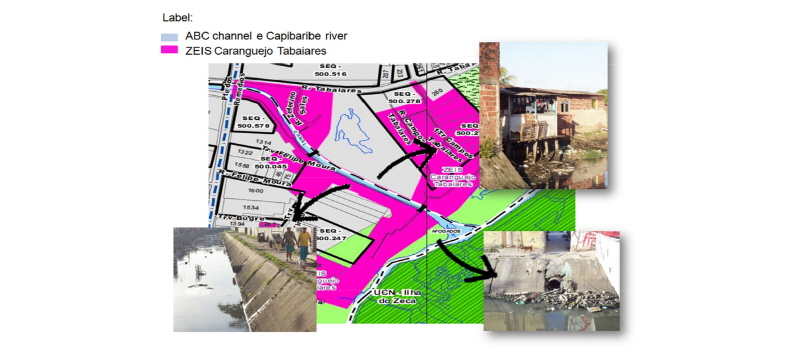
According to the informal interviews with local residents during the exploratory visits, respiratory illnesses, meningitis, leptospirosis, hemorrhagic dengue, chikungunya, zika, and scorpion bites have been reported and have been the cause of death for many children in the poorest communities due to the unsanitary conditions to which they are subjected.
Definition of Guidelins for the Prepartion of Projects and Layout Proposal for Urban Biodigesters
The guidelines were divided into three sub-items: (1) basic elements, (2) choice of location and minimum distances from areas of influence, and (3) specific elements to establish criteria for the development of biodigester projects in needy communities. Based on current legislation, technical standards, guidelines from manufacturers’ manuals, as well as on data obtained from the exploratory visits to needy areas of Recife, the criteria are detailed on the following flowchart:
|
Figure 2. Guidelines for Project Preparation. Source: Created by the author based on Fortlev, 2016; Fantinatti et al., 2015; Creder, 2006. |
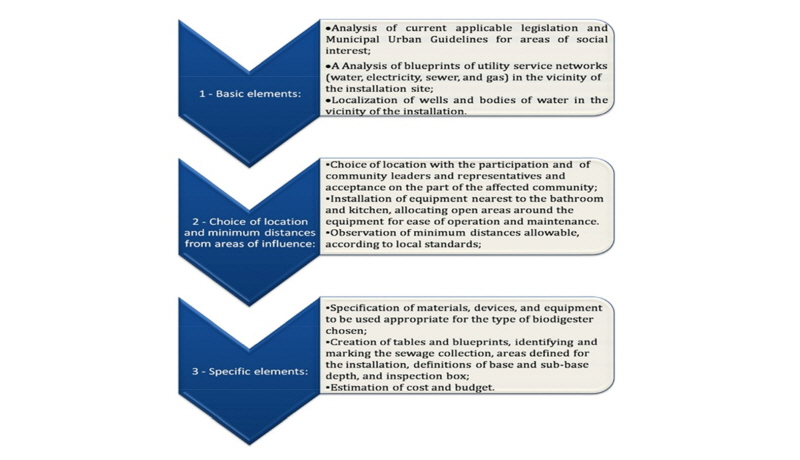
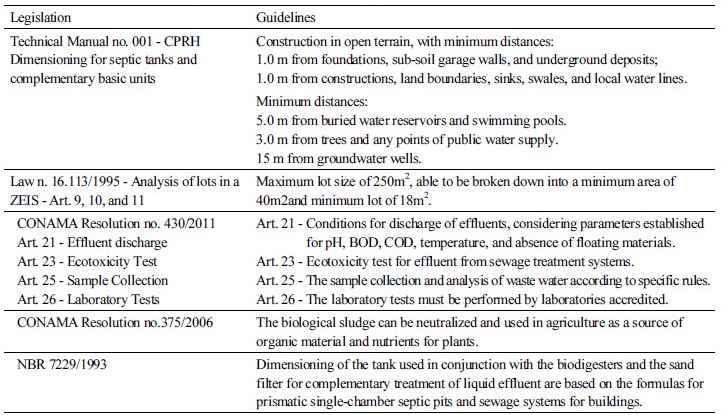
Table 1 shows the local legislation, resolutions, and technical standards relevant to the creation of a proposed biodigester layout for needy areas in the city of Recife. Some of the topics considered in the references, while relevant, did not generate guidelines because they are practices and values already deeply ingrained in the culture of the technical manuals of the researched biodigesters.
Based on the legislation applicable to biodigesters and the exploratory analysis in the field, the Total Waste (RT) value was calculated in accordance with Equation (1), considering the value of Organic Waste (RO) produced per person/day added to the waste water (NA) generated per person/day.
The RO value (0.9924 kg/person/day) was calculated from the Pernambuco Solid Waste State Plan (SMAS & ITEP, 2012), which considers a percentage of 63% of gravimetric composition for organic waste produced daily from the total daily amount of waste produced per resident of the city Recife, estimated as 1.58 kg/person/day. For toilet waste water (AN), the value of 0.1 kg feces+urine/person/day was considered, according to NBR 7229/1993. The total waste feeding into the biodigester daily can be calculated by the expression below:
The dimensions of the system were calculated according to ONUDI (2016), and using Equation (2) below. The process was considered to be mesophilic with fermentation in 30 days and the average temperature of Recife around 30°C, obtaining a reactor volume (fiberglass box) of 5.97 m3. For the gasometer, a PVC tarp attached to the base of the fiberglass reactor that stores the biogas generated, a volume of 30% of the VReactor, 1.791 m3, wasestimated.
Were, VReactor in m3 for the biodigester, Q = total contribution RT sun Water in m3.day-1 and TRH = Water Retention time, in days.
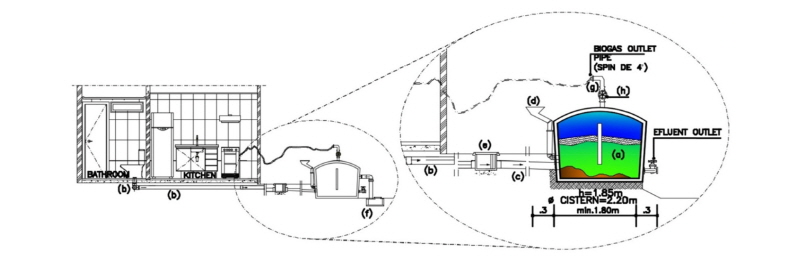
Because the biodigester will be connected to the toilet, inputs to the biodigester beyond the RT of 5,462 kg/Day calculated by Equation (1) must be considered: the amount of water released by the flushing action of the toilet (6 liters per flush) multiplied by the quantity of flushes (A), considering an average of 5 to 8 flushes per resident per day, and by the number of residents, shown in Equation (3). From the analysis, a complementary treatment of the liquid effluent through the use of a buried sand filter (ABNT, 1993) is indicated, as shown in Figure 3 (f).
To create the Urban Biodigester prototype (Figure 3),materials available in the market were considered and a family made up of five (5) residents was contemplated. The prototype will use a 5000 L fiberglass box (to fit the estimated waste according to Equation 2); 3.40 m2 of PVC canvas, shown in Figure 3 and indicated by the letter (a); 100 mm PVC pipes shown by the letter (b) to transmit waste water (AN), for the output of biofertilizer (c), and for receiving organic wastes (d). To operate the biodigester, a slope of 5% should be used for the waste water pipes. For the biogas output, the installation of a 4” Spin pipe connection is suggested, as well as a gas filter (g) and a meter to measure the biogas output (h).
A commercially available inspection/interconnection box must be installed and adapted with an interior grid having a minimum diameter of 30 cm (Tigre, 2016), illustrated by the letter (e) in Figure 3, before the input pipes to the biodigester in order to hold accidental discards of non-biodegradable material in the toilet, such as wipes and plastic packaging that can clog the system (Fortlev, 2016).
For the digester operation phase, operational guidelines should be structured and presented by various means of communication, helping to educate the target population on proper use of the system. They should also consider the protection of users during the manipulation of organic wastes (grass, feces from pets, chickens, pigs, biomass in general) e during the maintenance of the inspection/interconnection box. As biogas is subject to high pressure can be extremely inflammable, because of its proximity to residences, it is also necessary to prepare an evacuation plan for the area and contingency measures in situations of hazard and emergency. Also, CONAMA Resolutions no. 375/2006 and no.430/2011 should be used in order to neutralize the sludge and evaluate the effluent generated.
This system is expected to generate 1/4bottle of LPG.month-1 and 20 L of biofertilizer/month, considering that the first withdrawal during the production period should occur after approximately 30 days have passed. The average time to recoup the initial investment was estimated to be 2.6 years, from the sale of biofertilizer and savings from the reduced purchase of cooking gas.
Conclusions
Large Brazilian cities, just like cities in other developing countries, have suffered because of the close link between lack of efficient public policies, unequal income distribution, disorderly settlement, and environmental degradation, which threatenthe preservation of remaining natural areas located in protected areas and compromise the quality of life of the general population, and especially that of excluded communities.
The guidelines proposed here should be analyzed as a set of ideas that will need to constantly evolve, in order to overcome problems such as the sanitation crisis that humanity lives in. The projects must be integrated and multidisciplinary in order to develop biodigester profiles that are suitable for the urban environment where they will be located. The most appropriate solution is that with lowest cost that meets the criteria for safety and efficiency in sewage treatment, taken into account local limitations, the so-called “social technologies” (low cost products, techniques, and equipment that can be replicated at any location throughout the country).
The implantation of urban biodigesters is consistent with Law 11.445/2007,contributing to the management of sewage and solid wastes, by using them as fuel for the biodigester itself. It is believed that, once implemented and properly maintained, biodigesters can help improve the quality of water in cities, avoiding contamination of water bodies, ameliorating the effects of flooding, and reducing the proliferation of the viruses responsible for zika, chikungunya, and dengue, as well as generate biogas from solid wastes, which is currently a problem for city managers responsible for basic local sanitation.

