


Introduction
Literature Review
An Overview of Bhopal City
Methodology Adopted
Observations and Analysis
Methodology Adopted for Observations
Result and Discussions
Conclusion
Introduction
In India, the residential sector is a significant user of primary energy at 37 per cent of the total. If only electricity consumption is considered, building sector has 30 per cent electrical energy consumption in India; what’s more, its consumption is growing at the rate of 8 per cent per annum. This poses a challenge to the overall energy supply, and at the same time has an impact on the environment. The use of energy efficient design and technology therefore is crucial. In India, there is a potential to reduce energy consumption in new as well as existing buildings by up to 50 percent. Various methods are adopted for the building design for reducing energy consumption, either active or passive.
Using solar reflective material on envelope of building is a method of Solar Passive cooling. Cool materials are characterized by high solar reflectance (SR) and high thermal emittance values see [1]. A number of white or light colored materials are currently commercially available for rooftops having high solar reflectance values ranging from 0.4 to 0.85. The thermal emissivity of these materials was measured to be about 0.9. For a white surface with solar reflectance of 0.8, the temperature rise is about 10°C. Surface temperature measurements demonstrated that a cool coating can reduce a concrete tile’s surface temperature by 7.5°C and it can be 15°C cooler than a silver grey coating, see [2,3]. Furthermore, new cool colored materials that are highly reflective in the near infrared are being developed for the cases where the aesthetics of darker colors is preferred, see [4,5]. There are many types of passive cooling strategies that can be recommended for use in a hot humid climate such as the Bhopal. The use of light or reflective-colored materials for the building envelope and roof, careful sitting and wise orientation decisions alongside appropriate landscaping design, see [6].
For existing building for applying passive cooling with less or no destruction in building some selected strategies can be used. Understanding these limitations the researcher used common, easily available insulators for wall and roof. The aim of this paper is to investigate the usefulness of applying the insulator to increase the difference between outside and inside temperature of residential buildings in hot humid climate settings, namely, Bhopal in India. For the purpose of this investigation, four rooms in two real case building were selected and four passive cooling strategies were applied in 12 different conditions. Consequently, this has helped in cooling the surrounding areas well as regulating the internal building temperature and decreasing the amount of energy required cooling the building structure.
Literature Review
In a different part of the world, researchers adopted methods to explore how energy consumption is minimized in residential buildings by optimising even passive design measures for different cities. These measures included the altering thickness of the walls, thickness of roof insulation, and thickness of external wall insulation, window orientation, and window-wall ratio, glazing type and sun room depth/overhang depth. Al-Sallal et al., see [7]., in his study has proved that through optimisation, passive design could considerably reduce thermal load of buildings. It was suggested that a green roof could also reduce the requirements for traditional insulation another study conducted by same researcher Al-Sallal et al. see [8] simulated three cases with laminar and turbulent wind flow as a passive cooling via natural ventilation and its impact on human comfort depending on the ASHRAE adaptive model has investigated passive cooling performance in modern urban contexts of Dubai.
Suman et al., see [9] studied to determine influence of thermal insulation on conductive heat transfer through roof-ceiling construction when thermal insulation material was integrated to roofing system. Roof with polystyrene performed better than fibreglass. Parker et al., see [10] reported that the space cooling requirements, after application of reflective roof coatings on nine Florida homes, decreased by 19%. On the other hand, Suehrcke, see [11], used a numerical simulation of a building, and suggested that the peak values of heat flow from a roof could reduce by as much as 60% when a white surface replaces a corroded galvanised one.
Simpson et al., see [12] found from measurements of 1/4-scale models in Arizona, that ceiling insulation is more effective in reducing daytime heat gain than increased roof albedo. They also made the interesting observation that on a 24-h basis an increased albedo was about as effective as addition of ceiling insulation in reducing building heat gain. This is explained in the paper due to the enhanced nighttimes heat loss Griggs et al. see [13] provide a comprehensive and very useful study on the effect of roof colour. Their study includes a ‘‘work sheet’’ to calculate the energy cost savings as a result of a roof reflectance change and its use is demonstrated with two examples. There are analytical methods for the calculation of roof heat gain see Granja and Labaki, see [14]. However, many of these methods appear to be limited to simple thermal conduction problems (e.g. a solid concrete roof with insulation) and do not provide general answers on the effect of roof colour. Levinson et al. ,see [15] gave al the best calculation method for the roof heat gain accompanies a paper on non-white roof coatings that reflect the invisible parts of solar radiation. The method recognizes that changes in solar roof absorption approximately cause proportional changes in ceiling heat flux. However, the issue of the roof thermal mass is not fully resolved and the ceiling heat flux due to outside to inside air temperature differences is not explicitly included in the equations.
An Overview of Bhopal City
Bhopal is located in the central part of India, and is just north of the upper limit of the Vindhya mountain ranges. The climate of Bhopal is subtropical, with hot and humid summer and a cool but dry winter. The average temperature during the day is around 30 degrees Celsius, whereas in the month of May, it rises to 44 degrees. Humidity always remains high during this time and hence the atmosphere remains sweaty. Monsoons usually start from July and last till September end. With the advent of October, temperature start falling and as winter approaches, it goes down till 16°C on average. Like any other city of India the green construction work is encouraged by engineers and architects in Bhopal. But all the emphasis is given to new construction where as a lot of potential of energy saving is in the field of existing buildings.
Methodology Adopted
As the major energy consumption in residential sector is mainly due to cooling load in summer, the researcher select and performs analysis on existing residential building to convert them into energy efficient building. For this research we select four rooms individually in two buildings one have RCC roof and other has Asbestos sheet roof. Details of the buildings are given in Table 1. All the rooms selected are at top floor of the building as they get maximum heat. Bhopal is in hot humid climatic zone where high temperature is found from April to October (8 months) with two months of rainy season, and winter is of 2 months only. Hence we took observations in peak summer i.e. from mid of April to end of May’2016. The material applied as insulator with its detail is given in Table 2.
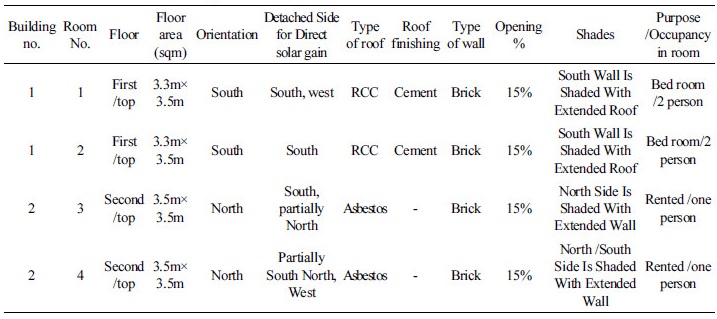
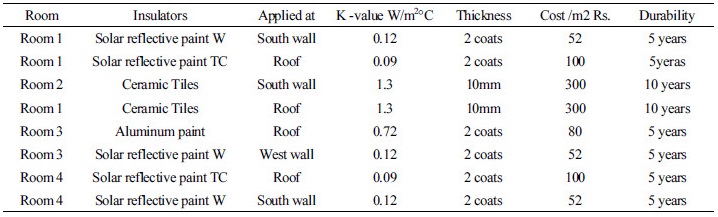
Since the building is residential all the rooms selected are occupied as bed room night time only when they became little cool, the room no.1 and 2, walls are facing towards south the temperature is very high since morning and thermal comfort is low, so they remain unoccupied during day time, they are used as bed room during night only. Similarly Room no. 3 and 4 are also mostly occupied at night, as the rooms are at rent and occupied by tenant.
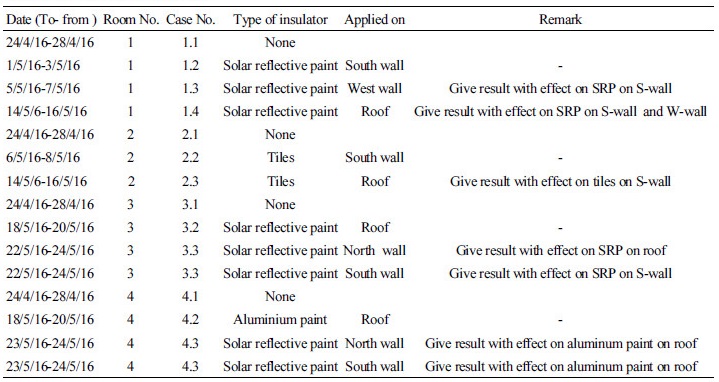
The temperatures and humidity were taken five peak times in a room for three days first without applying any strategy and then again three days after applying the passive strategies. The schedule followed is given in Table 3.
Observations and Analysis
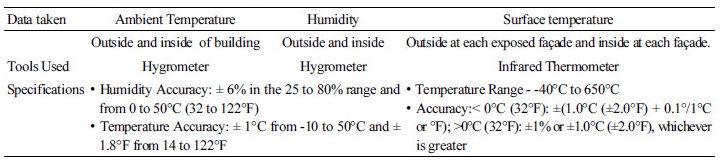
Observation in each room for all conditions was taken for three continuous days considering individually and five times in a day. Detail of tools used to measure is shown in Table 4.
Methodology Adopted for Observations
Following methodology was adopted for observations:
1.Taking the readings of temperature and humidity in existing condition without insulator.
2.Apply the insulator as per scheduled.
3.Taking readings after applying insulators.
4.Analysing the data, comparing result before and after applying insulator by taking maximum reading among the three days.
The observations were taken five times to view the time leg effect properly. The times selected were 9 am, 12 pm, 3 pm, 6 pm and 9 pm i.e. from 9 to 9.
Analysis is done for the readings of temperature difference at maximum radiant temperature among all three readings, as if the conditions would satisfy for maximum than it would be satisfactory for other temperatures also. Also a check is performed by taking average of readings for all the five times.
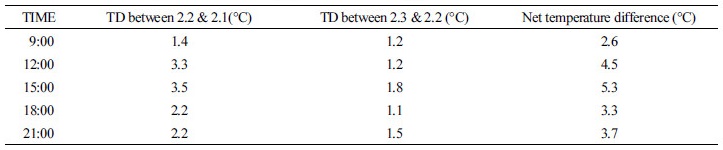
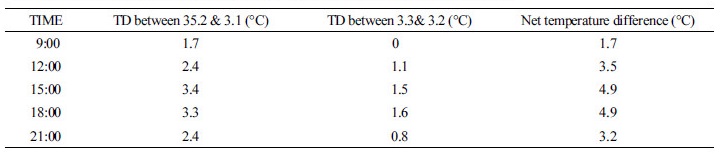
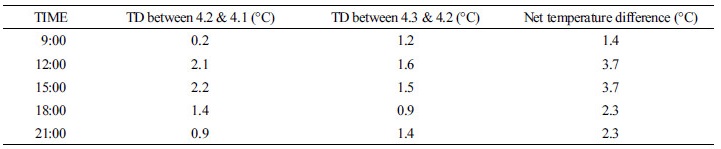
As all the rooms are bed room hence observation during night for healthy sleep under cool roof are essential. Almost in all the rooms it is seen that at 9 am and 9 pm the inside temperatures are higher than the outside, which were reduced after the experiments. Total 12 observations were taken, in which 4 were without applying insulators in each room. Rest is in different conditions. The change in pattern of temperature difference under different conditions is also shown in Figure 4, 5, 6, 7 for every room. The result in increase in temperature difference will show in Table 5, 6, 7, and 8.
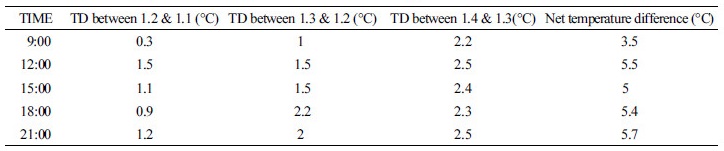
From above observations it is seen that there is decrease in temperature in each condition, but maximum reduction is observed by applying SRP on Roof by more than 2.5°C.While applying SRP on south and west wall maximum temperature reduction is 1.8°C at 12 pm and 2.2°C at 6 pm respectively. SRP give their effect only when the solar radiation incident normal on wall, here in these room (1, 2, &4) the extended roof obstruct the direct radiation. Maximum decrease in temperature 16.1% is observed at 12 pm, and 15.9% at 9 pm, earlier at this time generally the Room temperature was much higher than the outside air temperature. After applying the insulators the temperature reduces by net 5.8°C. Minimum difference is observed at 9 am. the surface temperature reduces by 3.5°C
From above table and graphs it is observed that maximum reduction in temperature were observed is by tiling on wall by 6.3% or 4.5°C at 3 pm followed by 6.2% at 12 pm. While tiling roof decreases the temperature more, maximum reduction at 12 pm by 5.2% and at 3 pm by 4.5%. Net maximum reduction at 12 pm is by 11.4% or 4.3°C and at 3 pm by 10.8%. Again net minimum reduction is at 9 am by 2.5% hence by applying tiles on wall reduction can be up to 2.7°C and tiling at roof gives the reduction up to 1.9°C. Net result can be maximum reduction of room temperature by 4.5°C.
In this room SRP at roof shows its affect maximum at 3 pm, and 6 pm. The outside temperature directly affect the inside temperature. But it was observed that the temperatures are always high in these rooms initially. Minimum reduction is seen at 9 am. Net maximum reduction is at 12.1% by 4.9°C at 3 pm and 6 pm, which is remarkable. Initially the outside temperatures are either found equal or less than the internal temperature, after applying Insulators the temperature reduces; hence give thermal comfort to occupants. SRP at South and North walls give maximum affect at 12 pm, 3 pm and 6 pm, here time lag can be observed. The affect of SRP on south can be considered since south wall is exposed.
Room No.4 observations: In this case the roof is of asbestos sheet, hence initially the rooms were too hot and temperatures were always much higher than RCC roof rooms, though False ceiling is provided, than even the temperatures were high, since the thermal mass of Asbestos Sheet is less hence the heat does not store in mass and the temperatures directly changes as the change in outer temperatures. Temperatures were also reduces less in comparison to RCC roof .maximum reduction by applying Aluminium paint on roof is by 2.2°C or 5.2% and 2.1°C or 5.4% at 3 and 12 pm respectively. Applying SRP at North and South wall does not make much affect, maximum reduction of temperatures at 12 and 3 pm were 1.6 and 1.5°C respectively. Hence Aluminium paint is not give result in comparison to SRP on roof. Net reduction in temperature by Aluminium paint on roof and SRP on north and South wall is at 12 pm and 3 pm by 11.4% and 8.9% respectively.
Result and Discussions
All the four rooms are exposed from south. And two are exposed from west. Initially occupant found very discomfort due hot during day time. And the heat effect last till late night due to time lag. After applying insulator the occupants found very comfort as the internal temperature reduces. Also the duration of using air coolers reduces which finally reduces energy consumption .The results observed for all four rooms in different conditions are discussed below taking all the rooms separately: the initial condition (without insulator) was same for all the rooms.
∙ Maximum affect on SRP is observed by insulating roof. For RCC roofs and Asbestos sheet, SRP at roof individually is the best solution as it reduces temperature by 2.5 and 3.4°C, which is sufficient to reduce cooling load and improve thermal comfort.
∙ The temperature on walls can be reduced by maximum by 3.5°C by applying ceramic tiles on south wall and by 1.5°C by applying SRP.
∙ After insulation of west wall the temperature difference is found 2.2°C at RCC roof room.
∙ Individual affect of north wall were not observed as the insulators on wall or roof effects only when solar radiation incident on it.
∙ Maximum affect is observed with combination of tiles on roof and wall by 5.3°C.
∙ Maximum temperature difference by single application of 3.5°C is found at 3 pm by applying tiles on south Wall.
∙ At RCC roof minimum affect by 0.3°C, by single application of SRP on south wall at 9 am is observed, while the affect increases by 1.5°C .Hence this is concluded that the minimum affect does not remain constant but increase with time.
Conclusion
Several studies are on insulators indicates that the Increasing the solar reflectance lowers the surface’s temperature since solar radiation is reflected rather than absorbed. Result of this decreases the heat penetrating into the building. In respect to indoor temperature in summer, top flats is the worse where the temperature reach up to 39.2 and 41.5°C in RCC and Asbestos sheet roofs respectively in peak hours of day beside the temperature does not drop to comfortable level during night, the situation are much better on ground flat even though the recorded temperature still above when the walls are exposed from south side or west side but not as high as those recorded on top floor. Hence for analysis all the rooms selected are at top floor in summer. Insulation on roof proved much more effective than the wall insulation (reduces inside temperature up to 3.5°C). When the west side is exposed the insulation should be applied on this side result in low temperature during night. For better results modification on windows can be done. For a climate like Bhopal, solar reflective material at roof gives sufficient reduction in inside temperature. If applied on walls the temperature difference increases. This research concludes that by applying solar reflective material one can achieve best result in very low rates.

