


Introduction
Methodology
Characterization of Antarctica and the Comandante Ferraz Antarctic Station
Modeling and Simulations
Thermal performance evaluation
Results and Discussions
Determination of Conditions
Simulations
Conclusions
Introduction
Performance rating systems, the analysis tools and certification schemes serve to contribute to a better performance of buildings; however, there are still difficulties in establishing environmental values to the buildings, which is due to the broad interpretation of the word sustainability (Smith, 2003). In this context, to concern with sustainability becomes even more important when considered as territorial limits the Keller Peninsula in Antarctica, given that it is a harsh environment, where environmental, landscape and architectural impact may be more evident in compared to consolidated urban areas (Reis & Alvarez, 2015).
The first Brazilian occupation in the Antarctic occurred in 1984, with a compound of twelve men team, operating the eight modules of the EACF - Estação Antártica Comandante Ferraz (Comandante Ferraz Antartic Station) (Secirm, 2014). The Station underwent successive extensions and reform over time, and with no formal or environmental concern (Alvarez et al. 2004). In February 2012 a fire destroyed the main body of EACF and in the surroundings were installed the MAE - Módulos Antárticos Emergenciais (Antarctic Modules Emergency), which are in operation since early 2013, serving to continue the activities of the station (Mech, 2013). After the event, a project of the procurement process was initiated for new permanent buildings through the development of a Term of Reference, which was aimed at the reconstruction of the Research Station in order to meet the needs of the scientific community and to serve as reference for future buildings in Antarctica (Secirm, 2014).
Considering that the new Brazilian buildings in Antarctica were designed from innovative techniques it is justified the need for studies on the types of materials proposed especially with regard to thermal performance, aimed at improving comfort conditions. The atypical characteristics of the region suggest systemic studies to gather with less environmental impact and materials that provide energy efficiency, especially about the reduction in fuel consumption for heating. To develop the Terms of Reference that guided the design competition for the Brazilian station, several stations were studied and, among them, the Princess Elisabeth (2007), belonging to Belgium, whose technology envelope is composed of elements in laminated wood and seals composed of a set of nine layers and clad with stainless steel blades.
The Amundsen-Scott Station (2008) belonging to the USA, was built in steel with composite panels by sealing two sheets of OSB - Oriented Strand Board, and the insulation EPS - Expanded Polystyrene (Montarroyos, 2015). Another reference is Neumayer III station (2009) of Germany, with the construction technique, wrapped containers on modular steel frame and outer coating metal panels and internally with magnesium and plastic panels with glass fiber. The insulation is made from polyurethane foam and mineral fiber. The Haley VI (2010), Britain, stands out for being the first station that allows a complete relocation of its modules through a system of rails that slide on the ice. It has a steel substructure as tread base and its coating is made of plastic panels reinforced with glass fiber insulation with closed cell polyisocyanurate foam encapsulated in panels - GPR.
The Indian station, Bharati, 2012, was built from prefabricated containers wrapped in a sealing structure in sandwich panels with external coating of steel. The station pertaining to Spain, called Juan Carlos I, 2013 has a structure in modular monocoque rings reinforced plastic fiber coating also reinforced plastic fiber, which is part of the structure, and its insulation is polyurethane foam (Montarroyos , 2015).
The old EACF facilities were composed of metal containers made of sealing sandwich, filled with polyurethane. Already the new facilities are predicting major structures of high-strength steel (Montarroyos, 2015), to obtain favorable conditions for the improvement of performance and thermal comfort. Considering the technology adopted for the new buildings of EACF, the research aimed to evaluate the thermal performance of an environment with greater exposure - two sides facing outwards - considering as conditioning the material proposed in the project and the possible use of PVC as outer covering of sandwich panels.
Methodology
The research was established from three main stages: characterization of Antarctica and the Comandante Ferraz Antarctic Station; realization of modeling and Simulations; and evaluation of thermal performance.
Characterization of Antarctica and the Comandante Ferraz Antarctic Station
Antarctica has 14 million square kilometers and is the fifth largest continent on the planet, and in the winter due to the freezing of the surrounding seas, there is an increase in size, reaching up to 20 million square kilometers (Felicio, 2007). The region has unique environmental characteristics: low temperature, strong wind gusts, isolation and preservation of the natural environment, which induce a process of human occupation in a sustainable way (Cruz et al., 2007). The Comandante Ferraz Antarctic Station was established in 1984 on King George Island, fulfilling the Brazilian stay on the continent (Alvarez, 1995). Since its introduction, the EACF passed through expansion and modification processes, even performed with inherent concerns the environmental impact, eventually result in local ecosystem impacts, due to poor planning and previous design (Alvarez et al., 2007).
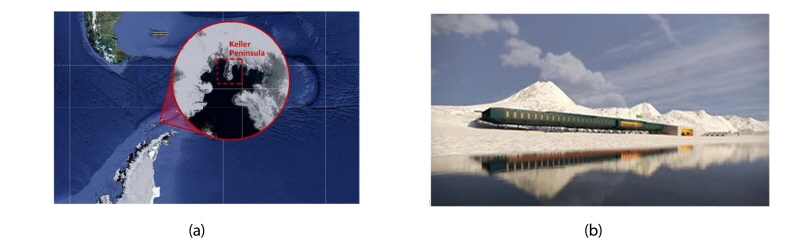
The new buildings of EACF are being built on the same site of the former, on King George Island, Keller Peninsula (Figure 1a). Its design dates from 2013 and its construction has forecast for completion in the year 2018, according to the Defesa Aérea e Naval (Air Defence and Naval) (2016). The various proposed settings for the station have a total built area of 4,500 m² divided into six sectors: social, private, service, operation / maintenance, laboratories and isolated modules, forming functional blocks and UIS - Unidades Isoladas (Isolated Units), which in its full configuration will form the basis for the operation of activities and research.
The area of laboratories with 14 units was designed to meet many requirements, emphasizing the priority of the PROANTAR - Programa Antártico Brasileiro (Brazilian Antarctic Program) for scientific activities (Brazil, 2012). The project was developed considering the best practices of sustainability and should constitute at a facility of excellence, the highest quality, to promote its main objective, scientific research (Estudio 41, 2013). The set was designed from containers, which will later be enveloped by a system composed of insulating material and with properties that mitigate the effect of salt spray and low temperatures (Figure 1b).
Modeling and Simulations
The climatic conditions of Antarctica were obtained through the weather file EPW - EnergyPlus Weather for the year 2002 (Laboratório…, 2015). For the simulations, considering the conditions of the study area, the windows do not have the function to aerate, thus the model was configured with the same closed. The architectural typology adopted for the simulations was the design of new buildings of EACF and the environment, a laboratory with two external faces (worst situation). The reference values of thermal properties of building components related to the envelope, as well as the characteristics of clothing and activities performed by the laboratory users, shown in Table 1. The type of clothing and activity is related to atypical climatic conditions of Antarctica, as well as the type of environment use.
The design proposed in the envelope consists of sandwich panels consisting of two external surfaces made from galvanized steel coil of 0.75 mm thick and coated with each paint PVDF - Fluoreto de Polivinídeo (Polivinilideo fluoride), internal layer of rigid PUR -polyurethane foam, with a distance of 50 cm between the wall of the container and the envelope (Figure 2a). The panel is used to cover the outer vertical seal, the floor and has two types, one with 220mm and other with 170mm (Reis & Alvarez, 2015).
It was adopted for the comparative study an exterior coating of PVC - Polyvinyl Chloride (Figure 2b), replacing the steel sheet while maintaining the same thermal insulation. PVC is a material consisting of 57 % of chlorine and 43% of ethylene, thermoplastic material and is the second most produced worldwide. It has mechanical properties such as low flammability, resistance to moisture, UV light and salinity, is lightweight and easily recycled (Instituto do PVC, 2016).
The simulations were carried out at the Molecular Biology Laboratory of the environment (Figure 3a) located in the functional block, 5.29 m above the ground (Figure 3b). The Laboratory is located at one end of the blocks, having two of their faces exposed to the weather. It was simulated orientation proposed on the design, considering the summer period (21/ Dec 21/ Mar) and the winter period (21/ Jun to 23/ Sep).
| ||
Figure 3. a)- Molecular Biology Laboratory floor plan. b) - Section plane of the Function Block where the Laboratory of Molecular Biology is located. Source: ESTÚDIO 41, 2013. | ||

Thermal performance evaluation
For the evaluation of thermal performance conditions was used the hourly operating temperatures and temperature comfort, defined by ISO - International Standard 7730 (International ... 2005), which the criteria for the comfort temperature were the types of activity involving walking and running lab work; the clothing of 0.5 clo for summer and 1.0 clo for winter, considering the best category (A), and reaching the value of 23 ° C.
For measurement of the maximum temperature of comfort, the external mean monthly temperature was determined, using the design software version 4.5.0.128 Beta Builder - DBSIM. For environmental thermal performance evaluation were used indicators proposed by Nico-Rodrigues (2015), which made it possible to analyze the hourly changes in operating temperature, for summer and winter.
Indicators
The indicators used for the systematization of data were the FDT - Frequência de Desconforto Térmico (Frequency Thermal Discomfort) and GhDT - Graus-horas de Desconforto Térmico (Degrees-hours of thermal discomfort), who had their results entered into the buoyancy diagram.
The FDT quantifies the hours in discomfort, in percentage unit during certain time interval, and the maximum value refers to the maximum time limit. To set this percentage of time the whole time, there is the percentage at which the operating temperature is above the maximum comfort temperature. In this study, the proposal was to analyze daily periods, of 24 hours, corresponding to a maximum frequency of 100%.
The GhDT is the difference between the hourly operating temperature and the temperature of comfort when the operating temperature exceeds the set value of the comfort temperature established for the month under study. To obtain the maximum reference value it was adopted the highest value of GhDT, considering all the features of the model and climatic conditions. For the analysis of FDT and GhDT indicators was adopted the buoyancy diagram, which considers the assessment of the frequency on two levels: temporary and frequent; and the intensity condition for the degree-hours, light and intense levels (Figure 4).

Results and Discussions
Determination of Conditions
The results defined the internal hourly air temperature of the Molecular Biology Laboratory aiming to determine the environmental thermal performance with emphasis on thermal comfort using in your envelope galvanized steel and PVC. The results were subjected to statistical treatment to set the maximum amounts of daily GhDT, which is the reference value used for laboratory analysis with the two materials (Table 2).
Simulations
The simulations made it possible to assess the environmental thermal performance according to the materials used in its envelope, especially the use of artificial heating as a strategy for thermal comfort.
The first series of results demonstrated the internal conditions of the molecular biology laboratory with the use of galvanized steel in the envelope, and second, the results of PVC. The FDT and GhDT values obtained for each day showed the buoyancy diagram, featuring the end of thermal conditions for thermal comfort environments (Figure 5). It is noteworthy that the buoyancy diagram lists the FDT values with the highest GhDT value of each season, showing everyday situations, being the best condition that it converges to the origin.
The results of performance simulations have shown that the use of galvanized steel in the envelope, partially meets the conditions for thermal comfort determined by the ISO 7730 standart as well as the use of PVC since even using a temperature of 23°C, the standart allows variations in other categories, with temperatures up to 19°C were variations in the standart, which increases the amount of time within the comfort limits.And with the use of And with the use of PVC were obtained better performance results compared to the previous situation, especially in the summer season. It was observed that the results of the FDT and GhDT indicated two levels of discomfort for the simulations with the steel, being levels (a) and (b) and three levels for the simulations with PVC, they are (a), (b ) and (c): (a) days of frequent and slight discomfort; (b) days of frequent and intense discomfort; and (c) days of temporary and mild discomfort.
The results showed for the seasons of the summer and winter uncomfortable environment, but the comparative analysis between the two simulated materials, changes were evident for the better in the environment internal conditions with the use of PVC in the envelope. Observing the analysis of materials separately in both seasons, it was found that in the envelopment with galvanized layers, the temperature values remained constantly below the comfort threshold, classifying the discomfort as intense, and a FDT common in winter. In the summer the temperatures remained below the limit, but the discomfort is rated as mild to intense, and the FDT remained intense.
In the simulations with layers of PVC, temperature values remained below the comfort limit in winter, with a few days with hours within the limit, classifying discomfort as frequent, and an often FDT. In the summer there was an improvement in the results, to days presenting hours in the comfort limit, but with a few days still below the threshold, classifying the discomfort as intense or temporary, and FDT ranging from heavy and light.

The adoption of PVC as an alternative caused an improvement in results, however it was not enough to achieve the optimal results. It is suggested that the wall exposed to the weather, is also used spacing of approximately 50 cm, already adopted in the other external wall, serving as attenuator space, which holds a layer with temperature at 10 ° C, since this constructive proposal has proved effective in other situations analyzed. It is possible to obtain better results by using different types of insulating determining, according to the physical and thermal properties, greater or lesser thermal inertia. It is noteworthy that the station of Belgium, for example, is classified as the most efficient among the studied due, among other factors, the adoption of nine insulation layers with properties that potentiated the thermal efficiency of the same.
Another likely factor responsible for improving internal conditions in the summer and winter is the incidence of solar radiation and the different behaviors of steel and PVC in the outer layer. In the summer period, the amount of solar radiation is much bigger and it is probably being absorbed by the glass of the windows and at the same time keeping the temperature in the spaces between the panels heated a lot longer. Although the PVC is thinner, its performance is better than the steel plate, observing, still, Juan Carlos Station in Spain that used a similar material in the form of modular rings of plastic fiber.
Conclusions
From the analysis made with the methodology adopted, it was possible to understand the environmental performance for buildings in the Antarctica, focusing on thermal comfort. The daily fluctuations in the operating temperature guided to solutions aimed at improving the thermal comfort and the indicators allowed the understanding of the internal conditions of the environment.
It is important to know that the building system from containers surrounded by a second outer layer coating on the sandwiches panels is a technique whose maintenance activities may be carried out by the Navy in Rio de Janeiro, which has a lot of experience in such activities in Antarctica. Studies with the use of PVC in the Antarctica environment are still in the initial process, and those results are an incentive for continuity, because it was realized that the model with PVC had an improvement in the results when compared to model that used steel. However, it was noted that the two models still require interventions that meets the indications of the standard adopted.

