


Introduction
Theory
Case Analysis
Overview of Incheon Machinery Industrial Complex
Planning Perspective Analysis
Physical Perspective Analysis
Industrial Perspective Analysis
Selection and Planning of Regeneration Anchor Facility in the Incheon Machinery Industrial Complex
Conclusions
Introduction
Traditional manufacturing-centered industrial complexes established during the early stages of industrialization are experiencing functional decline and the spread of urban issues due to facility aging and changes in industrial structures. These problems extend beyond the confines of the industrial complexes, affecting broader urban areas with issues such as material emissions, noise, traffic congestion, nighttime hollowing-out, and spatial discontinuity [1]. Moreover, these traditional industrial complexes fail to meet the evolving demands resulting from technological advancements and increased public awareness of industrial environments. To address these issues, South Korea has designated aging industrial complexes as “Aging Industrial Complex Regeneration Project Zones” and is promoting their development into smart and smart-green industrial complexes [2]. The focus is shifting from merely expanding physical conditions to considering environmental factors, emphasizing the importance of integrating support facilities and establishing industry-academia-research linkages to revitalize these complexes [3]. Since 2009, South Korea has been implementing two main projects for the redevelopment of aging industrial complexes: the Industrial Complex Regeneration Project under the “Industrial Sites and Development Act” and the Structural Advancement Project under the “Act on the Promotion of Industrial Clusters and Establishment of Factories.” Research by An Jung-geun (2009) highlighted the significance of architectural and environmental planning among five key areas—land use, infrastructure, architectural planning, landscape planning, and environmental planning—for sustainable industrial complex development [4]. Although numerous studies have addressed structural advancement, they predominantly emphasize urban-level planning. A distinct gap remains in exploring spatial strategies at the architectural and facility level, which this study seeks to address. Additionally, analyzing the location of anchor facilities aimed at creating innovative employment and improving convenience for residents and workers can provide insights into securing regenerative spaces for environmental improvement and advanced industrialization. The subject of this study is the Incheon Machinery Industrial Complex, located in Incheon Metropolitan City. Designated as an Aging Industrial Complex Regeneration Project Zone in 2023, it is planned to undergo structural advancement alongside the Juan National Industrial Complex and the Incheon Local Industrial Complex as part of the 2040 Incheon Urban Master Plan. However, specific development plans have yet to be established. This study aims to select candidate sites for regeneration anchor facilities through analyses of planning, physical, and industrial aspects of the target area. This study aims to derive candidate sites for regeneration anchor facilities within aging industrial complexes by analyzing planning, physical, and industrial aspects. First, the causes and characteristics of industrial complex decline are analyzed through a review of relevant literature and previous studies. Second, the definitions and contents of structural advancement projects are examined based on documents and research using keywords such as industrial complex regeneration and structural advancement. Third, the current status of the Incheon Machinery Industrial Complex is analyzed to identify its characteristics and problems. Finally, based on the findings from the current status analysis, candidate sites within the complex are identified for proposing regeneration anchor facilities.
Theory
The structural advancement project for industrial complexes is defined as a project that enhances the competitiveness of industrial complexes and improves working environments through the advancement of tenant industries and the expansion of cultural, welfare, and convenience facilities. To address the problems of aging industrial complexes, South Korea has been promoting two types of redevelopment projects since 2009: the Industrial Complex Regeneration Project under the “Act on Industrial Location and Development” (hereinafter referred to as the Industrial Location Act) and the Structural Advancement Project under the “Act on the Promotion of Industrial Clusters and Establishment of Factories” (hereinafter referred to as the Industrial Cluster Act). According to the Industrial Cluster Act, the structural advancement project is defined as a project aimed at promoting the attraction of businesses and enhancing the competitiveness of tenant companies by advancing tenant industries, strengthening business support services, and maintaining, improving, and expanding infrastructure, industrial facilities, and public facilities within the complex. Although both projects aim to solve the problem of aging industrial complexes and develop them into advanced industrial zones, they differ in processes and content. Most of the structural advancement projects are characterized by environmental improvements, such as the advancement of specific industries, expansion of business support and convenience facilities, and infrastructure improvements (Table 1). Since these projects usually utilize already-owned sites, closed factories, or privately owned land, they offer advantages such as reduced time for compensation negotiations and lower land acquisition costs [5]. In this study, prior research related to structural advancement was investigated by classifying it into studies from administrative/institutional perspectives and spatial perspectives. First, from the administrative and institutional perspectives: Hong Jin-ki and Heo Moon-goo (2006) presented the issue of declining growth momentum in the Changwon National Industrial Complex as a typical production structure system problem. As effective strategies to overcome this, they proposed detailed innovation factors based on specialization areas within the complex and corporate demand surveys. Key tasks included strengthening R&D capabilities, revitalizing industry-academia cooperation and technology transfer support projects, incentivizing cooperation between large and small enterprises, promoting internationalization support projects, training demand-centered technical personnel, and enhancing business support functions [6]. Park Hwan-yong, Park Ji-ho, and Jang Seung-il (2018) reviewed proposed projects from nine industrial complexes that applied for the Aging Industrial Complex Competitiveness Enhancement Project. They categorized these into five types of projects and analyzed problems encountered in the planning stages of projects requiring land-use changes. As a conclusion, they suggested policy recommendations including revisions to mixed-use land and activation zones, key amendments to regeneration and implementation plans, and administrative simplification through streamlined procedures [7]. Ko Seok- chan (2010) focused on industrial complex management services needed by tenant companies in Seoul Digital Industrial Complex. He pointed out problems such as the absence of key technical cooperation entities, lack of transportation infrastructure, and difficulties in securing labor. He proposed solutions like administrative district integration of the digital complex, resolving infrastructure shortages, and strengthening support services from Korea Industrial Complex Corporation [8]. Jung Hyun-jin and Kwon Young-sang (2018) analyzed why private-led projects achieved better industrial clustering than public-led ones in industrial facilities. The study emphasized the importance of pursuing concrete goals, supporting specific technologies, and enabling smooth communication among stakeholders after governance formation [9]. Kim Tae-hyun and Lim Dong-il (2014) identified problems such as outdated infrastructure, lack of convenience and welfare facilities, insufficient adaptability to changing industrial environments due to a focus on traditional manufacturing, inadequate support systems for regeneration projects, and passive roles of managing entities in the Usan Industrial Complex in Wonju. Improvement directions included phased project implementation, expansion of infrastructure and public facilities by local governments, securing re-settlement measures for existing tenants, and restructuring the management functions of the complex [10]. Kim Dae- geun and Kang Myung-goo (2011) compared and analyzed regeneration and structural advancement projects in terms of legislation, content, project methods, procedures, budgets, and funding. They concluded that revitalizing industrial areas requires not only physical improvements but also integrated development and restructuring projects, expanded dedicated organizations for long-term management, and active resident participation and private sector involvement [5]. From the spatial perspective: Choi Hyung-gu and Kim Won- pil analyzed physical characteristics of adjacent areas near industrial complexes and proposed urban contextual issues and solutions. Focusing on Seoul Digital Industrial Complex, they analyzed boundaries of the complex in terms of vehicle and pedestrian systems, open spaces, and landscape types. They pointed out issues such as lack of consideration for topography, underutilized open spaces, and insufficient visual openness and landscape diversity. They proposed managing individual architectural projects under the district unit plan for coordinated planning inside and outside the complex [11]. Jo Gi-sool and Lee Woo- jong (2015) conducted spatial characteristic analyses on Seoul Digital Industrial Complex, considering physical factors, public facility areas, locational factors, infrastructure, specific characteristics by complex, and high-tech industries. They proposed securing infrastructure, ensuring continuity and adequate sidewalks between buildings and public transit, and developing underground spaces under roads within the complex [12]. Lee Joo-young and Jung Jae-yong (2007) aimed to suggest guidelines for internal space reorganization and mixed-use programming in structural advancement projects. They analyzed land use, physical/ environmental, and legal/institutional aspects of national industrial complexes. Their proposals included differentiated designs for apartment-style factories considering lot sizes and characteristics, securing space for public facilities, establishing and mandating green buffer zones, utilizing open spaces, and integrating welfare, cultural, residential, and commercial facilities [13]. A review of prior studies related to structural advancement reveals that most research has focused on administrative and institutional aspects. Spatial studies have largely been conducted from the perspective of resolving disconnection issues between aged industrial complexes and surrounding urban areas. However, empirical studies that address site selection and spatial planning within the industrial complexes themselves for structural advancement are notably lacking. Therefore, this study seeks to explore methods for selecting target sites for regeneration anchor facilities by focusing on the Incheon Machinery Industrial Complex and conducting spatial analyses within the broader urban context, with the aim of planning facilities that support structural advancement.
Table 1.
Structural Advancement Project Implementation Complex
Case Analysis
Overview of Incheon Machinery Industrial Complex
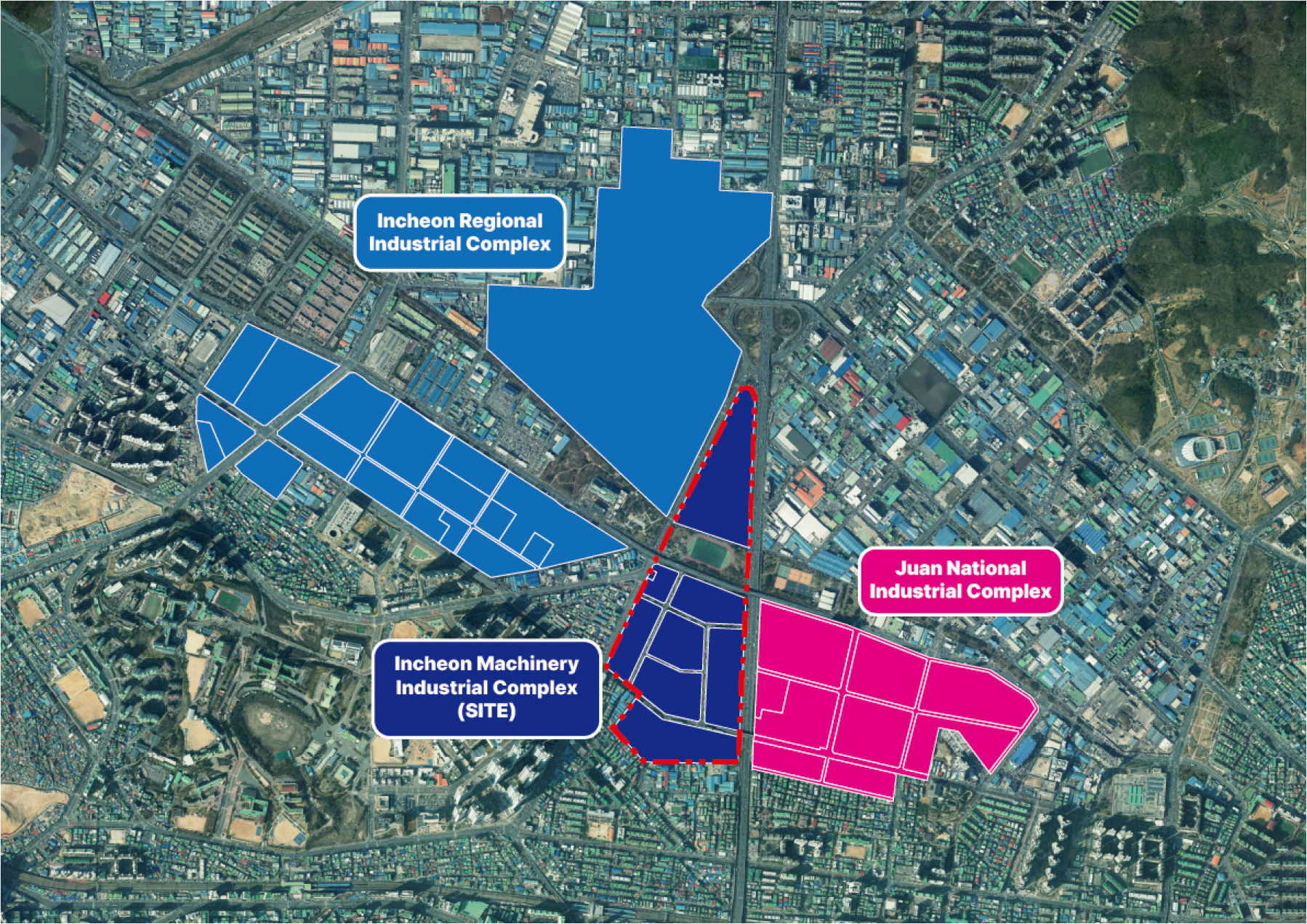
The Incheon Machinery Industrial Complex is located in Dohwa-dong of Michuhol-gu and Gajwa-dong of Seo-gu in Incheon. It was designated as an industrial zone in 1965, and the complex was established in 1978. It has continued operating to this day as one of Incheon’s representative industrial complexes, developed during Korea’s early industrialization along with other complexes in Bupyeong and Juan. It has benefited from its geographical advantages such as proximity to ports, highways, and labor force, along with local efforts. It was intended to foster mechanical industry growth and contribute to the local economy. However, it now faces internal and external challenges such as changes in industrial technology trends, deterioration of physical facilities, and discord with the surrounding urban environment (Table 2, Figure 1).
Table 2.
Basic Status of Incheon Machinery Industrial Complex
| Area | Tenants | Operators | Number of Employees | Yield | Exports |
| 350 | 179 | 177 | 2,466 | 74,206 | 4,008 |
Planning Perspective Analysis
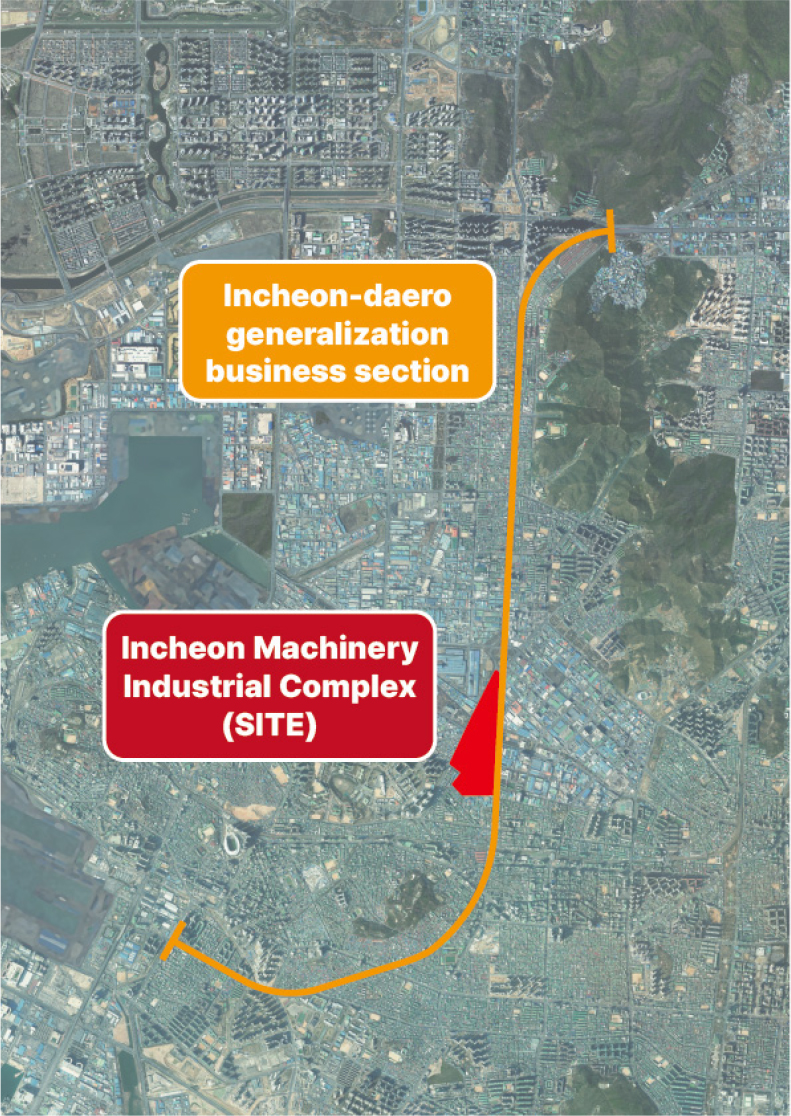
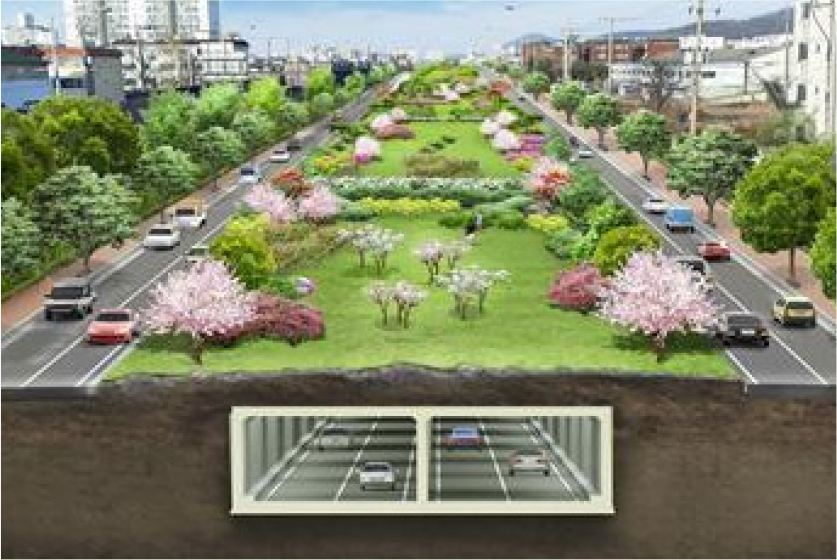
According to the 2040 Incheon Urban Master Plan issued by the city of Incheon, there are plans to create futuristic smart industrial complexes in Namdong National Industrial Complex and advanced industrial zones in Bupyeong and Juan. The plan also includes structural advancement of the adjacent Incheon Machinery Industrial Complex and Incheon Local Industrial Complex. Rather than focusing solely on regenerating individual complexes, the aim is to link industrial regeneration with urban regeneration to form a unified living zone, improve settlement conditions, and expand social overhead capital (SOC). In the Ministry of Land, Infrastructure and Transport’s 2023 contest for “Regeneration Projects for Aging Industrial Complexes,” both Incheon Local and Machinery Industrial Complexes were selected. A total budget of KRW 27.3 billion will be allocated to the regeneration project through 2028. Although the city of Incheon has outlined a vision to create a cultural job space, upgrade industrial structures, improve work environments, and enhance image, it has yet to specify detailed development plans as of early 2024 (Table 3). In a 2024 competition for “Competitiveness Enhancement Projects for Aging Industrial Complexes,” hosted by the Ministry of Land, Infrastructure and Transport and the Ministry of Trade, Industry and Energy, Incheon’s industrial complexes were selected. Incheon proposed a “Regional Development Innovation Plan Centered on Industrial Complexes,” which connects Bupyeong and Juan National Industrial Complexes with Incheon Machinery Industrial Complex, Incheon Local Industrial Complex, and Beautiful Park General Industrial Complex. The selection was based on industrial linkage, economic weight, and geographical accessibility, emphasizing systematic industrial revitalization. Incheon- daero, a major expressway located between Juan National Industrial Complex and Incheon Machinery Industrial Complex, is frequently used by general and large logistics vehicles from industrial areas. The road is currently undergoing transformation, with underground development beginning in 2022 and scheduled for completion by 2030. The aim is to relocate vehicle traffic underground and use the upper section as a park and public transportation space, thereby reconnecting previously disconnected urban areas and revitalizing the old downtown. While this project will improve access between the two industrial complexes and lift building height restrictions, it may also increase traffic congestion as large logistics vehicles are rerouted through city outskirts (Figure 2, Figure 3).
Table 3.
Industrial Complex Base and Research Group Selection Criteria
Physical Perspective Analysis
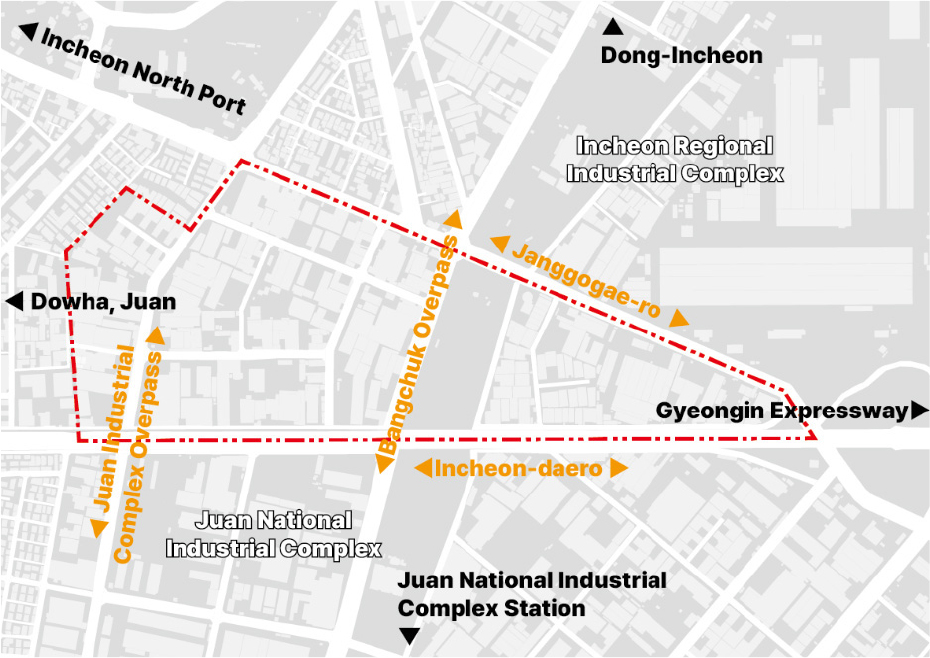
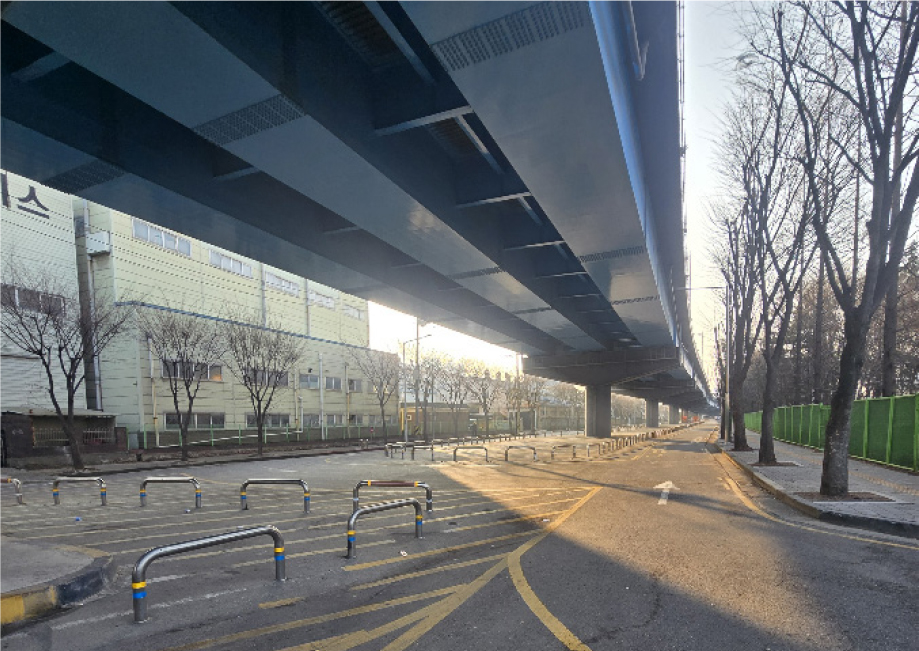
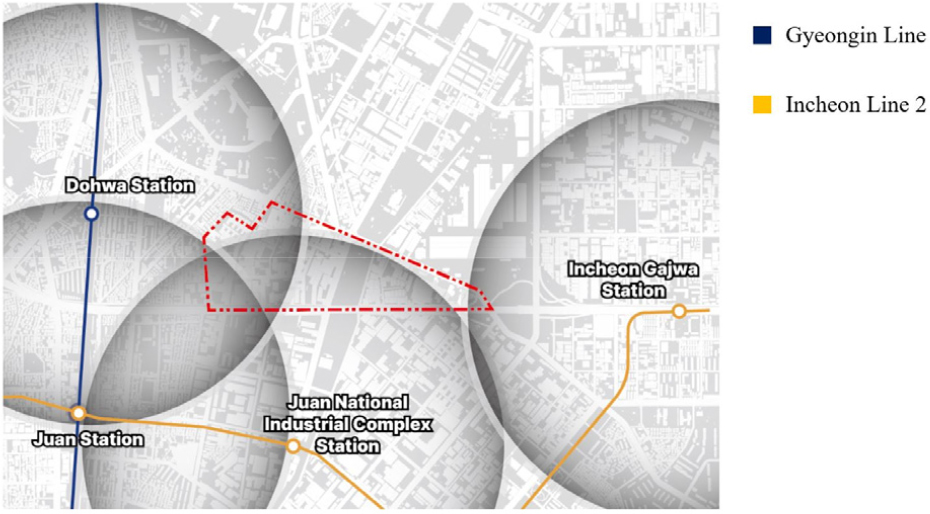
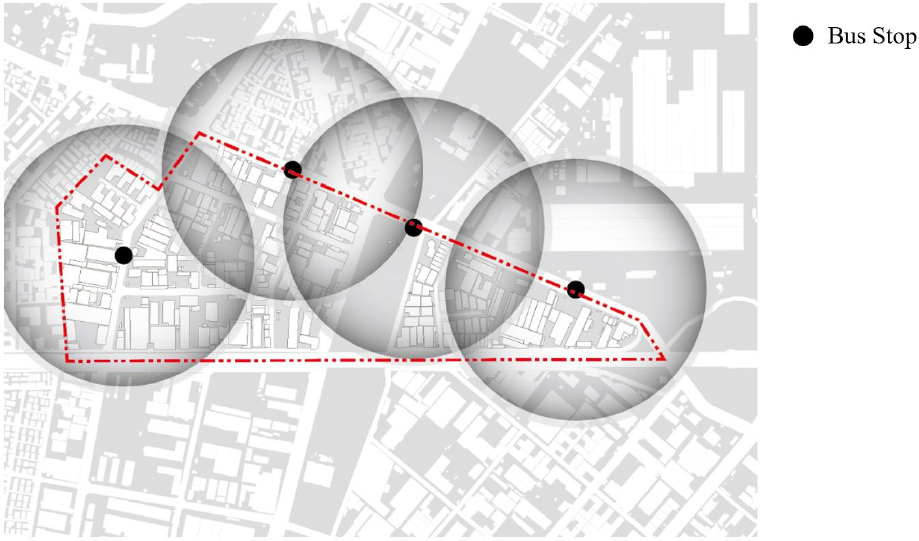
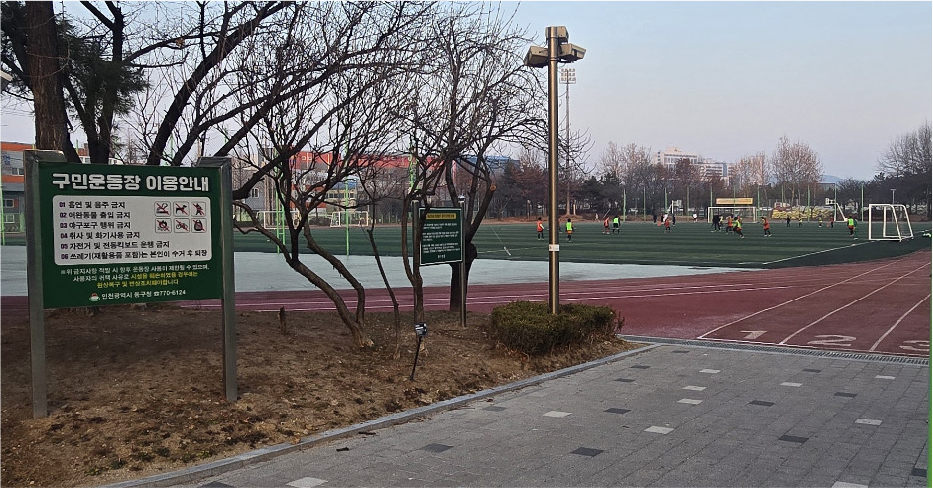
The Incheon Machinery Industrial Complex is situated between the Juan National Industrial Complex to the east and the Incheon General Industrial Complex to the west, playing a connecting role between the two. This gives it a favorable location as an industrial complex. However, to the south lies the residential area of Dohwa-dong, creating a mix of residential and industrial zones. Recent active development around Dohwa Station has brought apartment complexes like e-Pyunhansesang into close proximity, disrupting the urban landscape’s continuity. A park runs through the center of the complex, and the Dong-gu Citizens’ Sports Ground is located there. However, as it lies within the industrial complex, it is not easily accessible to nearby residents and is primarily used for reserved football games, leading to low usage even among workers in the complex (Figure 4). Inside the Incheon Machinery Industrial Complex, 83.4% of the land is designated as industrial use, with all of it being used for factory facilities. Public facility zones total 57,000 m2, of which the Dong-gu Citizens’ Sports Ground occupies 37,000 m2, meaning there are very limited public facilities available for workers. Additionally, there are no other support facilities, making the need for their supplementation urgent (Table 4). The complex lies between Janggogae-ro and Incheon- daero, both of which define its eastern and western edges. Internally, the road network follows a grid pattern. Yeomjeon-ro, located to the south, connects westward to the North Port and eastward to Juan Industrial Complex via overpasses, making it a key road for the complex. Janggogae-ro, a six-lane boulevard to the west, also connects to the port and industrial distribution centers, and thus carries heavy truck traffic. Incheon-daero, currently an expressway, connects Incheon Port to the north with the Gyeongin Expressway and provides good accessibility to Seoul. However, due to its elevated structure, the complex is currently cut off from Juan National Industrial Complex, requiring use of overpasses like Juan Industrial Complex Overpass and Bangchuk Overpass to traverse. Especially, the Bangchuk Overpass next to the Dong-gu Citizens’ Sports Ground contributes to the disconnection between the northern and southern parts of the complex. Also, on-street parking along internal roads reduces usable road and sidewalk space, and the absence of dedicated sidewalks makes pedestrian conditions very poor (Figure 5, Figure 6). The complex is accessible via the Gyeongin Line and Incheon Subway Line 2, which surround the area and offer high connectivity to other regions, including express and rapid trains from Juan Station to Seoul. However, due to the elevated structure of Incheon-daero, accessibility to Juan National Industrial Complex is reduced unless the road is fully undergrounded (Figure 7). Bus stops are placed along major roads such as Janggogae- ro and Yeomjeon-ro, and all facilities within the complex are within 300 meters of a stop (Figure 8). The Dong-gu Citizens’ Sports Ground is centrally located in the complex and primarily functions as a football field. Though adjacent to parks like Incheon Bridge Park and Gajwa Tennis Court, it is physically disconnected due to six-lane roads like Janggogae-ro and Incheon-daero. A pedestrian underpass links it to Incheon Bridge Park, but its steep incline and the exclusive-use nature of the football field limit foot traffic. There is no pedestrian connection to the Gajwa Tennis Court, resulting in practical disconnection (Figure 9).
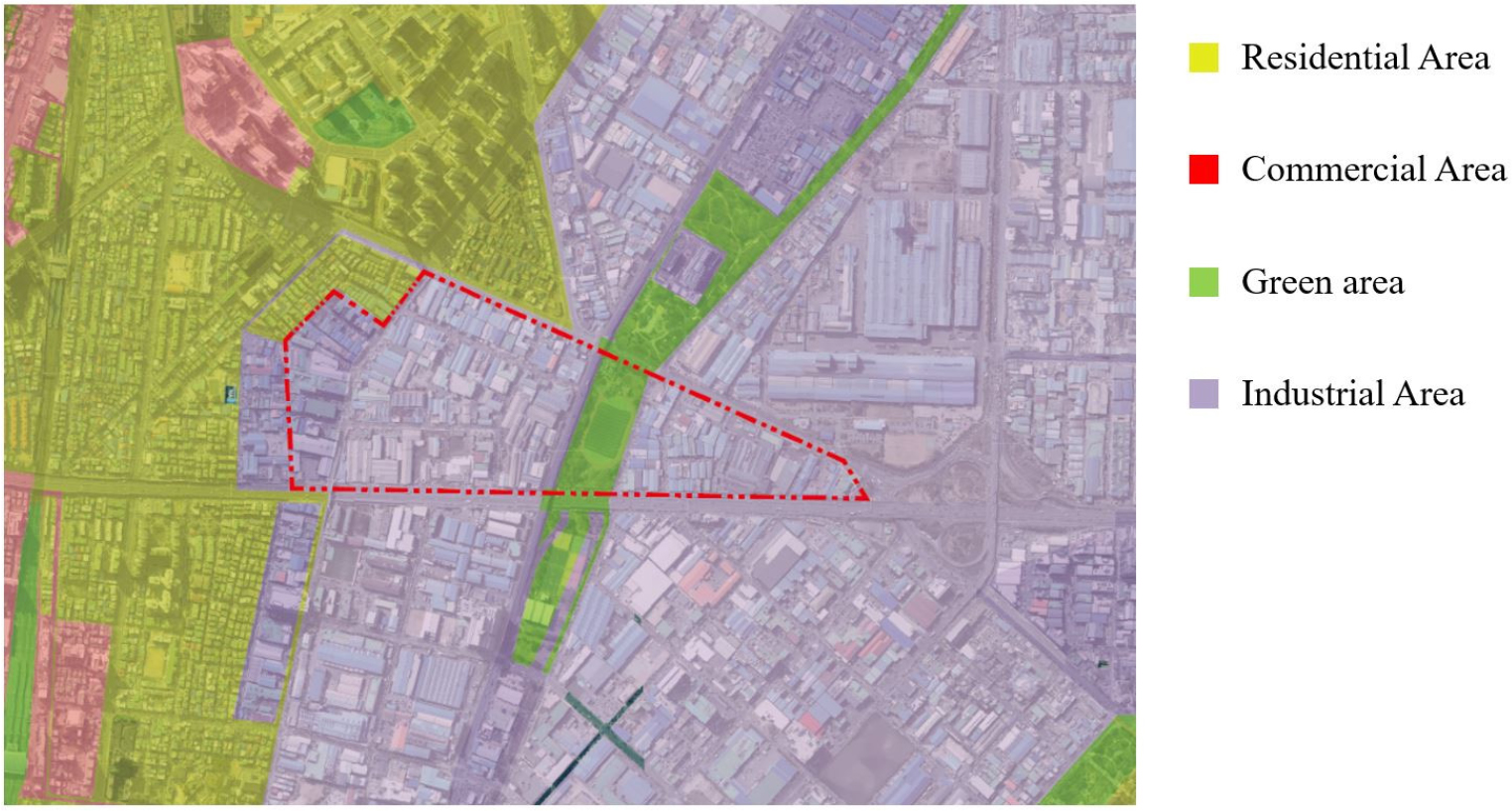
Table 4.
Incheon Machinery Industrial Complex Area by Use
| Total area | Industrial Facility Area | Support Facility Area | Public Facilities Area |
| 350 (100) | 292 (83.4) | - | 57 (16.6) |
Industrial Perspective Analysis
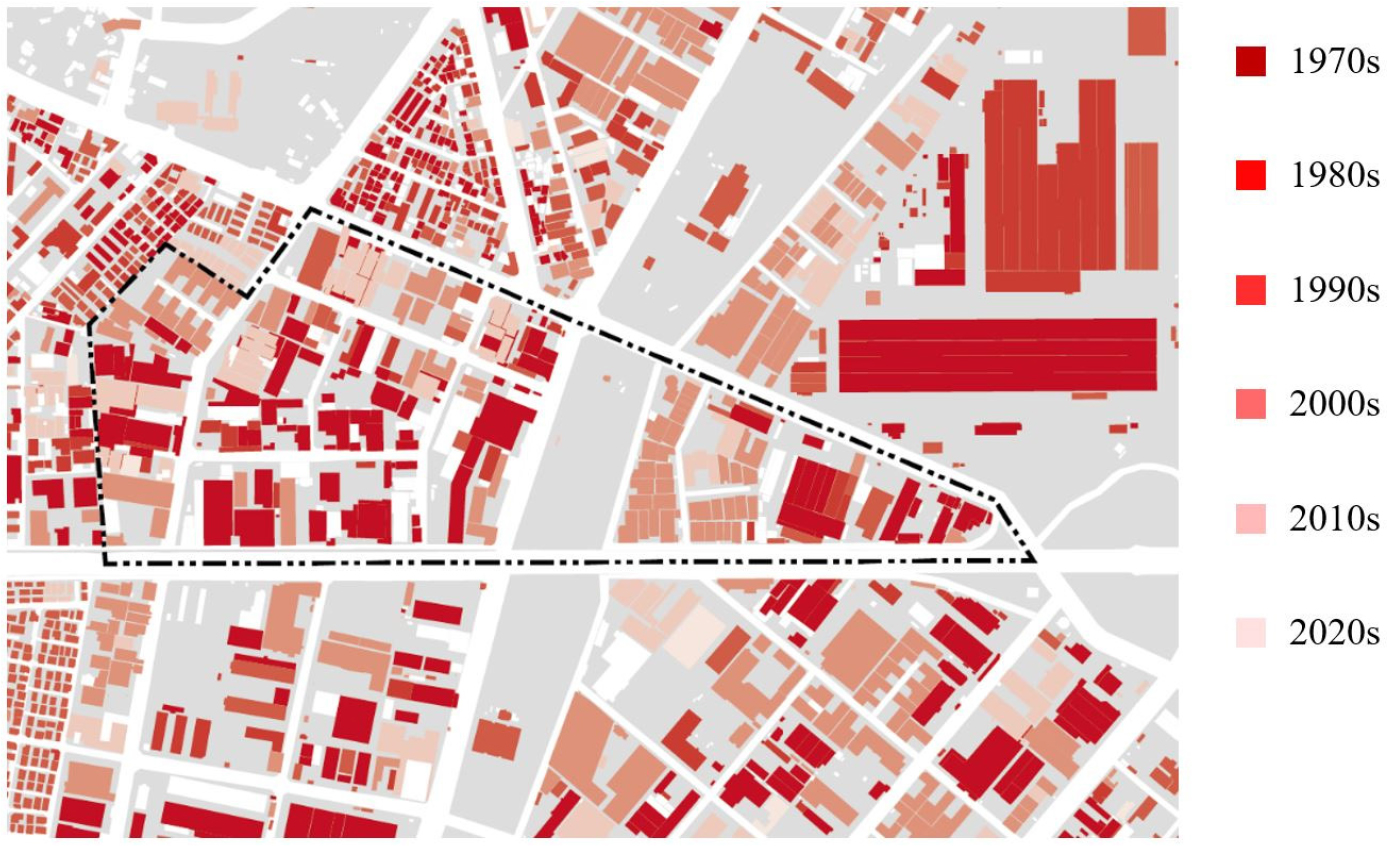
The Incheon Machinery Industrial Complex serves as a key foundational industry that supplies equipment for traditional core sectors such as construction and machinery, contributing to national competitiveness. The majority of tenant industries are in manufacturing, with 110 companies in the machinery sector, followed by metal and electrical/electronic industries (Table 5). Having operated for nearly 60 years since 1965, the complex has many aging facilities. Although the industrial complex master plan has been revised continuously since 2007, and infrastructure has been maintained, the production facilities located on privately- owned land are severely deteriorated. Aged facilities are evenly distributed throughout the entire complex, with most buildings constructed before the year 2000 and thus categorized as outdated (Figure 10).
Table 5.
Incheon Machinery Industrial Complex Resident Companies by Industry
| Number of tenants | Tenant Companies by Industry | ||||||||
| Total | Manufacturing | Non-manufacturing | Machine | Electricity electron | Steel | Nonmetal | Metal | Etc. | |
| 179 | 164 | 15 | 110 | 29 | 4 | 2 | 30 | 4 | |
Selection and Planning of Regeneration Anchor Facility in the Incheon Machinery Industrial Complex
Based on the analysis of current conditions, potentials, and constraints, the Incheon Machinery Industrial Complex shows strong development potential as an advanced industrial zone due to its location near Juan National Industrial Complex, good transportation access, and connectivity with surrounding industrial complexes. However, it also faces serious facility aging and a marked shortage of welfare and convenience facilities. Since most of the old factories are still in operation, it is difficult to secure sites for new facilities or structural advancement projects (Table 6). Among the existing sites within the complex, the Dong-gu Citizens’ Sports Ground, which occupies a large area and is located at the center—physically dividing the complex—has been selected as a candidate site for regeneration anchor facilities. Although the sports ground acts as a physical barrier, it can be transformed into a key site for enhancing connectivity between the north and south parts of the complex. The Dong-gu Citizens’ Sports Ground has an area of 34,263.8 m2 and is designated as a natural green area. It is adjacent to factory facilities on both its north and south sides and connects to green spaces leading to the Incheon Local and Juan National Industrial Complexes on the east and west. It is also close to residential areas to the southwest. The sports ground is bordered by Incheon- daero, a major arterial road, to the east, and by Janggogae-ro, a six-lane boulevard, to the west, providing excellent vehicular accessibility. To the south lies the Bangchuk Overpass, an elevated road, under which underutilized land is located, potentially causing further disconnection from the southern industrial area (Figure 11). As mentioned earlier, the Dong- gu Citizens’ Sports Ground, being centrally located, currently contributes to the fragmentation of the complex. However, this also implies high accessibility from both sides. Moreover, Juan National Industrial Complex’s development plan includes a green corridor linking Juan, Incheon Machinery, and Incheon Local industrial complexes, with the sports ground included as part of this green zone. Therefore, developing the Dong-gu Citizens’ Sports Ground into a regeneration anchor facility could strengthen intra-complex and inter-complex connectivity. By planning welfare and convenience facilities here for industrial workers, improvements in working conditions and utilization of this underused space are also anticipated.
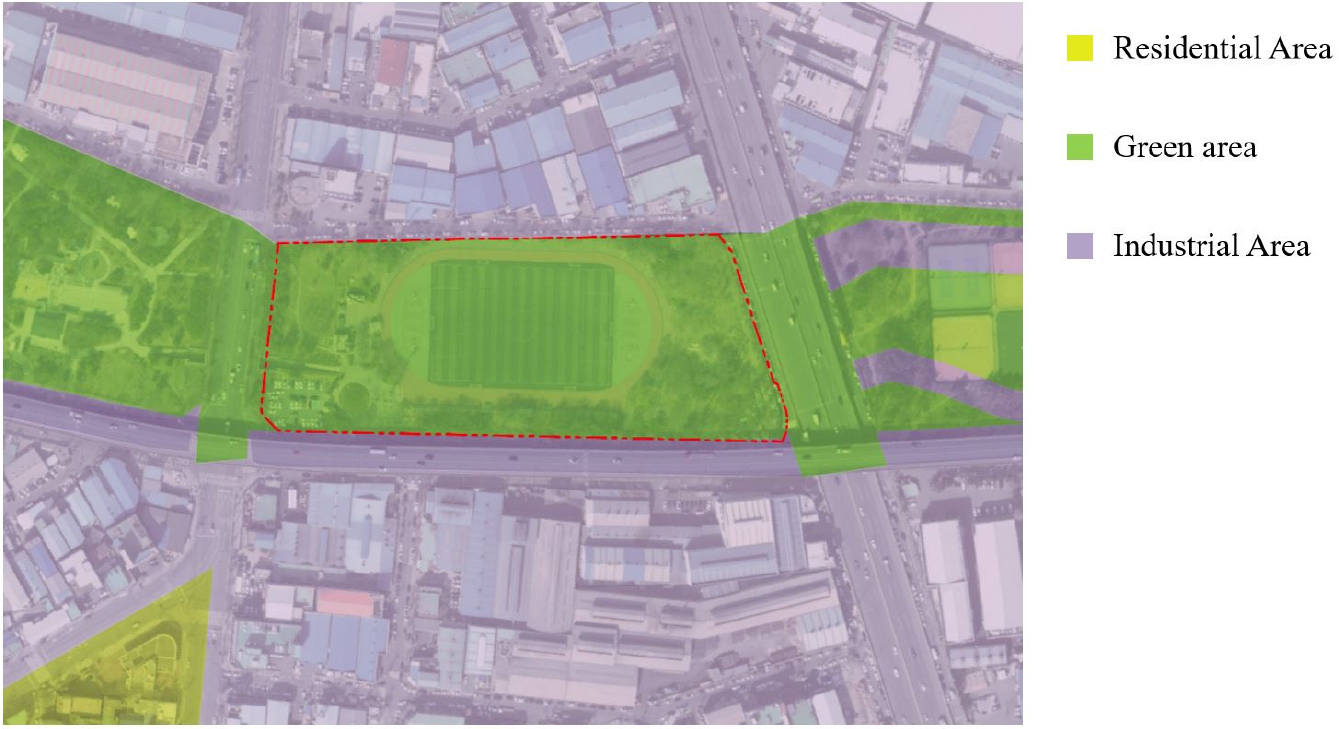
Table 6.
Potential and Constraints by Field
Conclusions
This study focused on the Incheon Machinery Industrial Complex, one of the aging industrial complexes in Incheon Metropolitan City, South Korea. It aimed to explore spatial utilization possibilities by identifying candidate sites for regeneration anchor facilities based on locational feasibility for environmental enhancement and industrial advancement. Through literature review and site analysis, the study examined the concept of structural advancement and assessed the physical and planning characteristics of the complex. As a result, the Dong-gu Citizens’ Sports Ground was proposed as the most suitable site for regeneration anchor facilities. Located at the center of the complex, the site has strong potential to improve intra-complex connectivity and integrate with nearby urban regeneration corridors. While the analysis primarily focused on spatial and planning dimensions, this study is limited in its consideration of economic, social, and operational factors. Future research should evaluate financial feasibility, social impact, and user- centered planning and design to ensure sustainable and inclusive redevelopment.

