


Introduction
Materials and methodology
Composition of the studied materials
Experimental determination of thermophysical parameters and hygric properties
Heat and moisture transfer model
Results and discussions
Profile and evolution of the temperature in the walls
Profile and evolution of the moisture content in the walls
Comparison of heat flux densities and energy gain
Conclusion
Introduction
Ensuring indoor comfort while reducing energy consumption remains a significant challenge in modern construction [1, 2, 3]. Occupants demand optimal indoor conditions in terms of temperature, humidity, air quality, and lighting. However, energy use is directly linked to greenhouse gas emissions, which contribute to climate change [4, 5]. As a result, the building sector is increasingly turning towards innovative, sustainable materials that can simultaneously improve comfort and lower environmental impact.
In recent years, research has shown growing interest in bio-based and waste-derived composite materials as alternatives to traditional combinations of conventional materials with separate insulation layers. These composites often exhibit low thermal conductivity, low embodied energy, and favorable environmental performance. For example, the integration of hemp–lime with low-embodied-energy binders such as recycled pozzolans can improve both energy performance and indoor environmental quality [6], while the strategic use of agricultural by-products such as straw waste can yield eco-friendly and cost-effective wall insulation materials [7]. Similarly, gypsum-based insulating panels manufactured from industrial waste have been proposed for energy-efficient construction [8]. Other studies have explored mycelium composites [9], natural resin–fiber biocomposites [10], zeolite-based phase change materials with superior moisture and temperature regulation [11], and natural or waste fibers such as coconut and jute to improve building envelope insulation [12]. Additional works have examined the benefits of palm date fibers [13], the environmental advantages of renewable-resource-based insulation [14], and the integration of natural plant fibers into cement-based composites to enhance curing and durability [15].
Among these innovative solutions, hemp concrete and polystyrene concrete have gained attention for their potential to enhance thermal comfort and reduce energy demand in sustainable construction. Despite recent progress in the development and application of hemp concrete, there remains a notable lack of data regarding its hygrothermal behavior under diverse climatic conditions, especially when used in exterior wall assemblies exposed to outdoor environments [16]. This knowledge gap limits the reliable generalization of its adoption in sustainable construction practices.
Experimental studies have indicated that the thermal and moisture-related properties of hemp concrete evolve with material age, significantly affecting its hygrothermal performance over time and highlighting the need for updated data and robust predictive models [17]. At the building scale, comparisons with conventional materials suggest that hemp concrete can provide better thermal performance and humidity regulation. However, these studies also conclude that further data are required to optimize its use across different climates [18].
This study aims to address this gap by conducting a detailed analysis of the thermal and moisture performance of hemp concrete and polystyrene concrete, in direct comparison with conventional concrete under identical climatic conditions. The primary goal is to carry out numerical simulations to evaluate their hygrothermal behavior. Specific objectives include:
-Developing accurate physical models for coupled heat and moisture transfer,
-Utilizing both experimentally measured properties [19] and literature data [20, 21, 22], and
-Highlighting the environmental and operational benefits of these materials in sustainable building applications.
By achieving these objectives, this work seeks to demonstrate the practical advantages of hemp and polystyrene concretes, thereby supporting their broader adoption in energy-efficient construction.
Materials and methodology
Composition of the studied materials
Hemp concrete is a bioaggregate-based building material made of commercial fibrous hemp shiv and a commercial lime-based binder with a 0.5 hemp/binder mass ratio. The mass percentages of its components are as follows: hemp shiv, 33.33%; lime-based binder, 66.67% [20].
Polystyrene concrete is made of cement, sand, water, and polystyrene beads. The mass percentages of its components are as follows: cement: 22.03%, water: 11.01%, sand: 66.08%, and expanded polystyrene: 0.88% (bead size: 1.5 to 2.5 mm).
Conventional concrete is composed of cement, sand, water, and gravel. The mass percentages of its components are as follows: cement: 15%, water: 7%, sand: 35%, and gravel: 43% (medium gravel: 10--20 mm).
Table 1 presents the composition of the studied concretes, expressed in kg.m-3 and calculated from their respective mass percentages and bulk densities, thereby ensuring consistency, comparability, and reproducibility of the mixtures.
Table 1.
Composition of the studied concretes in kg.m-3
Experimental determination of thermophysical parameters and hygric properties
To ensure robustness and reliability of the input data, certain properties were determined experimentally by the authors in previous work, while others were obtained from reputable literature sources. The experimental determinations include the density and thermal conductivity of conventional concrete and polystyrene concrete, as well as the sorption isotherm of polystyrene concrete [19]. In contrast, the density, thermal conductivity, and sorption isotherm of hemp concrete, along with the sorption isotherm of conventional concrete, were taken from the literature [20, 21, 22].
Density and thermal conductivity
The density of each material was calculated from the mass and dimensions of the samples. Thermal conductivity was measured using the guarded hot plate method, designed and implemented by the authors in earlier research [19]. The thermophysical properties obtained from experimental measurements and literature data are summarized in Table 2.
Table 2.
Thermal and physical properties of conventional, polystyrene, and hemp Concrete
| Material |
Density kg.m-3 |
Thermal conductivity W.m-1.K-1 | Reference |
| Conventional concrete | 2200 | 1.6 | Author’s previous experiment [19] |
| Polystyrene concrete | 1220 | 0.62 | Author’s previous experiment [19] |
| Hemp concrete | 381 | 0.138 | Results from literature [20] |
Under laboratory conditions (20°C and approximately 50% relative humidity), conventional concrete exhibited the highest density at 2200 kg.m-3 and a thermal conductivity of 1.6 W.m-1.K-1, reflecting its high mass and significant heat transfer capability. These values are primarily attributed to its low porosity and high proportion of solid mineral phases.
Polystyrene concrete showed a density of 1220 kg.m-3 and a thermal conductivity of 0.62 W.m-1.K-1, making it lighter and providing better insulation than conventional concrete. The inclusion of expanded polystyrene, a low-density material with a highly porous structure, increases air entrapment, thereby reducing the overall thermal conductivity.
Hemp concrete presented the lowest density (381 kg.m-3) and the best insulation performance, with a thermal conductivity of 0.138 W.m-1.K-1. These characteristics are due to the light, fibrous nature of hemp shiv, which creates a highly porous matrix. The significant volume of air contained in these pores further enhances its insulating capability, as air is a poor conductor of heat.
The observed differences in density and thermal conductivity underline the specific advantages of each material: conventional concrete for strength and thermal mass, polystyrene concrete for reduced weight and moderate insulation, and hemp concrete for superior insulation and sustainability.
Sorption isotherms
The sorption isotherm characterizes the interaction between water vapor and the internal surfaces of the pore network, thereby revealing the material’s moisture- buffering potential. For polystyrene concrete, the sorption isotherm was obtained experimentally by the authors in earlier work [19], using samples equilibrated under controlled temperature and relative humidity. Relative humidity levels were maintained using saturated salt solutions.
The experimental sorption data were fitted using the BET and GAB models (Figure 1). The BET model accurately describes multilayer sorption for relative humidity values below 50%, whereas the GAB model extends this approach over a broader range (5%–95% relative humidity). Parameter fitting was performed via the least squares method.

Figure 1.
Experimental sorption isotherms of polystyrene concrete (author’s previous experiment [19]).
Results show that polystyrene concrete has a high sorption rate, attributed to its porous structure, which facilitates rapid moisture uptake. The curve rises sharply at low relative humidity, then levels off as saturation is approached. The desorption curve reveals significant macroporosity in the material.
The sorption isotherms for hemp concrete and conventional concrete were obtained from the literature [21, 22].
Heat and moisture transfer model
Models of coupled heat and mass transfer in porous media have been studied by several researchers over the years. Glaser, Luikov, Philip and De-Vries, and Whitaker were pioneers in this field. Glaser developed a model based on Darcy’s equation [23], Luikov proposed a theoretical approach using conservation equations [24], Philip and De-Vries developed a model for heat and mass transfer in unsaturated media, taking into account moisture effects [25], and Whitaker proposed a unified approach using the method of volume averaging [26]. These models have since been further developed by other researchers, depending on the specific case studied [27, 28, 29, 30, 31, 32, 33, 34, 35]. All of these models are based on one of the aforementioned models (Glaser, Luikov, Philip and De-Vries, Whitaker). Finally, a very recent critical study of these models was conducted by Ndukwu et al., who reported that all of these physical models are suitable for all porous media, and that the choice of a specific model depends primarily on the nature of the material [36].
In this work, we use a physical model that we developed in previous research [37, 19], which is based on the Philip and De-Vries model. This model takes into account the effects of temperature and moisture gradients. It is suitable for hemp, polystyrene, and conventional concrete materials, which are the materials studied in this article. It enables a thorough description and enhanced understanding of physical phenomena, yielding accurate results and faithfully replicating observed phenomena in porous media.
Governing equations
By using temperature “T” and moisture content “w” as the driving potentials, the energy and moisture conservation equations are written for each material as:
where:
Dw (m2. s-1) and DT (m2. s-1. K-1) are the diffusion coefficients corresponding to the moisture content gradient and the temperature gradient, respectively. The subscript “v” denotes the vapor state. These coefficients were determined following the approach adopted in the authors’ previous study [37], c: specific heat (J.kg-1. K-1), λ: thermal conductivity (W.m-1. K-1), ρ: density (kg.m-3), L: energy involved in the phase change of moisture (J.kg-1), t: time (s).
Boundary conditions
Energy balance at the exposed surface:
Moisture balance at the surface:
where h (W.m-2. K-1) and hm (m.s-1) are the heat and moisture transfer coefficients, respectively. j (kg.m-2. s-1) is the vapor flow.
Modeling Assumptions
The porous solid is homogeneous, rigid, and isotropic; all phases are in thermal and hygroscopic equilibrium; the gas phase obeys the ideal-gas law; no chemical reactions occur; the liquid density is constant; gravity effects are neglected.
Simulation Setup
A one-dimensional wall section (thickness 0.15 m) is considered, with discretization along the thickness only. The 1D assumption is adopted because the study targets through-thickness heat and moisture exchange between the building interior and exterior. The simulation spans 200 h with a 60 s time step.
Boundary initial conditions represent typical summer operation: exterior air at 37°C and 70% RH; interior air maintained at 22°C and 50% RH; initial uniform material temperature T0=22°C and moisture content w0=0.02 kg·kg-1.
Numerical Implementation
The coupled partial differential equations (1) and (2) were discretized using the finite difference method with an implicit time integration scheme. A MATLAB code was developed, and a convergence criterion of 10-6 was imposed on the maximum relative error between successive iterations for both temperature and moisture content.
Numerical simulation duration
The numerical simulation was performed over a total period of 200 h. This relatively long duration was selected to account for the slow hygric response of the materials, ensuring that both moisture transfer and coupled heat–moisture phenomena could be fully captured and stabilised.
Results and discussions
Profile and evolution of the temperature in the walls
Considering that the thermal response of the materials is considerably faster than their hygric response, two representative time steps—1 h and 10 h—were selected to analyse the temperature profiles in detail. At 1 h, pronounced temperature gradients are still present within all materials, and distinct differences between the three concretes are discernible throughout the entire wall thickness. At earlier stages, these differences are confined to regions near the surface exposed to the thermal excitation. By 10 h, the temperature distribution within each material approaches a quasi- steady state, yet the contrasts in thermal behaviour between materials remain evident.
Figure 2 presents a direct comparison of the temperature profiles for conventional concrete (conv), hemp concrete (hemp), and polystyrene concrete (polyst) at both 1 h and 10 h. Among the materials studied, hemp concrete exhibits the steepest temperature gradient, a result of its lower thermal conductivity, which effectively limits heat penetration and enhances resistance to heat transfer. Polystyrene concrete demonstrates intermediate performance—better thermal insulation than conventional concrete but lower efficiency compared to hemp concrete. In contrast, conventional concrete shows the smallest temperature drop across its thickness, indicative of higher thermal conductivity and a greater propensity for heat to penetrate deeply into the material.
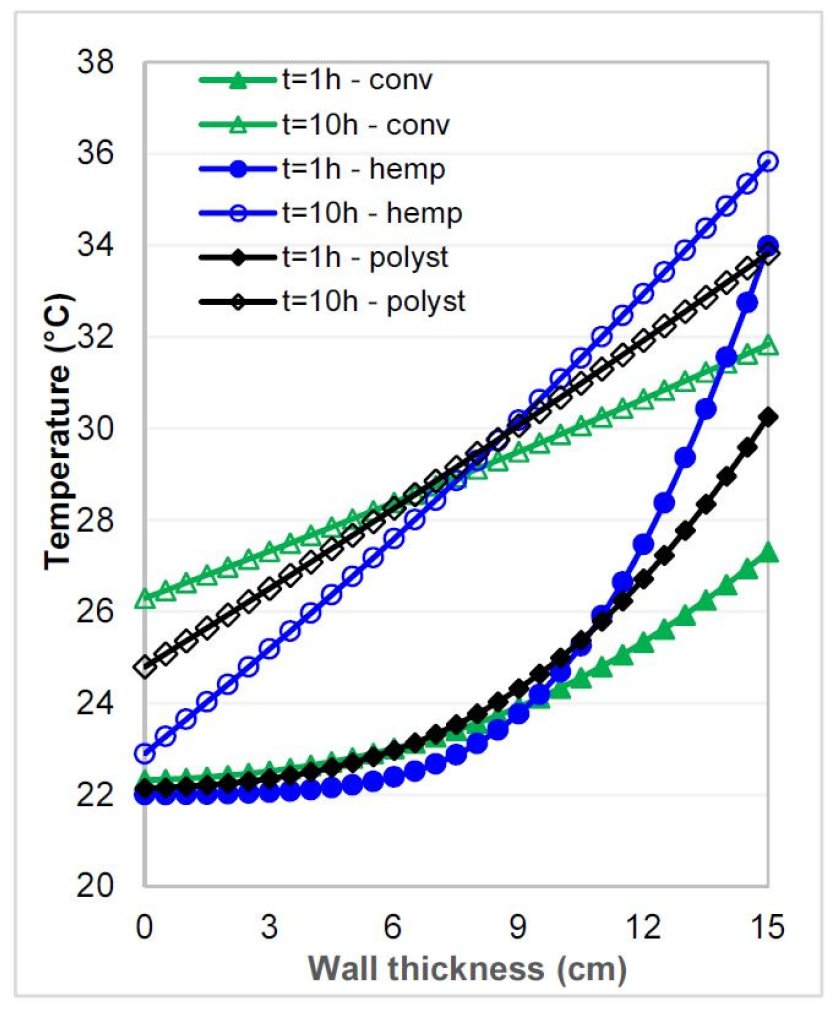
Figure 3 shows the temporal evolution of temperature at three locations within the wall: 1 cm from the interior surface, 1 cm from the exterior surface, and at mid-thickness (7.5 cm). The points near the surfaces were selected to capture boundary effects, which are strongly influenced by indoor and outdoor thermal conditions and generally exhibit the largest temperature variations. These measurements are essential for obtaining insight into the heat flux and for identifying thermal inertia effects. The mid-thickness location, in turn, provides valuable information for characterizing the internal thermal gradient and assessing the rate of heat penetration through the material.

At 1 cm from the interior surface, the temperature in hemp concrete remains relatively stable throughout the simulation period, reflecting its superior insulation performance and slower heat transfer. In comparison, polystyrene concrete and, more markedly, conventional concrete show a greater temperature increase, with conventional concrete exhibiting the highest rise.
At 1 cm from the exterior surface, all three materials experience a rapid temperature increase during the first hours, in response to outdoor temperature fluctuations. This rise then slows, reaching a plateau around the tenth hour. Notably, hemp concrete displays a higher rate of increase in this zone, which confirms its ability to delay rapid inward heat transfer by storing thermal energy near the outer boundary.
At mid-thickness, differences between the three concretes are much less pronounced. This is because the central zone is partially insulated from the direct influence of both faces; here, heat transfer is primarily governed by conduction through the surrounding material, which acts as a thermal buffer. As a result, temperature at this point changes more slowly and remains within a narrower range, regardless of the concrete type. This observation is consistent with heat conduction theory, according to which the central part of a homogeneous wall experiences delayed and attenuated temperature variations compared with the surfaces.
By combining data from the surface zones and the core, it becomes possible to distinguish the role of each material’s thermal properties in both the immediate surface response and the delayed internal response, thereby strengthening the validity of the comparative analysis. From a practical perspective, such information is essential for optimizing wall design in high-performance buildings, as it enables determination of the ideal configuration and thickness of materials to maintain indoor comfort while minimizing heat losses or gains.
Profile and evolution of the moisture content in the walls
The best concrete for moisture transfer, or the best “water insulator,” depends on the material’s ability to resist water absorption and its ability to hold and release moisture.
Figure 4 shows the moisture content (kg.kg-1) based on the wall thickness (cm). Hemp concrete (hemp) has a relatively stable moisture content throughout the wall thickness. This value is lower than those of other materials, especially near the outer surface. This shows that it better regulates moisture by absorbing and releasing it in a balanced way. Polystyrene concrete (polyst) has a moderately high moisture content, but is lower than conventional concrete. There is a slight variation in moisture content across the wall thickness. The conventional concrete (conv) has the highest and most variable moisture content. This shows that it poorly regulates moisture, resulting in the accumulation of more water on the surface.

Figure 5 illustrates the temporal evolution of moisture content (hours) at two positions within the wall: 1 cm from the inner surface and 1 cm from the outer surface. The evolution at mid-thickness is not presented here, as the variations observed at this location are very small—consistent with the trends already evidenced in Figure 4—and would not provide additional insight, while unnecessarily complicating the figure. All materials initially exhibited a rapid increase in moisture content due to external climatic conditions.
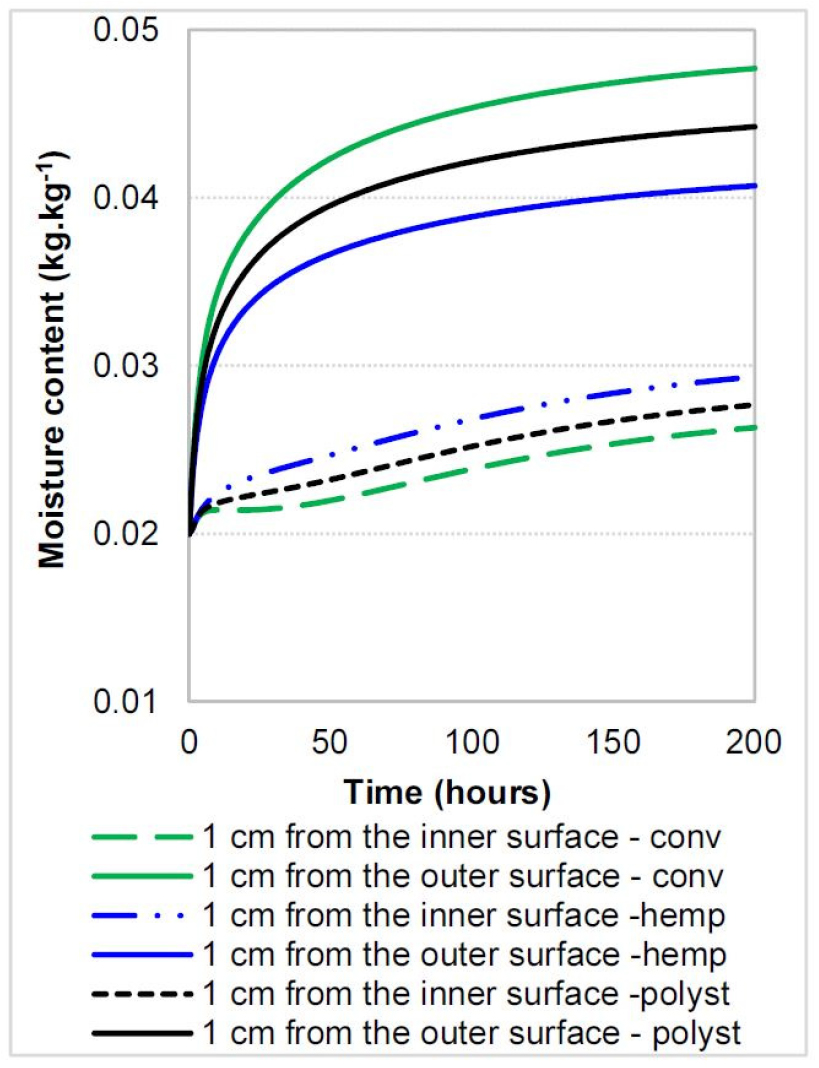
Hemp concrete maintained a relatively stable moisture content throughout the simulation period, confirming its capacity to regulate humidity, which is beneficial for indoor comfort and occupant health. Polystyrene concrete showed a gradual increase in moisture content, remaining lower than that of conventional concrete. Conventional concrete, in contrast, displayed a marked increase, indicating a limited ability to regulate moisture.
In summary:
-Conventional concrete exhibits low porosity, leading to limited initial water absorption. Once saturated, it absorbs little more water but dries slowly, making it moderately effective as a moisture barrier.
-Polystyrene concrete, although porous, is hydrophobic, which limits water absorption. Some infiltration can still occur, but its overall performance as a moisture barrier remains high.
-Hemp concrete is highly porous, allowing rapid absorption and release of moisture. This results in high initial uptake—less desirable in certain applications—yet provides excellent long-term moisture regulation.
Comparison of heat flux densities and energy gain
The heat flux density through conventional concrete exhibits a steady rise, attaining approximately 59 W.m-2 after 180 minutes (Figure 6), thereby reflecting its relatively high thermal transmittance and substantial capacity for heat transfer through the wall over prolonged exposure. In comparison, polystyrene concrete displays a markedly lower heat flux density, stabilizing at approximately 37 W.m-2, indicative of its superior ability to attenuate conductive heat flow relative to conventional concrete. Hemp concrete demonstrates the most favorable thermal performance, with heat flux density values commencing at roughly 10 W.m-2 and progressively stabilizing at around 13 W.m-2. Such behavior underscores its outstanding thermal insulation properties and its pronounced efficiency in mitigating heat transfer across the building envelope.

Figure 7 shows the ratio of heat flux density between conventional concrete and other concretes over time. The ratio of Qconv/Qpolyst stabilizes at 1.6, meaning that the heat flux through conventional concrete is 1.6 times greater than that through polystyrene concrete. The ratio of Qconv/Qhemp stabilizes at approximately 4.6, indicating that the heat flux through conventional concrete is 4.6 times greater than that through hemp concrete.

The energy gains (in percentage) over time is shown in Figure 8. It is calculated as the difference between the heat transferred by conventional concrete and that transferred by other concrete, divided by the heat transferred by conventional concrete. For polystyrene concrete, the energy gain stabilizes at approximately 37%, indicating a significant reduction in heat transfer. For hemp concrete, the energy gains reach almost 78%, indicating a very large reduction in heat transfer.

The results of the last three figures clearly show that hemp concrete and polystyrene concrete are more effective than conventional concrete at limiting heat transfer through walls. Using conventional concrete leads to very high energy costs for heating and cooling or reduced indoor comfort.
In conclusion, the use of alternative concrete materials such as hemp concrete and polystyrene concrete can offer significant benefits in terms of energy efficiency and indoor comfort, while also improving the durability and thermal performance of buildings.
Conclusion
This paper provides new insights into sustainable construction practices, emphasizing the potential of insulating composite materials to enhance energy efficiency and environmental performance in buildings, with possible cost-saving implications through reduced heating and cooling demands. By employing hemp concrete and polystyrene concrete, significant reductions in heat transfer can be achieved, leading to more comfortable and energy-efficient structures with minimized environmental impact and optimized resource use.
A comprehensive hygrothermal model of these materials was developed, enabling a comparative assessment against conventional concrete. The study reveals that heat transfer through conventional concrete can be up to 4.6 times greater than through hemp concrete, and 1.6 times greater than through polystyrene concrete. Consequently, replacing conventional concrete with hemp concrete can reduce heat losses through building envelopes by up to 78%, while polystyrene concrete can achieve reductions of up to 37%. These results highlight the substantial potential for lowering energy demands for heating and cooling, which may, in practice, lead to notable cost reductions—particularly in climates with pronounced seasonal variations.
From a moisture regulation standpoint, polystyrene concrete demonstrates excellent insulation performance due to the hydrophobic nature of polystyrene, effectively limiting water absorption while maintaining some porosity. Hemp concrete, though more absorptive, excels in moisture management, making it suitable for environments where such control is essential. In contrast, the lower moisture regulation capacity of conventional concrete increases the risks of water accumulation and potential degradation.
The implications of adopting these innovative materials are significant. The transition to hemp concrete and polystyrene concrete can lead to considerable reductions in energy consumption and improved indoor comfort. Furthermore, the use of bio-based materials such as hemp concrete aligns with global sustainability goals and carbon mitigation strategies in the construction sector. Despite their advantages, the mechanical limitations of hemp and polystyrene concrete currently restrict their application in load-bearing structures. Nevertheless, their use as infill materials remains highly promising. Future research should focus on enhancing the mechanical strength of hemp concrete to broaden its applicability, alongside investigating the long-term durability of both materials under varying climatic conditions. Addressing these challenges could position hemp concrete as a more versatile and impactful material, further strengthening its role in the advancement of sustainable construction practices.

