


Introduction
Background
Sustainability of POSS
Method
Al-Shawarbi Street
Survey
Results and Discussion
Conclusion
Introduction
Recently, several researches have shifted the focus on urban sustainability from the city-scale towards the development of neighborhoods ]. However, among the three dimensions of sustainability, priorities have been given to environment and economic sustainability while social sustainability has largely neglected ]. A well- designed street is the subject of many recent studies as it is not just a design; it is a strategic approach of a collaborative system of relationships that integrates the environmental, social, and economic variables ]. Shop-ping streets attract a large number of city dwellers, as they are places of refreshment and leisure. They also serve as economic zones for city informal traders and places for social movements. With the new global awareness of the importance of public spaces, and the adoption of Sustainable Development Goals, (Goal 11, Target 7 which aims that by 2030, provide universal access to safe, inclusive and accessible green and public spaces, in particular for women and children, older persons and persons with disabilities) ]. Cities have recently witnessed placemaking efforts and rehabilitation of the public, in order to create a livable and social sustainable city. Social sustainability seeks to promote healthy livable communities that are diverse and socially cohesive [.
A pedestrian-oriented shopping street (POSS) - the so-called “pedestrian mall”-consists of one or more streets inter-connecting each other. The central part of a POSS is a street-wide outdoor landscaped pedestrian area along with both sides, where there is a variety of stores and services [. A successful POSS is characterized by high pedestrian activity, since one of the principle goals of urban outline and the present development toward manageable urbanism is to decrease auto reliance and increased pedestrian activity [. Therefore, POSSs are critical and deserve more attention. With proper design and implementation, successful pedestrian spaces can enhance livability, quality of life, and sustainability of cities. However, a recent study reported that approximately out of 200 pedestrian malls, 89% are either removed, struggling or are combined with transit. This gives American pedestrian malls an overall success rate of 11% [. POSS have faced a difficulty after the evolution of technology, although online shopping is increasing, the in-store shopping is still very important for a superior shopping experience.
On the other hand, Urban technologies-chiefly as systems-provide what may be called the “sinews” of the modern city: its road, bridge, and transit networks…etc., Not only have these technological systems permitted urban growth and diversification, but they also have encouraged profound changes in the urban landscape design [. Urban design needs technology; incorporating technology can effectively boost creativity connections and trust within a given community. As technology is essential to the Social sustainability for shopping experience nowadays, it should be utilized to maximize the customer experience and it should not only meet but also exceed customer expectations . In addition, technology can create an attractive environment through making the shopping experience engaged and memorable .
This paper attempts to contribute to the on-going debate concerning the technological effect on one of the liveable designed environment, POSS, through understanding how technology implementation contributes to the social sustainability of POSS. The research starts with the background section providing a review of existing literature about POSS factors of success related to sustainability, in-depth study of urban street amenities and the ability of implementing technology in their elements, case study of a POSS located in Egypt, Cairo (Al-Shawarbi St), qualitative and data analysis gathered through site visits, interviews, and questionnaires. The results are then analyzed using SPSS. Last, implications and conclusions derived and further research proposals are addressed.
Background
Sustainability of POSS
Designing streets as successful public spaces represent the spine of all sustainable urban movements . The Sustainable Streets concept introduces three focuses of sustainable street design: movement, community, and ecology. The concept of resilience has increasingly been used in urban and regional planning literature as a key topic to study the dynamics of spatial economic systems, specifically to identify how such systems respond to major shocks, disruption, and disturbances . According to Pendal et al., two approaches are defined for the concept’s applicability: (1) the equilibrist approach that refers to systems remaining in equilibrium, and (2) the evolutionary approach that refers to systems that reorganize to evolve into a stage, where new social, economic and ecological relations are defined . A study of Wrigley and Dolega suggests that the retail centers which proved most resilient to the shock wave of global economic crisis were characterized by both diversity and corporate-food-store entry .
The sustainability of cities highly depends on city center viability and shopping street resilience [. Therefore, the shopping streets have adapted to the changes, thus become more resilient to the negative impacts of shopping centers.
Castillo-Manzano, et al. examine the satisfaction of citizens or frequent visitors with these schemes in two streets that are not part of the urban center of the city of Seville (Spain) . Their results show that both pedestrianization has resulted in significant changes in citizens’ shopping and consumption habits in establishments located in the pedestrian zones, which have been turned into open-air malls with improvements to their lively ambiance.
Kurose et al. suggest that shopping pedestrians will never leave the attractive shopping streets before completing their shopping . Their findings suggest that the model based on choice heuristics might be useful to classify and identify the sequences of stops and route choice behavior of shopping pedestrians in a shopping center.
Vural-Arslan et al. develop an integrated approach to the economic and social revitalization of the commercial district that achieves more than just physical regeneration .
In the modernization view, the urban public space represents a waste of space that could be utilized for economic purposes; with high-rise office and residential blocks and shopping malls replacing open markets in the drive towards ever-increasing consumption. However, after years of urban practices that have neglected the urban public spaces, there has been an increasing awareness and growing realization of how important public spaces are in promoting social sustainability, especially in the urban areas .
The importance of socially activating street is crucial for people- who use such spaces, and the sustainability of our cities as well. In this regard, lively streets have been always desired, as they offer greater opportunities for optional and social activities . Therefore, identifying relevant attributes of the concept is the major focus of this section. This study develops previous frameworks suggested for social sustainability and the principal urban design theories and texts relevant to shopping streets, including but not limited to DETR and CABE (2002), Gehl (2010), and Mehta (2014), according to Ghahramanpouri et al. study, the significant factors affecting urban social sustainability dimensions in public spaces are connectivity, legibility, sense of place, preservation of local characteristics, safety, comfort, public services, urban street amenities, inclusiveness, and diversity . Accordingly, the factor analysis, of social sustainability variables results of this study, found that quality of place, participation and accessibility, legibility, adaptability, place attachment, street amenity, food and economic services, heritage & local culture, and permeability respectively are the important factors that influence urban social sustainability in streets .
The first factor (factor 1) refers to the quality of space includes safety and security at day and night, enjoyment, and comfort. Factor (2) points out the participation and accessibility refer to freedom of choices and provision of opportunities to socialize and participate in activities, as well as the access of space for users of varied conditions. Factor (3) considers legibility construct, attractive views, vistas and visual aspects of the shopping street. Factor (4) highlights the adaptability of street according to user needs through future conditions. Factor (5) is place attachment which describes the relation and bonding between the user and the settings , urban identity and sense of place. Factor (6) is related to Street amenities, which will be discussed in details in the next section it includes street furniture, lighting, flooring…etc. Factors (7, 8) refer to food and economic services, heritage and local culture, the presence of restaurant, street café, food stalls are very essential in the social sustainability of shopping. While for heritage construct, preservation of what persists earlier and regular maintenance of existing good conditions are vital variables in social sustainability.
The last factor (9) is street permeability that covers urban layout and networks of a connected street (visual and physical) and all movement for pedestrians and other users of the street, including the feasibility visual and physical access towards the destinations.
Various studies have supported these findings and highlighted the importance of Street amenities factor for social sustainability of streets, For example, Chan and Lee (2008) suggested the provision of facilities and amenities for groups with special needs including the disabled, elderly, and children. This factor is directly related to equity and basic need in social sustainability.
Street amenities role in Pedestrian shopping streets Factors of Success
Various variables have been collected from different urban theories, which indicates certain factors that directly help in producing a successful pedestrian-oriented shopping street and public spaces in general. Those elements were organized as four main “pillars” (See Figure 1): “Accessibility, Design, Use, and Comfort” .
|
Figure 1. Four pillars of a successful pedestrian-oriented shopping street (POSS), the study will emphasis on Design pillar. Source: Researchers, 2017. |
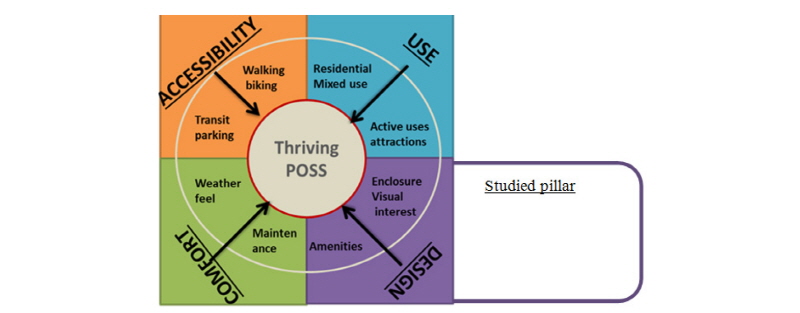
The “Design Pillar” shows urban form factors as, the location of the street, perception of an enclosure, visual interest, and urban street amenities. That collaborates to create a successful people place. Street Amenities include: seating, greeneries, trees, maps and signage, lighting elements, paving, water features, public toilets, and waste bins, etc. 5-2.
In this research, we are investigating the Urban Street Amenities Factor and their sub-elements, as it is an important common factor between Social sustainability and the pedestrian shopping streets success pillars.
Additionally, the POSS sensory elements are especially important, as users look for entertainment while shopping. Therefore, the shopping experience should provide a convenient, relaxing, and fun environment that makes shopping pleasurable, and technology can significantly contribute to that. Utilization of new technologies will enable shopping streets to be very different places in the future .
Technology in Pedestrian Shopping Paths’ street amenities: Typologies and Implementations
Before determining which technologies to utilize in any project, shopping field developers, designers, and owners must first be aware of what technologies are available. Researchers have identified sixty-six types of technologies in shopping and have grouped them into the following eight categories :
(1) Customer Tracking and Database Marketing Technology, (2) Technology as Entertainment and Visual Merchandising, (3) Technology to provide Information and Shopping Assistance for Customers, (4) Direct Broadcast Satellite Technology, (5) Information Technology for Communications and Data Sharing, (6) Technology for Energy Management and Resource Conservation, (7) Technology for Security, and (8) On-Line Shopping Services. The research attempts to deal with only two types of shopping technologies, as their applications are more related and directly affect the POSS’ street design elements, these types are:
∙Technology as Entertainment and Visual Merchandising
∙Technology for Energy Management and Resource Conservation
Technology as Entertainment and Visual Merchandising (V.M) implementations
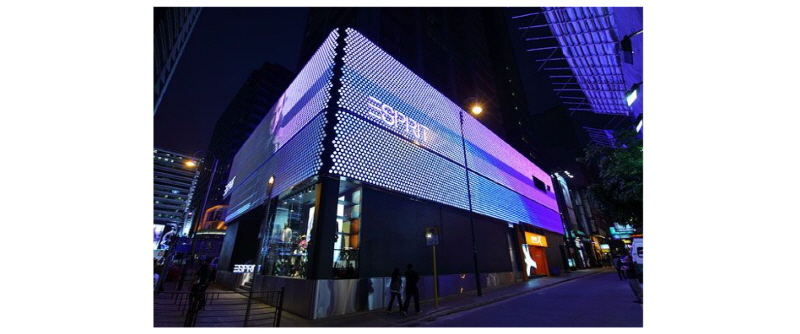
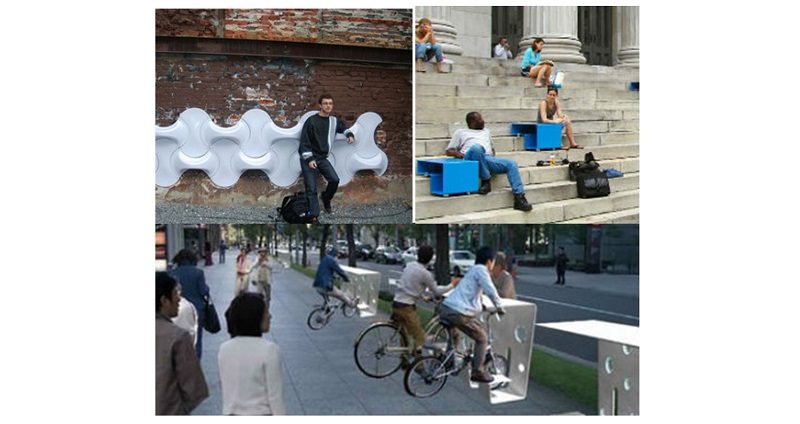
By 2020 experts predict that garment display and visual merchandising will become considerably more technologically driven; combining craftsmanship and technology is something that will ultimately become the height of innovative and imaginative retail . For example, the ‘Virtual Displays’ are very efficient in attracting shoppers in their tracks . ‘Media Facades’ allow media content to be displayed on a grand scale (See Figure 2), and more intelligent control systems offer interactivity to the urban landscape . ‘Movable Mannequins’ will always be crucial in the V.M world as discerning users demand more from the shopping experience. ‘The Smart Floor’ provides smart services for security and safety, the technology can also detect a person’s mood . The ‘Innovative Water Feature’ elements, such as the Crown Fountain is regarded as one of the world’s most technologically advanced human creations . The ‘Digital Art Urban Screen’ on building facades projections, can bring POSSs to life, especially at night and increase its livability For example, the ‘Safari Urbain’ that implemented in Paris, France, and the ‘Innovative Seating Design’ has recently spread throughout the world, and implementations of the Stair Square, Sky Station Chair, Leaning Mold, Urban Adapter Bench, and Bike Table have revolutionized city livability (See Figure 3).
|
Figure 2. Hong Kong “Esprit” media façade Source:http://www3.traxontechnologies.com/showcase/showcase_details/ 593/Esprit%20%20Hong%20Kong, %20China. Accessed May 1, 2017. |
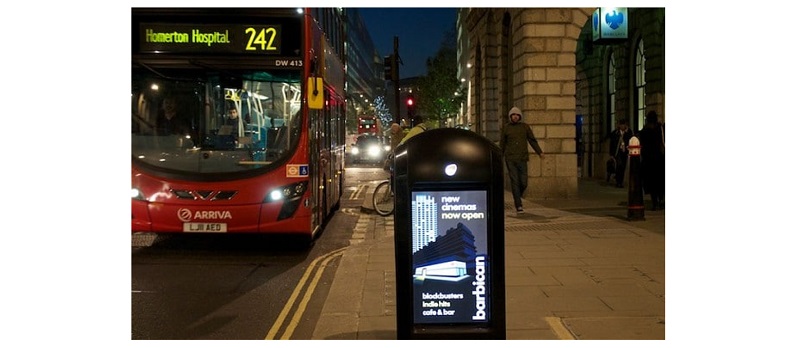
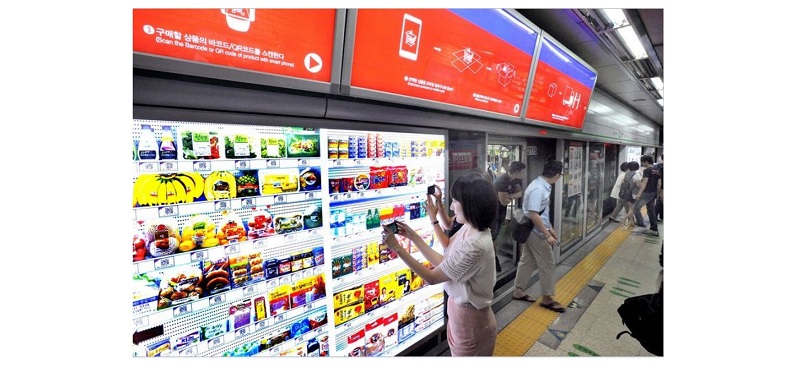
‘Facial recognition’, moods and tracking technology is used in many ways. For example, in London, England the Rubbish Bin is bombproof and contains digital screens assisting pedestrians with breaking news connects to smartphones with Wi-Fi (See Figure 4). The ‘Virtual store’ is another example of a new retail system, which is implemented in South Korea, assists shoppers to shop through their smartphones. (See Figure 5). The ‘Beacon Based Tracking Location’ targets customers at the right place, time and offer in the store utilizing Bluetooth low energy technology . ‘Digital Signage and Mapping’ (Totem), a very significant tool in visual merchandising, attracts attention more than ordinary signage . ‘Moving walkways’, is a facility for shoppers with disabilities such as; Travelators. ‘Rail braille and audio rail’ were installed in the Nature Discovery Center of Earth Place, CT, along with an accessible trail, and more recently at Battery Park City in New York .
|
Figure 4. Tracking technology in London’s Bin. Source: D. Jorgic, “Bomb-proof bins installed in London before Games”, Reuters, 2016. |
Technology for Energy Management and Resource Conservation (sustainability approach)
Retailers and shopping streets are also implementing technology as an energy-savings tool in many of the design elements as the following examples. ‘Sustainable Flooring Tile’ as developed by “Pavegen” which is made of recycled truck tires, light pathways through converting footstep kinetic energy into electrical energy . Lightening Units called ‘Intellistreets’, a LED street light system connects technologies that provide people with visual messages as it also has public speakers. Smart grid street lights, digital signage, emergency call stations, and environmental sensors are also included, which are currently in Hollywood Studios . ‘Solar Powered Fur-niture’, can be equipped with hi-tech sensors in each unit that measure environmental outdoor data, such as air quality and temperature, giving people critical information to improve livability While for ‘City stations’, (signage, mapping) a microgrid device design serves as an off-the-grid charging station, and info kiosk and Wi-Fi tower are also installed.
‘Artificial smart trees’ like Treepod systems are capable of removing carbon dioxide from the air and releasing oxygen . ‘Smart Waste Stations’ such as Barcode Recycling Station is a solution to recycling confusion. Each bin has an automated lid that opens for business whenever rubbish is presented . Big Belly solar dual trash and recycling compacting units station have been installed in New York city for waste management with a cloud-connected system . Stations communicate real-time status to an actionable web-based software. Communities benefit from optimized & streamlined operations, beautified public spaces & reduced carbon footprint .
Implementing ‘Innovative Drinking Fountains’ provides water stations that allow users to refill water bottles and reduce the consumption of disposable plastic water bottles is now presented by many companies, and can also be available for free.
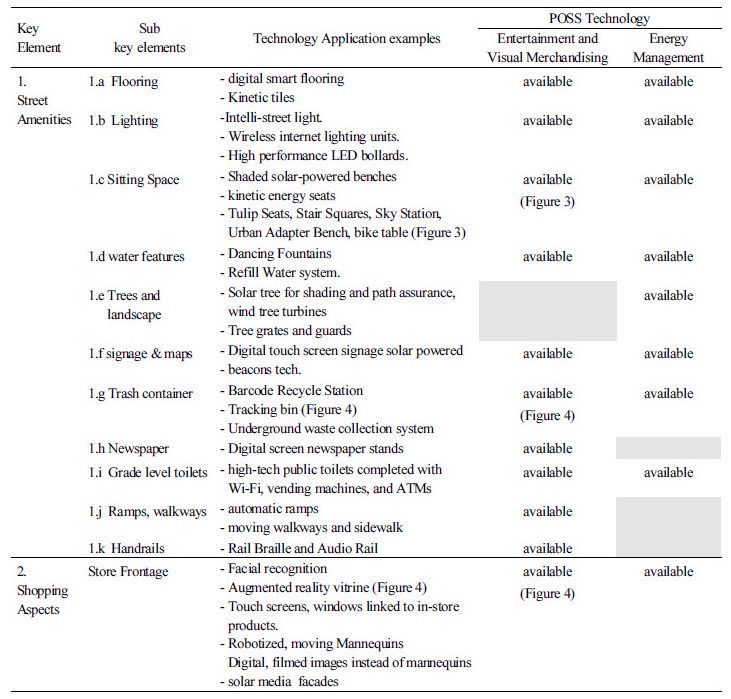
From all literature review, a correlation matrix is developed shows the possible advanced technologies implementations corresponding to Design of urban street elements (See Table 1).
Method
The Empirical study of this research relies on data collection through a combination of site visits, on-site observations, and user surveys. The case study city and corresponding POSS street selected was, Al-Shawarbi Street located in Cairo, Egypt.
The case study was chosen due to its pedestrian livability. As well as, its urban context has passed over different ages and changes in community and social demographics. In addition, the most significant change is that Al-Shawarbi Street has lost its resilience development and social sustainability. Case study site was visited between April- October 2017.
Al-Shawarbi Street
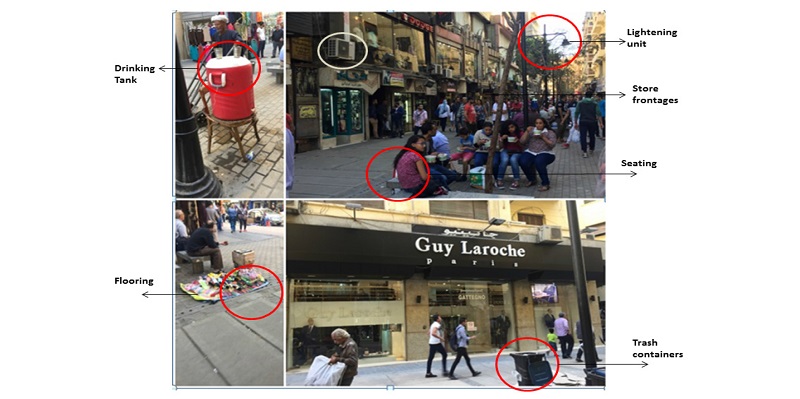
Al-Shawarbi Street is located in Cairo’s Downtown and is in the city’s heart. It was once one of the most famous pedestrian shopping malls in downtown Cairo. The situation changed in the early 1990s when street vendors occupied the sidewalks of the corridor to sell their goods. The original international brands of clothing disappeared. However, the selling and buying movements were still very popular. The street is now in a mess, due to street vendors occupying the sidewalks. To attract customers, a large number of shop owners spread their hidden goods on sidewalk seatings or in the pedestrian path. The street was developed before in 2011 but its effect was only in the form, organization, and cleanliness of the street, but with no economic benefit . Problems uncovered by a survey in Al-Shawarbi St. found that major inefficiencies were the result of low-quality street design elements, and a low sense of safety during the day and night (see Figure 6).
Survey
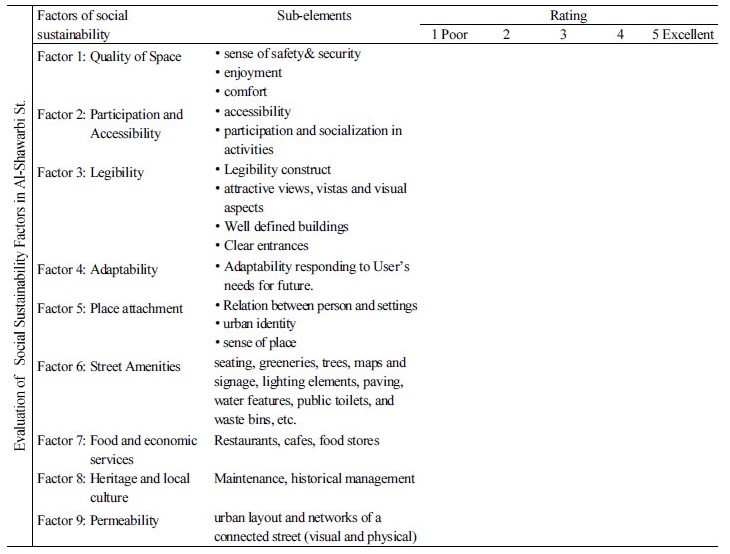
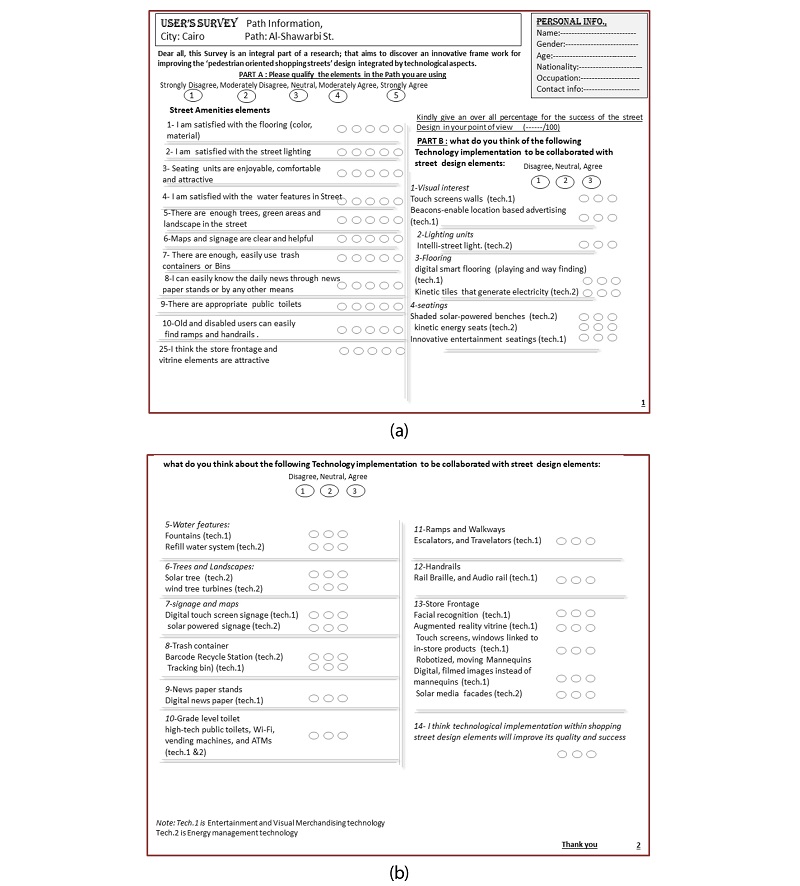
A survey, based on the previous literature review was performed, to determine why people stopped preferring Al-Shawarbi Street as a POSS anymore, identifying current social situation of the path, and to determine how far technology implementation, in Street amenities, would increase the social sustainability and resilience of POSS. The survey was divided into three sections; First rating Social sustainability factors in the street (Quality of Space, Participation & Accessibility, Legibility, Adaptability, Place attachment, Street Amenities, Food & economic services, Heritage &local culture, and Permeability), (see Table 2), Second is in-depth rating of factor (6) street amenities as a significant part of social sustainability, (see Figure 7a). Finally introducing technology imple-mentations for each of street amenities element, and ask users whether they agree on its importance or not as a future improvements (see Figure 7b). The survey included 100 users, with different nationalities (Egyptians, Americans, and others from Arab countries) who visited the street.
Table 1. The relation between possible technologies implementations corresponding to urban street amenities, and its design elements |
|
|
Figure 7. Case study user’s survey, rating the current status of the street and user’s acceptance for adding technologies. Source: Researchers, 2017. |
Results and Discussion
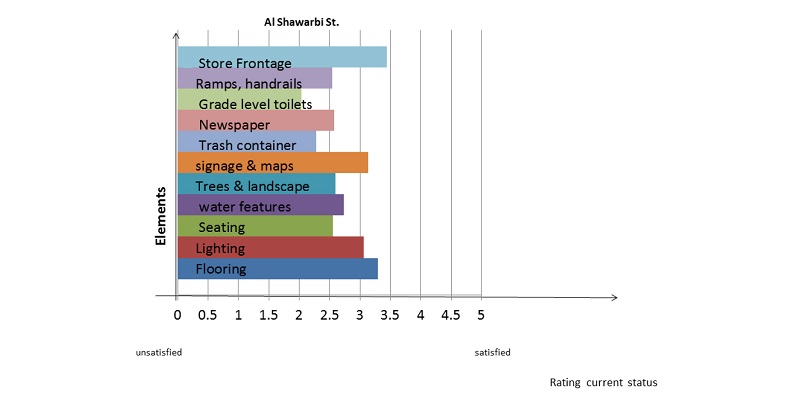
Primary results from collected data survey showed that overall success rate for Al-Shawarbi St. was average satisfactory with 62% success rate. The results clearly showed that elements that caused success for Al-Shawarbi Street are, Location and Urban form only, all the other design elements are not fulfilling user’s needs, those elements are (seating spaces, handrails, ramps, water features, trash containers, toilets, lighting, flooring etc.). Public toilets had the lowest rating due to its absence and users had to enter store’s toilets, followed by trash containers as there is only 2 ordinary baskets that are not enough for the path, on the other hand, users are quite satisfied with store frontages and flooring but they need water fountains or tanks (water features). Comparing these results to the results of the second part of the survey (technology implementation), we will find that there is a great demand for technology in public toilets by 97%, lighting 90%, signages 88%, while for flooring 82.6% approval. These results were quite convincing, as it approves users’ needs that we collected in the interviews. The following chart shows user’s satisfaction rate for each sub-element of the POSS’s street amenities (see Figure 8). These results are in line with Goal 11, Target 7 of the sustainable development goals ]. The POSS seems to provide universal access to safe, inclusive and accessible and public spaces, in particular for women and children, older persons and persons with disabilities.
|
Figure 8. User’s satisfaction Chart for each sub-element of POSS’s street amenities. Source: Researchers, 2017. |
One of the most important results of the survey was that 92.6% of users accept and prefer implementing technologies in POSS; accordingly, the main purpose of the analysis is to identify elements effect classification and to find effect of techniques on each element.
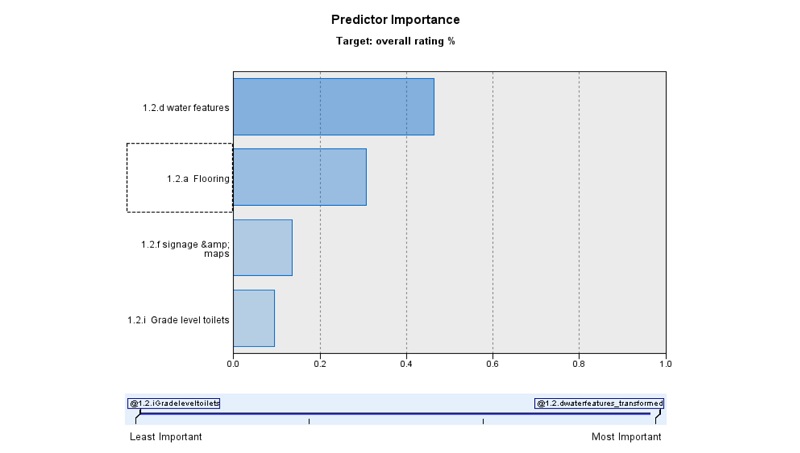
Statistical analysis was performed using SPSS. Linear models predict a continuous target based on linear relationships between the target and one or more predictors. As shown in (See Figure 9) illustrates the results of linear modeling using SPSS. The elements with significant contribution to users overall rating of the space include: water features, flooring, signage and grade level toilets. The most significant element was water features as it was responsible for 48% of users’ satisfaction with space, water feature main element was drinking fountains.
|
Figure 9. The results of linear modeling using SPSS indicates that elements with significant contribution to users overall rating of the space. Source: Researchers, 2017. |
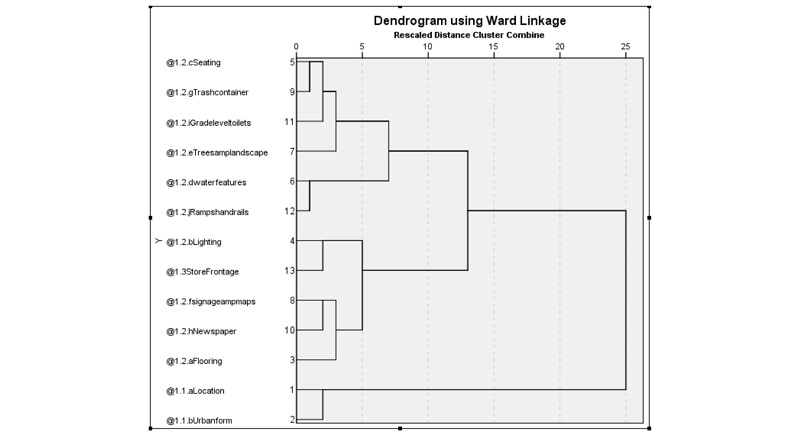
The results of hierarchical cluster analysis test using Ward’s method indicate that the elements that should be near to each other and the relationship between elements and their effect on each other as, (seating and trash containers), or (lightning and store frontage) etc. (see Figure 10). These findings agree with Filho et al. (2017) that creating liveable and social sustainable city depends on place making and rehabilitation of the public. In addition, the results are in agreement with Rodrigues (2010) because the services provided in the POSS increase pedestrian activity and decrease auto reliance.
|
Figure 10. Hierarchical cluster analysis using Ward’s method indicates the relationship between elements and their effect on each other. Source: Researchers, 2017. |
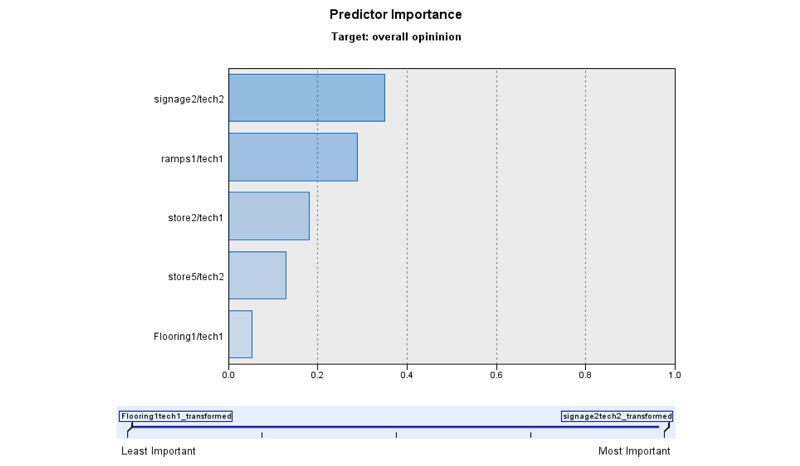
Linear modeling statistical test of prediction of users satisfaction of the visual interest of the Entertainment and Visual merchandising Technology (tech 1) revealed most significant elements are store frontage, newspapers, and Trees (see Figure 11). While for Linear modeling test of prediction for users overall opinion of the technologies showed that ramps, handrails, store frontage and flooring significantly affected users’ opinion regarding the entertainment and visual merchandising technology used. On the other hand, results show that signage and store frontage have significant impact on users opinion regarding the Energy management technology implementations (see Figure 12). It is believed that signage facilitates user navigation and way finding in the urban spaces. These facilities positively enhance the shopping experience and make them memorable as indicated by Childers et al. (2001).

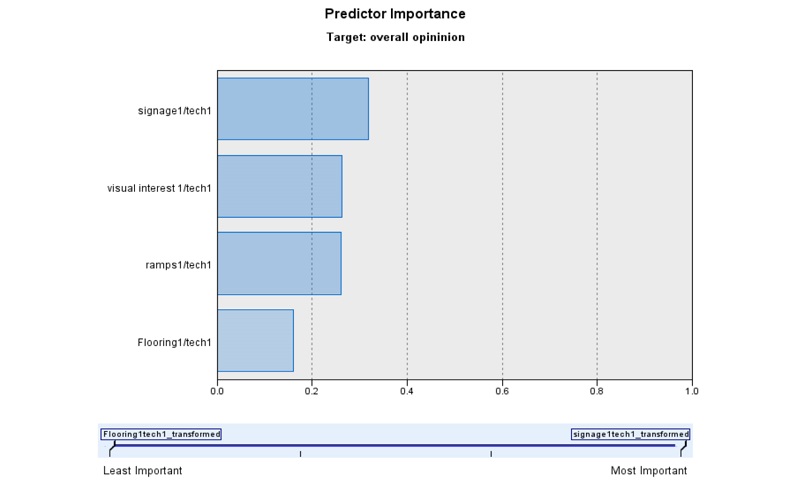
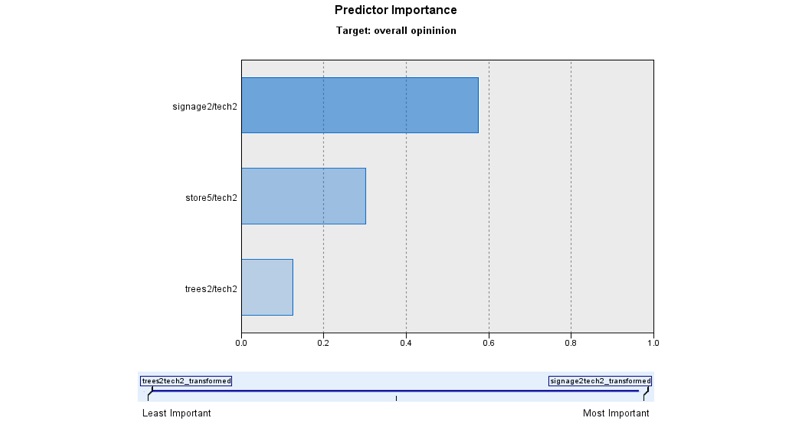
Linear modeling test of prediction of users overall opinion of Entertainment and Visual merchandising Technology revealed that signage, visual interest, ramps and flooring significantly affected users experience and impressions (See Figure 13). While for the Energy management technology, Linear modeling test of prediction of users overall opinion revealed that signage, stores, and trees significantly affected users experience and impressions. Signage contributed with 58% of the users’ satisfaction (see Figure 14). These results corroborate the idea of the research which emphasized the significance of technology implementation on POSS social sustainability. The results stress that incorporating technology can effectively enhance creativity connections and trust in a given community because it maximises the customer experience as illustrated in the high percentages of satisfaction.
Conclusion
Al-Shawarbi St. is just an example of POSS development marrying retail environments with technology as Entertainment and Visual Merchandising, which shows the significance of technology in thriving POSS. Adding categories of technology in Al-Shawarbi St. (e.g., water refill tanks, seating, trash containers) will solve many of the problems, enhance customer experience, therefore, increase its liveability and social sustainability. In addition, Cairo being such a vibrant city with many tourists will certainly benefit from such implementations.
This research argues that technology is one of the major factors that are incredibly important in making POSS work well, currently. Results showed that it could be thoroughly applied in urban street amenities as establish an important factor for social sustainability. Further research might look at new ways in which other pillars can improve city liveability. In order to improve the Social sustainability of Pedestrian Oriented Shopping Street (POSS), several factors should be taken into consideration, while for increasing its liveability and success four pillars should be taken into consideration. The most crucial dimension is the Design pillar, emphasizing street amenities as a common factor, was the core of our study. Two categories of technology were selected and implemented as demonstrated in the illustrated examples. Subsequently, urban street amenities were linked to two types of applicable technology, formulating a proposed framework, and a survey that was applied to Al-Shawarbi St. located in Egypt, to prove its credibility. The overall agreement between the literature review and the empirical study supports the idea of implementing technologies in POSS.
Technology implementation in street life deserves more attention, and further research dealing with other pillars of POSS success will be very useful, for future case studies. Finally, technology can be an effective tool utilized by urban designers to improve social sustainability of Pedestrian Oriented Shopping Streets.

