


Introduction
Literature Review
Methodology
Research design and case screening
Analysis of national guidance and approval documents
Requirement level and requirement structure analysis
Results of Case Screening and Requirement Analysis
Case screening results and classification of operating mechanisms
Results of requirement identification and requirement level analysis
Results of Cross-country Requirement Structure Analysis
Proposal of a Function-based and Type-adaptive Procurement Document Framework for Modular Housing
Principles for structuring the framework
Priorities for document structuring by operating type
Proposed procurement document structuring framework
Illustrative application to the LH Design–Build Tender Guide
Discussion and Conclusion
Introduction
Recently, modular construction has emerged as a response to structural limitations in the construction industry, including declining productivity and a shortage of skilled labor [1, 2, 3, 4, 5, 6, 7]. Through factory-based production, modular construction offers the potential to improve project outcomes by reducing construction time and enhancing quality [6, 7, 8, 9]. However, the realization of these benefits depends heavily on the integration of the design, manufacturing, transportation, and assembly stages [5, 8, 10]. When collaboration is insufficient, redesign and schedule delays may occur, and the expected gains in quality assurance may be undermined [11, 12, 13]. In particular, modular housing must simultaneously satisfy a wide range of performance requirements, including not only structural safety but also thermal insulation, waterproofing, airtightness, fire resistance, and building services integration, making integrated management across the entire process even more critical [14, 15, 16, 17]. The technical and managerial conditions required to achieve these multidimensional performance objectives and inter-stage integration should therefore be defined as explicit project requirements at an early stage of the project [18, 19, 20]. As a result, early- stage procurement requirements serve as a critical baseline for ensuring consistency throughout subsequent delivery stages [8, 10, 18, 19, 20].
However, procurement requirements for modular housing are not consolidated into a single document; rather, they are dispersed across multiple categories of documents depending on each country’s procurement and approval structure [21, 22, 23, 24, 25]. Even in cases such as Singapore, where procurement criteria are relatively well systematized, technical guidance and manufacturer certification schemes remain fragmented, requiring practitioners to undertake substantial efforts to integrate and interpret this information when translating it into bidding strategies [21, 22, 23]. Moreover, differences in national procurement and approval systems, as well as in document organization, cause requirements to be scattered across multiple document groups, making it difficult to interpret and classify them consistently across functional areas such as design, manufacturing, transportation and installation, and project management [21, 22, 23, 24, 25, 26, 27]. In this process, omissions or ambiguous definitions of requirements can lead to frequent changes during the design and manufacturing stages and delays in approval, thereby undermining the economic feasibility of projects [11, 28, 29, 30]. Therefore, there is a need for a strategic framework that supports the identification of both standard and project-specific requirements and guides the systematic structuring of procurement documents [20, 26, 27, 32, 33].
Nevertheless, existing research on modular construction has largely focused on project performance- related variables such as cost, schedule, risk, and supply chain management [7, 8, 11, 28, 30, 31]. In contrast, discussion of how requirements are structured and organized at the early procurement stage remains relatively limited [18, 20, 26, 27, 32, 33]. Existing studies on client requirements and procurement documents have likewise concentrated primarily on the difficulties of requirement management and the evaluation of document quality [18, 19, 20, 26, 27, 34, 35]. More recently, some attempts have been made to structure the constituent elements of requirements [32, 33], but these efforts remain largely exploratory and are primarily concerned with conceptually organizing the structure of client requirements. However, previous studies have not sufficiently addressed how modular- related requirements dispersed across national guidance, approval, certification, and assessment documents can be reorganized into functional sections of procurement documents. To address this gap, this study aims to develop a function-based and type-adaptive framework for structuring procurement documents for modular housing. Specifically, it identifies countries with established modular-related document systems, classifies their operating mechanisms, extracts and reclassifies requirements into the functional domains of design, construction, construction management, and submission and evaluation, analyzes differences in functional concentration and requirement intensity, and proposes a document-structuring framework that adjusts the level of detail of specific blocks according to operating type.
Literature Review
Client requirements in construction projects have been understood as core information that defines project objectives, performance levels, quality expectations, constraints, and priorities. Kamara et al. (1999), Kamara et al. (2002), and Yu et al. (2010) explained that such requirements should be systematically identified, organized, and managed at the early stage of a project and treated as a structured body of information that guides subsequent decision-making. While these studies established the theoretical importance of defining and managing early-stage requirements, they paid relatively limited attention to how such requirements should later be translated into the actual structure of procurement documents.
Related studies have also discussed how identified client requirements are communicated to and interpreted by designers and subsequent project participants. Kamara et al. (2001) emphasized the need for briefing in projects that require early multi-party collaboration in order to facilitate the sharing and coordination of client requirements, while Ryd (2004) described the design brief as a key medium for conveying the client’s expectations, priorities, and project conditions to designers in a structured manner. Although these studies clarified the communicative function of briefing, they did not provide sufficient guidance on how communicated requirements should subsequently be operationalized into function-specific document structures in actual procurement practice.
The importance of defining early-stage requirements becomes even more pronounced in modular and off-site construction (OSC) projects. Wuni and Shen (2020), Hwang et al. (2018), Hyun et al. (2022), Jin et al. (2018), and Lim et al. (2022) described modular projects as integrated production systems in which design, manufacturing, transportation, and installation are tightly interconnected, and argued that early-stage decision- making directly affects manufacturability, transportability, installation strategies, and interface coordination. These studies suggest that client requirements in modular projects need to be defined in a more proactive and integrated manner than in conventional construction. However, they likewise do not provide a direct framework for organizing these expanded requirements within the structure of actual procurement documents.
Meanwhile, some studies have suggested that client requirements must ultimately be translated into documentable conditions within procurement and approval systems. Yu et al. (2010), Collinge (2017), Eriksson (2017), Govender et al. (2022), Siyi et al. (2023), and Hassan and Le (2021) showed that project requirements should be operationalized through formal document structures such as procurement strategies, technical specifications, bid evaluation criteria, and contract conditions. In addition, practical documents such as the New York State Department of State guidelines, the Singapore BCA guidelines, and the UK NHBC System Review illustrate how such requirements are materialized in the form of technical requirements, submission documents, review procedures, approval conditions, and quality assurance systems. Nevertheless, neither academic studies nor practical documents have sufficiently presented a methodology for reconstructing requirements dispersed across national systems and document groups into a comparable function-based structure. These limitations of previous studies and the corresponding focus of this study are summarized in Table 1.
Table 1.
Limitations of previous studies and the focus of this study
Accordingly, although previous studies have accumulated discussions on the importance of client requirements, the need for their communication, the significance of early integration in modular projects, and the necessity of documentation, they have not adequately addressed how to typologize differences in national institutional operating mechanisms and reconstruct dispersed requirements according to procurement document functions so as to provide a practical framework for document structuring. To address this gap, this study analyzes national operating types and the requirements identified in national reference documents and proposes a framework for determining what content should be incorporated into each functional area of procurement documents when procuring modular projects.
Methodology
This study employed a qualitative document analysis to reconstruct the requirements involved in procuring modular housing from the perspective of procurement document structuring. Rather than directly comparing document titles across countries, the analysis focused on how modular-related systems operate through specific institutional mechanisms and how relevant requirements are articulated in national documents. To this end, countries with modular-related systems were reviewed, the operating structures of selected cases were typologized, and the requirements identified in national modular-related documents were extracted and classified according to procurement document functions. In addition, the level of each requirement and the functional concentration of requirements across countries were examined, and a quadrant analysis was conducted on this basis. This approach was intended to establish a function-based analytical framework that could inform the preparation of procurement documents in practice, beyond differences in national systems and document formats. In this study, several analytical terms are used to clarify the comparison of national requirement structures. An operating mechanism refers to the institutional way in which modular-related requirements are established, reviewed, approved, certified, and enforced in each country. A functional block refers to a major procurement document function used to organize requirements, namely design, construction, construction management, and submission and evaluation. A document regime refers to the structural pattern through which a national document system organizes and operationalizes requirements across these functions. A regulatory mode refers to the degree and manner in which requirements operate as recommendations, obligations, submission or review conditions, approval criteria, certification requirements, or conformity assessment conditions.
Research design and case screening
This study was designed as an exploratory investigation aimed at reconstructing modular-related requirements presented in national reference documents according to procurement document functions. The analytical procedure consisted of the following stages: review of candidate countries, comparison of operating mechanisms, selection of national modular-related documents, extraction of requirements, functional classification, requirement-level analysis, and quadrant analysis. Through this process, the study examined how differences in national operating systems and document structures are reflected in the composition of requirements and integrated the findings from the perspective of procurement document preparation. Candidate countries were reviewed based on three criteria: experience in operating modular or off-site construction (OSC)-related systems, the availability of technical requirements, submission requirements, and approval procedures in documentary form, and the comparability of operating mechanisms. National institutional structures were compared in terms of the bodies responsible for setting standards, the administration of approval procedures, and the role of warranty and certification systems. Based on this comparison, the operating structures of the selected countries were typologized and used as an interpretive framework for the subsequent document analysis. The review of operating mechanisms focused not on document titles themselves, but on how each system establishes, reviews, and approves requirements in practice.
Analysis of national guidance and approval documents
The final document set consisted of national modular- related guidance, certification, accreditation, approval, and assessment documents from the six retained countries. For Singapore, the analyzed documents included waterproofing accreditation documents, PPVC-related guidance and accreditation materials, IDD requirements, and public sector standard contract conditions [36, 37, 38, 39, 40, 41, 42, 43, 44, 45, 46]. For the United Kingdom, building regulation documents, BOPAS guidance, NHBC standards, and MMC-related guidance were included [47, 48, 49, 50, 51, 52]. For the United States, HUD manufactured housing regulations and New York State modular building approval-related documents were included [53, 54, 55, 56, 57]. For Hong Kong, MiC- related practice notes, appendices, and submission requirements were analyzed [58, 59, 60, 61]. For New Zealand, the BuiltReady scheme rules, whole-building guidance, modular component guidance, and scheme guidance were analyzed [62, 63, 64, 65]. For Australia, ABCB handbooks and CodeMark-related materials were analyzed [66, 67, 68, 69].
The analysis focused not on project-specific procurement documents, but on national modular-related reference documents. Accordingly, the materials were selected from three main categories: technical standards or guidance documents, certification and assessment documents, and approval and submission requirement documents. Technical standards or guidance documents include criteria and guidelines related to design, performance, manufacturing, and construction. Certification and assessment documents include requirements related to conformity assessment, quality review, and certification systems. Approval and submission requirement documents include documents required during institutional operation, such as submission drawings, review procedures, and approval conditions. This categorization was intended to compare how national reference documents present and operate requirements, even when document titles and formats differ across countries. The unit of analysis was defined not as the document itself, but as requirement statements or items within each document. Accordingly, the study identified statements that require project participants to perform or provide actions related to performance, design considerations, construction execution, management procedures, assessment and approval, and submission. By contrast, descriptive content that did not contain direct requirements, such as background explanations or general institutional descriptions, was excluded. Repetitive items with similar meanings were consolidated where appropriate, but retained separately when their scope of application or required function differed. Through this process, dispersed requirements contained in national reference documents were reorganized into a comparable analytical dataset. The extracted requirements were classified not by document title or national procedure, but by the functions they perform in procurement document preparation. The functional categories were defined as design, construction, construction management, and submission and evaluation. Design includes requirements related to spatial planning, performance criteria, system configuration, and interface conditions. Construction includes requirements directly related to implementation stages such as manufacturing, transportation, and installation. Construction management includes requirements associated with project operation, such as scheduling, quality management, coordination among participants, and allocation of responsibilities. Submission and evaluation includes not only requirements related to conformity assessment, review, certification, and regulatory approval, but also documents required in approval procedures, such as drawings, calculations, test reports, and certificates. This classification was intended to reinterpret the requirements presented in national reference documents from the perspective of procurement document preparation.
To enhance the consistency and reliability of requirement extraction, a coding protocol was established before the full analysis. In this study, a requirement statement was defined as a sentence, clause, checklist item, or document item that explicitly required project participants to perform an action, submit evidence, satisfy a performance condition, undergo review, or demonstrate conformity. By contrast, descriptive explanations, background information, and general institutional descriptions without direct operational implications were excluded from the dataset. The coding process was conducted in three stages. First, potentially relevant requirement statements were extracted from the selected national reference documents. Second, the extracted statements were reviewed and classified according to the four predefined procurement document functions: design, construction, construction management, and submission and evaluation. Third, overlapping or repetitive statements were consolidated when they had the same functional meaning, while statements were retained separately when they differed in scope, project stage, required evidence, or institutional function. Ambiguous cases were reviewed iteratively based on the coding protocol. In particular, when a requirement could be assigned to more than one functional category, its primary procurement function was used as the classification criterion. For example, a statement concerning inspection during factory production was classified as construction management when it mainly concerned quality control procedures, whereas it was classified as construction when it mainly concerned production or installation execution. This procedure was intended to reduce subjective interpretation and ensure that the extracted requirements were consistently reorganized according to their procurement document functions. To further clarify the coding procedure, additional criteria were applied for separating, consolidating, and classifying requirement items. When a single statement contained multiple requirements, it was separated if the required action, project stage, evidence, or procurement function differed. Similar statements were consolidated when they had the same functional meaning, but retained separately when they differed in scope, responsible party, required evidence, or linkage to approval and certification procedures. Requirement levels were assigned according to the degree of obligation and institutional linkage: Level 3 for general obligations, Level 4 for obligations linked to submission, review, inspection, or reporting, and Level 5 for requirements directly linked to approval, certification, qualification, conformity assessment, or acceptance decisions. Representative examples are provided in Table 2.
Table 2.
Examples of requirement coding
Requirement level and requirement structure analysis
Requirement level was analyzed based on the degree of stringency and mandatory force with which each requirement was presented in national reference documents. Specifically, the analysis examined whether a requirement was framed as a simple recommendation, as an obligation requiring compliance or submission, or as a condition directly linked to assessment and approval, and used this as the basis for determining its relative level. This made it possible to distinguish, even within the same functional category, between requirements more strongly emphasized in institutional operation and those playing a relatively supporting role. Requirement-level analysis considered the strength of wording used in national documents, the degree of obligation attached to submission or review, and the extent of linkage to approval procedures. Quadrant analysis was applied to interpret national requirement structures by considering both functional concentration and requirement intensity. Functional concentration refers to the relative proportion of requirements assigned to the four functional categories: design, construction, construction management, and submission and evaluation. Requirement intensity refers to the proportion of high-level requirements, defined as Level 4 and Level 5 items, among the identified requirements. In this study, Level 4 and Level 5 requirements were treated as high-intensity requirements because they were directly linked to specific submission, review, approval, certification, conformity assessment, or qualification procedures. By combining functional concentration with the Level 4+5 ratio, the analysis identified how each national document regime emphasized particular procurement document functions and how strongly those functions were operationalized as requirements. This quadrant analysis was used not as a statistical ranking method, but as an interpretive tool for comparing national document regimes. It supported the classification of countries into different document regime types, such as integrated management-oriented, design–warranty, procedure- and evidence-intensive, approval- and evidence-centered, and execution- and evidence-centered regimes. This quadrant interpretation was not based on strict numerical thresholds, but on relative comparison across countries using the two dimensions.
Results of Case Screening and Requirement Analysis
Case screening results and classification of operating mechanisms
To identify comparative cases applicable to the structuring of procurement documents for modular housing, this study searched national modular-related documents using the primary keywords modular, PPVC, MiC, offsite construction, modular housing tender, and modular housing specification. Supplementary keywords such as prefabricated housing, industrialised/industrialized construction, factory-built housing, modern methods of construction (MMC), and serial and modular construction were added to account for cross-national differences in institutional terminology. This process produced an initial long list of 11 countries: Singapore, Hong Kong, the United Kingdom, New Zealand, Australia, the United States, Germany, Sweden, the Netherlands, Canada, and South Korea. The search keywords and identified countries are presented in Table 3.
Table 3.
Search keywords and countries identified in the initial screening
The countries in the long list were then screened based on the directness of public institutional systems for modular housing, the identifiability of requirements, the direct relevance to public and residential projects, and the feasibility of cross-national comparison. As a result, six countries—Singapore, Hong Kong, the United Kingdom, New Zealand, Australia, and the United States—were retained as the final comparative cases. Germany was excluded because its documents were judged to be more policy- and framework-oriented than directly linked to approval, assessment, and warranty documentation. South Korea, Sweden, the Netherlands, and Canada were excluded because their national-level modular housing operating systems were relatively weak or their requirements were not sufficiently identifiable for functional reclassification.
The six retained countries were grouped into three operating types. Singapore and Hong Kong were classified as central regulatory authority-led systems, in which central regulatory bodies directly lead standard setting and conformity recognition or pre-approval procedures. The United Kingdom and New Zealand were grouped as certification-, warranty-, and conformity-centered systems, in which warranty, insurance, or certification systems play a central role in determining technical conformity. Australia and the United States were classified as national framework with subnational approval implementation systems, in which national-level standards or guidelines exist but approval and enforcement are strongly shaped by subnational systems. This classification provides the interpretive basis for the following comparison of requirement structures. The screening results and operating-type classification are summarized in Table 4.
Table 4.
Screening results and classification of identified countries
Results of requirement identification and requirement level analysis
Requirements identified from national modular- related reference documents were reorganized into four functional categories: design, construction, construction management, and submission and evaluation. Where a sentence or paragraph contained multiple requirements, these were separated into distinct requirement items. Requirement levels were assigned on a five-point scale based on wording strength and the degree of linkage to submission, review, approval, assessment, certification, or qualification decisions.
A total of 281 requirement items were identified for Singapore, 103 for the United Kingdom, 74 for the United States, 71 for Hong Kong, 64 for New Zealand, and 52 for Australia. The relatively large number of requirement items identified for Singapore should be interpreted in relation to the scope and structure of the analyzed document set, rather than as a simple indication that Singapore imposes more requirements than other countries. Singapore’s document system includes multiple interrelated materials covering PPVC acceptance, manufacturer accreditation, CORENET X submission procedures, waterproofing accreditation, precaster accreditation, IDD requirements, and public sector contract conditions. As a result, requirements related to design, production, quality management, approval response, and submission are articulated across several document groups and were therefore identified as separate requirement items. By contrast, some countries present modular-related requirements through more concentrated certification, approval, or guidance documents, resulting in fewer separately identifiable requirement statements. Therefore, cross-country differences in the number of identified requirements reflect not only differences in regulatory intensity, but also differences in document volume, institutional fragmentation, document granularity, and the way requirements are expressed in national reference documents. For this reason, the comparative analysis focuses on the relative distribution of requirements by function and requirement level, rather than on the absolute number of requirement items identified in each country. As shown in Figure 1, Singapore showed the strongest concentration in construction management and submission and evaluation requirements, whereas the United Kingdom showed a relatively high proportion of design requirements. New Zealand exhibited an overwhelming concentration of submission and evaluation requirements, while Australia showed relatively strong concentrations in construction and submission and evaluation. In the United States, submission and evaluation accounted for the largest share, and Hong Kong likewise showed a relatively strong concentration in submission and evaluation together with design.
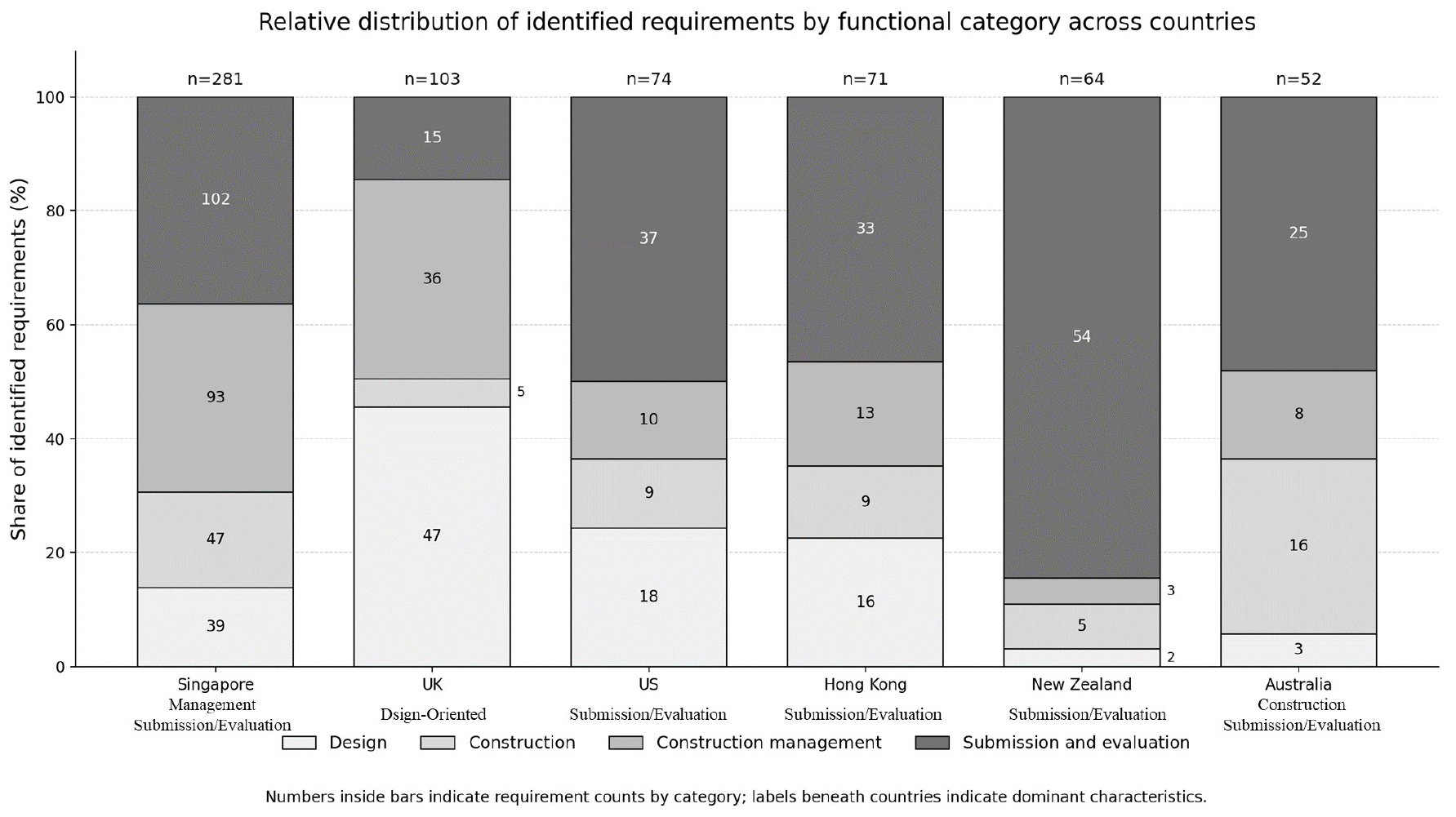
The identified requirements also reflected the characteristics of national document systems. In the design category, recurring items concerned structural and non-structural performance, module interface conditions, building services integration, and design conditions reflecting manufacturing, transportation, and installation. In the construction category, recurring items concerned factory production procedures, transportation planning and protection, lifting, installation sequence, assembly conditions, and on-site connections. In construction management, recurring items included quality management plans, inspection and testing, traceability, role allocation, and inter-stage coordination and approval management. In submission and evaluation, recurring items centered on drawings, calculations, test reports, certificates, qualification evidence, conformity assessment materials, and approval application documents used to demonstrate conformity and support approval procedures. Together, these patterns point to a common functional logic for procurement document preparation despite differences in national document systems. The functional distributions shown in Figure 1 also reflected differences in operating mechanisms. In Singapore and Hong Kong, submission and evaluation requirements directly linked to approval and conformity recognition were particularly prominent. In the United Kingdom, design requirements were relatively more prominent because technical, performance, and warranty acceptance structures were closely tied to the design stage In New Zealand, submission and evaluation dominated because the BuiltReady system centers on certification, registration, certificate use, and building consent support, all of which require evidence-based submission and review procedures. In Australia, construction as well as submission and evaluation were relatively prominent because conformity demonstration and supporting evidence are central to approval and enforcement.
Differences were also observed in requirement-level distributions. As shown in Table 5, Singapore exhibited broad distributions at Levels 3 and 4, indicating a structure combining general and specific obligations.
Table 5.
Distribution of identified requirements by country and requirement level
The United States showed the largest share of Level 5 items, suggesting strong linkage to approval, certification acceptance, and conformity demonstration.
The United Kingdom displayed a relatively even spread from Levels 2 to 5, indicating a mixed structure of recommendations, general obligations, and warranty- or certification-linked requirements.
Hong Kong was centered on Levels 3 and 4, New Zealand on Level 4, and Australia on Level 3 with a substantial number of Level 5 items. Overall, these findings show that national reference documents differ not only in the number of identified requirements, but also in their functional structure and normative intensity.
Results of Cross-country Requirement Structure Analysis
National reference documents exhibited different requirement structures in both functional composition and requirement-level distribution. These differences reflect not merely descriptive variation, but distinct document regime types and regulatory modes of operation. Even when national modular-related documents address similar themes, they differ in which functions are placed at the center of the document system and the level at which those functions are operationalized as requirements.
From the perspective of functional distribution, three broad types of document regimes can be identified. First, New Zealand exhibited a procedure- and evidence- intensive document regime, characterized by a high concentration in submission and evaluation functions, with requirements organized mainly around certification, consent support, and submission procedures. Second, Singapore showed an integrated management-oriented document regime, in which design, construction, construction management, and submission and evaluation were distributed relatively broadly, combining approval response, manufacturing, installation, quality management, and operational control within a single structure. Third, the United Kingdom, the United States, Australia, and Hong Kong can be interpreted as hybrid document regimes, in which one function is dominant but multiple functions are structured together. Within this hybrid type, however, the dominant emphasis differed: design in the United Kingdom, submission and evaluation in Hong Kong, construction together with submission and evaluation in Australia, and approval- and conformity-demonstration in the United States. These findings indicate that national document regimes differ not only in the quantity of requirements, but also in the arrangement and emphasis of functions.
Figure 2 shows both the proportion of each functional category by country and the relative concentration of each function, clarifying cross-country differences in functional emphasis. It highlights the prominence of design in the United Kingdom, submission and evaluation in New Zealand, and construction management together with submission and evaluation in Singapore, while the Level 4+5 ratio indicates the extent to which each national document regime contains high-intensity requirements.
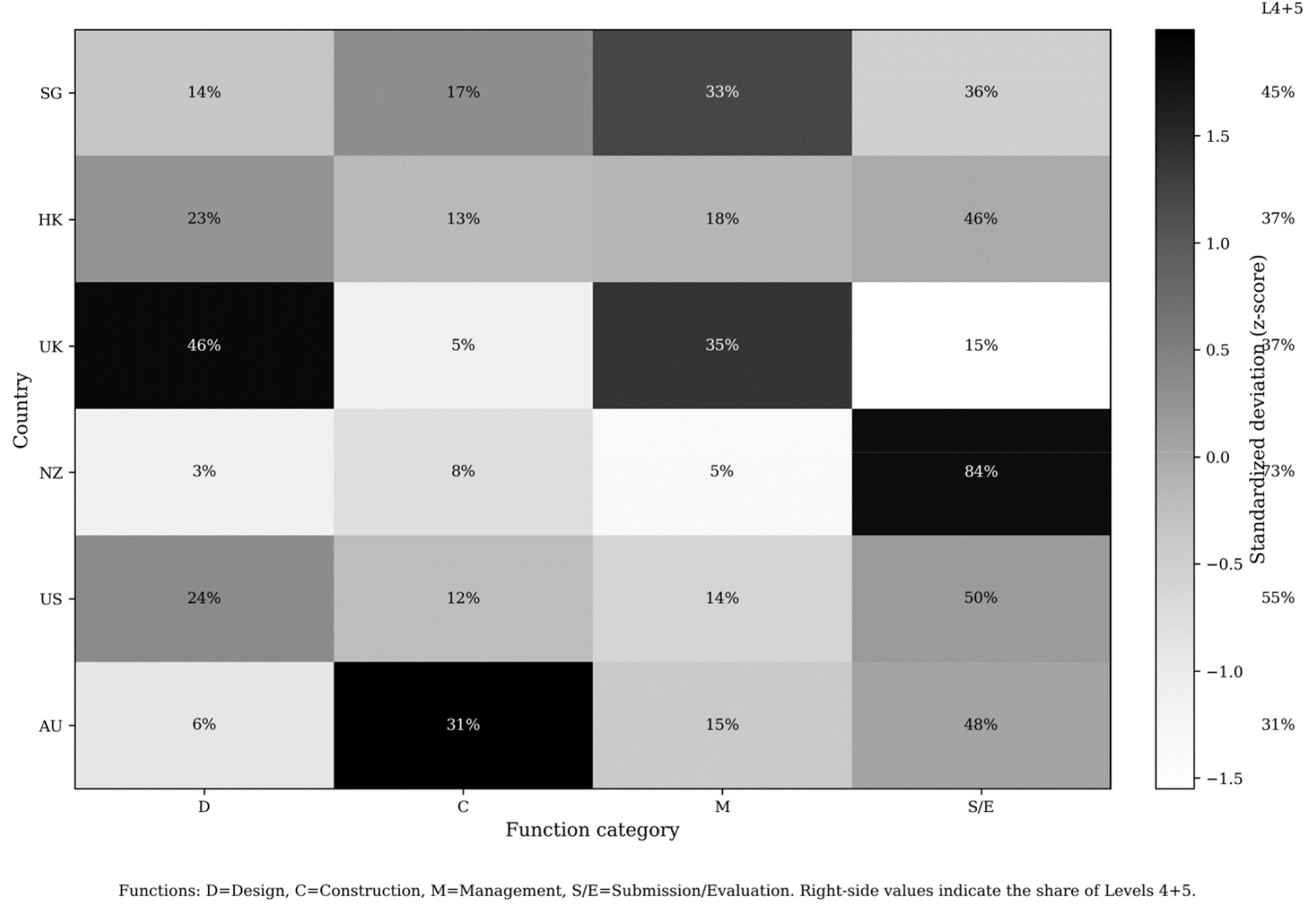
In interpreting Figure 2, functional concentration refers to the relative share of each procurement document function within each country, while requirement intensity refers to the proportion of Level 4 and Level 5 requirements. These levels were treated as high- intensity requirements because they are linked to submission, review, approval, certification, conformity assessment, or qualification decisions. Accordingly, the country types were interpreted through relative comparison of dominant functional categories and Level 4+5 ratios, rather than through strict numerical thresholds.
From the perspective of requirement-level distribution, national document regimes also differed in their regulatory modes. New Zealand showed a high concentration at Level 4 and can therefore be interpreted as exhibiting a procedure-linked regulatory mode, in which requirements operate mainly through submission, review, certificate use, and consent linkage. The United States showed the largest share of Level 5 requirements, reflecting an approval- and conformity-demonstration-linked regulatory mode in which requirements function directly as grounds for approval and certification acceptance. Singapore showed a broad spread across Levels 3, 4, and 5, consistent with a multi-layered normative mode in which general obligations, specific obligations, and approval-linked requirements coexist. The United Kingdom exhibited a hybrid normative mode, Hong Kong an obligation–submission-linked mode, and Australia a dual operating mode in which general obligations coexist with conformity-demonstration requirements. Thus, requirement- level distribution reveals not only what national documents require, but also how those requirements are operationalized institutionally.
The relationship between operating types and requirement structures further supports this interpretation. In central regulatory authority-led systems, submission and evaluation together with construction management are prominent, indicating a document regime in which approval response is combined with operational control. In certification-, warranty-, and conformity-centered systems, submission and evaluation remains central, while design is also systematically structured, indicating that design conformity is closely linked to certification and warranty systems. In national framework with subnational approval implementation systems, submission and evaluation remains a common core, while construction accounts for a relatively larger share, indicating that implementation-stage conformity and supporting evidence are particularly important in approval and enforcement processes. Operating type should therefore be understood not merely as a classificatory device, but as an interpretive framework for explaining which functions are prioritized and how strongly requirements are operationalized.
Table 6 summarizes these findings using the concepts of document regime and regulatory mode. Taken together, the results show that national modular-related documents are not merely isolated institutional cases or inventories of requirements, but structured systems that differ in both functional emphasis and normative operation. Despite country-specific differences in wording and institutional format, a comparable logic of document structuring can be identified at the functional level. Submission and evaluation emerged as a consistently important function across all countries and operating types, whereas the relative structuring of design, construction, and construction management varied according to document regime type and regulatory mode. These findings provide the basis for the function-based procurement document framework proposed in the following section.
Table 6.
Interpretation of document regime types and regulatory modes by country
Proposal of a Function-based and Type-adaptive Procurement Document Framework for Modular Housing
Principles for structuring the framework
The findings of the previous section showed that, although national modular-related documents differ in detailed wording and institutional format, they share a comparable logic of document structuring at the functional level. In particular, the identified requirements could be consistently reorganized into four functional categories: design, construction, construction management, and submission and evaluation. Cross-country differences were observed primarily in terms of which functions were relatively emphasized and the degree of intensity with which requirements operated. This suggests that procurement documents for modular housing should be structured not by listing country-specific requirements in parallel, but by organizing them around functional blocks.
The framework proposed in this study provides a document-structuring logic for organizing procurement documents according to functional blocks and operating type-specific emphasis. Accordingly, procurement documents are structured into four functional blocks—design, construction, construction management, and submission and evaluation—each of which can be implemented as an independent document section or a major chapter. Among these, submission and evaluation was repeatedly identified as an important function across national reference documents. In this framework, submission and evaluation serves as a functional block for linking design, construction, and construction management requirements to the evidence needed for review, conformity assessment, and approval. By contrast, the design, construction, and construction management blocks are retained as common structural components, while their level of detail and degree of emphasis are adjusted according to operating type. Therefore, this study proposes a function-based, type-adaptive structuring framework that adopts four common functional blocks as its basic structure while incorporating operating type-specific principles of emphasis.
Priorities for document structuring by operating type
The analysis by operating type showed that, although the same four functional blocks are required in all cases, the extent to which each block should be elaborated within the document differs by operating type. In central regulatory authority-led systems, submission and evaluation as well as construction management were found to be relatively important. This is because not only approval response and conformity recognition procedures, but also quality management and implementation control, are structurally embedded in the document system. Accordingly, in this type, the construction management block should be described in greater detail, while requirements related to approval response should be reflected separately in a manner appropriate to the relevant operating environment.
In certification-, warranty-, and conformity-centered systems, the design block appeared relatively more important alongside submission and evaluation. In this type, design conformity serves as a key basis for the acceptance of warranty, insurance, or certification. It is therefore necessary to structure in detail those design requirements related to structural and non-structural performance, interfaces, system integration, and design conditions that take manufacturing, transportation, and installation into account. Accordingly, in this type, the subcomponents of the design block should be expanded, while matters related to conformity demonstration should be managed as separate submission requirements.
In national framework with subnational approval implementation systems, submission and evaluation remains a common core function, while the construction block appears relatively more important. This reflects the fact that, in actual approval and enforcement processes, the conformity of implementation stages—such as manufacturing, transportation, installation, and on-site assembly—becomes a major object of review, and the submitted materials are likewise organized to demonstrate conformity at these stages. Accordingly, in this type, the construction block should be described in greater detail, and matters related to implementation-stage conformity should be presented more explicitly within construction requirements. In summary, although submission and evaluation remain a core function across all three operating types, central regulatory authority-led systems require relatively greater emphasis on construction management, certification-, warranty-, and conformity-centered systems on design, and national framework with subnational approval implementation systems on construction.
To clarify the substantive meaning of the proposed framework, Table 7 presents the common functional blocks together with their relative emphasis by operating type and the illustrative contents that may be incorporated into each block. Table 7 shows how the proposed framework retains a common four-block structure while varying the degree of elaboration assigned to each block according to the operating environment. In this way, the framework can be understood not only as a formal structuring principle, but also as a content-oriented guide to what should be more fully specified in procurement documents under different national operating conditions.
Table 7.
Operating type-specific emphasis and illustrative contents of the proposed procurement document framework
Proposed procurement document structuring framework
Table 8 presents how the proposed framework can be translated into an actual procurement document structure by organizing requirements into four common functional blocks and adjusting the level of detail of specific blocks according to operating type.
Table 8.
Example of a type-adaptive procurement document structure
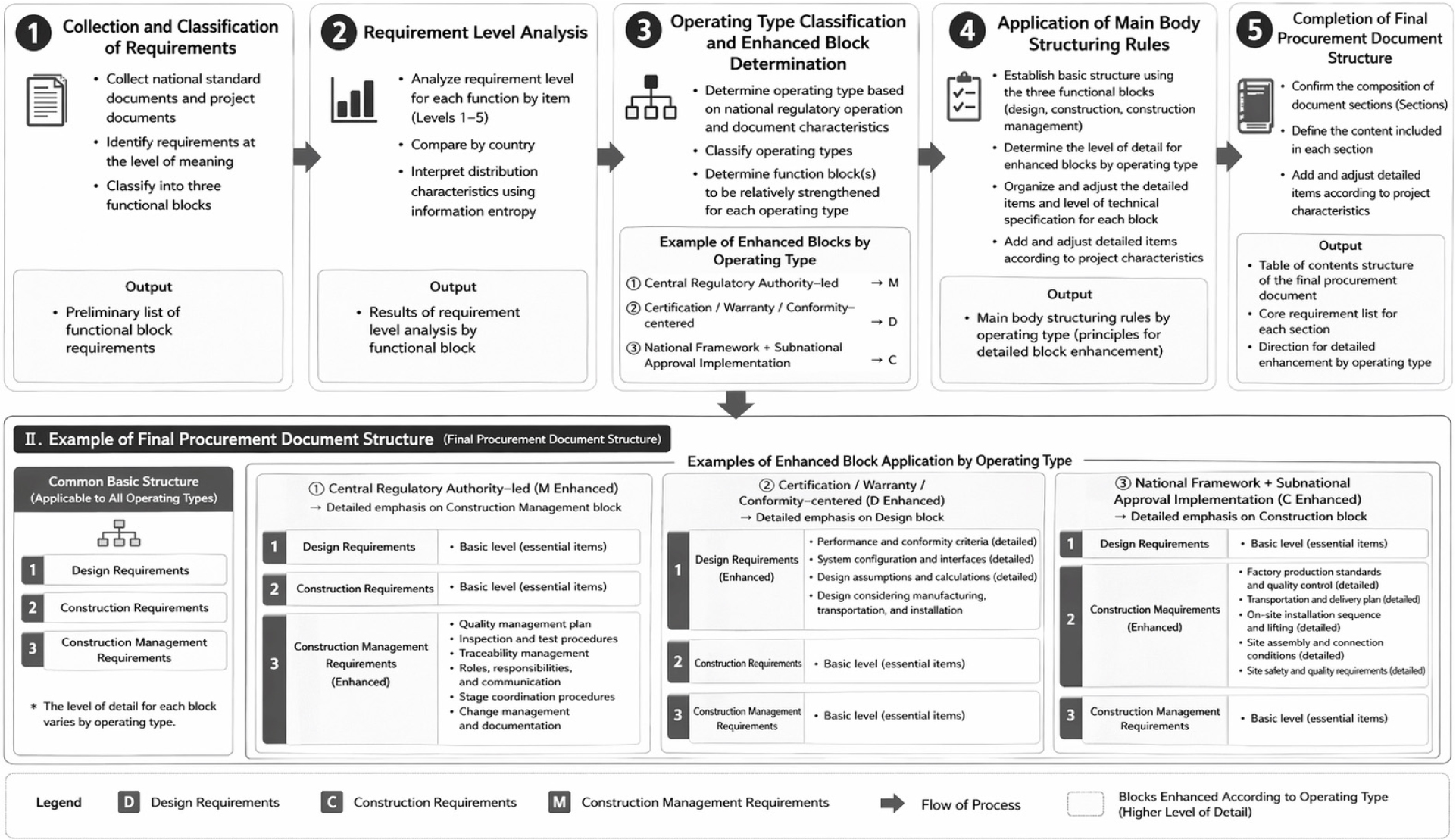
The structure presented in Table 8 is an application example that combines a common structure with type- specific enhancement principles. Accordingly, when preparing actual procurement documents, the detailed content and level of specification of particular sections may be adjusted according to the operating type and approval environment of the project. For example, in central regulatory authority-led systems, Section 3 may be developed in relatively greater detail; in certification-, warranty-, and conformity-centered systems, Section 1 may be elaborated more extensively; and in national framework with subnational approval implementation systems, Section 2 may be structured in greater detail.
The proposed framework translates the functional structures identified in national reference documents into a practical logic for organizing procurement documents. It retains four common functional blocks while varying the level of detail assigned to specific blocks according to operating type. Construction management is strengthened in central regulatory authority-led systems because approval response, quality management, and regulatory coordination are closely embedded in the document system. Design is strengthened in certification-, warranty-, and conformity-centered systems because design conformity and interface coordination form the basis for warranty or certification acceptance. Construction is strengthened in national framework with subnational approval implementation systems because manufacturing, transportation, installation, and on-site assembly conditions are central to approval and enforcement. Submission and evaluation remains a common core block across all types because it provides the evidentiary basis for reviewing compliance with design, construction, and construction management requirements.
Figure 3 illustrates both the application stages of the proposed procurement document structuring framework and an example of the resulting procurement document structure. Here, an enhanced block does not indicate the general importance of a particular function; rather, it refers to the need for that function to be implemented within the procurement document through a more differentiated section structure and a higher level of technical detail.
Illustrative application to the LH Design–Build Tender Guide
The practical applicability of the proposed function- based and type-adaptive framework was illustratively examined through its application to the preparation of the Design–Build Tender Guide for the Public Housing Construction Project in Administrative City 5-1 Living Area, L5BL, prepared by LH. This case is not presented as quantitative evidence that the framework improved project performance in terms of cost, schedule, quality, or coordination efficiency. Rather, it is presented as an illustrative application showing that the proposed document-structuring logic can be used in the preparation of actual public procurement documents for modular housing.
In the application process, the four functional blocks proposed in this study were used as organizing criteria for structuring the main requirement areas of the tender guide. The design requirements block was reflected in requirements related to performance criteria, modular interfaces, building services integration, and design conditions considering manufacturing, transportation, and installation. The construction requirements block was used to organize execution-stage requirements, including factory production, transportation, lifting, on-site installation, connection, and assembly conditions. The construction management requirements block was reflected in requirements related to quality management, inspection and testing, traceability, roles and responsibilities, approval response, and schedule coordination. The submission and evaluation requirements block was linked to the evidentiary materials needed to verify compliance with the preceding functional requirements, including drawings, structural calculations, test reports, certificates, quality management plans, and construction plans. In the review process by LH procurement officials, the applicability of this functional organization to an actual tender guide was examined, together with the consistency among procurement requirements, required submissions, and review items. The application of the proposed framework to the LH Design–Build Tender Guide is summarized in Table 9.
Table 9.
Application of the proposed framework to the LH Design–Build Tender Guide
Discussion and Conclusion
This study conducted a function-based analysis to identify modular housing-related requirements dispersed across national institutional and document systems and to reconstruct them from the perspective of procurement document preparation. To this end, countries operating modular-related systems were screened and classified according to their operating mechanisms, and the requirements presented in national reference documents were categorized into the functional domains of design, construction, construction management, and submission and evaluation. In addition, cross-country differences in document regime types and regulatory modes were interpreted by examining both the functional structure and the distribution of requirement levels. The significance of this approach lies in the fact that, rather than directly comparing country-specific wording and document formats, it interprets requirement structures through a common analytical lens based on the structuring logic of procurement documents.
The findings confirmed that, although national documents differ in detailed wording and format, they share a comparable logic of document structuring at the functional level. In particular, submission and evaluation emerged as a generally important function, while the relative emphasis placed on design, construction, and construction management varied according to operating type. Central regulatory authority-led systems showed a greater need for detailed construction management provisions; certification-, warranty-, and conformity-centered systems showed a greater need for detailed design provisions; and national framework with subnational approval implementation systems showed a greater need for detailed construction provisions. These findings suggest that procurement documents for modular housing should retain common functional blocks as a basic structure while varying the level of detail of specific blocks according to operating type. In other words, this study extends previous research by moving beyond a simple comparison of country-specific dispersed requirements and transforming them into an analytical framework that can be translated into the structure and table of contents of procurement documents.
On this basis, the study proposed a function-based, type-adaptive framework for structuring procurement documents for modular housing. The framework translates these findings into document-structuring rules that connect common functional blocks with operating type-specific emphasis. The significance of this framework lies in the fact that it is not a classification scheme that merely lists the relative importance of requirements, but rather a set of document-structuring rules that translates nationally dispersed requirements into the structure and chapter organization of actual procurement documents. Furthermore, the practical applicability of the proposed framework was illustrated through its application to the preparation of LH’s Design–Build Tender Guide for the Public Housing Construction Project in Administrative City 5-1 Living Area, L5BL. This case shows that the framework can be used as a structuring logic for organizing requirements in actual public procurement documents, although its effects on project outcomes require further empirical validation.
Nevertheless, this study has several limitations. First, the analysis was limited to reference documents from six countries operating modular-related systems, and caution is therefore required in generalizing the findings to other institutional environments. Second, because the study was based primarily on document analysis, it did not verify whether the proposed framework directly leads to improved project performance. Although the LH case demonstrates the practical applicability of the proposed framework, it does not provide quantitative evidence that the framework improves project outcomes such as cost, schedule, quality, or coordination efficiency. Third, further examination is needed through repeated application across diverse project types and procurement conditions to assess the broader applicability and adaptability of the framework. Future research should further validate the effectiveness of the framework through comparative analysis of multiple application cases, expert review, and comparisons of project outcomes before and after the application of the framework.

