


Introduction
Sustainable Procurement
Research Method
Discussion on Framework of Strategies
Environmental Impact Assessment (EIA)
Stakeholders’ Participation
Value for Money (VfM) Analysis
Skill and Knowledge of Sustainability Concepts
Incentives for Private Sector to promote sustainability
Bid Preparation and Evaluation
User Charges for Infrastructure Services
Risk Allocation and Mitigation in Model Concession Agreement
Bidding and Transaction Cost
Transparency and Accountability during Bidding
Conclusion
Introduction
Sustainable development has become a concept which all governments, organizations, and industries seemingly aspire to abide by while formulating the growth strategy. Subsequent to Rio de Janeiro Summit in June 1992, various governments have set up programmes and enacted policies to meet the objectives of sustainable development. Government of India has also enacted policies and initiated programmes to implement its commitment to the principles and goals of sustainable development [1]. These policies and programmes have been designed to fulfil its commitment towards social progress, accelerated economic growth, and increased environmental conservation. One of the key initiatives undertaken by Indian Government for accelerated economic growth is development of key infrastructure sectors such as highways, ports, power and urban infrastructure through increased private sector participation using public private partnerships (PPPs) route. PPPs have enabled the cash strapped governments to build the much-needed infrastructure. Governments have laid emphasis on infrastructure development on account of its spill-over effects such as poverty alleviation, increased international competitiveness, and improved productivity and these spill-over effects help in fulfilling the goals of sustainable development while limited access or low quality infrastructure has a far greater adverse impact on the poor than the rich. However, there exist various issues that adversely affect fulfilment of sustainable development goals when projects are procured through PPP route. For instance, El-Gohary, Osman [2] have cautioned that involvement of private sector in PPPs, on account its profit-making mind-set, raises critical sustainability related issues that are not normally encountered while procuring projects through traditional route. Two of the key principles necessary for promoting sustainable development goals are intra-generational equity and inter-generational equity and PPPs fail to protect society’s interest with respect to these two principles [3]. Intra-generational equity, in case of infrastructure projects, can be defined in terms of distributional equity (ensure that those who benefit from infrastructure share the costs and that those who are disadvantaged are compensated) and access equity (ensure socially desirable access to infrastructure is maintained). PPPs, however, are a preferable option for private sector when it focuses on providing “premium network” connections in high value locations, while less profitable projects and remote geographical locations are often overlooked [4]. Inter-generational equity, in case of infrastructure projects, refers to fairness in allocation of resources between current and future generations. Promotion of inter-generational equity in the context of PPPs will mean that cost of infrastructure is fairly distributed over the life of the asset such that current users do not have to pay in advance for future demand and that future generations are not penalized for today’s decisions. However, PPPs involve long term commitments of public finances and private investment resulting in transferring of massive liabilities to future generations. Regeczi [5], based on the analysis of different types of PPP infrastructure projects, has concluded that governments are yet to use PPPs to show concerted leadership on environmental and social protection practices. Based on the examination of global legislation in PPPs, Ryan [6] has also concluded that sustainability has not been a key focus in PPPs as sustainable development principles are largely absent from the theory and frameworks that underpin and direct PPP action. Rather, PPPs should embed environmental and social safeguards in their goals, designs and specifications, tender evaluation, supplier selection, and monitoring and contracting functions [7].
Indian Government, like other developed and developing countries, has adopted PPPs as one of the preferred route for development of infrastructure projects since the economic liberalization initiated in1990s. The Indian Governments have been able to attract private investment to the tune of INR 134,205 crore (US$224 billion; INR 60 D US$1) through PPP up to 2012 [8]. The major portion of the private capital around INR 109,073 crore (US$182 billion) has been invested in the development of transportation related infrastructure projects in sectors such as highways, airports, and ports. On the other hand, urban infrastructure sectors such as urban transportation, water, wastewater, and solid waste management have not been able to attract enough private investment to meet the widening demand-supply gap caused by rapid urbanization. In view of this, it will not be incorrect to say that private investment through PPP expands market forces leading to unequal development and social marginalization. The motives of PPPs appear not to be aligned with social welfare maximization objective. The Indian Government, therefore, has expressed the need for focusing on promoting sustainable and inclusive infrastructure development even through PPP route in the current 12thFive Year Plan (2012-2017). This highlights the need to improve the PPP procurement process through incorporation of sustainable development principles in PPP procurement process. The study in this area assumes immense importance as majority of research on PPPs has been limited to advocacy of PPPs such as PPP model and is application; risk management; financing and economic issues; legal and procurement issues; and government regulation and guaranty [9]. Besides design and logistics of PPPs, few research studies have been undertaken on improving the performance of PPP such as performance measurement of PPP using KPI [10] and sustainable teams’ selection for PPPs [11]. However, very few empirical studies have been undertaken to investigate PPP procurement process from sustainable development perspective. The main focus of this paper, therefore, is to gain insights on strategies that will facilitate integration of sustainability concept in PPP procurement process. The basic aim of this research is, therefore, to conduct an empirical study of the current Indian PPP procurement process to develop a framework of strategies for enhancing PPP procurement process from sustainability perspective.
Sustainable Procurement
Governments have initiated steps to integrate sustainability in public procurement since formulation of the 10-Year Framework of Programmes on Sustainable Consumption and Production (SCP). This global framework of action adopted by the Rio+20 Conference has helped to accelerate the shift towards sustainable procurement in both developed and developing countries. Some of the developed countries have initiated integration of sustainability concept in public procurement in the form of sustainability specific procurement policy, national procurement law, national action plans, and regulations. For example, the ‘Law of Promoting Green Purchasing” makes it mandatory for government institutions in Japan to implement sustainable procurement [12]. In New Zealand, “Government Framework of Sustainable Procurement” provides guidelines for federal, state and local governments for public procurement [13]. In the similar lines, the United Kingdom government mandates use of sustainable procurement standards for public procurement. A flexible framework to support progress towards sustainable development has been formulated as part of the sustainable procurement action plan [14]. The Department of Housing and Public Works has also developed guidelines for sustainable procurement of public works to be executed in the State of Queensland [15]. These procurement guidelines define sustainability in the context of public procurement as a process whereby organizations (public or private) procure goods and services in a manner that generates benefits to the organization, society, and the economy while ensuring that the environmental impact is minimal [16].
Public procurement in India has been governed by procurement policies such as General Financial Rules (GFR) [17]. The General Financial Rules lay down the basic principles of efficiency, economy, transparency, fairness and equitability and promotion of competition in procurement to be followed by central government departments/ agencies. Promotion of sustainable procurement in India has been undertaken in a decentralized manner by few public sector entities and government departments by internalizing environmental and energy efficiency criteria in their procurement decisions [18]. Consideration of environmental sustainability in the form of ecolabel and environmental standards in procurement of products, works and services is, therefore, not a common practice being widely adopted by the public agencies in India. In view of this, Government is in the process of enacting a procurement law in the form of draft Public Procurement Bill 2012 which is expected to provide legitimacy to procurers’ decisions of integrating environmental concerns in public procurement [19]. In order to complement this initiative, the government also needs to develop a well-defined framework highlighting the principles on integrating the dimensions of sustainable development in public procurement so that concept of sustainable procurement is operationalized at organization level.
Studies on sustainability in procurement of infrastructure projects have been limited to development of sustainability assessment frameworks to ensure that the selected infrastructure projects contribute to the three dimensions of sustainability. For instance, studies by Lim and Yang [20]; Ugwu and Haupt [21]; Shen, Wu [22] have concentrated on development of context-specific sustainability assessment indicators for infrastructure projects screening. Besides studies on development of indicators, few studies have also been undertaken on themes like development of methodology for identification of sustainability assessment indicators [23] and integration of sustainability in decision-making of all the phases of project lifecycle [24]. In order to ensure that public procurement contribute to goals of sustainable development, sustainability should be considered early in the procurement process, as later in the cycle there is progressively less scope to add value through improved sustainability outcomes.
The state of sustainability is normally explained using the triple bottom line approach as simultaneous achievement of environmental, social, and economic goals. The triple bottom approach, though, is a commonly adopted approach but it has been argued that separation of the concept of sustainability into three pillars of the triple bottom line tends to lay emphasis on potentially competing interests, rather than the linkages and interdependencies between them, making the task of integration extremely difficult and promoting trade-offs at the expense of environmental degradation [25, 26]. Alternatively, sustainability principles have been developed to specify the state of sustainability to which society aspires. For instance, George [27] and Sadler [28] have developed sustainability principles based on the fundamental principles of sustainability as defined by the Rio Declaration and Agenda 21. Gibson, Selma [29] have established a set of eight generic sustainability principles which can be used to develop sustainability criteria for assessment of plans, programs, and projects. These eight principles of sustainability formulated by Gibson [30] have been widely used in formulation of core criteria for sustainability assessment for urban development proposals [31]; water governance regimes [32] and critical river basin infrastructures [33]. The Gibson’s principles are: socio-ecological system integrity; livelihood sufficiency and opportunity; intra-generational and intergenerational equity; resource maintenance and efficiency; socio-ecological civility and democratic governance; precaution and adaptation; and immediate and long-term integration. These eight principles of sustainability have, thus, been used in the current study to guide integration of sustainability concepts in the current Indian PPP procurement process.
Internationally, the development of extensive sustainable procurement guidelines could be still viewed as nascent, except for few countries such as New Zealand, Australia, and the UK. And, studies on integration of sustainability concept in PPP procurement process in order to promote sustainable development goals is an area which has not been studied in detail. The current study is, thus, expected to help the governments in formulating framework for promoting sustainability in procurement of PPP infrastructure projects.
Research Method
The objective of the study is to formulate strategies to integrate sustainability concept in PPP procurement process for infrastructure projects. The study therefore seeks to answer the research question: ‘how to enhance sustainability of PPP procurement process.’ Qualitative research has been considered to be the preferred approach when the research question and objective for the study are descriptive in nature [34]. The study, therefore, has adopted a qualitative research approach using the grounded theory suggested by Strauss and Corbin [35]. As per this approach, the research inquiry should be through three sequential steps of data collection, data analysis and development of theory. The grounded theory approach enables inductive development of theory from a corpus of data, allowing triangulation using multiple sources of evidences. The study has, therefore, used multiple sources of evidence for research inquiry, comprising of literature review and focused interviews utilizing both secondary and primary data for research inquiry, respectively.
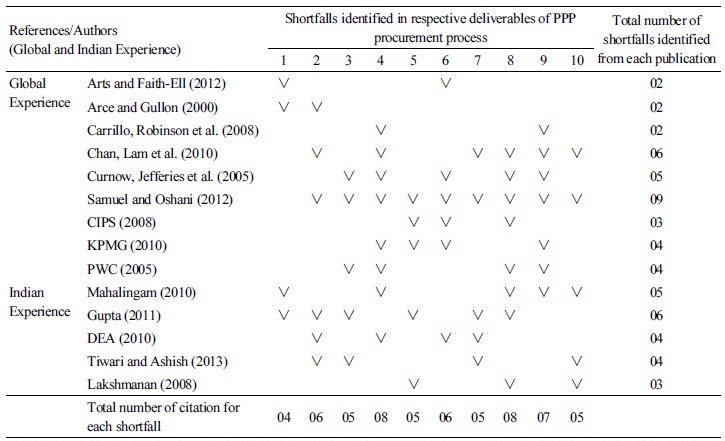
A critical review of the procurement process used for PPP infrastructure projects was carried to identify the areas which need to be improved to promote sustainable development (Table 1). The principles of sustainability postulated by Gibson were used for sustainability assessment of the PPP procurement process. The preliminary framework of strategies to improve PPP procurement process with respect to the above-mentioned areas was, then, identified through a critical review of research articles, reports, and online databases on experiences of infrastructure development and related sustainability practices worldwide. The feasibility of the preliminary framework was, then, evaluated through focused interviews with 24 stakeholders involved in development and implementation of PPP projects in India. The targeted respondents, thus, selected for this study represent the four key stakeholders of the Indian PPP programme such as transaction advisors (TAs), officials from government/public sectors (GSs), project managers from private sectors (PSs), and experts from financial institutions (FIs) involved in project finance. Hallowell and Gambatese [36] have recommended selection of experts for qualitative analysis studies based on criteria such as qualification, experience, and position in organization for qualitative analysis studies. Same criteria were used in this study for selection of experts for focused interviews, namely educational qualification of bachelor’s or higher degree (CR1), working position at top or middle level of organizational hierarchy (CR2), experience of more than five years in development of PPPs (CR3), and experience of more than five PPP projects developed (CR4). Table 2 shows the degree of fulfilment of the selection criteria by the twenty-four respondents representing the four categories of stakeholders. It could be observed from the Table 2 through the cross mark (×) that the almost all the respondents have fulfilled the requirement of selection criteria.
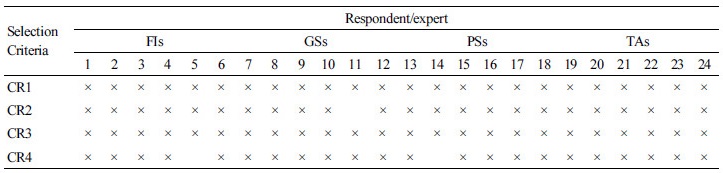
The focused interviews were designed to gain insights on respondents’ understandings on feasibility of including these strategies in PPP procurement process. The semi-structured interview template comprised of two sections- first section to gather demographic information of stakeholders; and (ii) second section was designed to seek respondents’ opinion and suggestions on preliminary strategies through open ended questions. The compre-hensiveness of the draft interview template was first established through pilot interviews with six experts involved in the development of PPPs in and around Guwahati region during the month of September 2014. The interviews were, then, conducted during the period November 2014 to January 2015.
The qualitative analysis of the primary evidences in the form of transcripts from focused interviews and secondary data from literature review was carried out using the computer assisted qualitative data analysis software package, NVivo10. For qualitative data analysis, the strategy suggested by Miles, Huberman [37] has been used for the present study. As per Miles, Huberman [37], the key steps for qualitative analysis are data condensation using the coding procedure, drawing of the conclusions, and confirming the findings. The data from literature review and interviews on the identified themes for each strategy were coded as free nodes, which were then displayed in the form of a framework matrix in order to facilitate further analysis. In order to draw conclusions from the open coded data for each strategy, qualitative analysis techniques of constant comparison analysis and classical content analysis were used. Leech and Onwuegbuzie [38] have suggested these techniques for drawing the conclusions and generating the meanings if the data are generated from literature review and interviews. The constant comparison analysis helps in categorization of identified strategies as per the respective areas where the strategies should be integrated into the procurement process. Classical content analysis gives the count of number of references and number of respondents coded for each strategy. With datasets that have codes emerging multiple times, classical content analysis can assist in understanding what concepts were predominantly discussed. The main interest for this analysis is to understand the extent to which the respondents suggested agreement on feasibility of each strategy.
Lastly, the confirmation of the findings was carried out using the technique of micro-interlocutor analysis developed by Leech and Onwuegbuzie [38]. The confirmation was done through checking of consensus and dissent views of each respondent on each strategy, presenting the outcome in the form of a matrix. The matrix indicates how many respondents have provided substantive statement indicating agreement or disagreement with the identified strategies. Furthermore, a five-point scale (1 for strongly disagree, 2 for disagree, 3 for neutral, 4 for agree, and 5 for strongly agreed) was used to score the twenty-four respondents’ view on the degree to which a particular strategy would help in enhancing the sustainability of PPP procurement process. The overall score on consensus of all the respondents’ viewpoints on each strategy has been calculated as a mean value of all respondent’s score by using above mentioned five-point scale. The mean value for each strategy represented by an acronym is displayed in the last column of Table 3 as an overall score. It could be observed from the overall score for each strategy that the respondents have agreed on inclusion of all the strategies for enhancing the sustainability of PPP procurement process.
Table 3. Framework of strategies to enhance the sustainability of PPP procurement process 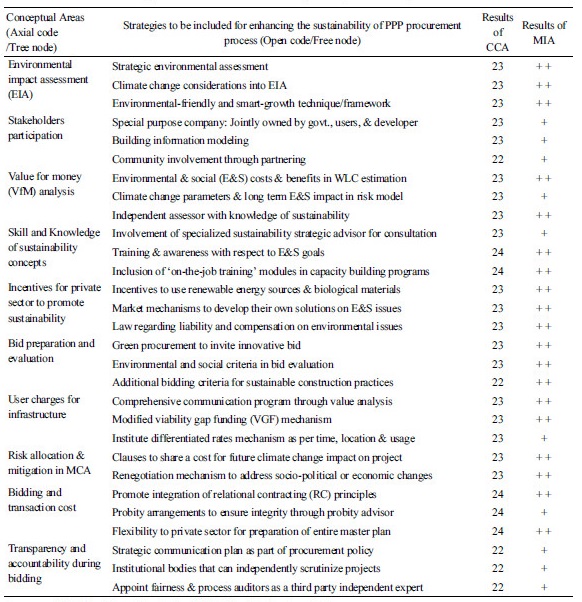 | |
Acronyms - CCA: Classical content analysis and MIA: Micro-interlocutor analysis. | |
Finally, to validate the framework of strategies a questionnaire was conducted. Respondents for this survey were the interviewees who had participated in the focused interview. The questionnaire adopted for the validation study is based on the questionnaire based validation study adopted by Yeung [39] to validate the ‘Partnering Performance Index’. The validation of the model was assessed based on six parameters: appropriateness, objectivity, replicability, practicability, reliability and suitability. To validate the current framework, the respondents were asked to rate the framework based on these six aspects. The respondents were asked to rate their extent of satisfaction for each of the six validation aspects on a scale of 1 to 5, where ‘1’ represents ‘poor’ and ‘5’ represents ‘excellent’. The questionnaire was administered via email during August to September 2015. The questionnaire data was then analysed using statistical analysis package to ascertain the descriptive statistics measures for each validation aspect. All the validation aspects were rated as highly satisfactorily (at least 3.5),with the mean values of all the aspects have scored more than 3 - Degree of appropriateness - 4.12, Degree of objectivity - 4.20, Degree of replicability - 3.66, Degree of practicality - 3.75, Overall reliability - 3.95, and Overall suitability for PPPs in India - 3.75.
Discussion on Framework of Strategies
The framework presents the strategies that should be adopted for improving the PPP procurement process from sustainability perspective, which are categorized under ten thematic areas. The themes are Environmental impact assessment; Stakeholders’ participation; Value for money analysis; Skill and knowledge of sustainability concepts; Incentives to private sector; Bid preparation and evaluation; User charges for infrastructure services; Risk allocation and mitigation; Bidding and transaction cost; Transparency and accountability during bidding; and Goal conflicts of public and private sector. Discussion on these strategies is presented in this section on a theme wise basis.
Environmental Impact Assessment (EIA)
In the current PPP procurement process, EIA is a part of the feasibility study to minimize the impact of the project on surrounding environment and society. However, the experts have expressed the opinion that EIA has focused only on ensuring that project impacts are within the acceptable limits without giving due importance to optimizing the project for the environment, social and community benefits. The EIA and SIA, as per the respondents, therefore needs to be an in-depth study so that it can provide an elaborate input on design and operation aspects of the project.
Strategic environmental assessment (SEA)
Adopting SEA will ensure consideration of environmental issues from the beginning of the decision-making process and can help to detect potential environmental impacts at an early stage, even before the initiation of design of the projects. And, SEA should be conducted with quantifiable set of parameters. Incorporating SEA in prefeasibility study of PPP projects will help to take into account the long term impacts of infrastructure development in the early stage of the procurement process and will help in enhancing the sustainability aspect.
Climate change considerations in EIA
The private entity in a PPP project has accessed to new technologies and they should be encouraged to provide innovative solutions to achieve the goal of greenhouse gases emissions reduction/avoidance. In order to take advantage of this, government should give emphasis on assessment of climate change consideration along with or as a part of EIA during the pre-feasibility study of PPP identification stage, while the mitigation measures could be workout during later stages while dealing with detailed design.
Environmental-friendly and smart-growth (EFSG) technique
There are various environmental-friendly, smart-growth (EFSG) tools/frameworks for assessing the sustainability of infrastructure projects. The most common EFSG frameworks include BREEAM, LEED and CASBEE are the main existing methods for assessing the building environment as well as sustainable infrastructure development. Inclusion of similar kind of EFSG framework along with EIA in feasibility study of PPP could be effectively tool to assess the impact of the project on surrounding environment and society. One of the expert’s have suggested that the EFSG framework should be the part of feasibility study in detail design or TEFR (Techno-Economical feasibility Report), but inclusion through evaluation body or advisory body. The implementation of EFSG tools in the proposed PPP project early in the project concept development process to turn potential adversarial groups into advocates.
Stakeholders’ Participation
PPP projects often encounter public opposition on social and environmental issues and in some extreme cases such challenges affect the financial viability of the projects. Similarly, all the respondents have strongly agreed that this is one of the challenges being faced by Indian PPP projects in the form of stakeholders and local public opposition during project development. Experts have expressed the need for introducing new innovative approach to improve stakeholder participation.
Special purpose company (SPC) - Jointly owned by government, users and developer
PPP projects are generally governed by SPV, which brings together various parties like lenders, public sector and export credit agencies, suppliers and off-takers. However, SPV lacks representation from users. In order to allow participation of all the stakeholders, alternative institutional mechanism in the form of a special purpose company, which is jointly owned by government, users and private developers, can be instituted for development of PPP projects. Process for inclusion of SPC mechanism in team formation should commence before the commencement of full feasibility study of PPP project.
Building information modeling (BIM)
BIM promotes an integrated project delivery approach that encourages collaboration amongst the various stakeholders to the project over its lifecycle. In PPP procurement process the maximum benefits from adoption of BIM could be derived by including it in need and option analysis of the feasibility study and utilizing it for independent monitoring during implementation and operation stages so that it can serve as an effective communication tool for stakeholder’s participation in decision making.
Community involvement through partnering
PPP worldwide experiences indicate that PPP projects are often at risk from community and non-governmental organisation (NGO) mobilization against the project. Community involvement can therefore contribute to PPP projects success by creating an enabling environment to resolve disputes relating to community over the project lifecycle. The community involvement could be established through creation of partnership between the public agency and local community-led NGO, who can play a key role in convincing the community on the benefits of this project. However, the respondents have stated that the project sponsor should not enter into partnering with NGOs having a vested interest from either implementation or stoppage of the project. Furthermore, the focus of community participation should be to concentrate on convincing the communities about the project and not the PPP aspect of the project.
Value for Money (VfM) Analysis
Value for money is an optimum combination of whole life-cycle cost, risks, completion time and quality in order to meet public requirements. As per whole life cycle cost theory, higher capital expenditures are justified in order to gain more operating efficiencies. However, savings in operating costs would result from adopting sustainable design, which will increase capital costs and the associated risks. In practice, the private sector would try to reduce the capital expenditure and keep the associated risks level low. The respondents have criticized this misleading practice and have raised concern about not taking into consideration environmental and social externalities of the projects.
Environmental & social (E&S) costs and benefits in WLC estimation
VfM is the optimum combination of whole-of-life costs and quality of the good or service to meet the user’s requirements. Inclusion of environmental and social costs and benefits in whole-of-life cost can streamline the PPP process to promote adoption of renewable energy sources and cost effective technologies as the current WLC estimation has not specifically given a due weightage to social and environmental dimension. Consideration of environmental and social costs, and benefits in WLC estimation for VfM analysis will also promote adoption of cost effective technologies and relied more on renewable energy sources. Furthermore, whole life-cycle costing should also attempt to include the cost of monitoring and testing environmental related issues at project site.
Climate change parameters and long term E&S impact in risk model
UNECE [40] has indicated the need for dealing cautiously the risk and uncertainty through precautionary measures, when the environmental impacts of the activities are not known, until the likely impacts can be determined. The current risk model of VfM analysis should also include risks relating to climate change impact, and long term social and environmental impact on project from natural calamities as the current model focuses on risks affecting the financial and economic viability of the project only.
Independent assessor with knowledge of sustainability
Independent engineer conducts assessment of VfM on technical parameters like whole lifecycle costing, risk, and quality while the important parameters related to the cost of future social and environment risk are outside the purview of this study. If the above-mentioned strategies, like E&S cost and benefits of sustainable activities; and climate change parameters and long term E&S impact are included in WLC and risk model of VfM analysis, respectively, then an unbiased assessment of these strategies through the independent assessor would be required for this study. One of the experts has also suggested that government could include consultants who has practical knowledge of sustainability concept in the empanelled list of consultants.
Skill and Knowledge of Sustainability Concepts
PPP projects require multidisciplinary and highly specialized expertise on account of complex nature of the business transaction. Public officials are not well trained in areas such as financial and legal matters and to fill this capacity gap, external experts such as financial experts, legal experts, and transaction advisors have been involved in PPP projects. Similarly, public officials also lack awareness about sustainability and green concepts as applied to infrastructure development. The respondents have expressed the need to take substantial steps by central and state governments to enhance the capacity of existing manpower with respect to sustainability aspect.
Involvement of specialized sustainability strategic advisors
Sustainability strategic advisors are experienced consultants with sound knowledge of both engineering and sustainability principles who can provide tailored advisory services to infrastructure development organisations. They assist the organisations in developing strategies for attitude change and re-orient the decision making processes to give conscious attention to environmental and social objectives [40]. The respondents have expressed the need for early involvement of specialized sustainability advisors to assist the contracting authorities in order to take into account sustainability considerations in PPPs. And, they have also indicated that these advisory firms can also partner with the organizations to enhance their long-term performance by making them understand the connection between sustainability and performance and show organizations how integrating sustainability into products, services and operations can lead to competitive advantage.
Training and awareness with respect to E&S goals
Capacity building programs have been undertaken by all the tiers of the Indian government to train the public procurement teams on bidding of infrastructure projects through PPP route. However, these programs need to be extended to build capacity to enable the procurement team to gain awareness and knowledge about including sustainability consideration in bidding documents preparation and tendering process. It has also been suggested by respondents on inclusion of such training modules will bring a change in attitude and help them in making procurement decisions that give conscious attention to environmental and social objectives of sustainability.
Inclusion of “on-the-job training” modules in National PPP capacity building programs
Extending the current PPP capacity program of classroom-based seminars and workshops to practical ‘on-the-job’ training for the public entities has been cited as one of the strategies by respondents for enhancing the skills and knowledge of public officials for improving their institutional capacity and governance structure relating to sustainability aspect. Conducting visit to PPP projects in India/abroad that have demonstrated successful imple-mentation of the projects from sustainability perspective and inclusion of such pilot cases in training modules should be module for ‘on-the-job’ training. These training programs should become an integral part of current capacity building programs and attempts should also be made for international skill transfer while executing the projects.
Incentives for Private Sector to promote sustainability
Indian government has introduced several fiscal supports to make PPP attractive to private investors. Key initiatives include India Infrastructure Project Development Fund, Viability Gap Funding, tax breaks and access to infrastructure debt funds. The current schemes do not provide right incentives for private sector to invest, innovate and provide optimum solutions to adopt sustainable solutions and energy efficient systems.
Incentives to use renewable energy sources and biological materials
Through proper incentive schemes, private parties in PPP projects can be incentivized to provide innovative solutions. This opportunity can be used to promote private entities to consider design features and construction methods, and use building materials that generate optimum whole life costs. Similar kind of approach could also be used for capturing and leveraging the natural capital and promoting the usage of renewable energy resources and materials in a sustainable way.
Market mechanisms to develop their own solutions on E&S issues
The cases of PPP projects encountering time and cost overruns on account of various environmental and social resistance have been well documented worldwide. An alternative route for minimizing these issues could be attempted by inviting the private sector to include in the bid innovative strategies for resolving these environmental and social issues. It has also been suggested by some of the respondents that government should establish incentive structure that promote market mechanism which will make it feasible to maximize benefits or minimize costs to develop their own solutions and responses to the E&S problems.
Law regarding liability and compensation on environmental issues
Besides including provision to encourage private sector to adopt innovative solution to resolve environmental and social issues, provision should also be included to penalize for adversely affecting the environment. One of the respondents have stated that the public sector should think about including clauses in agreement to maintain the environmental benchmarks, beyond which penalty clauses will become imposed. The public sector also needs to establish law regarding liability and compensation to those persons who are adversely affected by pollution or who is creating the pollution. Moreover, the entire requirement related to liability and compensation on environmental issues should be well defined in request for proposal.
Bid Preparation and Evaluation
Bid proposals submitted by private sector in case of PPP projects are normally evaluated on basis of technical and financial aspects only. Furthermore, the criteria used for prequalification of bidders have also focused on technical, financial and legal aspects only. The majority of the transaction advisors, who play a key role in design of bidding process, have expressed that criteria used for bid evaluation of PPP projects are inadequate and evaluation should encompass social and environmental dimensions also. The evaluation should be quality based selection, giving proportionate weightage on parameters like promoting green procurement, and experience in social and environmental mitigation.
Green procurement to invite innovative bid
Adoption of green procurement principles in bidding will give preference to bid that proposes to use innovative technologies to reduce pollution, climate change mitigation and recycling of waste. Efficiency, expertise, and innovation from the private sector could be utilized to contribute to a better infrastructure and greater cost and time savings across the construction and operation phase of the project, thereby increasing the VfM equation of the project. However, government must fix clear objectives and specifications in contracts and identify the key performance indicators, as well as environmental risks and the party that should manage them.
Environmental and social criteria in bid evaluation
The current procurement process is designed to select concessionaire predominantly on the basis of financial criteria. Inclusion of practices to give more preference to private entities which actively adopt environmental and social protection policies such as ‘Equator Principles’ will promote private sector to give more weightage to avoid serious damage to environment and society. Finally, besides giving weightage to it during bid evaluation stage, this parameter should be included as one of the performance parameters subject to monitoring during project implementation stage.
Additional bidding criteria for sustainable construction practices
Sustainable construction practices such as lean construction principles are the set of tools that assist in maximizing client’s delivered value while eliminating waste. Elimination of waste will lead to improvement of quality and reduction of production time and cost, thereby resulting in better VfM for PPP projects. Large infrastructure projects especially procured through PPPs are characterised with the excessive use of natural resources and consumption of energy, which have a crucial impact on the environment. In view of this, additional conditions can be introduced in the PPP procurement process to promote utilization of efficient construction and management techniques to minimize construction, and operation and maintenance related wastes.
User Charges for Infrastructure Services
Majority of the experts representing government and transaction advisors have indicated that user charges for infrastructure services are high and this will make the service unaffordable and deny access to poorer section of the society. There is a need for formulating innovative pricing mechanism to ensure that the interests of users are protected taking into consideration affordability of users and certainty of pricing and revenue stream for private investors.
Comprehensive communication program through value analysis
Creating awareness among the consumers to pay for the infrastructure services in exchange for uninterrupted availability is a key determinant for successful delivery of PPP projects, particularly in social sectors projects. It is recommended that local governments should conduct comprehensive communication program to educate public users about the necessity of improved services, as the new service saves their time and cost. Awareness about the value created in the form of saving of time and operational cost due PPP services should be communicated with the affected people. Inclusions of such programme in need and option analysis, which is carried out during feasibility study, will educate public about the necessity of user charges and improve stakeholders’ participation in PPP process.
Modified viability gap funding (VGF) mechanism
Viability gap funding has been adopted as the financial support to develop financially unattractive projects on PPP mode in India. As per this scheme, government provide grant up to 40% of total project cost to make the projects attractive to private investors. However, this VGF funding is not sufficient for projects undertaken in regions with lower economic activity and for projects in social sectors where local public are opposed to pay higher tariff charges for infrastructure services. The extent of financial support should be determined on a project to project basis instead of fixing the funding limit at 40% of project cost.
Institute differentiated rates mechanism as per time, location and usage
PPP projects are normally criticized for the high user charges levied for the infrastructure service provided, leading to resistance from the community. In order to avoid this adverse social consequence, alternative tariff structure where user charges are differentiated by time, location and usage intensity will help to maximize revenues and ensure efficient capacity usage. Such a mechanism will enable users to avail the infrastructure services during period of low tariff and this will help in countering the complaints from users on high user charges for infrastructure services. Inclusion of such mechanism of institute differentiated rates would help in minimizing conflicts related to user charges and help in satisfying intra-generational and intergeneration equity goals of sustainability.
Risk Allocation and Mitigation in Model Concession Agreement
Concession agreement defines the roles and responsibilities of both the public agency and private investors and the risks allocated to both the parties. Typically, the risks that normally considered in the risk allocation framework are the ones that adversely affect the financial viability and bankability of the projects. Majority of the public and private sector experts have expressed reservation about the current risk allocation framework as it has not considered the risks of future unforeseen impacts on the projects.
Clauses to share cost for future climate change impact on project
The model concession agreement used for PPP projects in India recommends mitigation of force majeure risk through insurance. The adverse impacts on the project due to effects of climate change thereby affecting the contractual responsibilities and requiring additional investment to adapt to these changes have not been accounted in the current risk allocation mechanism. The respondents have expressed that the current model concession agreement should have flexibility to address future unforeseen or unpredictable issues related to climate change, and related risks. They were also of the opinion that additional clause or in the form of sub-clause of force majeure clause should be included in model concession agreement with the provision for sharing the costs of future unexpected risks due to climate change impact on project, through proper monitoring by independent assessor.
Renegotiation mechanism to address socio-political or economic changes
The tenure of infrastructure projects spans several decades wherein the socio-political and economic environment could change resulting in a situation wherein contractual responsibilities need to be changed to adapt to the new environment. To counter such situation, the current model concession agreement, which is a rigid contract, needs to bring in flexibility in concession agreement design. One of the ways to bring in flexibility is to move away from traditional simple contract model to hierarchical contract model. In case of hierarchical contract model, in place of indicating specific clauses to be renegotiated, when the set of ‘trigger’ conditions get activated, the concerned set of clauses are re-examined by a panel of participants. Such mechanism could be built into the contract as a renegotiation mechanism. Such mechanism will enhance the risk allocation mechanism, improve the relationship between public and private sector, and minimize goal conflicts between them. The public and private sector will be willing to engage in a meaningful dialogue with an understanding that the contracts could be re-examined in the event of extenuating circumstances and that neither party would unnecessarily have to solely bear the consequences of unforeseen events.
Bidding and Transaction Cost
Lengthy and complicated bidding process increases the bidding and transaction cost of PPP project procurement. High transaction costs limit the competition to financially sound large private entities. The experts, particularly representing the private sector, have suggested the need for altering the bidding process to reduce transaction cost.
Promote integration of relational contracting principles
Relational contracting (RC) helps to bind the members of the group towards common goals and help in building trust amongst them. This help to streamline the dispute resolution process and promote equitable risk sharing. Integrating relational contacting principles in PPP will help to optimize the long term contractual arrangements of PPPs, help to balance risk allocation between public and private sector, and minimize transaction cost. One of the respondents have stated that benefits of integrating relational contracting principles in PPP project will be maximized when it is integrated during the pre-bid stage.
Probity arrangements to ensure integrity through probity advisor
Independent assessment of the transaction and bidding procedure for PPP projects through a probity advisor may help to reduce the bidding and transaction cost. The probity adviser will help in assessment of procurement process, ensure that prescribed obligations are adhered, provide advice on probity issues which may arise before and during the procurement process, and ensure that the process is equitable and conducted with integrity. Comprehensive assessment and monitoring of PPP procurement with the help of probity advisor will help to develop thrust between the parties and maintain the reputation which are core ingredients for sustainability of PPP project.
Flexibility to private sector for preparation of entire master plan
Providing enough flexibility to private sector during PPP development and procurement stage will facilitate them to submit innovative and competitive bids. In addition to this, flexibility in PPP procurement process will also equip the organization to respond to potential internal or external changes during procurement stage and promote effective participation of bidders. In line with this, one of the respondents have stated that flexibility has to be given to private partner for preparation of master plan during the designing of the PPP project and the master plan must be vetted by a competent authority. Finally, the existing laws which empower local/state governments to prepare/approve master plan should also be modified to give enough flexibility to respond to changes in the procurement process.
Transparency and Accountability during Bidding
The governments have established procedure to maintain transparency, equity and fairness in bidding of infrastructure projects. However, the experts who participated in the study have raised concerns about lack of transparency and accountability in the Indian PPP bidding process.
Strategic communication plan (SCP) as part of procurement policy
The private sector has often complained about unavailability of information pertaining to the project in spite of the appointment of a procurement and evaluation team for communication with the bidder. Furthermore, publicity about projects taken up on PPP mode often focuses on criticisms about the project from PPP critics and from media houses. However, a proactive stance should be adopted to shift the focus to topics like economic benefits from the project, greater service access provided to those in need, especially socially and economically disadvantaged groups. This could be achieved by including strategic communication plan as part of the procurement policy thereby providing a platform for close debate between the critics and proponents during the bidding and execution stage.
Appoint fairness and process auditors as a third party independent expert
Audit mechanism is normally used by governments to maintain transparency, equity and fairness in development and implementation of public sector projects including PPP project. However, the role of auditors comes only after the completion of bidding stage. A regular monitoring mechanism by a ‘fairness and process’ auditors (FPAs) will provide a sense of assurance to government sponsors, bidders and the public that the procurement process will fair, equitable, and appropriate [40]. Similar mechanism has also been suggested by the respondents and have recommended that the FPAs must have no ties with the public and private entities and they should get involved in early stage of procurement process so that they can develop a scrupulous understanding of the project in order to maintain a complete and unbiased audit of the bidding stage. Inclusion of FPAs services in PPP procurement process will, therefore, help to enhance transparency in procurement process and accomplish the strong governance aspect of sustainability.
Institutional bodies that can independently scrutinize projects
An independent and technical review of PPP projects by a separate institutional body which can scrutinize the projects can help in ensuring transparency and accountability of PPP projects [40]. Similarly, the respondents were also of the viewpoint that an institutional independent body should be formed consisting of members who have excelled in the fields of environment, finance, media and engineering. This group can keep a close look on the sustainability matter and make the public and private party aware of any issue of concern. The role of this body will be different from the functions carried out by the PPP units which have been developed to streamline the PPP process and build capacity at parastatal organization level.
Conclusions
The Indian Government has adopted PPPs as one the alternative routes for infrastructure development in India. Several initiatives have been undertaken by the government to streamline the PPP procurement process. Though these initiatives have facilitated private sector investments in financially attractive projects and sectors but the lack of similar kind of private sector participation in other social infrastructure has highlighted the need for strengthening the procurement process so that it helps in promotion of sustainable development goals. The framework of strategies will facilitate enhancement of the current PPP procurement process to promote fulfilment of sustainable development goals. The resulting framework comprises of twenty strategies categorised under ten thematic areas. The themes are Environmental impact assessment; Stakeholders’ participation; Value for money analysis; Skill and knowledge of sustainability concepts; Incentives to private sector; Bid preparation and evaluation; User charges for infrastructure services; Risk allocation and mitigation; Bidding and transaction cost; Transparency and accountability during bidding; and Goal conflicts of public and private sector. The integration of these strategies will help in improvement of the key deliverables of PPP procurement process by incentivising the various stakeholders to adopt practices which promote sustainable development goals. This framework will incentive private sector to promote innovation, effective risk allocation, reduces the transaction and bidding cost, enhanced transparency during bidding, and strong relationship with public sector. Incorporation of these strategies will make PPP mode of procurement for development of infrastructure projects acceptable to users as well it helps to focus on minimizing environmental and social issues and user’s charges for infrastructure services, and improved participation.
The framework has been developed with focus on PPP procurement practices in the context of infrastructure development in India. The study has adopted a qualitative research approach which has enabled gaining insights on PPP procurement process from the key stakeholders of PPP projects. The study on development of such framework is in a nascent stage and the findings from the study will be of use to practitioners and academia. However, the feasibility of integrating these strategies in another contextual environment of other countries using PPP as the preferred mode of infrastructure development needs to be studied. Finally, further study in another context would help enhance usefulness and applicability of the framework to the practitioners.

