


Introduction
Background and purpose of research
Method and scope of research
Building life cycle assessment of G-SEED
Analysis target and method
Overview
Analysis target
Analysis method
Result of analysis
Conclusion
Introduction
Background and purpose of research
Recently, the environmental issues arising from the building has been growing in the international community as sustainable architecture has become a paradigm of the international society [1, 2, 3, 4]. In order to cope with this, each country have set targets to reduce greenhouse gas emissions, introduce various policies and develop advanced technologies to reduce GHG emissions in the construction sector. In particular, research of Life Cycle Assessment (LCA) that quantitatively evaluate the environmental impacts from the perspective of the life cycle of building are actively under way, and each country has adopted its own Green building certification system to reduce the greenhouse gases occurred from the buildings and established Life Cycle Assessment Certification items for building to gradually intensify the qualification standard [5, 6, 7]. On the other hand, the Green Building Certification System (G-SEED) which is operated in South Korea, has strengthened the certification standards for 2016, through this, it encourages the environmental impact assessment on the life cycle of residential buildings (single family houses, general houses and apartment houses) and non-residential buildings (office building, school building, sales building and accommodation building) [8, 9]. However, it is difficult to quantitatively figure out the environmental of non-residential building of the life cycle because the research is conducted mainly on apartment houses in the existing study of building life cycle assessment [10, 11].
Therefore, this study aims to analyze the environmental impact of the office building life cycle as part of the analysis of the environmental impact of the non-residential buildings. For this purpose, the data about the design documents, quantity building energy efficiency rating, and primary building materials were collected, and the annual energy consumption of buildings were analyzed in accordance with the international standard ISO14040s and the life cycle assessment method of G-SEED. In addition, the environmental impacts of the building life cycle assessment were quantitatively evaluated and the environmental emissions by the stages of production, construction, operation and decommission were analysed.
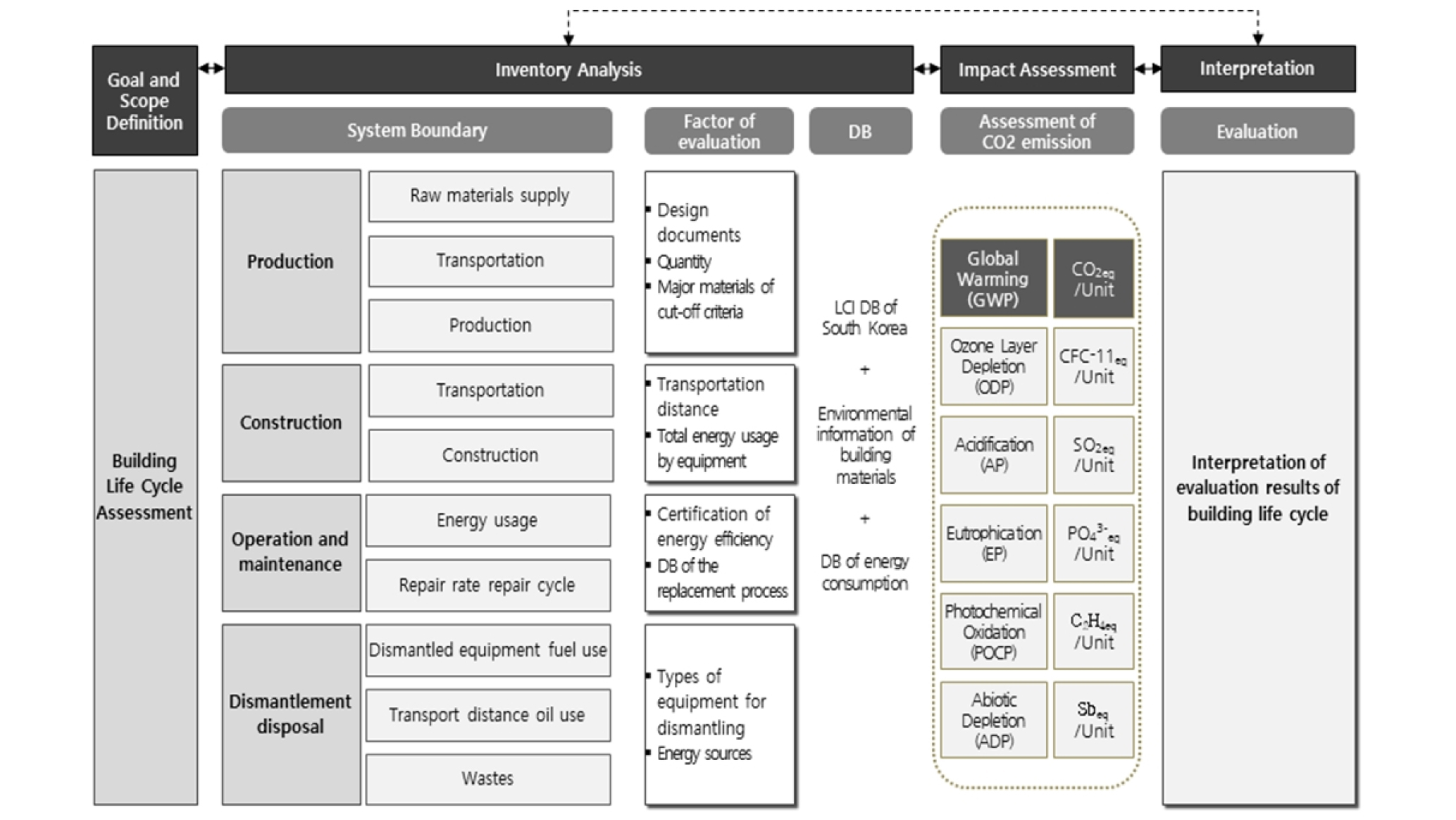
Method and scope of research
Figure 1 shows the method and scope of the research. In this study, basic information and procedures required in the building life cycle assessment of G-SEED and life cycle assessment guideline suggested by the international organization for standardization (ISO) are identified and analyzed the environmental impact of life cycle by stage [8, 9, 12, 13]. The scope of this study is the life cycle including the production phase, the operation phase, the decommissioning and disposal phase for the life cycle assessment of the building. The environmental impacts of the building were quantitatively evaluated and analyzed based on the collected data at each stage.
Building life cycle assessment of G-SEED
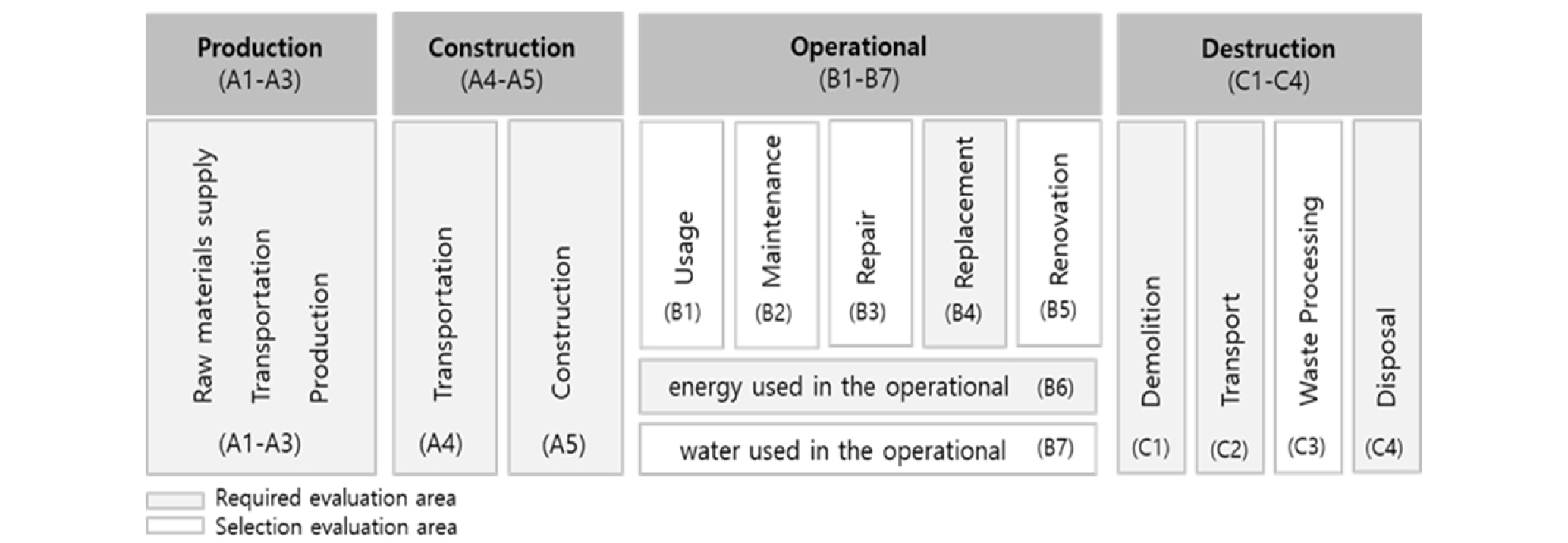
G-SEED which is green building system in South Korea reduces environmental burdens such as the use of energy and resources and the emission of pollutants that can occur throughout the building life cycle from the stage of production, construction, maintenance and disposal of building (Figure 2), It is a system to evaluate and certify the environmental performance of building with the aim of realizing sustainable development [8]. G-SEED has been continuously implementing revisions in accordance with international trend. Recently, it has been gradually revised its certification standards to prepare for international certification system by newly adding evaluation items of building life cycle through revision in 2016. In South Korea, studies are being conducted to evaluate the environmental impacts of buildings in terms of the life cycle and to reduce environmental impacts. However, most of studies related to building life cycle assessment are limited to apartment houses. In particular, the research on the quantitative environmental impact evaluation of buildings is being studied, but the scope of the research is limited mainly to the study of the energy sector in operation stage. In addition, it focuses only on the quantitative evaluation that occur in the life cycle of buildings, and there is only a little research on plans and alternatives for reduction of environmental impacts by stages through the evaluation of building life cycle. Therefore, it is necessary to analyze the causes of the increase and decrease of the environmental impacts of each stage based on the life cycle assessment and to propose GHGs reduction plans and alternatives considering the characteristics and types of buildings.
Analysis target and method
Overview
In this study, the life cycle assessment of the office building was performed to evaluate the environmental impact of the building. First, the data for the environmental impact assessment by stage including the production phase, construction phase, operation phase, decommissioning and disposal phase necessary for building life cycle assessment were collected. The life cycle assessment of building was conducted based on data collected with the ISO14040s international standard for life cycle assessment and the guidelines for building life cycle assessment of G-SEED [8, 9, 12, 13]. The environmental impact assessment in this study performed Global Warming (GWP), Abiotic Depletion Potential (ADP) and Ozone Layer Depletion Potential (ODP) of the six major environmental impact categories defined in ISO14025 [14]. In this case, the function of the evaluation criteria is the office building, and the functional unit is the unit area (m2) of the office building which would be used for 50years. Also, the reference flow is the material and energy which would be put into the office building that will be used for the next 50 years. Details are shown in Table 1.
Table 1. Evaluation criteria
Analysis target
Table 2 is overview of the office building analyzed in this study. This study quantitatively assessed the potential environmental impacts that could arise during the life cycle of the office building. The evaluation period was set at 50 years according to the guidelines for the building life cycle assessment in South Korea. In this case, the applied environmental impact characterization values were applied to the national LCI DB established by the Ministry of Environment and Ministry of Commerce, Industry and Energy and the national database of the Ministry of the Environment which is constructed by the Ministry of Land, Transport and Maritime Affairs.
Table 2. Overview of the analysis target

Analysis method
Production stage
The detailed process classification of the production stage is divided into raw material supply, transportation and manufacture, and it is recommended to collect and evaluate data for each unit process. This study collected the design details and the quantity calculation sheets of the building in order to derive the main building materials of the office building, and the major building materials with high cumulative weight contribution were analyzed base on the weight-based cut-off criteria method which is the most basically applied in the life cycle assessment. The weight-based cut-off criteria analysis method is a standard analysis method defined in ISO14040s which is the international standard for life cycle assessment. It is a quantitative method that can be excluded from the input assessment process of life cycle assessment in order to improve the easiness of the life cycle assessment, and 95% or 99% of the total weight is usually applied. In this study, the scope of construction was classified based on the design details and the quantity calculation sheet of the office building for analysis, and the amount of the building material corresponding to the construction work was identified. All of them were converted into weight units, and the major building materials corresponding to 99% of cumulative weight were analyzed according to the life cycle assessment method. For the building unit conversion coefficients used for the weight unit conversion, the domestic construction standard estimates, construction specifications and metal specific gravity table were consulted. The temporary materials, including the formwork, floor posts and safety materials used for temporary construction were excluded from the system boundary of this study because all of these were collected after use and reused at the construction sites of other buildings. In addition, accessory materials and work by-products representing less than 0.01% of the total weight of the building materials used for non-residential building construction were excluded from the scope of analysis [9]. The major building materials of case 1 were analyzed the ready mixed concrete, steel, concrete brick, cement, aggregate, stone, tile as reinforced concrete structure. The environmental impacts from the life cycle assessment of the building were evaluated based on the seven major building materials analyzed in the previous section. The main building materials of the building to be evaluated are shown in Table 3.
Table 3. Analysis of major building materials
After that, the environmental impact assessment of the major building materials was conducted. In this case, the applied environmental impact characterization values were applied to the national LCI DB established by the Ministry of Environment and Ministry of Commerce, Industry and Energy and the national database of the Ministry of the Environment which is constructed by the Ministry of Land, Transport and Maritime Affairs. The environmental impact characterization value for each construction materials were derived using the following equation.
LoadE=𝛴(𝑀𝑗,𝑖×Emission 𝑈𝑛𝑖𝑡j, E)
LoadE : Environmental impact emissions in the production stage
Mi,j : Quantity of construction material(i) of construction type(j)
Emission Unitj,E : Environmental impact emission basic unit by building materials(j)
Construction stage
The detailed process classification of the construction stage encourages the collection and evaluation of data on the environmental impacts of the transportation process and the construction process of the major buildings transported into the building. The system boundary of the construction stage includes the process of transporting the major building materials from the production site to the construction site and the environmental impacts generated by the use of various mechanical equipment by work types. In this study, the transportation distance and means of transportation of selected major building materials to evaluate the environmental impact of the transportation process. In this case, the data of transportation means for the building materials to be evaluated were referenced to the domestic construction standard estimates, and the transportation distance was assumed to be 30km according to the guidelines for the building life cycle assessment of G-SEED. In addition, the energy consumption data of the construction process of the office building were applied to the scenario of the construction process of other buildings similar to the evaluation target building. Each environmental impact assessment for transportation and construction at the construction stage was derived using the following equation.
LoadE=𝛴(E𝑗,𝑖×Emission 𝑈𝑛𝑖𝑡j, E)
LoadE : Environmental impact emissions during transportation in the construction stage
Ei,j : Energy consumption(j) of the transportation vehicles(i)
Emission Unitj,E : Environmental impact emission basic unit by energy source(j)
LoadE=𝛴(E𝑗,𝑖×Emission 𝑈𝑛𝑖𝑡j, E)
LoadE : Environmental impact emissions during construction in the construction stage
Ei,j : Energy consumption(j) of the building equipment(i)
Emission Unitj,E : Environmental impact emission basic unit by energy source(j)
Operational stage
The detailed process classification of the operation stage is divided into usage, maintenance, repair, replacement, renovation, energy used in the operational and water used in the operational, and replacement and energy used in the operational are included in the mandatory evaluation area of these. The environmental load generated during the operational stage is a significant part of the life cycle assessment. This include the environmental impacts arising from the use of the building’s operational energy and major building materials being replaced during the repair and maintenance of the building. In this study, the certification and evaluation report of this office building energy efficiency grade, and the repair cycle and the recovery rate of the building materials that need to be replaced during the building life cycle of the selected building major materials were collected to evaluate the energy consumption in the operational stage. Table 4 and Table 5 are data on the replacement process and operating energy of the office building collected for this study.
Table 4. Data collection for the replacement
| Name of material | Unit | Repair cycle (Year) | Recovery rate (%) | Amount of input | Data quality | |
| Material | Detailed materials | |||||
| Tile | Ceramic tile | ton | 20 | 100 | 129.71 | measurement |
| Vinyl tile | ton | 20 | 100 | 37.60 | measurement | |
Table 5. Data collection for operational energy
Then, the environmental impact assessment by the usage and maintenance of the operational energy used for 50 years which is the life cycle of the building were conducted based on the information of the collected office building. In this case, the environmental impact characterization value of the operational stage was applied to the LCI DB established by the Ministry of Environment and the Ministry of Commerce, Industry and Energy, and the environmental impact database of the overseas energy source. The environmental impact characterization value of the operational energy stage was derived using the following equation.
LoadE=𝛴(E𝑗,𝑖×Y×Emission 𝑈𝑛𝑖𝑡j, E)
LoadE : Environmental impact emissions of the energy consumption in the operational stage
Ei,j : Energy consumption(j) by energy source(i) for 1 year
Y : Years of use of the building (50years)
Emission Unitj,E : Environmental impact emission basic unit by energy source(j)
LoadE=𝛴(M𝑗,𝑖×Emission 𝑈𝑛𝑖𝑡j, E) +(E𝑗,𝑖×Emission 𝑈𝑛𝑖𝑡k, E)
LoadE : Environmental impact emissions of the replacement process in the operational stage
Mi,j : Construction material quantity(j) by construction type(i)
Ei,j : Energy usage(j) by maintenance equipment(i)
Emission Unitj,E : Environmental impact emission basic unit by building materials(j)
Emission Unitk,CO2 : Environmental impact emission basic unit by energy source(k)
Disposal stage
The detailed process classification of the disposal stage was divided into the dismantling process, the transportation process and the disposal (incineration, landfilling), and it is recommended to collect and evaluate the data for each unit process. The amount of equipment, fuel economy data, and the amount of the major waste building material generated during the dismantling process to dismantle the major building materials were collected the assess the environmental impact of the dismantling process. In this case, the environmental impact assessment was performed assuming that the amount of the major waste building materials generated during the dismantling process is the same as the quantity of the major building materials input in the production stage.
LoadE=𝛴(E𝑗,𝑖×Emission 𝑈𝑛𝑖𝑡j, E)
LoadE : Environmental impact emissions of dismantling process in the disposal stage
Ei,j : Energy consumption(j) of the demolition equipment(i)
Emission Unitj,E : Environmental impact emission basic unit by energy source(j)
LoadE=𝛴(E𝑗,𝑖×Emission 𝑈𝑛𝑖𝑡j, E)
LoadE : Environmental impact emission of waste transportation process in the disposal stage
Ei,j : Energy consumption(j) of the waste transportation vehicle(i)
Emission Unitj,E : Environmental impact emission basic unit by energy source(j)
LoadE=𝛴(E𝑗,𝑖×Emission 𝑈𝑛𝑖𝑡j, E)
Loadco2 : Environmental impact emission of disposal process in the disposal stage
Ei,j : Energy consumption(j) of the landfill equipment(i)
Emission Unitj,E : Environmental impact emission basic unit by energy source(j)
Result of analysis
Table 6 and Figure 3 shown the results of the environmental impact assessment of the office building. According to the graph, GWP 4.44E+07kg-CO2eq, ADP 3.44E+05 kg-Sbeq and ODP 1.4E+00kg-PO43-eq were assessed for each environmental impact category, and each environmental impact emission per unit area were analyzed as GWP 4.44E+07kg-CO2eq, ADP 3.44E+05 kg-Sbeq and ODP 1.4E+00kg-PO43-eq. The contributions by the stage of GWP of the office building were analyzed as 24.28% in the production stage, 0.99% in the construction stage, 73.57% in the operation stage and 1.16% in the disposal stage. This tendency is a general tendency similar to the result of GWP of other existing buildings. It is attributed to the energy consumption of heating, cooling, hot water, lighting and ventilation sectors which are continuously used for 50 years. The contributions by the stage of ADP were analyzed as 16.23% in the production stage, 1.05% in the construction stage, 81.63% in the operation stage and 1.08% in the disposal stage. This result by the stage of ADP is similar to the result of the GWP evaluation. This is attributed to the large use of resources such as fossil fuels to produce building materials and energy expected to be used in the production stage and operational stage of the office building. In additional, the contributions by the stage of ODP were analyzed as 35.11% in the production stage, 8.56% in the construction stage, 41.66% in the operation stage and 14.67% in the disposal stage. This result by the stage of ODP is somewhat different from the result of GWP and ADP described above. The results of GWP and ADP absolutely affected by the environmental impact of energy consumption in the operational stage, whereas the result of ODP was relatively largely affected by the environmental impact of production stage.
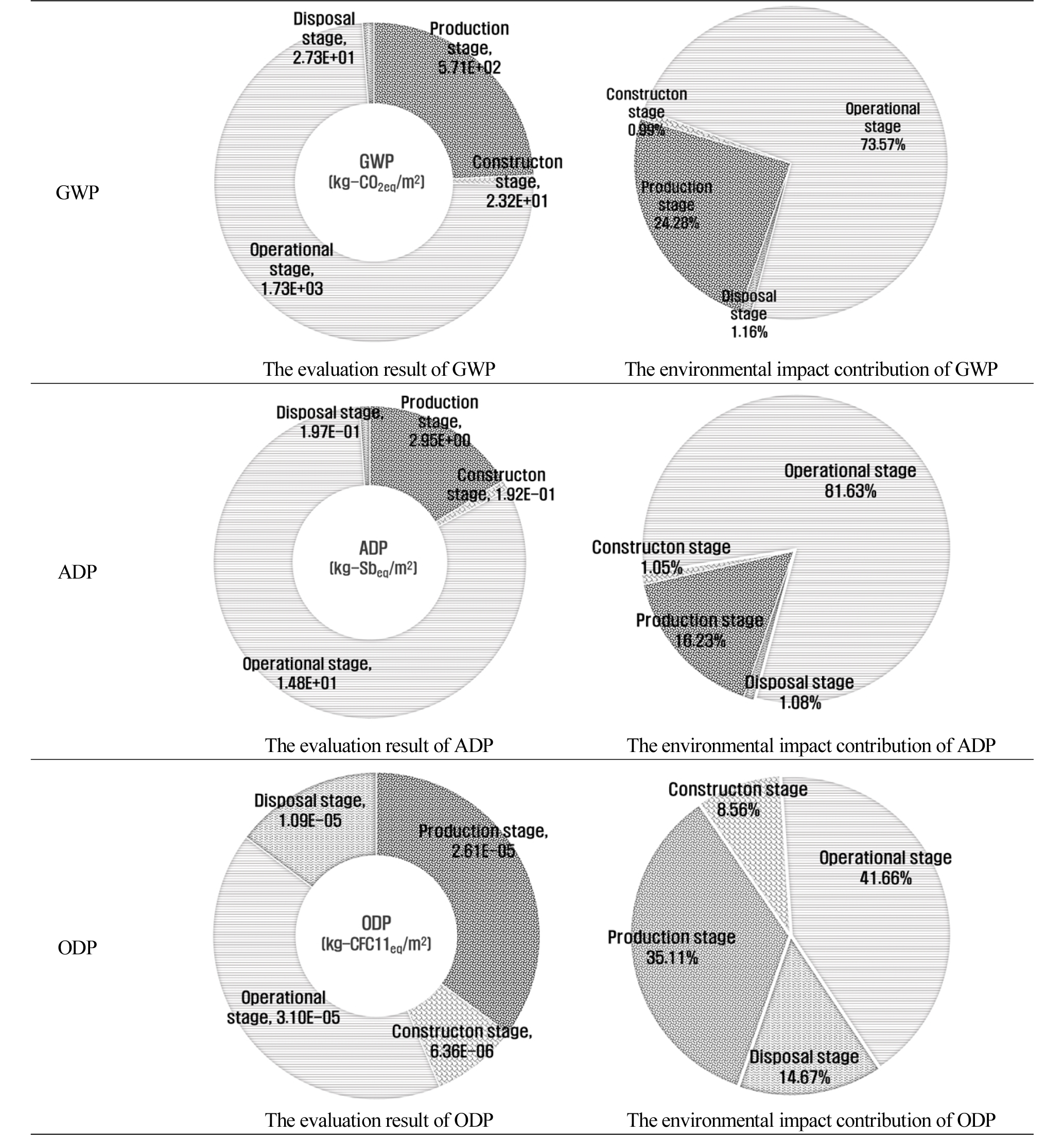
Table 6. Results of the environmental impact assessment for each stage
In the case of GWP, the environmental impact per unit area of the production stage was 2.95E+00 kg-CO2eq/m2,accounting for about 24.28% of the total global warming impact during the life cycle of the office building. It was analyzed that the effect of GWP in the production stage was attributed to the amount of concrete and steel reinforcement that contributed to the cumulative weight contribution of the input quantity. The impact of GWP per unit area in the operational energy process in the operational stage was 2.95E+00kg-CO2eq/m2, accounting for about 73.57% of the total GWP. The environmental impact of ADP per unit area in the production stage was assessed to be about 16.23% of the total global warming impact of2.95E+00 kg-Sbeq/m2, and the impact of ADP per unit area in the operational energy process in the operational stage was 1.48E+01 kg-Sbeq/m2 which is 81.63% of the total global warming impact. This result was deducted because although the types of building materials used in the production stage were various, the substances that affected ADP were Crude oil, Natural gas, Hard coal, Soft coal, etc. not the raw materials such as aluminum (Al), Cadmium (Cd), Iron (Fe). In addition, the environmental impact of the operational stage was somewhat higher than other same type of buildings due to the fact that the tiles were selected as the major building material to be replaced in the replacement process during the life cycle of the office building. In the case of ODP, the environmental impact of ODP per unit area in the production and operational stage were analyzed as 2.61E-05 kg-CFC11eq/m2, 3.10E-05 kg-CFC11eq/m2, accounting for about 35.11% and 41.66% of the total ozone layer influence. The evaluation result of ODP was slightly different from the results of GWP and ADP because of the building materials to be evaluated have Bromotrifluoromethane (Halons 1301) which is a major influence on the ODP, and analyzed that the energy source of cooling, lighting and ventilation used in the operational stage is the electrical power which is remarkably low the ODP emission. The reason why the environmental effect in the construction and disposal stage of DOP was higher than GWP and ADP was that the use of oil which had the greatest influence on the ODP.
Conclusion
This study analyzed the environmental impact emissions of the office building based on the building life cycle assessment of G-SEED. The following conclusions were obtained.
1.The major building materials were analyzed based on ISO14040s and guideline for the building life cycle assessment of G-SEED which was green building system in South Korea to produce the environmental impacts in the building life cycle of production, construction, operational and disposal stage. As a result of the analysis, the major building materials of the evaluation target were analyzed as 7 kinds of the ready mixed concrete, steel, concrete brick, cement, aggregate, stone and tile. The environmental impact emissions were assessed based on the analyzed the major building materials.
2.This study assessed the environmental impact assessment of Global Warming Potential (GWP), Abiotic Depletion Potential (ADP) and Ozone Layer Depletion Potential (ODP) of the six environmental impact categories defined in ISO14025s. The environmental impact emissions of each environmental category were assessed as GWP 4.44E+07kg-CO2eq, ADP 3.44E+05 kg-Sbeq and ODP 1.4E+00kg-PO43-eq, and each environmental impact emissions per unit area were GWP 2.35E+03kg-CO2eq/m2, ADP 1.82E+01 kg-Sbeq/m2, ODP 7.43E-05kg-PO43-eq/m2.
3.The environmental impacts of each environmental impact category were largely generated in the production and operational stage. In particular, the environmental impacts of GWP and ADP were dominantly analyzed in the operational stage. It was considered that the environmental impact emissions in the operational stage were highly evaluated due to the energy consumption of the heating, cooling, hot water supply, lighting and ventilation sectors which were continuously used for 50 years. On the other hand, the result of the environmental impact assessment of ODP in the production stage was analyzed relatively higher than the GWP and ADP. It was considered that this was due to the fact that the building materials to be evaluated had Bromotrifluoromethane (Halons 1301) which was a major influence of the ODP, and analyzed that the energy source of cooling, lighting and ventilation used in the operational stage was the electrical power which was remarkably low the ODP emission.
This study analyzed the environmental impact emissions of the office building by stage for the building life cycle assessment of the non-residential building based on the building life cycle assessment method of the G-SEED. In the case of buildings, the building materials that affect the environmental impact and the energy source used in the construction stage were varied as usage and type of the building. Therefore, the research of the environmental impact assessment of the building life cycle is needed through comparative analysis of the type and structure of the building in order to propose the GHGs reduction plan by stage considering the characteristics of the building.

