


Introduction
Material and Methodology
Concept of Infill and the Long-Life Housing System
International Trends
Domestic Trends
AI Smart Housing Testbed Analysis
Overview of the Testbed Site
Applied Technologies
Service Configuration and Operation
Findings from the Testbed Analysis
Development of Standard Construction Guidelines for Embedded Infill Devices
Construction Guidelines for Residential Spaces
Proposed Construction Guidelines for Infill- Embedded AIoT Installation
Result and Discussions
Conclusions
Introduction
AIoT (Artificial Intelligence of Things) in residential environments has emerged as a service-oriented infrastructure in which sensors, actuators, networks, data, and artificial intelligence are vertically integrated to enhance occupant safety, health, energy management, and daily convenience in a holistic manner [1]. Since the COVID-19 pandemic, the demand for non-face-to-face services—such as remote work and online education—has become persistent, while the rapid increase in aging populations and single-person households has further accelerated the need for remote monitoring and senior-care services [2]. In particular, the growing adoption of Life Cycle Housing has underscored the importance of infill design, wherein the structural frame (support) is separated from non-structural interior components (infill) to ensure long-term maintainability and spatial adaptability [3]. Life cycle housing emphasizes not only structural durability but also the replaceability and maintainability of internal infill components, which constitute fundamental prerequisites for the stable integration of AIoT devices into residential environments.
In other words, AIoT-based residential services must be conceived not as add-on devices but as embedded systems within the infill architecture. This requires the standardization of physical and informational interfaces from the early infill design stage. For AIoT services to operate reliably and continuously in real housing environments, the performance of the physical infill system—which supports device installation, replacement, and future expansion—must first be secured. The term infill herein refers to the collective assembly of non-load-bearing interior components (e.g., walls, ceilings, floors, partitions, moldings), embedded or exposed wiring and ducts, power and communication harnesses, device-mounting interfaces (e.g., brackets, rails, modular panels), and maintenance access components (e.g., inspection openings, racks, shafts). An infill system is required to simultaneously satisfy demands related to mechanical performance, environmental durability, safety and fire protection, security and privacy, maintainability, and the overall quality of the residential environment. Failure to meet these requirements exposes even sophisticated AIoT services to installation constraints, malfunction risks, and reduced user acceptance [4].
Despite these needs, research that consistently defines AIoT-related infill components from a service perspective and establishes a systematic, space-level infill design platform remains insufficient. In particular, existing studies lack a standardized framework that links AIoT device installation with infill design, empirical construction guidelines derived from real- world testbeds, and validation of physical constraints such as wiring separation, device accessibility, and long-term maintainability. This gap limits the scalability and reliability of AIoT services, as device performance is increasingly dependent on the spatial and infrastructural characteristics of the infill environment. Table 1 summarizes major problems commonly observed in current AIoT–infill installations, highlighting the need for structured installation standards and infill-based integration frameworks.
Table 1.
Major Problems Observed in Existing AIoT–Infill Installations
Accordingly, this study pursues three interrelated research objectives. First, it seeks to identify the essential infill components and physical interface conditions required for stable integration of AIoT devices in residential environments.
Second, it aims to derive technical criteria and construction requirements that can support consistent installation, replacement, and expansion of AIoT systems.
Third, it intends to translate empirical installation problems observed in a full-scale testbed into generalized guidelines that can serve as a standardized framework for future smart-housing construction.
Therefore, this study aims to develop a standardization framework that secures consistency and scalability in the installation of AIoT devices within buildings. To this end, infill components and installation conditions of AIoT devices installed in a real-world residential testbed were systematically analyzed, and corresponding standard installation guidelines were proposed. The findings of this study are expected to contribute to improving the reliability and scalability of AIoT services in buildings and to fostering interoperability in residential digital infrastructure.
Material and Methodology
Concept of Infill and the Long-Life Housing System
The concept of infill refers to an architectural strategy that separates the structural frame (support) from non-structural interior components (infill) to facilitate functional upgrades and spatial adaptability over the building’s lifespan. In How Buildings Learn, Brand (1994) conceptualized buildings as an assemblage of multiple “layers of change,” emphasizing that the replacement cycles of structural systems, service infrastructure, and interior furnishings differ considerably [5]. This temporal stratification has since evolved into a key strategy for enhancing building flexibility and sustainability.
In South Korea, the concept was institutionalized with the introduction of the Long-Life Housing Certification System by the Ministry of Land, Infrastructure and Transport (MOLIT) in 2014 [6]. Under this system, long-life housing must be designed and constructed to satisfy three core principles—variability, maintainability, and durability—marking the first national guideline to explicitly codify the support–infill separation. The certification encourages standardized design of infill components such as plumbing ducts, electrical cable trays, and modular interior partitions to enable functional upgrades throughout the building life cycle.
Because the design principles of long-life housing directly align with the installation, replacement, and maintenance requirements of AIoT devices, the standardization of infill design is essential for the successful deployment and long-term operation of AIoT services. Previous studies have addressed physical durability and replaceability in long-life housing, analyzed technical architectures of smart-home systems, and evaluated AIoT service applications. However, comprehensive research that establishes standardized infill design criteria specifically to ensure the installability and maintainability of AIoT devices remains limited.
In AIoT-enabled residential environments, power, communication, and data wiring are intrinsically linked to the spatial configuration, making it difficult to ensure long-term operational stability when relying solely on conventional attachment-based device installations. In response, this study analyzes the installation conditions of AIoT devices and the construction characteristics of infill systems in an actual residential testbed and identifies the infill elements required for AIoT integration. Based on these findings, we propose standard installation guidelines and a standardization framework encompassing the full cycle of design, construction, and operation. These outputs aim to contribute to establishing a robust physical foundation for AIoT-enabled smart housing.
International Trends
Recent international research has increasingly emphasized an integrated approach that combines AIoT (Artificial Intelligence of Things)–based smart housing with infill-oriented design strategies. Cao et al. (2018), in the journal Sustainability, proposed the Skeleton–Infill (SI) housing system and demonstrated that separating the structural frame (skeleton) from interior components (infill) can effectively extend housing life spans and enhance maintainability [7]. Their study defined the infill system not merely as interior finishing, but as a tech-ready envelope capable of accommodating future technological upgrades, thereby establishing a physical foundation for subsequent smart-home and AIoT device integration.
Nikolić (2018), writing in Energies, presented a strategic framework for advancing the infill industry to support large-scale residential retrofitting [8]. This research emphasized that modularized and standardized infill components will become essential infrastructure for housing renovation, and highlighted the industrial feasibility of infill modules that incorporate IoT-based sensors, wiring, and control devices. Such findings directly relate to the objective of this study, as they underscore the need for digital–physical adaptability throughout the residential life cycle.
Kylili et al. (2023), in a recent review article, classified smart-home systems from the perspective of energy- efficiency technologies and systematically analyzed the interaction structures among sensors, networks, and control algorithms [9]. Importantly, the study noted that a building’s physical infrastructure—including wiring, sensor placement, and infill configuration—has a decisive impact on the energy-saving performance of AIoT control systems. By outlining an artificial-intelligence-driven adaptive building control framework based on operational data feedback loops, the authors provided technical justification for embedding AIoT devices within infill components.
Popova and Izonin (2022) examined occupant- centered design and automation infrastructure in smart housing, analyzing how embedded installation of IoT devices during the renovation of aging residential buildings can improve energy efficiency and safety [10]. Similarly, Mazzara et al. (2019) proposed an interoperable architecture linking sensors, actuators, and data-management modules, thereby conceptualizing a layered platform–infill interface for smart buildings [11]. Collectively, these studies underscore the necessity of integrating AIoT systems with infill design from an energy-efficiency and system-interoperability perspective. However, research that empirically verifies physical performance in real construction settings and establishes standardized infill criteria remains in its early stages.
Domestic Trends
The convergence of IoT (Internet of Things) and AI (Artificial Intelligence) has evolved into AIoT, enabling residential systems that adapt to occupant behaviors through cyclic interactions among sensing, data processing, control, and feedback mechanisms. In South Korea, research on infill-based long-life housing has expanded significantly since the implementation of the Long-Life Housing Certification System in 2014, which formalized the separation of the structural frame (support) and interior components (infill) to extend the residential life cycle. Kim and Kim (2007) developed an analytical framework for systematically examining infill elements and their interfaces, highlighting the need for hierarchical classification and standardization of infill components. Their work laid an early theoretical foundation for establishing Korea’s subsequent infill design standards [12].
Following this, the Korea Institute of Civil Engineering and Building Technology (KICT) published the Final Report on the Development and Dissemination Model of Cost-Effective Long-Life Housing (2016), which defined key technical requirements related to infill replacement cycles, wiring modularization, and access for plumbing inspection [13]. This study proposed a dry-wall system and integrated wiring-duct infill modules as feasible solutions for implementing replaceable infill systems even in wall- structure apartment buildings. These technologies later evolved into the physical backbone supporting embedded installation of AIoT devices within residential spaces.
More recently, An (2022) established a structured evaluation framework for smart-housing services and proposed methodologies for quantitatively assessing the impact of physical infrastructure—including infill—on service performance [14]. As such, domestic research has progressed from early investigations of long-life housing infill concepts to integrated, AIoT- enabled smart-housing demonstrations that emerged after 2020, encompassing smart platforms, service systems, and infill design.
However, existing studies still lack a comprehensive performance evaluation framework that simultaneously considers the structural and mechanical characteristics of infill systems and the information and communication requirements of AIoT devices. In addition, integrated management approaches addressing life- cycle cost (LCC), security, and privacy remain insufficient. To address these gaps, the present study analyzes the current conditions of AIoT-related infill components using empirical data collected from the Sang-ri Energy Self-Reliant Village testbed, with the aim of developing standardized guidelines for infill design, construction, and operation.
AI Smart Housing Testbed Analysis
Overview of the Testbed Site
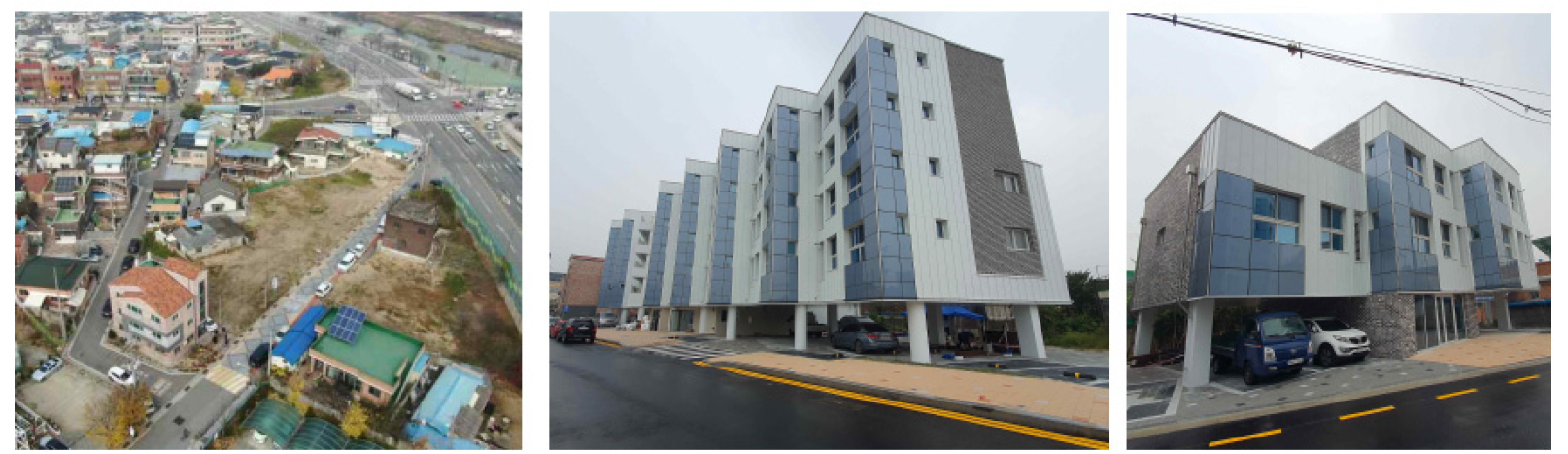
The testbed site examined in this study is a residential complex developed as part of a national Urban Regeneration New Deal initiative and an energy self- reliant village program. The complex was planned as an experimental housing district designed to validate a zero-energy residential model and AI-based smart- housing technologies following the redevelopment of an aged low-rise neighborhood. It consists of two- story low-rise block-type multi-family buildings.
The development comprises a total of 31 dwelling units—15 units of 34 m² and 16 units of 59 m²—along with two Living Lab units and shared community facilities. In accordance with the design guidelines proposed by the research team, the building envelope was planned to exceed the performance requirements stipulated in the Zero Energy Building Guidelines: the external wall thermal transmittance is 0.15 W/m²·K, the roof 0.13 W/m²·K, and the windows 1.0 W/m²·K. The A/V ratio (area-to-volume ratio) is approximately 0.85, resulting in a compact building layout that minimizes heat loss relative to the total floor area.
The testbed consists of two buildings. The first floor of each building serves as a shared demonstration space providing integrated medical, safety, welcome, and exhibition services. The second floor accommodates resident-focused demonstration units featuring adaptable interior layouts, cladding systems, and energy monitoring functions. Figure 1 illustrates the condition of the site before and after redevelopment. Figure 2 presents an overview of the testbed site.

Applied Technologies
The testbed is a residential complex developed as part of the Urban Regeneration New Deal initiative and the Energy Self-Reliant Village program. It was established to validate an integrated model that combines zero-energy housing performance with AI-based smart-housing technologies following the redevelopment of an aging low-rise residential area.
A multi-ministerial AI Smart Housing Platform—jointly developed by the Ministry of Land, Infrastructure, and Transport (MOLIT) and the Ministry of Trade, Industry, and Energy (MOTIE)—was fully deployed in the testbed. The MOLIT platform adopts an open architecture designed to scale from the household level to the community and urban levels. It manages data collected from IoT devices through both cloud-based and local servers and performs AI-driven data analytics and service control. The MOTIE platform operates as an on-device AI home platform that conducts computation and decision-making directly within the household, thereby enhancing privacy protection and reducing system response time. The two platforms are interoperable, forming an integrated system in which data processing, service delivery, and infill infrastructure are interconnected. The major technologies applied in the testbed are summarized in Table 2.
Table 2.
Major Technologies and Infill Application Characteristics
Service Configuration and Operation
The services demonstrated in the testbed can be categorized into five domains: Safety, Comfort, Energy, Amenity, and Maintenance. Each service is implemented through an integrated structure in which the platform and infill system operate in combination, ensuring coordinated design of data flow, power supply, sensor placement, and maintenance accessibility. All services adopt a three-layer architecture consisting of the platform, service layer, and infill infrastructure. The upper platform layer performs AI algorithms and data analytics, while the intermediate infill layer provides the physical foundation for device power, communication, load-bearing, and inspection access.
Data hubs, sensors, wall pads, and access points installed in each unit are interconnected through power, LAN, and PoE lines embedded within the infill structure, enabling real-time control and response to user behavior and environmental conditions. This configuration exceeds the conventional device-centered IoT model by functioning as an integrated architectural network in which AIoT technologies are embedded within infill elements. The results of the demonstration clearly indicate that AIoT devices must be designed and constructed as embedded infill systems, rather than surface-mounted components. The Service Components, Infill Integration Methods, and Operational Functions in the testbed are summarized in Table 3.
Table 3.
Service Components, Infill Integration Methods, and Operational Functions
Findings from the Testbed Analysis
The results of the field demonstration indicate that most AIoT devices installed within the residential units were connected to power and communication infrastructure through the wall, ceiling, and floor infill systems. While such embedded configurations enhanced spatial efficiency and aesthetics, numerous inconsistencies were identified between the installation standards specified in the design documents and the actual construction outcomes. Variations across units and contractors were evident in device installation methods, wiring routes, accessibility for maintenance, and finishing details, making it difficult to implement the original design intent consistently on site.
In particular, for infill-integrated devices, multiple issues were observed, including insufficient separation distances between power and communication lines, absence of inspection openings, and degraded ventilation and insulation performance. In some units, excessive overlap of wiring within the infill cavity resulted in heat accumulation, electromagnetic noise interference, and signal attenuation. In several cases, device replacement or inspection required rework of wall or ceiling finishes, indicating inadequate provisions for maintainability. These problems largely stem from the lack of standardized power and communication layouts within the infill structure, as well as insufficient coordination among electrical, communication, and interior finishing trades during construction.
These findings highlight that AIoT-based smart housing is not merely a collection of discrete technologies but rather a systemic environment in which architectural structure, building services, and communication infrastructure must be integrally designed and constructed. Therefore, to ensure the scalability and quality of future smart-housing applications, it is essential to establish a Standardized Infill Construction System that explicitly considers the installability, replaceability, and expandability of AIoT devices. Furthermore, detailed Construction Guidelines for AIoT Infill Integration must be developed to ensure continuity across design documentation, on-site construction, and long-term maintenance.
Based on the issues identified in the demonstration—such as installation inconsistencies, wiring interference, and limited maintainability—this study systematizes the installation, wiring, and finishing criteria for AIoT devices within infill systems. These findings serve as the foundation for the standardized construction guidelines proposed in Chapter 4, which aim to eliminate the problems observed in the testbed and establish a consistent construction quality framework enabling the embedded integration of AIoT devices.
Development of Standard Construction Guidelines for Embedded Infill Devices
This chapter proposes standardized construction guidelines for embedded infill installation, derived from AIoT device deployment cases in the demonstration housing complex. The objective is to establish a consistent construction process and quality management framework that enables AIoT technologies to operate reliably when integrated within building infill structures. Existing specifications—such as the Standard Specifications for Architectural Construction and the Standard Specifications for Information and Communication Works—lack sufficient definitions regarding material requirements, installation methods, and finishing quality for embedded IoT devices, making it difficult to implement design intent consistently on construction sites. Therefore, this study presents standardized installation criteria and quality- assurance measures for ceiling, wall, and floor infill systems, focusing on the concept of embedded infill integration, wherein AIoT devices are structurally incorporated into the building. The proposed guidelines are expected to serve as an integrated architectural–mechanical standard model that ensures installability, maintainability, and scalability of AIoT devices.
Construction Guidelines for Residential Spaces
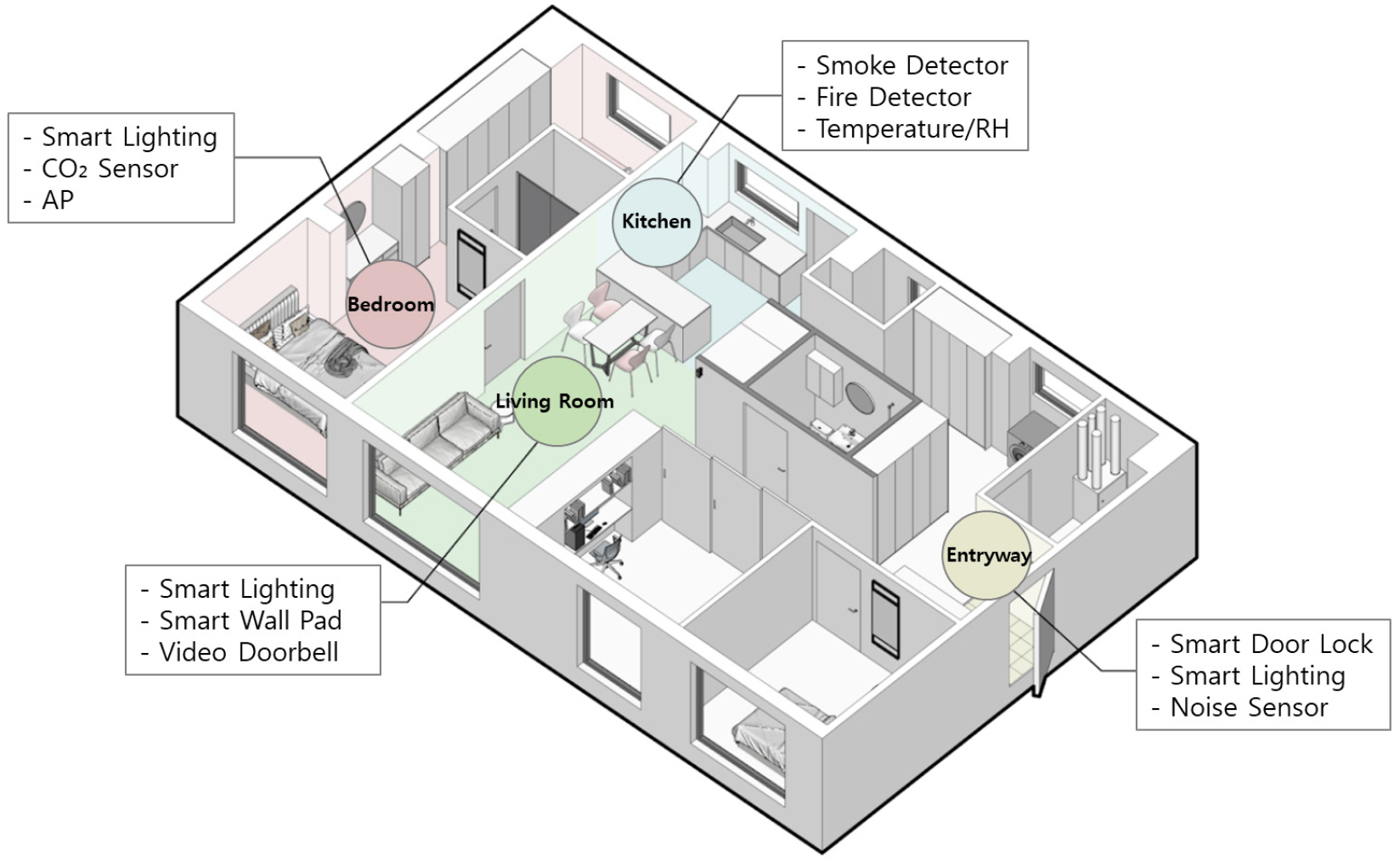
Residential space is the most fundamental and private domain supporting essential human activities and reflects not only physical functionality but also psychological comfort, social interaction, and cultural identity. Consequently, the installation of AIoT devices and the design of infill systems must prioritize comfort, functionality, and privacy, rather than solely focusing on technical efficiency. Residential spaces can be categorized into four primary zones—entrance, living room, kitchen, and bedroom—each requiring different types of IoT devices, installation positions, wiring strategies, and embedded infill configurations according to spatial hierarchy and circulation patterns.
These devices must be designed not as standalone units but as components of an embedded infill system, with power and communication infrastructure seamlessly integrated through ceiling, wall, and floor infill layers. While local wireless communication technologies such as Wi-Fi, Zigbee, and Bluetooth form the primary communication backbone of AIoT systems, supplemental wired circuits (LAN or PoE) are recommended to enhance signal stability, security, and power efficiency. During the design stage, communication protocols, power specifications, and inspection- opening locations for each device must be indicated clearly in the drawings. During construction, power cabling, conduits, and mounting frames should be installed prior to finishing works.
The living room and kitchen host the highest concentration of AIoT services—such as sensors, speakers, wall pads, lighting, and ventilation systems—and thus require adequate separation distances to avoid mutual interference among devices. By adhering to these standardized construction guidelines, AIoT devices can be fully integrated into the architectural framework, enabling the realization of an embedded smart living environment in which digital intelligence is inherently fused with spatial and material systems. Figure 3 presents an example diagram of device locations in residential spaces.
Proposed Construction Guidelines for Infill- Embedded AIoT Installation
This section presents installation characteristics and construction guidelines for major infill components within ceilings, walls, and floors, based on the findings of the demonstration project. These guidelines supplement conventional architectural specifications, which do not explicitly address embedded AIoT installations, and aim to ensure the safety, aesthetics, and maintainability of AIoT infill devices.
(1) Ceiling Infill Integration Guidelines
(a) Smart Lighting Installation Guidelines
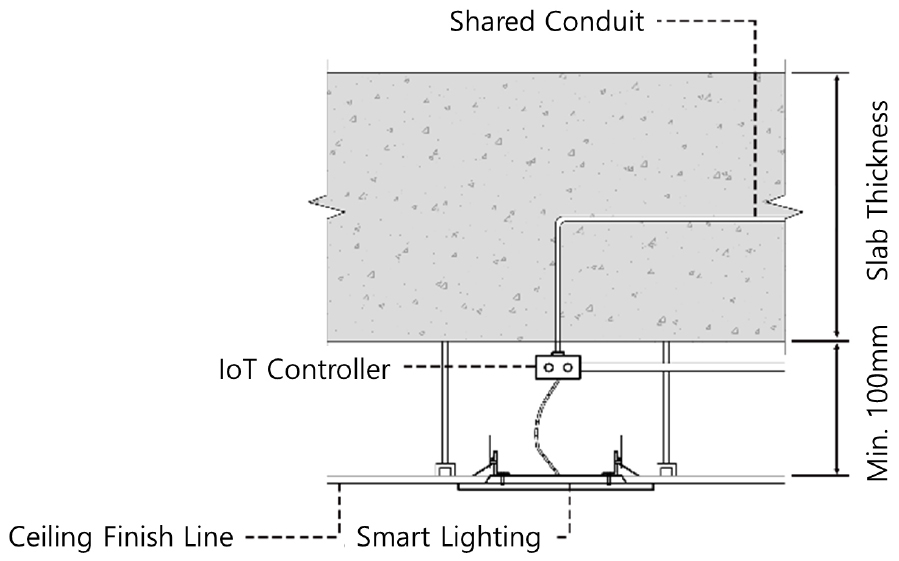
Smart lighting is a key infill component designed to enhance both occupant comfort and energy efficiency. The installation location must be clearly marked and prepared prior to gypsum board finishing, and fixtures should be embedded within the ceiling cavity. Light fixtures are installed through circular openings with a diameter of Ø75–Ø100 mm, and a minimum ceiling void depth of 100 mm must be secured to accommodate heat dissipation and wiring.
A spacing of 800–1,200 mm between fixtures is recommended to maintain uniform illuminance. Fixtures operate on AC 220 V, and control can be implemented through Wi-Fi or Zigbee-based wireless protocols. For luminaires requiring fixture replacement rather than wall switch replacement, compatibility of the SMPS (switching mode power supply) must be verified. Internal wiring should be organized using conduits and cable ties to minimize interference with ducts and ventilation components.
These guidelines provide the minimum design conditions necessary to ensure integration with architectural finishes while maintaining electrical safety and long-term serviceability. Figure 4 present the Smart Lighting Clearance Diagram.
(b) Smart Access Point (Wi-Fi AP) Installation Guidelines
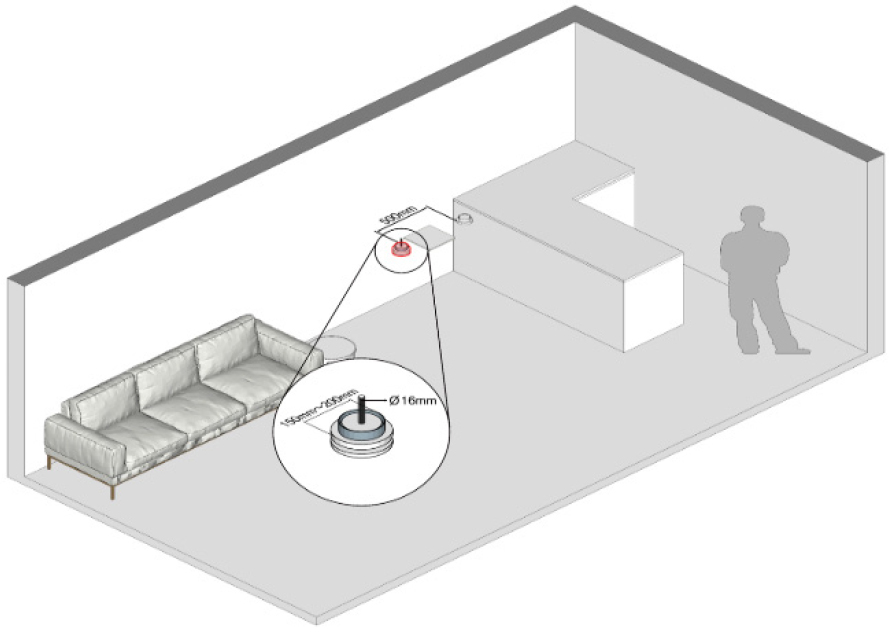
Smart access points ensure stable wireless network performance within residential units. They should be installed in the center of the living room ceiling as either fully embedded or semi-embedded units. Prior to installation, maintenance accessibility must be reviewed in relation to inspection opening placement, and the required ceiling opening should have a diameter of Ø150–Ø200 mm.
To prevent signal interference, APs must maintain a minimum clearance of 500 mm from HVAC diffusers and ventilation grilles, and at least 300 mm from metallic structural components. Power is supplied via PoE (LAN) or AC 220 V, and central placement within the living room minimizes signal dead zones. After installation, Wi-Fi signal strength must be measured to assess attenuation caused by obstacles, and checks should be performed to verify that nearby metallic ducts or reinforcements do not generate electromagnetic interference.
These procedures are essential for ensuring data reliability and communication infrastructure stability within residential environments. Figure 5 present the Smart AP Clearance Diagram.
(2) Interior Wall Infill Integration Guidelines
(a) Smart Wall Pad Installation Guidelines
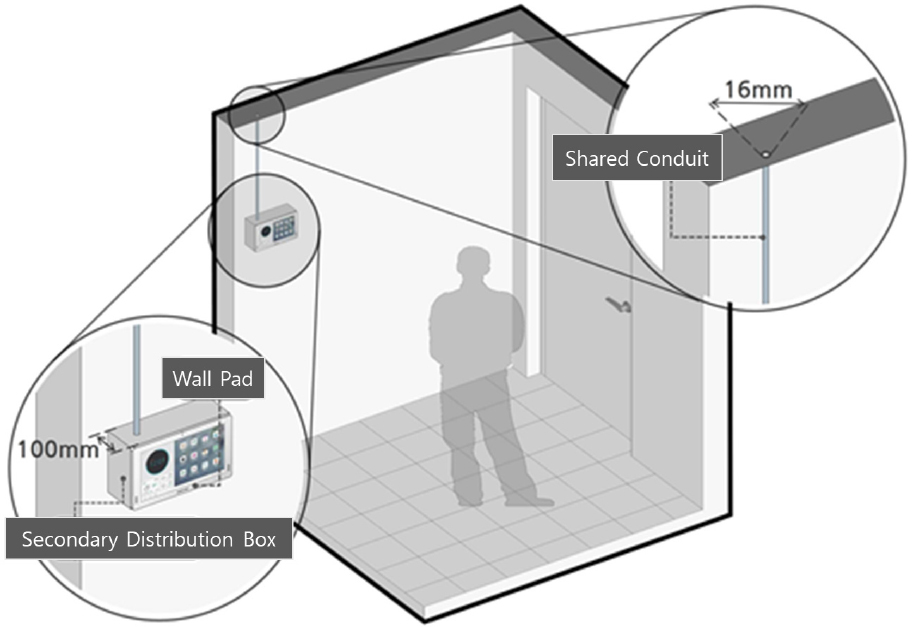
The smart wall pad serves as the integrated control interface within each unit and must be installed in a recessed configuration on a living-room or entry wall after applying plywood reinforcement (T ≥ 12 mm). A minimum cavity depth of 100 mm is required, and the screen center height should be positioned 1,350–1,450 mm above the finished floor level. Power is supplied via AC 220 V or a DC adapter, while wired LAN is the default network connection; supplemental wireless communication (Wi-Fi, Zigbee) may also be employed.
A cable slack of at least 100 mm must be secured during installation, and a ventilation clearance of at least 10 mm should be provided at the rear of the device to prevent overheating. The installation surface should align seamlessly with the wall finish, and a dedicated mounting bracket is recommended to prevent displacement caused by vibration or external forces. These standards ensure both the visual integration of the device and ease of maintenance. Figure 6 present the Smart wall pad Clearance Diagram.
(b) Smart Motorized Blind Installation Guidelines
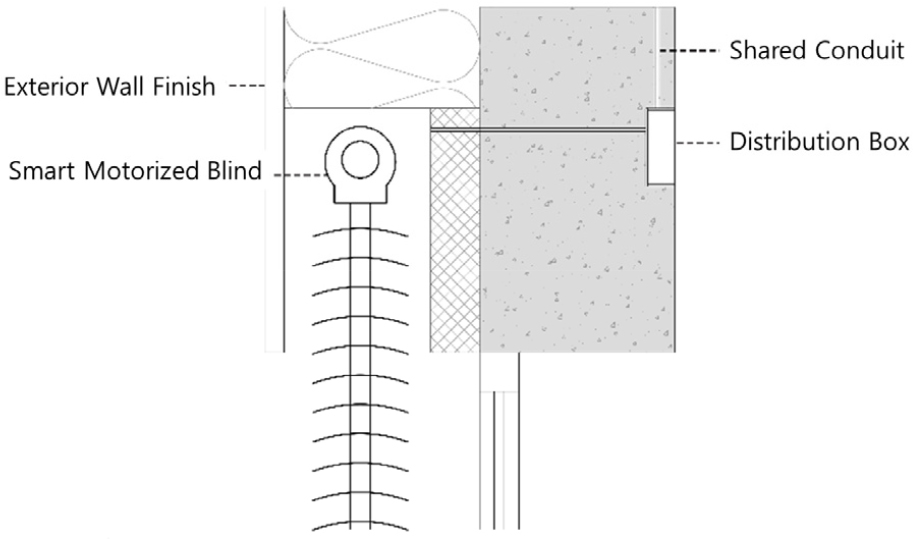
Smart motorized blinds regulate solar heat gain and outdoor exposure to enhance indoor comfort and energy efficiency. They may be installed on the exterior or upper interior zone of the window and consist of a motor, shaft, guide cables, sensors, and a gateway. Prior to installation, window dimensions, facade orientation, solar exposure, and power routing must be reviewed, and installation drawings must be approved. The blinds should be fabricated from noncombustible aluminum alloy materials (Fire Resistance Grade 1).
During installation, blind brackets must be anchored directly to the structural frame, and power and communication lines must be routed in separate conduits maintaining at least 150 mm of clearance to avoid interference. Supported control protocols include Zigbee, Wi-Fi, RS-485, and Modbus, enabling centralized, group, and individual operation under a network-based control system. Motors and controllers must meet a minimum IP54 ingress protection rating for dust and water resistance. After installation, functional testing—including opening/closing, angle adjustment, and noise assessment—must be conducted to verify proper operation.
These guidelines support the embedded integration of energy-control and solar-management systems within AIoT-enabled infill structures, providing a technological foundation for transitioning smart homes from manual operations to adaptive, sensor-driven environmental control. Figure 7 present the Smart motorized blind Clearance Diagram.
(3) Floor Infill Integration Guidelines
(a) Smart Leak Detection Sensor Installation Guidelines
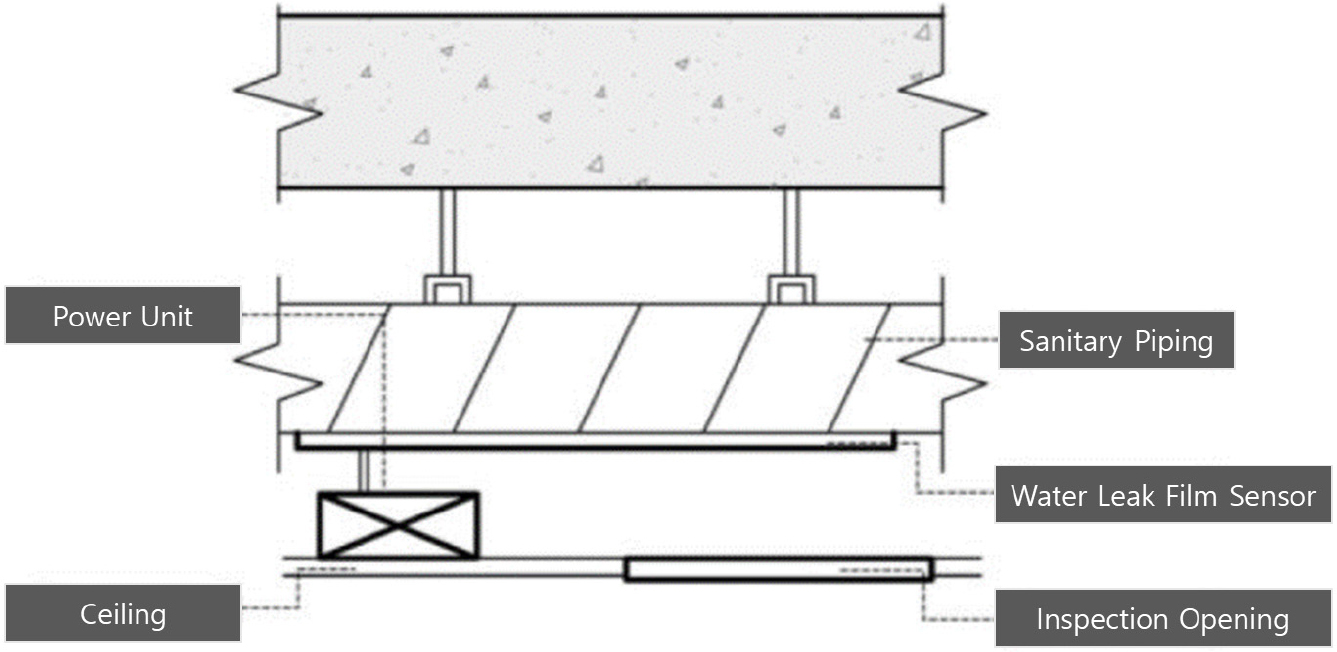
Smart leak detection sensors are installed on floors or at the lower portions of walls in areas with high leak risk, such as plumbing zones, laundry rooms, and kitchens. The sensors typically operate using a contact- type mechanism and detect water-level changes of 0.5 mm or greater within 1 second, triggering an output signal. Power may be supplied either through AC 220 V (wired) or DC 3–5 V (battery-powered) configurations, while communication is enabled via Zigbee, Wi-Fi, RS-485, or Modbus protocols linked to a gateway.
Prior to installation, floor levelness must be inspected, and sensors must be positioned at least 150 mm away from areas prone to splashing to prevent false alarms. Wiring must utilize waterproof materials, and power and communication conduits must maintain a minimum separation of 150 mm to avoid interference. After installation, a simulated leak test should be performed to verify detection speed, notification response, and valve-control integration. The test results must be documented in a commissioning report and submitted to the supervising inspector.
These guidelines serve as a foundational step toward preventing water-related damage in residential environments and demonstrate the feasibility of sensor- network integration within AIoT-enabled infill systems. Figure 8 present the Leak Detection Sensor Installation Diagram.
Result and Discussions
This study empirically analyzed the embedded infill integration of AIoT devices in the Sang-ri Energy Self-Reliant Village testbed and proposed a set of standardized construction guidelines for residential spaces. The results revealed that sensors, lighting fixtures, switches, gateways, and other devices in all units were connected through power and communication lines embedded within the infill system. This demonstrates a paradigm shift in AIoT deployment—from surface-mounted devices to information-oriented infrastructure structurally integrated into the building framework. Consequently, future smart-housing design must prioritize the configuration of layered infill systems, rather than individual devices, as these layers fundamentally determine the stability of power and data flows as well as long-term maintainability.
To address this, the present study developed detailed construction criteria for ceilings, walls, and floors based on empirical field data. These criteria serve as structural and ICT safety standards for AIoT-infused infill systems, filling gaps in existing specifications such as the Standard Specifications for Architectural Construction, which do not address embedded AIoT installations. Unlike previous IoT- oriented studies that largely focused on the “device–data” relationship, this study presents an integrated architectural–mechanical–information infrastructure model, providing a comprehensive physical–digital linkage framework. Furthermore, aligning the “infill replacement and maintenance guidelines” of the Long-Life Housing Certification System with the AIoT infill installation standards proposed in this study may enable the inclusion of new evaluation items—specifically, “AIoT infill installability and maintainability”—within future versions of the certification criteria. Such alignment also enhances compatibility with emerging digital-infrastructure certification systems (e.g., WiredScore, SmartScore), which increasingly emphasize structured pathways for power, communication, and device interoperability. In addition, the standardized infill guidelines developed in this study contribute to reducing unnecessary rework, material waste, and redundant installation caused by inconsistent device placement and non-uniform wiring practices. By minimizing repeated demolition of finishes and unplanned rewiring, the proposed framework supports sustainability goals at both the building and system levels. Specifically, embedded infill integration can reduce life-cycle environmental burdens by lowering maintenance-related construction waste and improving serviceability, thereby contributing to long-term reductions in life-cycle cost (LCC) and life-cycle carbon emissions (LCCO2). This positions AIoT-integrated infill design as a mechanism for enhancing the operational sustainability of residential buildings.
Such integration would serve as a foundational step toward developing a management framework for digital infrastructure across the entire building life cycle. Nonetheless, this study is limited in that the findings are based on a single demonstration complex and therefore do not fully reflect variations across different building types. In addition, quantitative analysis of device replacement cycles and actual maintenance costs throughout their life cycles remains a topic for future research. Despite these limitations, the study makes significant academic and industrial contributions by establishing and empirically validating a new research domain focused on the standardization of AIoT-infused infill systems
Conclusions
This study highlights the necessity of integrating AIoT devices within the infill structure of residential buildings and proposes standardized construction and quality-management guidelines based on empirical analysis from a real-world demonstration housing complex.
1.The testbed analysis revealed that most AIoT devices were connected to power and communication infrastructure through wall, ceiling, and floor infill systems; however, inconsistencies in installation methods across units and insufficient maintenance accessibility were identified. These findings confirm the need to standardize power and communication pathways, inspection openings, and maintenance criteria within infill structures.
2.Installation standards for key infill-embedded devices—smart lighting and access points (ceiling), smart wall pads and motorized blinds (walls), and leak-detection sensors (floors)—were derived, including requirements for wiring separation, finish integration, heat and moisture management, and safety measures. Based on these results, an integrated AIoT–infill construction guideline was established to simultaneously ensure installability, safety, and maintainability of AIoT systems.
3.The outcomes of this study provide empirical evidence that may support future incorporation of AIoT infill installation standards into national certification systems, such as the Long-Life Housing Certification and digital-infrastructure evaluation schemes (e.g., WiredScore). Furthermore, standardized infill design has the potential to enhance construction and supervision quality, improve operational efficiency, and contribute to building life-cycle carbon reduction (LCCO2).
Future research should evaluate applicability across various building types and scales, including office, commercial, and public facilities. Nonetheless, this study lays the foundation for such follow-up research and demonstrates that standardizing AIoT-embedded infill systems constitutes essential infrastructure for ensuring the quality, reliability, and sustainability of smart housing.

