


Introduction
List of symbols
Methodology
Preliminaries: RTCM
Climate Characteristics of the Ifrane city
Studied building architecture
Assumptions and methodology
Results
Discussion
Conclusion
Introduction
The sector of building is the second most energy consumer in Morocco after the transport sector, with a percentage up to 33% of the total national energy demand [1], split into 7% for commercial buildings and 26% for residential buildings [2]. Facing the energy in need dependence of 90.3% [2, 3], the Moroccan government had launched several programs concerning the integration of the foundations of energy efficiency in all energy-intensive sectors [4]. In the building field, the decision makers implemented the term of “ecological construction”, which can take place at two stages, that of the construction of new buildings with less energy consumption specification, which is considered as the better stage for enhancing building’s performances, as a thoughtfully planned building proves more efficient and cost-effective compared to one that requires renovations post-construction [5], or the stage of the renovation or rehabilitation of existing buildings to improve their energetic and environmental performances [3]. The enhancing of the buildings envelope performances remains one of the most effective way to reach the energy saving objectives [4], thus, in order to achieve that ultimate purpose, the Moroccan government elaborated a Thermal Regulation of Construction, the primary goal of this Regulation is to reinforce the energy efficiency of buildings and foster the development of a new generation of structures characterized by greater efficiency and cost-effectiveness in terms of energy consumption [2]. This encompasses minimizing heating and air conditioning requirements, enhancing thermal comfort within constructions, contributing to the reduction of the national energy expenditure, and aligning with principles of sustainability and environmental conservation [2]. Furthermore, the regulation aims to fulfill the country’s international obligations in combating climate change by ensuring a reduction in greenhouse gas emissions [2].
While Urbanization significantly raises both actual and ideal energy consumption, and simultaneously reducing the efficiency of energy use [6], a crucial step in ameliorating the buildings energy performance and carrying out sustainable development requirements is the improvement of buildings envelope performance [7], and in order to guarantee a high level of accuracy, the evaluation of the buildings envelope performance should be conducted with LCA approach, to investigate not only the impact of buildings envelope characterizations on Operational Energy (OE) use and dioxide of carbon emissions during the building usage, but also their effect on two important factors; the Embodied Energy (EE) and the Embodied Carbon (EC) [7], some researches prove that the EE can represent up to 40% of the total energy use in the life cycle of building [8, 9], which explains the relevance of analyzing the energy consumed and the gas emissions of buildings from “cradle” to “grave”. Furthermore, the assessment of the cost of the enhanced building envelope is important to evaluate the economic performances of the building, in order to accomplish a full multi-dimensional global analysis of building performances.
Several research treated the evaluation of buildings performances using LCA approach; Verbeeck et al. [9] showcased the outcomes of a contribution analysis conducted on the life cycle inventory (energy, gas emissions and cost) of four standard residential buildings in Belgium. Hong et al. [10] evaluated the life cycle energy and life cycle cost of five building envelopes inspired by the Passive House concept in the United States, this assessment was conducted through LCA and life cycle cost analysis (LCCA) in four distinct climate zones across the country. Nizam et al. [11] estimated the embodied, transportation and construction energy of building materials within Building Information Modeling (BIM) environment, by combining BIM tools with LCA tools to establish a connection between the model (with REVIT software) and its analysis (the developed prototype in form of add-on within the aforementioned software), the authors tested the tool with a case study of a R+3 building and validated it with detailed manual calculation. Mangan et al. [12] evaluated the energetic, economic and environmental buildings performances of different Turkey climate zones based on LCA approach, in order to choose the effective measures of residential building performances optimization, the authors adopted an Energy Lifecycle Assessment LCE, a dioxide of Carbon Lifecycle assessment LCCO2, and a Cost Lifecycle Assessment LCC in order to decide on energy saving solutions in terms of envelope insulation, green roof system, type and level of glazing, solar control system, and solar energy production systems. Ramesh et al. [13] conducted a LCE analysis of different types of residential building in India, using three dynamic simulation tools: Design Builder, Energy Plus and e-Quest, to evaluate saving features in term of envelope thermal insulation, and type of glazing for windows. Thaipradit et al. [14] undertook the examination of the life cycle energy and life cycle carbon of buildings with the aim of identifying strategies to minimize carbon emissions associated with energy use throughout the lifespan of a building. Dean et al. [15] evaluated the environmental characteristics of concrete construction in contrast to wood-framed construction, a LCA was performed on a house with two modeled exterior walls: one with a wood-framed construction and the other with an insulating concrete form wall.
In this context, this study aims to determine the optimum type and thickness of the thermal insulation material for a typical construction prototype in the city of Ifrane (Morocco), by conducting a LCA analysis (LCE, LCCO2 and LCC) to compare the performances of three different types of thermal insulation materials; Extruded Polystyrene (XPS), Rockwool (RW) and the cork boards (ICB), using a Dynamic Thermal Simulation (DTS), Ifrane was chosen specifically as the studied Moroccan climate zone following the fact that, in Ifrane, buildings account for 62% of the total energy consumption based on 2021 data, this makes it the Moroccan city with the highest energy demand for buildings, averaging 78.1 kWh/m² annually, following Ifrane, Marrakesh buildings consume 74.2 kWh/m² per year [16].
This paper is structured as follows. Section 2 emphasizes the methodology followed, it describes the climate characteristics of the city of Ifrane, and outlines the architecture of the studied construction, assumptions, and methods. The results of the DTS are presented in Section 3. Section 4 develops the results discussion. Finally, conclusion and perspectives are exposed in Section 5.
List of symbols
BC Base Case
BIM Building Information Modeling
DTS Dynamic Thermal Insulation
EE Embodied Energy
EC Embodied Carbon
ICB Cork Board Insulation
ICE Inventory of Energy and Carbon
LCA Lifecyle Assessment
LCC Lifecycle cost assessment
LCCO2 Lifecycle Dioxide of Carbon Assessment
LCE Lifecycle Energy Assessment
LCEE Lifecycle Embodied Energy Assessment
LCOE Lifecycle Operational Energy Assessment
MTEDD Ministry of Energy Transition and Sustainable Development
OE Operational Energy
OC Operational Carbon
RTCM Règlement Thermique de la Construction au Maroc (Moroccan Thermal Regulation of Construction)
RW Rockwool
U-Value Coefficient of thermal transfer
XPS Extruded Polystyrene
Methodology
Preliminaries: RTCM
In 2015, Morocco has launched the thermal regulation of construction (RTCM), it encompasses the housing sector (economic, standing) and tertiary buildings (hotels, administrative buildings – offices, education and higher education buildings, and hospitals). The RTCM is a tool that assists in optimizing the thermal and energy efficiency of a building’s envelope during the design phase, it can also function as a diagnostic tool for existing buildings, offering a standard for acceptable thermal insulation levels. Simulation software can be employed to evaluate the annual heating and cooling requirements of buildings and compare them to this standard [17].
The RTCM introduced the Moroccan climate zoning, the Moroccan territory has been divided into homogenous six climatic zones based on an analysis of climate data collected from 37 meteorological stations over a ten-year period from 1999 to 2008 [2, 18], the six climate zones are Agadir, Tanger, Fez, Ifrane, Marrakech, and Errachidia respectively. The RTCM defines two different approaches to determine regulated specifications required for a building; the first one is the performance approach which fixes the technical specifications required for the energy performance of the building, while the second one is the perspective approach which elucidates minimum technical specifications, including the window-to-wall ratio, minimum ground floor insulation resistance, solar factor coefficient of glazing, and thermal transmission coefficients for exposed roofs, external walls, and windows [17, 18].
Climate Characteristics of the Ifrane city
The Moroccan Thermal Regulation of Construction (RTCM) adopts a climate zoning approach, where Moroccan regions have been categorized into six climatic zones (Agadir, Tangier, Fez, Ifrane, Marrakech and Errachidia), by the National Meteorological Directorate and the Moroccan Agency for Energy Efficiency, with the support of international expertise [2, 17].
The simulations were conducted with Ifrane city climate characteristics. The weather in the city is considered temperate [19], the maximum temperature registered is 40° in July, and the lowest temperature is -5° in January, the months of December, January, and February experience the lowest temperatures due to reduced solar radiation, conversely, July stands out as the warmest and sunniest month of the year [20]. Ifrane falls within the humid subtropical climate (Cfa) climate zone according to the Köppen classification, which is known for its hot and humid summers as well as its cool winters [16].
Studied building architecture
The studied building case is a typical construction prototype in Morocco, based on the Moroccan residential construction market, with a surface of 46.2m2, the building was 3D-modeled with Revit Software as shown in Figure 1 below. Residential buildings consumed up to 26% of the total national energy consumption [2], exceeding the other building construction types. That makes the residential building sector a key one for achieving a touchable energy saving.
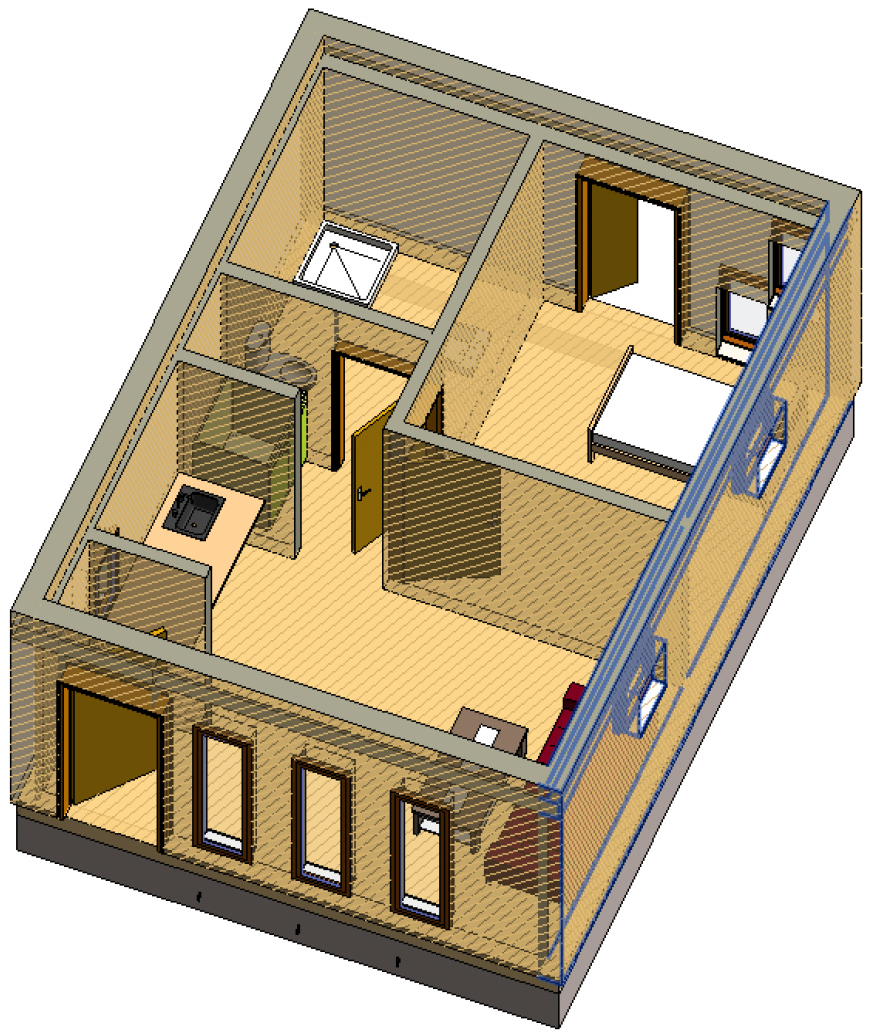
The building envelope architecture for the Moroccan typical construction is presented in Table 1, the outer walls are composed of five layers, the windows are made of single glazing with a wood frame. This type of architecture is considered as base case for the outcoming simulations.
Table 1.
Building envelope architecture
Assumptions and methodology
This study uses a LCA approach to uncover the optimal solution for energy saving and environment preservation, among three different thermal insulation materials; Extruded Polystyrene known as XPS, Rockwool (RW), and cork boards (ICB), in the case of the prototype investigated. Figure 2 provides an overview of the proposed methodology and the software tools utilized.
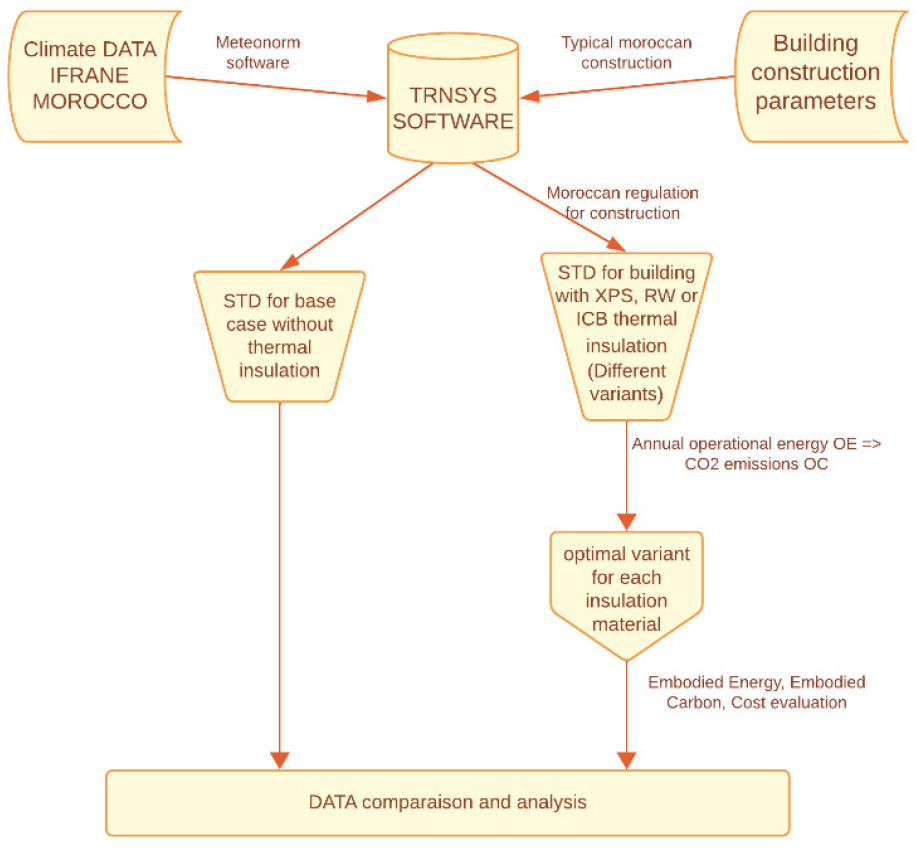
The analysis of these materials calls for the evaluation of four characteristics in relation to the LCA approach, a “cradle” to “grave” method [21]. The lifecycle energy assessment LCE requires the examination of the energy consumed during the lifetime of buildings, from the production of their construction materials until the end of their lifetime, passing by the product stage, the construction stage, the use stage, and the end-of-life stage [9]. However, the amount of information about the second and forth stages is often limited [22], thus, the LCE assessment carried out includes only the product and use stages, by evaluating respectively the Embodied Energy EE and the Operational Energy OE, the energy consumed over the lifetime of the building is the sum of these two energies. On the other hand, the LCCO2 adopted a comparable method, it stipulates the determination of the Embodied Carbon EC and the total Operational Carbon OC.
Moreover, the LCC method was utilized to assess the cost efficiency of various building envelope options, this analysis carried out in this research encompassed both the initial material costs and operational energy consumption expenses over the lifespan of the building, in addition, identical costs and costs of the building components with no influence on the energy performance of the reference building are excluded from consideration. The total LCC is calculated using the following equation 1[23]:
With:
IMC:Initial Material Costs of building elements
AOE:Annual Operational Energy in kWh calculated from the dynamic simulation for each evaluated variant;
UEC:Unit Energy Cost 0.116 USD/kWh [24];
USPW(d,N):Uniform-Series Present Worth factor based on a discount rate
d:discount rate of 2,5% [25];
N:building lifespan.
The USPW(d,N) is calculated as followed in equation 2 :
The EE and EC were obtained from the Inventory of Energy and Carbon (ICE) version 2.0 [26], and literature data [27, 28] as indicated in Table 2 below. The OE and OC were calculated by conducting a Dynamic Thermal Simulation DTS using TRNSYS software, this tool had proved its reliability in numerous studies [29, 30, 31, 32, 33]. The building studied is considered as a one-zone construction, with a lifetime of 30 years, the software allows to simulate thermal characteristics of the envelope as shown in Table 3 bellow.
Table 2.
EE and EC of thermal insulation materials
| Thermal Insulation material | EE in MJ/Kg | EC in KgCO2/Kg |
| XPS | 86,4 | 3,43 |
| ICB | 25 | 1,2 |
| RW | 16,8 | 1,12 |
Table 3.
Geometric and thermal characteristics of the studied building envelope
In the framework of this study, the developed variants aim to investigate the energy saving measures in terms of thermal insulation. The two approaches of the Thermal Regulation of Construction in Morocco are used [17], the prescriptive approach specifies the minimum technical specifications required for the thermal properties of the building envelope walls, including thermal insulation, and bay window rates. Whereas, the performing approach specifies the technical specifications required for the energy performance of the building, assessed based on its annual energy requirements [17], as shown in Table 4.
Table 4.
Minimum technical specifications fixed by the Moroccan Thermal Regulation of Construction (RTCM) for residential Buildings
| Climate zone | minimum technical specifications in kWh/m2/year for residential Buildings |
| Ifrane | 64 |
The study focuses on evaluating the energy loads profile depending on the type of thermal insulation material and its thickness. The variants consider the minimum thickness required, in thermal insulation guide, for the respect of the requirement of the Moroccan Regulation [2, 17], and then change it increasingly in sort to minimise the coefficient of thermal transfer values, while examining the results of energy annual loads of the running simulations with TRNSYST software. The studied variants are described in Table 5 bellow.
Table 5.
Variants simulated with TRNSYS
Results
The simulation with TRNSYS software allows the estimation of coefficients of thermal transfer (U-Value) for the entire building envelope in the different treated variants, the results are outlined in Table 6 below. With the aim of determining the variant with the optimal performances depending on LCE and LCCO2 assessment, the present study conducts thirteen simulations. Within the context of the obtained analysis results, the variants of the three thermal insulation type with the minimum annual operational energy OE are picked out for the next phase of the analysis, to calculate their EE and EC, in order to accomplish the four bases of the LCA approach performed. Hence, the optimal measure for energy-saving and environment preservation is evaluated depending on the final variant with the minimum energy consumption and the minimum dioxide of carbon emissions in the 30 years of the building lifetime, including its product stage.
Table 6.
U-Value of the building envelope for the different variants
The results of the thirteen simulations are illustrated in Figure 3. The carbon factor per kWh is set to 0,718 KgCO2 /kWh for the Moroccan case [34]. The base case with the typical construction type in Morocco presents a total annual OE higher than the one required by the Moroccan Thermal Regulation of Construction RTCM (see Table 4). The XPS variants showed different results according to the thickness of the thermal insulation in building envelope, ranging from the higher value 70,27 kWh/m2/year with variant N°1 to the lowest value 63,69 kWh/m2/year with variant N°3. However, variant N°4 showed a short increase in simulated OE, the thickness added of the XPS in ground caused an overheating, which generated more cooling loads. The ICB variants also exhibited varied outcomes based on the ICB thickness in the building envelope, between 69,35 kWh/m2/year and 63,34 kWh/m2/year. The latest thermal insulation examined in the RW, which registered a variation of OE between 72,94 kWh/m2/year and 63,37 kWh/m2/year.
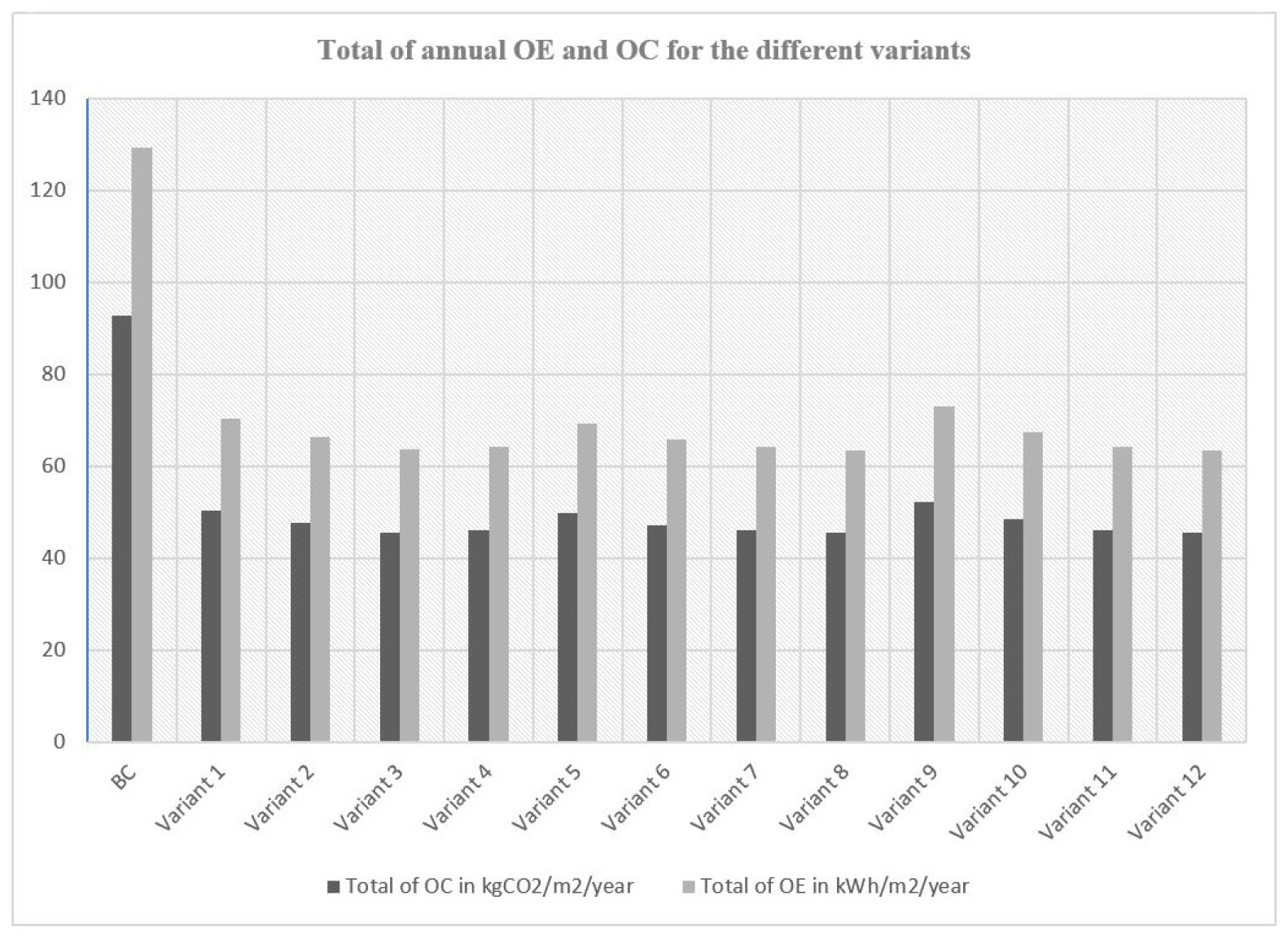
The variant N°9 displayed the maximum OE and OC with a value of 72,94 kWh/m2/year and 52,37 kgCO2/m2/year respectively, the thermal insulation in this variant is the RW, with a thickness of 55mm in outer walls, 50 mm in roof and 30 mm in ground. The most optimal variant among all the simulations is variant N°8 with ICB, the adding of 50 mm of ICB in the total building envelope fulfils the energy loads requirements of the Moroccan Thermal Regulation of Construction RTCM by an annual OE of approximately 63,34 kWh/m2/year, and an annual OC of nearly 45,48 kgCO2/m2/year.
Table 7 reveals the calculated EE and EC for the three thermal insulation variants with the optimal performance in terms of OE and OC: variant N°3, 8 and 12. The result shows that the XPS presents the most optimal solution depending on both calculated EE and EC, followed by the ICB and then the RW.
Table 7.
EE and EC of the three thermal insulation optimal variants
| Variant | Insulation Materials | Total of EE in MWh | Total of EC in tCO2 |
| Variant 3 | XPS | 35,1 | 11,6 |
| Variant 8 | ICB | 38,4 | 12,3 |
| Variant 12 | RW | 42,3 | 13,9 |
The LCC analysis is conducted for the three thermal insulation variants with the optimal performance in terms of OE and OC, the results shows that the Rockwool is the most effective solution in term of cost reduction by reducing 30,2% of cost in the lifespan of the building compared to the base case, followed by the XPS with a life cycle cost reduction of 21%, whereas the ICB doubled the LCC of the building.
The outcomes of the global LCA approach combining LCE (EE and OE analysis) and LCCO2 (EC and OC analysis) are illustrated in Table 8. The XPS is considered the most effective solution for energy saving and environment preservation according to the results of the LCA approach, by reducing 40,8% of the lifetime energy consumption and 46,2% of the total dioxide of carbon emissions compared to the base case, while the ICB diminishes the energy consumption by 39,4% and the carbon emissions by 45,9%. Besides, the RW lowers the energy consumption by 37,5% and the carbon emissions by 44,8%. However, this latter emerges as the most efficient solution in terms of life cycle cost analysis.
Discussion
The aim of the present study is the determination of the effective measure of building energetic and environmental performances optimization, amongst three different thermal insulation materials (XPS, ICB and RW) for a building simulated in Ifrane city, using a LCA approach combined with a dynamic thermal simulation. The purpose was the scrutiny of the thermal insulation with the most reduced energy consumption, less carbon emissions, and most cost- effective solution over 30 years of lifetime.
In line with the findings from the Life Cycle Energy (LCE) and carbon (LCCO2) analysis, the use of ICB achieves the most reduced operational energy and carbon, while the use of RW registers the maximum operational energy and carbon emissions among the three optimal variants, but still fulfils the Moroccan Thermal Regulation of Construction’s energy loads requirement. The estimate of the embodied energy and embodied carbon reversed the results; the XPS became the solution with the optimal building energetic and environmental performances, while the ICB left the Sommet, by recording a higher total required energy and carbon emissions. This twist plot is caused by the amount of energy required to produce ICB, and its related carbon factor, despite it being a natural organic material. In fact, the calculated EE of the building with the three final variants represented up to 32% of the total energy required in the building lifespan, whereas the estimated EC accounted for 15 to 18% of the total carbon emissions, which explain the decreasing of ICB energetic and environmental performance.
Hence, the data indicates that both EE/EC and OE/OC are influenced by the type and amount of insulation material, and as Moradibistouni et al. stated [35], It is necessary to integrate Lifecycle Embodied Energy (LCEE) and Lifecycle Operating Energy (LCOE) assessment to determine the most energy-efficient scenario by the end of building lifetime. On the other hand, the conducted simulations show that the application of the minimal materials specification fixed by the Moroccan Regulation cannot always assure the desired level of energetic performance [2, 17], as variants N°1 showed. Therefore, it is important for building designers and decision makers to conduct thermal simulation of buildings before passing to the construction phase.
In another hand, LCC analysis demonstrates that the RW is more economically efficient than the other alternatives, regardless of being in the bottom of the energy and environment performances list. Comparing to the XPS case, the RW showed lower results in term of energy saving and environment preservation, thus, deciding on the choosing alternative will be a question of priority selection, between either cost saving or environment conservation.
Ultimately, when examining the Life Cycle Energy assessment (LCE) data alongside the findings from the Life Cycle Cost (LCC) analysis, investments in high thermal insulation, such as ICB, might not consistently yield returns in terms of cost and energy savings or ecological preservation throughout the building’s lifespan. The initial cost of the ICB was remarkably higher than the other thermal insulation materials, affecting then its cost efficiency comparing to XPS and RW.
Conclusion
This paper treats the subject of building performance optimization, on both sides, energy efficiency and environment conservation. To assess the cycle of the consumed energy and the emitted carbon, the study adopted LCA approach by following the path of these two parameters during the lifespan of the discussed building. The methodology devised within the context of this study evaluated the performances of three different thermal insulation materials: XPS, ICB and RW, the outcomes of each step of the evaluation are different, the most effective thermal insulation depending on the OE/OC is not the one based on the complete LCA application, these findings prove the importance of carrying out a full review of energy consumption and carbon emissions before making decisions about buildings performances. Hence, exploring ways to minimize the embodied energy and embodied carbon of buildings could be a compelling subject for future research, the impact of these two endpoints becomes clear after analysing the LCA approach upshots.
In the framework of this study, the findings showed that the XPS is the most energy and environment effective alternative, while the RW is proven to be the cost most efficient solution. Thus, conducting a LCA method should take into account the different aspects of the planned project, in order to analyse the big picture of key building performances, and to decide carefully which solution to adopt, in respect with the energy, environment and cost performances requirements, and the projects primary planned objectives.
The present analysis did not consider the construction and end of life stages in energy consumption, carbon emissions and cost evaluation, moreover, it did not include labor costs during construction, because of the lack of related data, it is assumed that labor costs would differ for each construction project and could potentially affect initial construction expenses, these points can be a topic for further investigation.

