


Introduction
Methodology
Results and Discussion
P-wave velocity and index quality
Compressive and tensile strength
Durability of the aggregates
Conclusion and Recommendation
Introduction
High rate of infrastructure development and increase in construction activities, is posing huge demand on good quality aggregates for making concrete, pavements and ballast for railway tracks. Good quality aggregates are formed using hard and compact rocks (igneous and metamorphic rocks) whereas soft rocks i.e., sedimentary rocks are not generally preferred in such construction owing to their low compressive strength and durability. Further, sedimentary rocks are also highly susceptible to weathering and erosion as compared to the igneous and metamorphic rocks. Since sedimentary rocks are formed by weathering, erosion and deposition of the pre-existing igneous, metamorphic and sedimentary rocks itself, therefore it occupies approximately 75% part of the earth’s surface and remaining 25% is occupied by igneous and metamorphic rocks along with soil cover.
The rising demand of aggregate materials in India cannot be fulfilled using only hard rocks, therefore, good quality sedimentary rocks (soft rocks) must be utilized in concrete works, pavement for roads, ballast for railways tracks and other construction practices without compromising with the strength and durability aspects. But it is important to analyse the physico-mechanical behavior of rocks before recommending them for any type of constructional works, as their properties are adversely affected by the exposure conditions [1]. The existing rock types in northern region of India, like granite, marble, ryolite are expensive rocks and are mostly utilized in construction works like making tiles, flooring, terrace and for decorative purposes, thus their application as aggregate material is not economical. The existing quartzite terrain in Delhi, Haryana region cannot fulfill all the requirements of aggregates. Therefore, in the present study soft rocks present in abundance were selected and their suitability as an aggregate material was ascertained using standard tests.
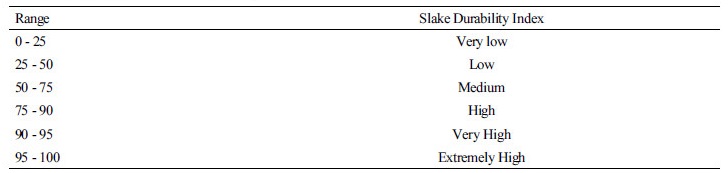
Aggregates used in the construction practices passes through several strength and durability tests like compressive strength test, slake durability test, impact test, porosity and permeability etc. The physio-mechanical properties of rocks play an important role in determining their utility for various construction works. For example the durability of construction materials is fundamentally important as it tells about the longevity of materials used in construction. Therefore some index is required to measure the degree of alterability for ranking rock durability. The range of durability of aggregates expressed using Slake durability index is illustrated in Table 1 as per Indian standards [2]. Other characteristics include shape, texture, toughness, strength, modulus, unit weight, water absor-ption and degree of heterogeneity of the aggregate material.
In the present study Kota sandstone has been selected for the study, which is widely available in abundance and severely affected by natural agents like temperature, rainfall, pollution and processes of weathering and erosion, which has degraded its structural soundness and appearance [1]. Further studies show that in sandstone the composition of the material and its micro-structure changes with escalation in temperature [3]. Moreover in sandstone at joints the peak shear strength is reduced by 20 to 24% due to wetting [4] and both Young’s modulus and porosity is significantly affects the unconfined compressive strength (UCS) of sandstone rock, which is a measure of ultimate stress a cylindrical rock specimen can take under axial load [5]. UCS is one of the most important properties of rock material used in design and analysis.
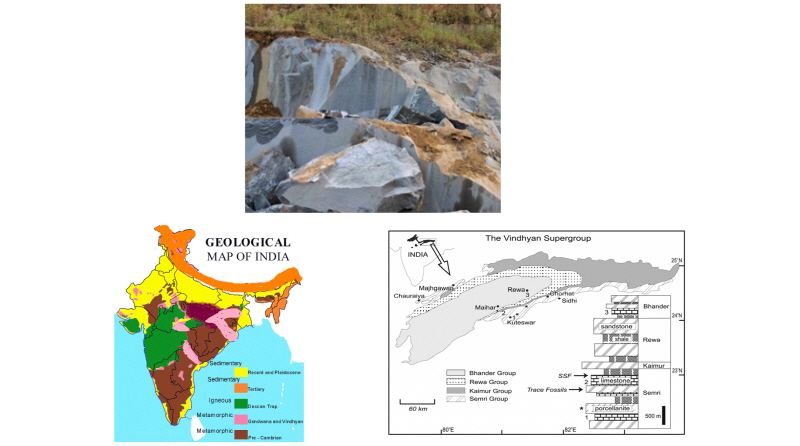
Kota sandstone is widely available in Vindhyan hills, of Kota region of Rajasthan state (Figure 1(b). It is fine grained in nature and is used in several types of construction projects due to red color and brown color shades, its good durability and, ease in polishing and carving [6-8]. In order to check its suitability as construction material, many researchers have performed dynamic compression tests and Quasi-static tests on rocks at low to medium strain rates [9-13].
In the present study Kota Sandstone which is widely available in abundance was selected for measuring its suitability as aggregate material for concrete, pavement and its findings were compared with preferred aggregate rock materials like Deccan Basalt (Figure 1(a)). The major objectives of the study are (a) to analyse compressive and tensile using direct and indirect methods in dry and saturated conditions; (b) to measure the durability of the aggregates using slake durability test, porosity (c) to measure dynamic modulus, and index quality from ultrasonic pulse velocity tests.
Methodology
Tests were done at the rock mechanics laboratory of Indian Institute of Technology (IIT), New Delhi to determine the physical and mechanical properties of Kota Sandstone in dry and saturated conditions. Dry density, saturated density, water content and porosity were determined and 107 specimen of 38mm diameter (BX) having slenderness ratio from 0.5/1 to 3:1 length/diameter are prepared. The results for various size of specimen are listed in in Table 2. Specimens passing through 475 micron sieve size were used for determination of specific gravity.
Specimen of 38 mm diameter (BX size) were prepared for determining mechanical properties as per IS 9179-1979 [14]. To understand the scaling effect specimen having different slenderness ratio were prepared.
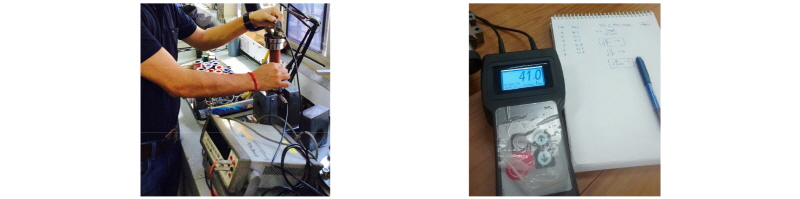
Ultrasonic pulse velocity test was conducted as per ASTM D2845-08 [15]. Sonic velocity test is a fast and non-destructive test which can be used to determine the fissuring and anisotropy in rocks. P-wave is the fastest traveling wave and is commonly used to calculating wave velocity measurements. P-Wave velocity is directly related to the density and porosity of rock. As the grains are in good contact in a highly compacted rock, a compacted rock has high velocity. The test was done under dry and saturated conditions to understand the degree of fissuring and heterogeneity in the rock. A pulse wave of 50kHz frequency was transmitted from one end of the specimen to the other end and time of travel of the wave from the transmitting end to receiving end is calculated using pulse data logger as shown in Figure 2. The time of travel through the specimen was used to determine the primary wave velocity. Variation in primary wave velocity was helpful in determining the degree of anisotropy and fissuring both in saturated and dry conditions in the rock specimen. Further, the time of travel and unit weight was used to determine the elastic dynamic modulus using the following equation:
 Eq. (1)

A durable rock is necessary for road subgrades, ballast in railways, and in various other construction applications which are capable of sustaining frost and salt action, alternate heating and cooling, drying and wetting conditions. Weathering processes of chemical and biological nature are not likely to result in disintegration of rocks during the life of structure however, other processes like frost, abrasion, leaching, chemical alteration and severe climatic conditions can deteriorate the rock in a short period of time [16]. Therefore, slaking test becomes necessary to understand and anticipate the swelling and other changes in rocks. Slake durability test was conducted using the IS: 10050-1981 [2]. For slake durability test 10 spherical specimen of 50gm each were prepared and oven dried (105ºC) before testing under slake durability apparatus as shown in Figure 3. Prior to testing the sharp edges in the specimens were removed essential for slake durability test. The drum having 2 mm mesh size, half filled with water at room temperature was used and all specimens were placed in drum. Test was conducted under two cycles of 10 minutes each and the weight retained after two cycles was used to calculate the durability of the rock specimen. The slake durability index (Id) is defined as the percentage ratio of final to initial dry weights of rock in the drum.

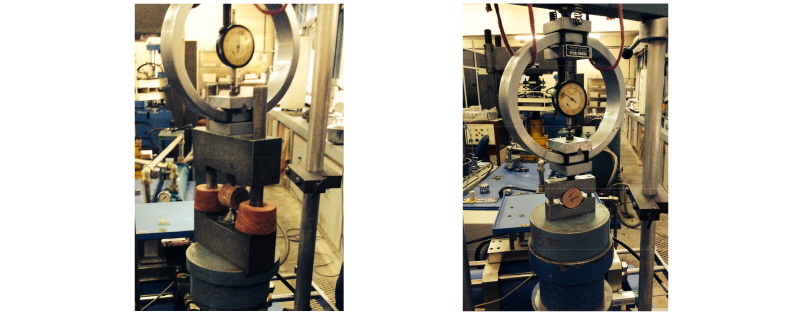
To determine the mechanical properties point load test and Brazilian tensile test were done as per IS: 8764-1998 and IS: 10082-1981 respectively [17,18]. Figure 4(a) shows the apparatus used for conducting point load test. Point load test was done on samples with slenderness ratio 1:1 under both axial and diametrical positions. Brazilian test was conducted on specimen of slenderness ratio 0.5:1 as shown in Figure 4(b). Brazilian test is useful to determine the tensile splitting behavior indirectly. Load was applied at a rate of 0.2 kN/sec and gauge readings were noted down, which were used to calculate the failure load.
Results and Discussion
P-wave velocity and index quality
A number of samples were tested under dry and soaked conditions. P-Wave velocity was found to be decreasing with decrease in degree of saturation. The ultrasonic test results are presented in Table 3. Ramana and Venka-tana-rayana, 1973 [19] has shown that P-wave velocity increases with increasing weight and saturation, which supports the present findings. Lama and Vutukuri [20] also showed that wetting of rocks leads to rise in P-wave velocities. Typical values of P-wave velocity in sandstone rocks is 6,000 m/s. Index quality (IQ) was determined, which is a measure of ratio of longitudnal wave velocity in an intact rock specimen to the actual wave velocity in rock specimen obtained. The range of IQ was found to be 44 to 60%.
A relationship between P-wave velocity and bulk density in dry and saturated conditions is shown in Figure 5. No clear relation can be deduced between P-wave velocity and saturation. Figure 6 shows slight increase in P-wave velocity (Vp) with increase in porosity. The increase in Vp due to saturation suggests that pores are present in form of cracks as pores present in form of round holes do not affect the P-wave velocity. Variation in the interconnected and non-connected round holes present in the specimen affect the P-wave velocity for different specimen.


The elastic modulus presented in Table 3 calculated using Eq. (1) suggests that elastic modulus was found to be higher under saturated conditions. However, the results of elastic modulus obtained from ultrasonic velocity is not a representative method of calculating elastic modulus as it is due to presence of water in the interconnected pores which tends to suggest an increase in stiffness of the material.
Compressive and tensile strength
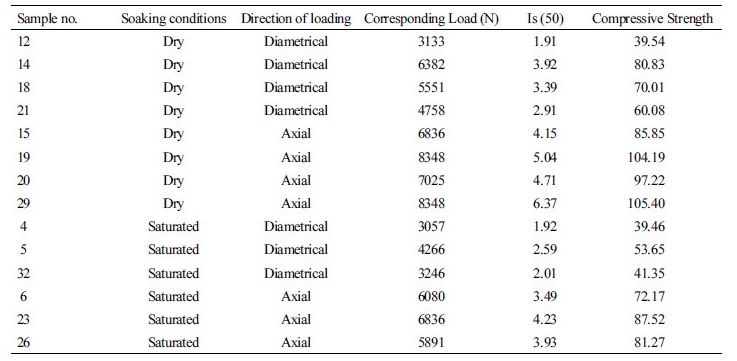
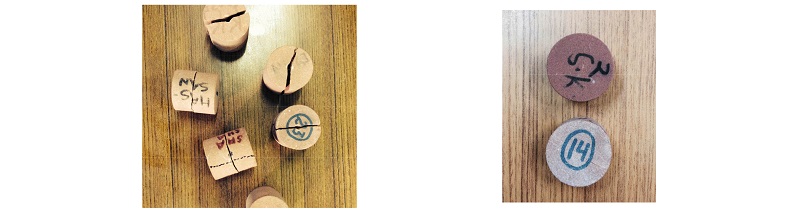
Point load test was conducted on specimen of slenderness ratio 1:1 as per IS 8764:1998. Point load strength index was determined and compressive strength (qc) given in Table 4 was calculated for both dry and wet conditions as per the given equation suggested in [5] qc= 22 Is(50); where Is is the corrected point load strength. The specimens were inserted in axial and diametrical positions in the test machine shown in Figure 3(a) to make a line contact. Tests were conducted on axial and diametrical positions to understand the effect of plane of anisotropy. The tests for which failure passed through only one loading point were rejected. Some of the failed specimens are shown in Figure 6(a).
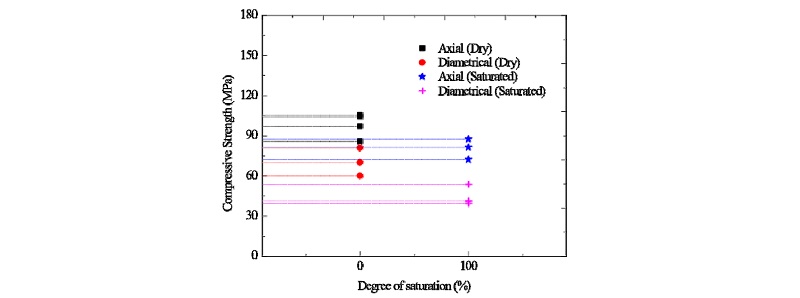
A comparison between dry and saturated compressive strength under different loading conditions is given in Figure 8. It can be seen that the compressive strength decreases upon saturation. And the compressive strength under diametrical position is found to be lower as compared to under axial loading condition. Axial loading direction is more representative of the compressive strength.
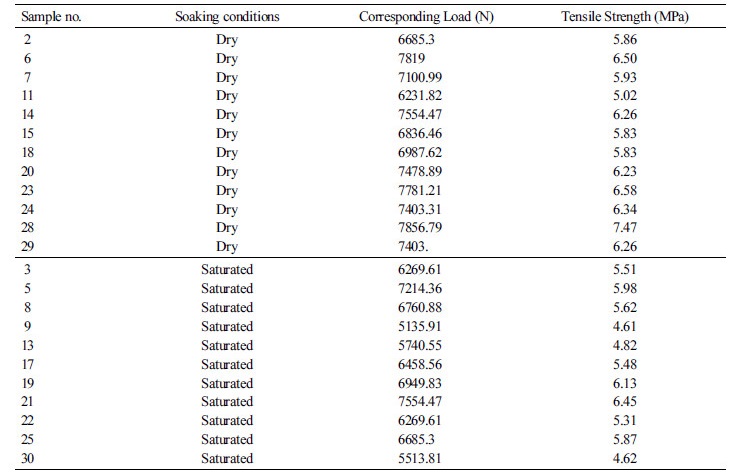
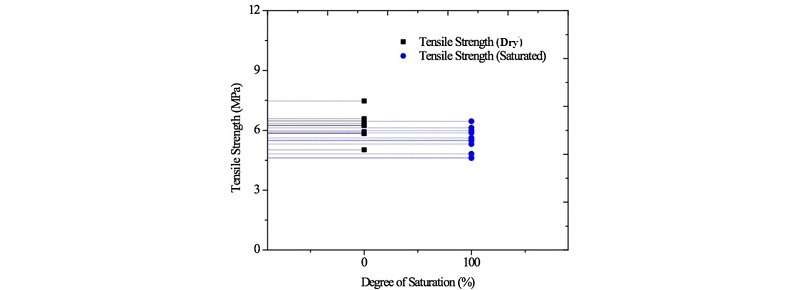
To determine the tensile strength Brazilian test was conducted whose results are given in Table 4. A comparison of tensile strength under dry and saturated conditions is given in Figure 9. It was found that under soaking the tensile strength of Kota sandstone decreases. The average value of tensile strength under dry state condition is 6.17 MPa, whereas under saturated conditions the average tensile strength is 5.49 MPa. This suggests a reduction of tensile strength by 11% upon saturation.
Durability of the aggregates
The durability test was conducted as per IS: 10050-1981 [4]. The results of durability test were presented in Table 5. The conduct of test is shown in Figure 9. The average slake durability index of Kota Sandstone was found to be 97.71% after two cycles of 10 minutes each, which shows that Kota sandstone is in the range of high durability. The slake durability index of compact Basalt is in the range of 99.44% [21] which is an extremely durable rock as per classification given in IS:10050-1981. Compared with compact Basalt, Kota Sandstone also has extremely high durability and therefore can be utilized in place of compact Basalt.

Conclusion and Recommendation
From this study following conclusions can be drawn:
1.Upon saturation of Kota Sandstone, the compressive strength can reduce up to 17% of dry conditions, while the tensile strength can be reduced up to 11% with respect to the dry conditions. This much of reduction in strength under soaking conditions are almost equivalent to hard rocks like Basalt and Quartzite, therefore Kota Sandstone can be utilised as aggregate in concrete also.
2.The P-Wave velocity of rocks increases with increase in saturation and for fully saturated rocks, the P-Wave velocity increases with increase in porosity. Similar characteristics are observed with hard rocks, thus the probability of early weathering or strength degradation.
3.Utilization of Kota Sandstone can reduce the dependence of construction industries on hard rock aggregates and can also help in narrowing down the deficit in demand and supply of aggregates.
4.Various characteristics of Kota sandstone rocks such as shape, texture, strength, durability makes it a suitable aggregate material in concrete works, road pavements, railway ballasts.

