


Introduction
Repairing Cost Evaluation with Probability Analysis for Carbonation
Carbonation mechanism
Background theory for probability analysis for determination of repairing timing
Repair Cost Simulation Approach for RC Structure under Carbonation
Outline of simulation
Effects of design parameters on repair cost
Changes in probability parameters
Simulation of optimum repair cost based on actual carbonated concrete in underground RC structure
Conclusions
Introduction
The problems caused by carbonation in underground structures have been reported due to increasing CO2 concentration from 1990’s [1, 2]. Carbonation is a representative deterioration phenomenon, which can cause corrosion in embedded steel by lowering pH in pore water [2-4]. In many Concrete Design Specification and Guidelines, durability design and the related maintenance strategy against carbonation have been proposed [5, 6]. A deterministic method has been conventionally adopted for determination of service life and repairing timing. The method needs a quantitative methodology for carbonation process and the evaluated carbonation depth is designed not to exceed the design cover depth within (ISL intended service life) [2, 5, 6]. From 1950’s the governing equation for carbonation has been studied with semi-empirical form [1]. From 1990’s, they have been enhanced with considering concrete behaviors in early age such as pore structure development, moisture transport, and carbonic reactions [3, 4, 7-9]. In another method, so called probability-based method, design parameters like cover depth, mix proportions, and environmental conditions are considered as random variables with probability distributions. The carbonation design based on probability method induces the condition that the probability of steel corrosion should be smaller than the maximum allowable probability within ISL. This technique has been enhanced and developed for evaluation of damaged area due to carbonation and remaining service life with spatial variability characteristics [10-12]. The concept of maintenance free period has been introduced from 1990’s considering initial construction conditions and it is very important for determination of maintenance strategy and extension of service life through repairs. Recently the significance in LCCA (Life Cycle Cost Analysis) is increasing and probabilistic techniques are adopted. However they simply estimate total cost based on an optimization of each process without service life from engineering modeling based on carbonation process [13-16]. Among the previous works utilizing probability technique, reduction of repairing cost and CO2 emission were attempted considering probability distributions of ISL and repair-service life [17, 18], however the effects of design parameter on service life and repairing frequency were not quantitatively evaluated.
In the work, two probabilistic distributions for initial and repair-service are considered, and design parameters for repair cost estimation such as safety index and repair frequency are evaluated. The effect of extension of initial and repair-service on repair feasibility and the related cost are also simulated. Utilizing the initial and repair cost from previous study, actual repair cost and the savings are obtained from the comparison of the results between conventional and probabilistic method for RC underground structure exposed to carbonation.
Repairing Cost Evaluation with Probability Analysis for Carbonation
Carbonation mechanism
Carbonation is determined as a deterioration phenomenon due to time effect. In the carbonic process, calcium hydroxide in cement hydration products reacts with carbon dioxide and turns into calcium carbonate, during which pH in pore water drops below 10.5 and the condition for corrosion initiation starts due to broken passive film around steel. The reaction of carbonation in concrete can be written as Eq. (1) and the schematic diagram is shown in Figure 1.


The properties in carbonated concrete are changed with carbonation progress. Porosity and saturation in carbonated concrete are altered by additional produced calcium carbonate and reduced surface tension in pore water [19, 20]. Many researches have been performed for an accurate carbonation modeling which can be capable of handling local environment condition, thermos-dynamic carbonation reaction, and interactions of various cations in cementitious materials [4, 9, 21].
Background theory for probability analysis for determination of repairing timing
The probability-based evaluation for repairing time has been explained well in the previous works [17, 18]. In the section, the background theory is briefly summarized. Two probability distributions are assumed as normal distributions for initial and repair-service life that is extended service life through repair. The condition for without repair can be determined as Eq. (2), where T1 and Tend are the 1st repairing period and ISL, respectively.

In the condition, PSLF (Probability of Service Life) can be calculated as Eq. (3).
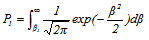
where  is PSL which requires 1st repairing timing and
  is safety factor (normalizinng factor) consisting of time, mean of the 1st service life (
 ), and standard deviation of
  . the safety factor in the condition is given as Eq. (4).
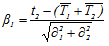
where  and
and  are mean and standard deviation of
  repairing time with increasing
  (
( ).
).
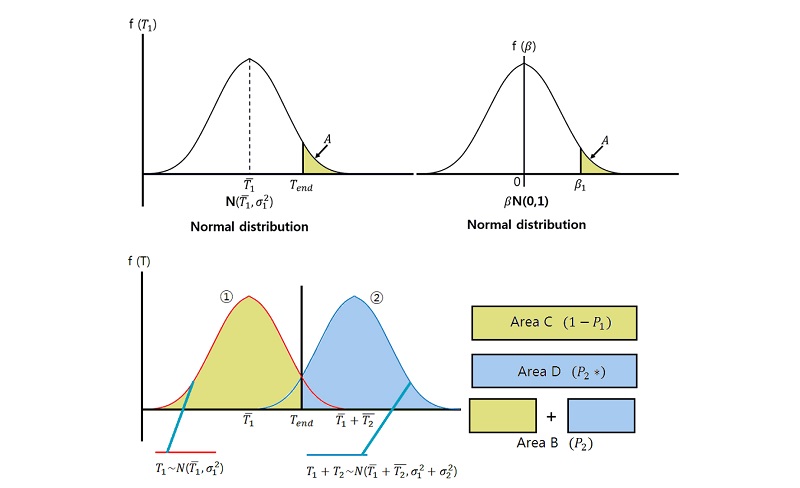
The condition for permitting only the 1st repairing time can be shown in Figure 2 considering the probability area of  .
.
 in Figure 2 can be calculated through Eq. (5) and PSLF of 1st repairing time can be written as Eq. (6)


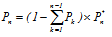
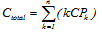
With increasing number of repairing,  for nth repairing time can be generalized as Eq. (7) and total repair cost (
 ) in a given cost (
 ) per repairing can be determined as Eq. (8).
Repair Cost Simulation Approach for RC Structure under Carbonation
Outline of simulation
In the section, a given condition is assumed and the effects of changing design parameters are investigated on the number of PSL and repair cost. In the field investigation, the initial service life which does not need repair (maintenance free period) is approximately 40~50 years in normal construction condition [22]. The initial service life and repair-service life are assumed as 40 and 20 years, respectively. The quality of construction is closely related with COV of service life, so that COVs for initial and repair-service life are assumed as 0.20 which seems to be reasonable. The level of COV (0.15~0.20) is allowable construction variation for steel location, cover depth, and locally varied quality of concrete. The control case for analysis is listed in Table1.

Effects of design parameters on repair cost
Simulation of control case
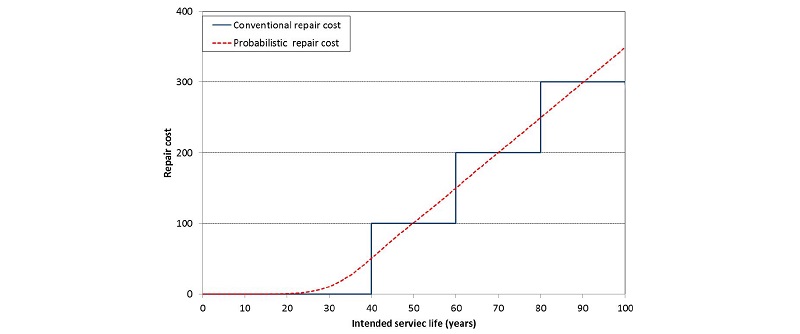
Control case for maintenance is simulated with increasing ISL. Control case includes 40 years of initial service life and 20 years of repair- service life. The results are shown in Figure 3 where the cost from probabilistic method shows a continuous line. After 100 years, the cost with repeated repairs is 300 for conventional method and 348.8 for probabilistic method. The cost from probability method is much higher than that from probabilistic method at 100 years, however the cost from probability shows more cost-benefit when ISL is shortened to 80~90 years. In the previous researches [17, 18], the cost function from probabilistic method always crosses the middle of cost jumping from conventional method since mean values in the both probabilistic distributions are considered at the period.
Effect of repair-service life extension on repair cost
In the given initial service life, the repair cost from probabilistic method is compared with varying extension repair-service life. The cost for repair is assumed to linearly increase with extension of service life, which is 100 for 20 years, 150 for 30 years, and 200 for 40 years of extension. The results are shown in Figure 4.
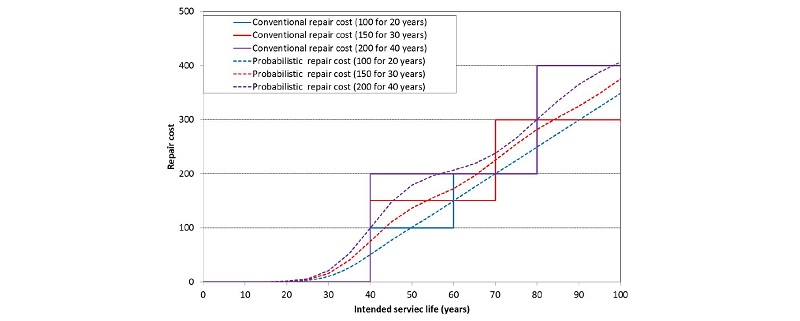
As shown in Figure 4, the final repair costs to 100 years are 300 (20 years of repair-service life), 300 (30 years of repair-service life), and 400 (40 years of repair-service life) for conventional method while the costs to each repair-service life are 348.8, 375.5, and 406.6 for probabilistic method, respectively. If the ISL is changed to 80 years, the least cost is 150 from conventional method, however minimum repair cost is evaluated to 274 from probabilistic method when ISL is assumed as 85 years. With varying ISL, the optimum cost changes. Before construction, maintenance planning with repair cost is important since, it determines of repair frequency and the related cost.
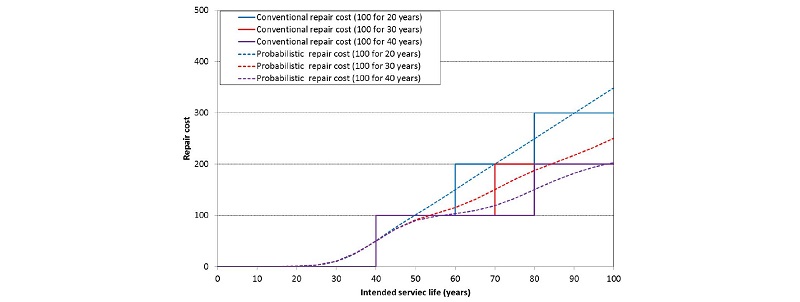
In the condition of constant repair cost with repair-service life, the cost in Figure 4 is changed to Figure 5.
As shown in Figure 5, the total cost can be reduced significantly with extension of repair-service life with constant repair cost. It means the extended service life due to repair with low cost is a key parameter in the maintenance planning. When ISLis determined as 100 years, the least cost is 200 from conventional method with 40 years of repair-service life. If ISL is assumed as 85 and 90 years, the least costs are 167.5 and 182.4 from probability method, respectively.
Effect of additional service life and quality on repair cost
The pattern of repair cost varies with changing COV. With a given initial and repair-service life, COV for each service life is changed to from 0.2 to 1.0. The initial and repair-service life are assumed as 40 years and 20 years, respectively. The results are plotted in Figure 6.
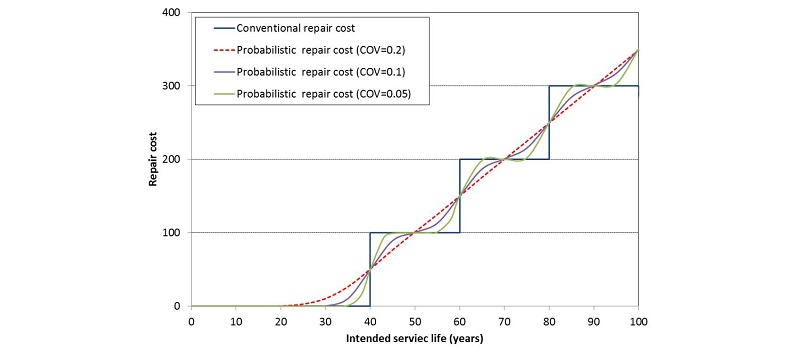
As shown in Figure 6, the results from probabilistic method approach to those from conventional method with decreasing COV. The COV of service life is much related with construction quality and the uncertainties in construction [11]. As shown in the results, the repair cost varies in spite of the same initial and repair-service life. For example, when ISL is determined as 75 years, the cost from probability changes from 224.6 (COV: 0.2) to 215.4 (COV: 0.1) and 202.1 (COV: 0.05) with decreasing COV, respectively. The reasonable determination of COV which can represent an actual repair quality is necessary for maintenance planning.
Effect of initial service life and quality
In the section, the effect of extension of initial service life on repair cost is evaluated. For the analysis, initial service life assumed from 20 years to 60 year with fixed 20 years of repair-service and 0.1 of constant COV. The results are shown in Figure 7.
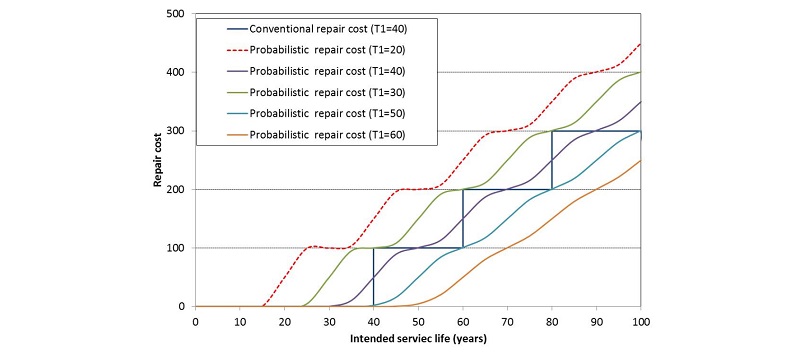
When ISL is determined as 100 years, the repair cost is 450 with 20 years of initial service life and it decreases by 50% with increasing initial service life to 60 years. The results can be expected easily since the results are almost same as those from conventional method.
Changes in probability parameters
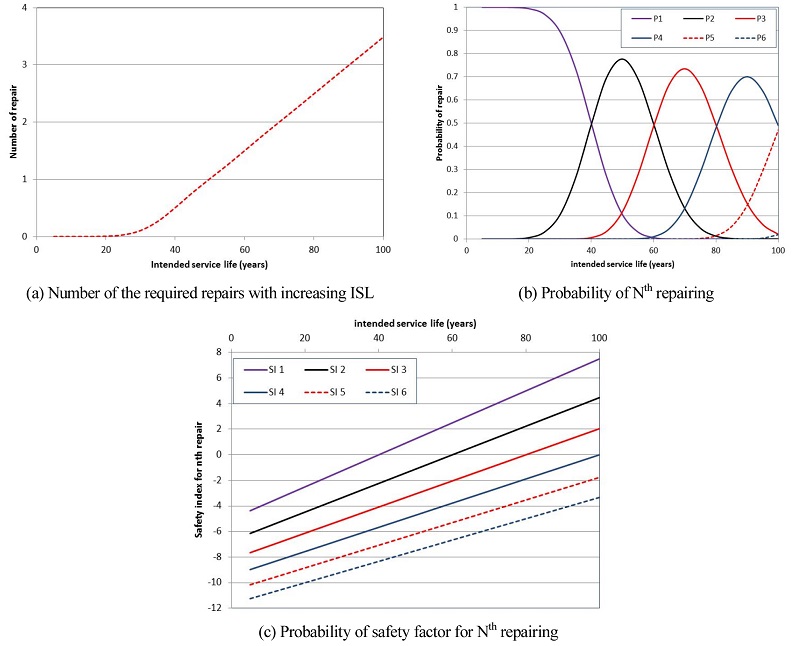
With increasing ISL, the required number of repair also increases. In the given condition of 40 years of initial service life and 20 years of repair-service life, the required repair frequency increases as Figure 8(a), which shows 3.48 times of repairing at 100 years. During the period, the probability for repairing number is altered. Before 20 years, additional repair is not necessary since the initial service life with 0.2 of COV is dominant, however after 30 years, 1st repairing time comes so that probability for 1st repairing increases. With increasing ISL, probability  for i-1th repair event decreases but
  for ith repair event increases. The changes in probability for
  repair are shown in Figure 8(b). The safety index in Figure 2, which means the starting point for calculation of failure probability increases with extension of ISL. The results of safety index are plotted in Figure 8(c).
Simulation of optimum repair cost based on actual carbonated concrete in underground RC structure
In the previous research [22, 23], 4 mix proportions were considered, and initial and repair-service life were obtained. 2 typical mix proportions were adopted and the result for each service life is summarized in Table 2. The calculation of total cost is shown in Figure 9.
Table 2. Initial and repair-service life for RC structure under carbonation from previous study [23] |
|

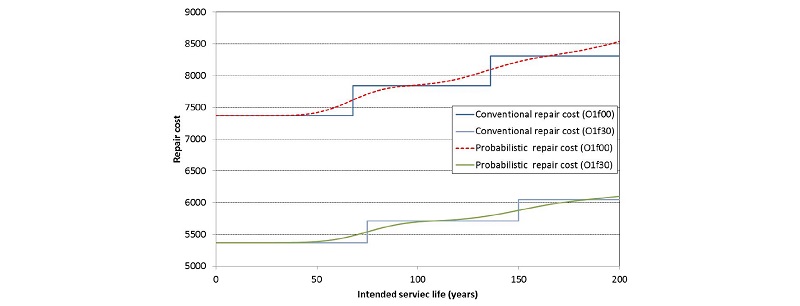
As shown in Figure 9, total cost in O1f00 mix conditions shows 8,310 from the conventional method and 8,538 from probabilistic method, respectively. If the intended service life is optimized to 140 years, 8,134 from probabilistic method is much lower than shows 8,310 from conventional method, which shows 2.4% cost saving to initial construction cost by simply optimizing ISL. In the case of O1f30 mix conditions, 6,048 from conventional method and 6,101 from probabilistic method are evaluated. The ISL is optimized to 150 years, the gap from the methods is 169, which yields 3.2% cost saving to initial construction cost.
Conclusions
In the work, the repair cost is evaluated from the probabilistic and conventional method, and the strong/weak point are compared as well. Adopting the previous research, total cost including initial construction cost is evaluated and quantitative cost-saving ratio is derived by simply optimizing ISL. The conclusions from the work are as follows.
1.The repair cost from probabilistic method is shown in the continuous line in contrast with conventional method. In the control case containing 40 years of initial service life and 20 years of repair-service life, 348.8 and 300 of repair cost are evaluated from probabilistic and conventional method at 100 years of ISL. If ISL is shortened to 80 years, 50 of repair cost is saved through adopting probabilistic method.
2.The repair- service life with low cost is a key parameter for repair cost optimization. When ISL is determined as 100 years, the least cost is 200 from conventional method with 40 years of repair-service life, however assuming 85 and 90 years of ISL, the optimized costs are 167.5 and 182.4 from probability method, respectively.
3.With decreasing COV of each service life, the result from probabilistic method turns into those from conventional method. The COV in service life is so closely related with construction and repair material quality that determination of reasonable COV for repairing technique is necessary.
4.Adopting the actual initial and repair cost for RC structure subjected to carbonation, 2.4~3.2% of cost saving to initial construction cost is evaluated from probabilistic method by optimization of ISL of the structure.

