


Introduction
Design and Specification of the Building
Feasible operating procedure of mini-turbines
Turbine specifications
Reduction in CO2 emission and saving in terms of carbon credit.
LCC analysis for proposed building design
Results
Conclusion
Introduction
To meet the increasing demands of energy, designing and construction of energy efficient building is continuously increasing. Due to unprecedented urbanization and escalation in population especially in developing countries like India, demand for the construction of multistoried buildings has increased manifold. In India the total electricity generated from the thermal power plants is around 155968.99 MW (68.19%) and from hydro-power plants is around 39788.40 MW (17.39%), [1]. Owing to the increase in energy demand and rising global emissions of greenhouse gases, the current centralized generation system is challenged [2]. It is estimated that in majority of the industrialized countries, approximately 50% of the CO2 emission comes from the building sector. Therefore, the best possible solution is to use the renewable energy to reduce the emissions of GHGs. Studies show that the carbon emission can be reduced by more than 60 % which corresponds to 1.35 billion tons of carbon with the help of energy efficient buildings [3-4].
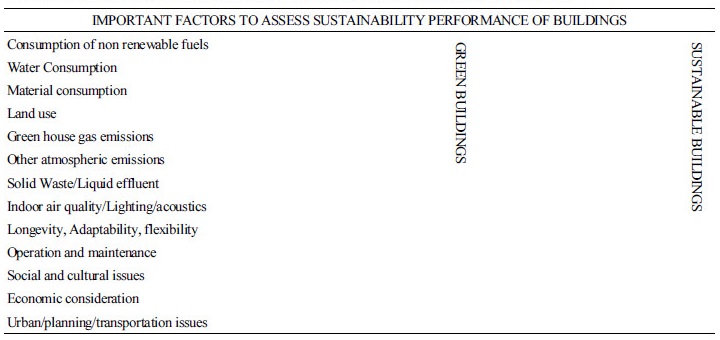
Solution is renewable energy that is an energy, which can be generated using natural resources like precipitated water, sun-light, wind, and tides etc. without deteriorating its quality. In hydropower generation plants, potential energy of the water is converted into electrical energy and the water remains clean after the generation of electricity and it can be used for domestic and irrigation purposes [5]. A micro hydropower plant may have the capacity up to 100 kW or more. A small or micro hydroelectric power system can produce enough electricity for a home, farm, ranch, or village [6]. World energy shortage, points out that it becomes imperative to develop the natural energy around local inhabitants [7]. Studies on economical feasibility analysis, of hydropower project have revealed that the payback period of such project is severely affected by the effective water-head than the water-flow rate [8]. Thus such buildings can be designed, which may play a significant role in minimizing the climate change impact and sustainable development of renewable energy. As per the UNEP, 2008 guidelines [9], there are several parameters that must be considered while assessing the performance indicator of green and sustainable buildings that are shown in Table 1.
In India as per the Ministry of New and Renewable Energy, hydropower plants are classified under following categories: (a) Micro-hydro: - up to 100 kW (b) Mini-hydro: - 101-2,000 kW (c) Small-hydro: - 2,001-25,000 kW [10]. Below 100 kW capacity would come under Pico Hydro and above 25,000 kW capacity would be under large hydropower projects. MNRE has also classified hydropower plants on the bases of water-head as (i) Ultra low-head: - below 3 m. (ii) Low head: - less than 40 m and (iii) Medium/high head: - above 40 m.
In the present study, the concept of utilizing the multistoried building water-flow and available water head to generate the hydropower has been explored. Mini-turbines installed in the building, will not generate any extra vibration and noise, while hydropower generation. After hydropower generation, through mini turbines, water would automatically transfer to water storage tanks through piping networks that will be utilized for the domestic purposes by the building occupants. This feasible study will help in promoting the utilization of untapped renewable energy in today’s power scarcity world. Various basic parameters like designing of building, capacity of water storage tanks at various levels, turbine working period, water head, flow rate, and total power generation are studied. Depending upon the total daily requirement of water by the building, water available in the water tanks, calculation of different parameters like the water-head and discharge, maximum and minimum power that could be generated is also studied.
Design and Specification of the Building
A multi storey sustainable building of known height from 1 to 25 floors was designed using designing software. It is assumed that the building has total 100 flats, with 4 persons (ideal family size in urban areas) in each flat and the daily water requirement will be approximately 200 liters per day per person. Thus the estimated population of the residential would be 400 people and the daily water requirement would be around 80,000 liters per day. Building has five water tanks at 2nd, 8th, 14th, 20th, and 25th floor, with a capacity of 30,000, 50,000, 70,000, 90,000 and 100,000 liters respectively. Entire building has been divided into 4 levels on the basis of water-head required by the mini-turbine operations and hydro power generation [11]. Two turbines of 5 kW at 20th floor, 4 kW at 14th floor, 3kW at 8th floor and 2 kW at 2nd floor are installed. Figure 1 shows the design and locations of water tank and turbines in the designed building; whereas Figure 2 and 3 shows the floor plan of different floors within the building. As per the daily routine, water tank on the top of the building will be filled with water to fulfill the domestic requirements of the building occupants.
Feasible operating procedure of mini-turbines
In the designed building, as water from 25th floor water tank is released for daily water supply, it will flow in the designed piping system and operate the turbines installed at 20th floor. Supply of water in the flats located between 25th to 20th floors will be directly carried out using separate piping systems that is directly from the main water tank. The water released from the turbine will be collected in water tank located at 20th floor. Since, in hydro power generation, there is no effect on the quality of water thus the water collected will be used for domestic supplies in the flats located from 20th floor up to 14th floor. Through a separate piping system, each flat of the building will be connected with main water tank located on the 25th floor for potable water supply, in order to reduce the risk of any water quality deterioration. Likewise the turbine system installed at different levels will operate at different interval of time.
The capacity of the installed mini-hydro turbines is decreasing from 20th to 2nd floor because, as the day will progress, the amount of water and its flow will get reduced. In this feasibility study the design of the building and supply of water will be as normal as in the most existing multistoried buildings have. There will be no extra supply of water in the building, in order to run the turbine. Special piping system has been designed to maintain the water-head required at each level by the turbine. Piping system for the turbines and the main common pipes for the regulation of water will be inter-connected by a valve system, so that it becomes flexible and will help in case of any emergency water supply in the building. In Figure 1 location of different floors for constructing water tanks and installing turbine (dimension- 1 m × 2.5 m × 1 m) along with piping system for direct supply of water, having varying diameters are shown.
Daily water supply in majority of the residential building in urban areas is carried out in morning and evening to meet required demands. Working hours of the turbines at each floor has been fixed taking care of the availability of water and its flow rate. During day time, two turbines at each floor will operate simultaneously for one hour. Turbines at 20th floor will operate in the 1st hour (6 AM to 7 AM), 14th floor turbines will operate at 4th hour (10 AM to 11 AM), 8th floor will operate at 7th hour (2 PM to 3 PM) and 2nd floor will operate at 10th hour (5 PM to 6 PM). During night the utilization of water is less, therefore in order to ensure the availability of water in the main water tank and at other levels, only one turbine will operate at a time. During night one turbines at 20th floor will operate in the 1st hour (7 PM to 8 PM), 14th floor turbines will operate at 4th hour (10 PM to 11 PM), 8th floor will operate at 7th hour (2 AM to 3 AM) and 2nd floor will operate at 10th hour (5 AM to 6 AM). Table 2 shows the working hours and at different levels of the building at day and night and Graph 1 illustrate the power production by each turbine.
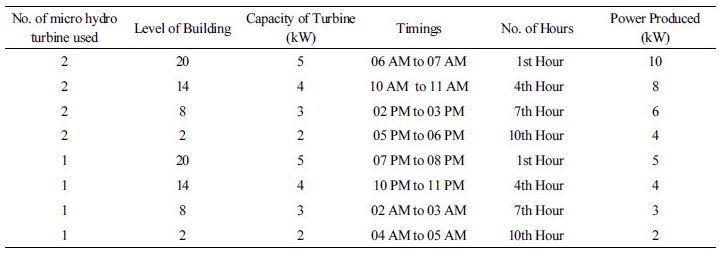
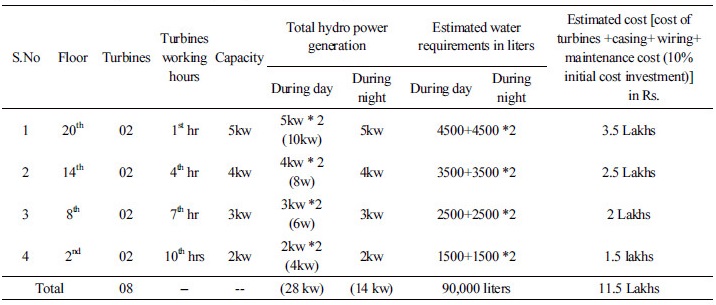
At different levels the requirement of water will depend on the capacity of turbine. At 20th floor, 5 kW turbine will consume maximum amount of water, i.e. approximately 90,000 liters that will be collected in the water tank located in same floor. At 14th floor turbines of 4 kW capacities will be used, which will consume around 70,000 liters of water and stored in the water tank. Likewise, at 8th and 2nd floor 3 kW and 2 kW turbines will consume 5,000 and 30,000 liters of water respectively. Decreasing order of turbine capacity in building from top to bottom floors will ensure less consumption of water for turbine operation and availability of sufficient water for residents. The total electricity generated can be exported to power companies using electrical instrument “Trivector meter” and accordingly total electricity bill of the building can be reduced.
Turbine specifications
Development in turbine technology has gain momentum as demand of electricity is increasing. Use of micro hydro turbine is considered as one of the best option for the onsite generation of electricity [12]. In the present study the electricity would be generated using mini- hydro-turbines through a network of piping and the potable water stored in the overhead tank that would be supplied through an organized pipe arrangement will run the turbines situated at different heads. The turbines will operate in such a way that no surcharge water supply would be required for the whole process. Thus such building needs a good mini hydro turbine with high reliability and workability; require low maintenance and high operational lifetime.
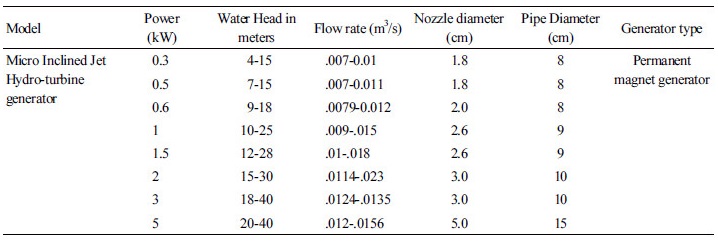
The water head and flow rate of water will continuously vary in the building. Thus Micro-Inclined Jet Hydro-turbine generator may be one of the best option, as this turbine can work at different water heads and flow rates and can produce electricity. Figure 4 shows the hydro power turbine and Table 3 illustrate different specification of turbines and its workability at different water-heads and flow rate. The life time period of this micro hydro turbine would be approximately 30-35 years.
Reduction in CO2 emission and saving in terms of carbon credit.
One of the important reasons for to prefer the utilization of hydro power in the building is to protect the environmental conditions and reduce the ill effects of harmful greenhouse gases emission. The performance of each available technology is calculated in terms of CO2 emitted by the conventional fuel and the environment index describes the importance of the energy consumption pattern in the buildings. The environment index would be increased twice by cutting the consumption of energy by 40% and such energy efficient buildings can reduce greenhouse gases emission by 60% [13].
The environment impact index for the proposed project can be calculated by using the equation [12] (Rezaie et al, 2013) mentioned in equation 1:
IE= Environmental impact Index (Dimensionless factor)
R CO2 = Reduced CO2 by the use of hydro energy
E CO2= Emitted CO2 by the conventional design
In India about 10 to 30 grams of CO2 emitted during the production of 1 kWh electricity by the use of hydro energy, whereas 1kWh electricity is produced by burning of 0.022 tons of coal which emit 0.062 tons of CO2 [14]. As per CO2 base line data report the value of reduced CO2 by the use of hydro energy can be taken as 1.26×10⁻³.
IE = (100) * (1.26 *10-3) tons/0.62 tons
IE= 0.0202
The CO2 emission mitigation (kg/year) because of the annual energy saving potential (kWh/year) for the proposed design is estimated using equation 2 [12] :
Annual energy savings (Total hydro electricity produced in kWh/Year) = 42 * 365 =15330 kWh/Year
= 0.98 * 1.6 * 15330
CO2 emission mitigated = 24037.44 Kg/year = 24.03744 tons/Year
As per the studies carried out by Watt M. A, Johnson M., Ellis H. [15], 0.98 kg/kWh is the CO2 emission intensity factor for coal-fired power plant, especially for European countries but for countries like India other factors are also included like 0.4 and 0.2 which accounts for the losses in transmission and distribution and loss of energy in transport of appliances to meet the requirement respectively [12].
The amount of carbon credit earned by proposed design can be calculated from the following equation:
1 euro = Rs. 85.00
The factor considered in Eq. (3) is Rs.1700.00 /ton of CO2 mitigation represents the monetary value of one carbon credit earned due to mitigation of 1 ton of CO2 emissions.
Carbon credits earned = 1700 * 24.03744 (tons/year)
Carbon credits earned = Rs 40,863.648/-
LCC analysis for proposed building design
There are100 flats within the building, with 4 persons in each flat, required around 80,000 liters of water daily. The initial investment (P) required was estimated as Rs.1150000.00 which comprises the cost of turbines, piping system, turbine base, maintenance cost (10% of initial investment) etc. Average power consumption in a regular sized flat is around 200 kW per month, thus the daily requirement of power in the proposed 25 floors building would be around 600 kW and the total power produced per day is 42 kW /day. Analysis on Life cycle cost (LCC) was carried out following standard methods shows the estimate the payback period around 9.4 years.
The value of payback period is evaluated for the proposed design based on the following derived expressions given by the study [12]:
Simple payback period  = Initial investment / Annual cash flow rate
Initial investment cost= (Cost of turbine + Casing + Wiring) = Rs. 115000.00
Annual cash flow rate = Rate per unit (as set by government) * power produced per day * 365 days
Rate per unit in Delhi (if the consumption is more than 700 units = Rs. 7.00 per unit)
Annual cash flow rate = 7 * 42 * 365 = Rs. 107310.00
Simple payback time =1150000.00/ 107310.00 = 10.71 years
Results
Hydro-power project constructed on rivers required detailed environmental studies to find out the associated effects of the proposed project in the surrounding areas and inhabitants. Major portion of the budget is invested in the studies associated with factors related with the submergence of area under reservoir, rehabilitation of people, danger of seismic activities, trees/forest cutting during construction and high level of noise causing pollution. After doing so much investment danger of failure of dam owing to any seismic activity, ill effects on aquatic life and fisheries, any hazardous effects of stored reservoir water and transmission of diseases in downstream areas due to less or heavy discharges of water is always there. All such environmental hazardous are directly or indirectly associated with big hydro-power plants constructed on a river. Thus the most significant part of the proposed project is that none of the above mentioned hazards and studies are required prior to the implementation of such project. Therefore, no additional cost is needed apart from the construction and installation of turbines and their maintenance in the project.
The feasibility analysis of the project shows that the proposed project can generate hydro-power in the multistoried building. The proposed project is completely viable both technically and financially. The maintenance costs of micro turbine are less and the life time period is around 30 to 35 years. Simple payback time of the proposed project is around 10.71 years. The study also revealed that approximately 42 kW of hydro power can be generated daily by running the turbines for fixed hours in day and night, without interrupting the regular water supply in the building. Table 4 shows the turbine capacity, estimated water requirement, power produce and cost for the proposed project. Study also demonstrates the importance of energy consumption patterns in the proposed project. Consumption of non-fossil fuels is important solution to the continuously escalating environmental problems and the conservation of energy is another part of resolution.
One of the important concepts given in this work is the complete storage and utilization of water for domestic purposes after power generation through turbines. The proposed concept is extremely useful and unique and could help in solving energy crisis problem. Study and development of such hydro power projects can make buildings more energy efficient and also save the plants, forest and major expenditure on big hydro-power projects.
Conclusion
Following conclusions can be drawn from the study:
∙The proposed system for generating a hydropower in multi-storey residential building is completely viable both technically and financially.
∙Buildings equipped with hydro-turbines will be more energy efficient as compare to other buildings.
∙Hydropower without disturbing the domestic supply and demand for extra water can be met.
∙ Problems associated with continuous escalation in power demand and increase in air pollution with the generation of thermal power plant can be addressed with the help of such projects.
∙Large scale expenditures on site investigation, rehabilitation of people and environmental hazards associated with the implementation of big hydropower projects on rivers can be minimised.

