


Introduction
Development of a Theoretical Framework
Framework characteristics
Qualitative systems characteristics
Quantitative systems characteristics
Synthesis of systems characteristics
Results
Discussion
Conclusion
Introduction
The Dutch governmental agency for business affairs RVO states 17 persistent problems in primary school design [1]. A complex interwoven diversity of multi-level scaled interrelated physical building and process related problems are involved due to a variety of interests, such as between governments, municipalities, school management boards and educational advisors, local communities, and end-user needs, and between these various stakeholders and related construction companies. The persistent failures of existing practices during the process and during the whole life cycle of the building describe a complexity that relates especially to the school building design process. For example, bad collaborations, inexperienced principals, complexity of responsibilities, distrust, a fragmented supply market, split incentives, finance systems, political underspending policy, and the role of the demand side et cetera [1]. It might be no wonder that this process generates also problems relating to the building performance, such as a bad indoor climate quality and a dissatisfied sustainability and energy performance, and subsequently the different interests make it even more worse. For example, the end-users need a good indoor quality and functionality of the physical learning environment, but political ambitions of maintaining the regulatory of good housing are mainly focused on the social process of good education. At the end they do not advocate to balance with end-user needs. A variety of these complex interwoven failures of existing practices starts with, for example, the different governmental ministerial responsibilities. For example, one ministry increases the building legislation rules to improve the sustainability goal, and another ministry shortens the financial budgets limiting good operation and maintenance [1]. The Dutch national government presents it as that it is hard to establish sustainable buildings due to all different definitions of sustainability, which makes it hard to make proper arrangements between investors, principals, constructors, and end-users [2]. Also a fast changing world of technological, economic, sociological and political changes makes it also hard to anticipate on future changes and educational trends see [3, 4, 5, 6, 24]. Dahl states that it is urgent to find better systems of progress towards sustainability and referred to the high dynamics of technological progress and globalization accelerating change in many economic, social and environmental processes [7]. These changes and effects emphasize the need for on the one hand a specified definition for sustainability, such as has been done by optimizing the sustainability ambitions of building construction and its performance and the use of sustainability assessment tools (e.g. BREEAM), and on the other hand to anticipate future changes, such as done by emphasizing a more holistic integrative perspective of building functionality by more flexibility. But the difficulties of the interwoven multi-level scaled complexity of physical primary school building performance problems, challenge also the politics to enhance more sustainability, not from only a definition, but also from incorporated sustainable development objectives in performance building regulations. For example, Koskela states that the challenge is an interdisciplinary discussion on the theory of the built environment to recognize it as an artefact, as a process, and as an ecosystem [8]. To improve the indoor climate quality of learning environments it is needed to consider all causes and effects from different levels of scales in an integrative way. For example, Grün & Urlaub state how improvement of the indoor environment on learning in schools in Europe can stimulate economic growth [9]. Obviously there is a relationship between the bodily effects at the end-users due to environmental exposures, and the huge economic effects between different sustainable development scales, such as healthiness and welfare.
The Dutch education system is one of the best systems in the world, and recently the ranking is moved from ‘good’ to ‘great’, referring to the report “Netherland 2016 foundations for the future” [10]. Whilst the educational system is great, the physical learning environments remain worse, for example, such as the disappointing performance of nearly zero emission of some primary school buildings [11]. The UNICEF report “child well-being in rich countries” states that the Netherlands is the clear leader in material well-being, health and safety, education, behavior, and, housing and environment [12]. Hence, remarkable antagonistic perspectives are identifiable between social systems (e.g. a good education system), and ecosystems (e.g. bad indoor quality). It should be noticed that Dutch children spend 90% of their time into buildings. Although the Netherlands is socially doing well for children, the high social education standard, well-being, and economic welfare obviously has hidden environmental costs. For example, the lack of integrative approaches is also stated by the worse quality of Dutch biodiversity, which is the worst of European countries by its reduction to 15% of its origin in 1900, due to intensive agriculture and urbanization factors influences [13]. To state the unbalanced situation from a multi-level scaled perspective of primary school building relationship with sustainable development, even more remarkable is the by United Nations University presented World Risk Report that reports a research of 171 countries in the world, within which the Netherlands ranks as most dangerous country in Europe, due to its high sea-level and low land-level risks [14].
Life Cycle Assessments (LCAs) are the instruments to measure levels of the environmental performance, also often used for buildings. Life Cycle Assessments (LCAs) are widely used, for example, in manufacturing industry, and generate metrics of environmental impacts and waste streams. LCAs can be classified in three levels, such as product comparison tools (e.g. Simapro), whole-building design tools (e.g. Ecoquantum), and whole-building assessment systems (e.g. BREEAM), see [60]. Besides BREEAM, the Dutch assessment tool GPR is used especially by municipalities, and thus for school building design, which is connected with the regulation established by the Dutch institution SBR CUR of the environmental performance for buildings and civil constructions (MPG), and the Dutch national environment-database (NMD) for environmental conditions of materials, processes and building elements (environmental database) [2]. These systems are introduced into building construction to balance the sustainability challenge. But these systems lack the simplicity to use as a practical application. For example, Jalaei & Jrade found that integration of the assessment tool LEED and Building Information Modelling (BIM) was feasible, but only with considerable constraints, and they reduced one of the biggest barriers by eliminating the documentation process [15]. Jalaei & Jrade also state that the general framework of sustainability still misses and is the research is ongoing [15]. Hence, there is some progress, but seemingly the bigger picture still lacks. Marjaba & Chidiac state that “scientific methods for measurements and criteria to evaluate impacts as a certification systems, that are useful and successful to meet their purpose, cannot be adopted as metrics for performance-based decisions or evaluations” [16]. Payman & Searcy identified that the analyzed metrics, that have been published in the literature (up to the end of 2012) on green supply management und sustainable supply management, show that the majority of these metrics were used only once, which indicates a lack of agreement on how performance should be measured in these areas [17]. Chang, Lee, & Chen revealed in this context four categories of problems, which include vague definitions, uncertain inventory data, fuzzy environmental impacts and trade-offs, and inaccurate interpretations [18]. New disciplines are necessary to collaborate to increase more balance into the process, that comes from not regularly knowledge domains, such as more involvement of environmental studies.
Current approaches to improve the school building performance, besides the use of minimal legislation and regulation rules, are mainly based on specific ambitions of the clients, the use of design quality indicators, and prescribed sustainability assessment tools and guidelines. A main issue however, that should be understood from a more holistic perspective, relates especially to recognizing the underlying dynamic patterns of social systems and ecosystem multi-level relationship with all physical building shell scales, such as neighborhoods and urban areas. This relationship however also captures a lot of school building design influences by stakeholders during the decision-making process of architectural synthesis especially based on dialogues and consensus. Several researchers recognize interwoven relationships between all these factors, however only a few of them consider the whole picture and existence of underlying patterns, for example, hexagonal forms of pupils’ desks, classrooms and school design [19]. Mock & Wernke state that “we now know that the physical, biological, social and even the economic universe is not random, and that we are beginning to determine just what that they seems to be not corrected placed in the height static elements as well as energy flows, living things, and their behavioral patterns [20]. Although a geometric theory of everything, as Grand Unified Theory, might be seductive to consider in this context of a search for the bigger picture, it shows also here the underlying social system patterns and the interrelationship with ecosystems and its resilience constraints [21]. For example, to balance end-user needs, institutional school management boards, local communities, ministries, and business interests, this means their social system interrelationships should also be balanced with their relationships with the also multi-level scaled interrelated ecosystems, such as global, regional, local, indoor, and even bodily levels (e.g. cells, immune system). Beside this social and ecosystem place related interconnections, also time related aspects play a role within the different scales of places. For example, such as the stages of design, built, operation and maintenance, in-use, reuse, demolition et cetera and their relationship with building construction places (e.g. structure, indoor walls, facades), and their related spaces (e.g. classrooms and playgrounds), which all should be taken into account by their interrelated levels of scales. Current tools do not take into account these multi-levels scales and relationships to recognize the whole picture and underlying “code” applicable for primary school building design. To solve the persistent physical problems and to meet the balance between the social systems and ecosystems, they should be approached more integrated and multi-level scaled to achieve real sustainable primary school buildings. This complexity needs a dynamic approach that uses multi-level scales to recognize the whole picture and underlying patterns of the relationship between human systems and ecosystems. It should recognize patterns to enable to establish also the functional specifications for clients briefs and building construction morphological design factors into more balance, such as the need for flexibility and to adapt future changes in primary school building design.
So the aim of this article was to develop a theoretical framework to find ground for recognizing the whole picture and underlying code and the relationships to untangle the complexity of interwoven primary school building design failures of existing practices during the process and during the whole life cycle of the buildings, and to deliver sustainability-centered guidelines for real sustainable primary schools (SCGs).
Development of a Theoretical Framework
This analytic research defines real sustainable primary school design by recognizing a number of underlying dynamic patterns of similarity to establish some guidelines from a holistic perspective. It recognizes the interrelated multi-level scales of entities by its patterns similarities such as between human needs, sustainable development factors, ecosystems, to establish clients brief specifications and morphological factors for primary school design, qualitatively and quantitatively, and derived from an integrated perspective of interests and characteristics.
Framework characteristics
The relationship of social systems and ecosystem is determined since many years by a number of sustainable development factors and perspectives started by business, such as done by Aguilar [22]. He used four sectors of his taxonomy of the environment: Economic, Technical, Political, and Social: so called ETPS [22]. Subsequently later other abbreviations, such as the STEP abbreviation, followed soon. A variety of taxonomies for sustainable development factors and abbreviations were introduced in the 80’s as variations of classifications by: PEST, PESTLE, STEEPLE etc. There is no implied order or priority in any of the formats and some purists claim that STEP or PEST still contain headings, which are appropriate for all situations ([23]. The use of these taxonomy however is integrated nowadays broadly, such as into the Dutch report ‘Horizonscan 2050’ that describes 150 signals for change and their relationship with STEEP factors of predicted future changes and trends [24]. These factors characterize societal, technological, environmental, economic, political issues [24]. Although a diversity of variations of taxonomies exist, such as Labor (L2), Ethical (E3), Demographic (D) and International (I) factors, these factors, just like cultural aspects, we considered to be part of the sociological factor (for codes see Table 1).
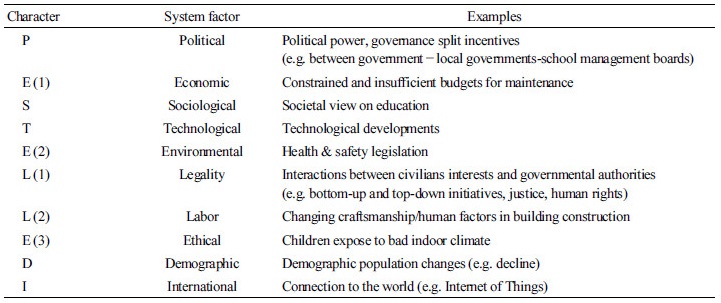
A common used system, derived from PEST but supplemented with legal and environmental (ecological) factors, is the PESTEL framework. This framework contains six factors: politics, economy, social, technology, environment, and legality. Combinations of these development factors, such as ecological-economic factors, state there are interrelated dependent connections to consider also. In research different kinds of combinations and interrelation-ships are used, for example, for descriptive concepts that gives insight into dynamic properties of ecological- economic systems. For example, resilience and sustainability are independent concepts, and that more criteria than just resilience have to be taken into account for sustainable development [25], which relates to the dynamic patterns of the factors and interwoven relationships.
Xu, Marinova & Guo state that most exciting studies emphasizes the ecological aspects of resilience, but only by including human activities in the modelling can resilience thinking inform sustainability in a meaningful way [26]. Inspired by positive psychological universal human needs six human needs factors are recognized that relates to sustainable development factors (PESTEL). Robbins uses six human needs by certainty, variety, connection, significance, contribution, and growth, as a human needs pattern of mutual and a hierarchical related factors [27]. These factors illustrate a rather similarity with the six PESTEL factors of sustainable development, within which the similarity patterns, as entities defined, can be recognized well by comparing them (see Figure 1 and Figure 2). Together all factors seem to be interrelated and qualitatively connected by social system and sustainable development interventions, multi-level scaled.
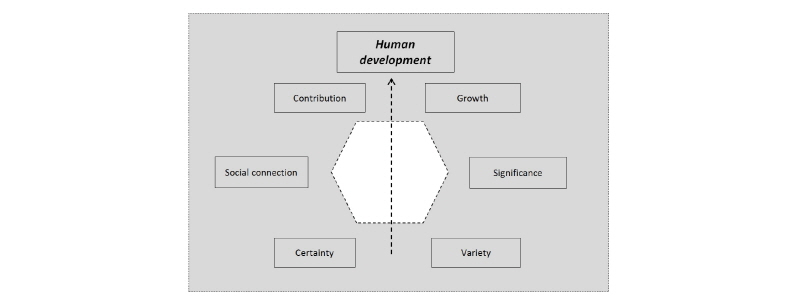
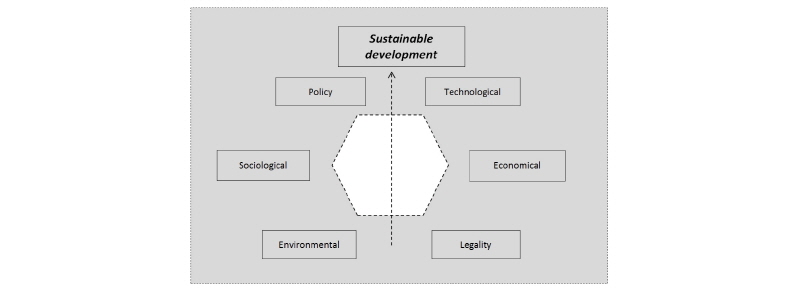
Although it is preferred to use the more common known PESTEL taxonomy, the similarity with human needs necessitates to change their characters order due to their hierarchical and mutual relationship into ELSEPT (Environmental, Legality, Sociological et cetera):
∙The need for certainty relates to the ELSEPT factor of environmental by the biological systems that nature offers, which include, for example, also bodily biochemical cell and immune system processes;
∙The need for variety relates to the ELSEPT factor of legality which should guarantee, for example, a certain individual autonomous or heteronomous freedom and flexibility scales between minimal legislation and desired ambitions;
∙The need for connection relates to the ELSEPT factor of sociological by social relations such as in (peer) groups, communities, cultures;
∙The need for significance relates to the ELSEPT factor of economic by having a special status, such as places, regions et cetera), or having financial ability to realize a new primary school building for the local community;
∙The need for contribution relates to the ELSEPT factor of policy such as sustainable benefits by local communities;
∙The need for growth relates to the ELSEPT factor of technological, such as new technological features.
The resemblance between the human needs factors and sustainable development factors is remarkable. This resemblance challenged us to further research qualitatively and quantitatively. Noticed is that when the sustainable development factors are just like human needs hierarchical and mutual related, also their polarities might be characterized as similar by their up- and downwards relationship, and their in- and outwards relationship [28]. It explains why the four factors of STEP or PEST also makes sense from a polarity perspective.
A multi-level scaled relationship of interrelated social system connections (individual, groups, community, society et cetera) per definition intervenes with ecosystems levels of scales (e.g. bodily, indoor, local, regional). Every human intervention relates to one of more levels of ecosystems (within or without rehabilitee of the system when exceeding the constraints). From sociological ecology derived social system related scale of (inter)subjective experiences (sensory reception of all senses), or a psychological associative cognitive experience (thinking about the perception), per definition the time related impact also relates to an ecosystem related scale of (inter)objective biophysical (bodily) experience of the environment. From this perspective it should be noticed that all senses are taken into account for a good balance instead of only dominance by visual building material assessment, see [29]. End-users of school buildings experience their physical learning environments socially (the social learning environment) and physically (the physical learning environment). The hierarchical mutual related social system of six human needs and bodily ecosystem illustrates here how this mechanism for individual end-users, which conditions are important influences to fulfil their needs psychologically and physiologically, and how biophysically factors of environmental circumstances play a role for them bodily (and by indoor conditions et cetera). This assumes an inseparable interrelationship between social systems an ecosystems for individuals, but considered from a multilevel scaled system, also between groups, communities and society. Referring to the weblog School of Wisdom “The Ultimate Paradigm Shift state that the free will of the individual in connection with the infinite is now primary” [30]. Anderies states “an Anthropocene era where human activities shape the planetary system in which built and natural environments are becoming more tightly linked across scales, these complex systems need to be considered as elements in a global network, i.e. as a coupled social–ecological system (SES) at the global scale” [31]. The social system and ecosystems are recognizable here as well as into the global relationship.
From a social system perspective the upwards driver is, as a mechanism of hierarchical and mutual relationship, a system condition that provides a certain balance to fulfil all human needs in harmony, searching for homeostasis constantly. Independent of the extent to which all needs are fulfilled a balance will be found by the fulfilled needs from a bottom-up approach hierarchically and mutually. That is, the human need for growth is stated by the desired development perspective (see Figure 1). But, development and growth are not the same. Sustainable development determines an upwards driver for all sustainable development factors, while sustainable growth (e.g. technological development) is just one of the factors. According to Daly, “growth can increasing quantitatively in a physical point of view, while development is more a qualitative improvement or unfolding of potentialities”, and “An economy can grow without general developing, or, developing without growth, or, both or neither” [32]. A four- dimensional model is developed for sustainability by economic, social, ecological and cultural dimensions see [33]. To identify their polarities, they can be recognized by the similarities between human needs and sustainable development factors. For example, the ‘economic’ factor interrelates with the ‘sociological’ factor, similar to feeling significance interrelates to feeling social connected. Hence, social human systems and sustainable development factor share a similar dynamic. It becomes more complex when sustainable development factors, such as economic, fulfils one of the other human needs then expected by similarity, such as economic fulfils the need for certainty. The interrelation of substituted factors, such as the economic factor that fulfils in fact the need for significance (think about status), also fulfils the need for certainty by ‘false’ interrelationships. Having money simply means feeling significance from an egoistic perspective, and secondly feeling certain from a hedonic perspective. To find support for this complex interpretation of dynamic interrelationships between social systems and ecosystems, we connect these pattern polarities to psychological system approaches. For example, Venhoeven, Bolderdijk, & Steg refer to egoistic, altruistic, hedonic and biospheric patterns, as paradox patterns of relationships [34]. Snelgar refers to the egoistic, altruistic and biospheric environmental concerns [35]. Both, these pattern similarities are recognizable within the sustainable development mechanism as outwards directed sociological (relates to social systems) and inwards directed economic (self-fulfilling) characteristics, and as downwards directed environmental (relates to ecosystems), and upwards directed technological factor polarity characteristics. Identifiable is the relationship between altruistic and the human need for social connection, and its relationship with the ELSEPT sociological factor. Also identifiable is the relationship between the egoistic (inwards directed) human need for significance, and the economic development factors (lose from the false need for certainty). Hence, biospheric can be related to the need for environmental concerns, while hedonic is more or less a factor which relates to the total fulfilment of needs, the driver for development, but especially to growth, such as the drive for development of new technology. The comparable relationships between the human needs and sustainable development factors assume the existence of an underlying system similarity pattern by their internal relationships. Hence, there is theoretical ground to state that a system approach by using similarity characteristics can be derived from a complex (interrelated dynamic) adaptive (substituting) mechanism of different levels of scales and patterns to balance.
Social systems relate thus hierarchically (up- and downwards directed) and mutually (in-and outwards directed) as a constant homeostatic search for balance between the ecosystems constraints or beyond (ecosystems prefer to rehabilitee). Due to their interrelated connections and time relationship of influences and human interventions (impact), transformations occur within the levels of different interacting ecosystems. Hassler & Kohler state “the speed of the transformations is not linear but instead it could be seen as a succession of gradual and rapid changes i.e. slow moving risks and disturbances versus rapid extreme events” [36]. Here we arrived at the Human Ecology, which contributes to describe the interrelated connections as an interdisciplinary and transdisciplinary study of relationships between humans and their natural, social, and built environments. It considers in general two main approaches:
1.social system (knowledge, social organization, population, and values);
2.ecosystem (air, plants, water, soil, animals, micro-organisms, human-built structures).
From an ecological perspective, humanity is an ecosystem itself. Individuals have their own ecosystems and interactions with the environment take place within the resilience of global, regional, local and indoor environments from an interrelated perspective of scales (e.g. bodily processes within indoor conditions et cetera). Hence, just like ecosystems, also social systems (e.g. society, local community, end-users, and individuals) relate to the continuum of small and large ecosystems, but their position is always enclosed and dependent of the surrounded ecosystems. Because of their enclosed multi-level scaled relationships, the connections between all these social and ecosystem processes might be seen as chaos-theoretical circumstances, but their enclosed relationship is clear. The grade of needs fulfilment depends thus of the conditions and circumstances, such as the way human are be able to intervene autonomously or heteronomously to improve their experiences of well-being performance. Theoretically also cognitive and health performance can be influenced, but are mainly unaware factors. Obviously human needs can be fulfilled temporarily by psychological (e.g. motivation), physiological (e.g. warmth), and bodily biological (e.g. sports) interrelated factors.
Because of the increasing availability of (inter)subjective fulfilment of needs by cognitive and sensory experienced stimuli, in current time of welfare for a part of the worlds’ population, the fulfilment is getting exceeded by all the opportunities (e.g. availability of fruit from all over the world instead of from biological origin of an own garden). This increased conditions decrease the fulfilment. Raudsepp-Hearne et al. found a paradox that human well-being has increased despite large global decline in most ecosystem services, instead of that environmental degradation lead to decline in well-being [37]. Hence, a paradox, or polarity unbalance, is recognizable well here by the need for human growth (social system) at the expense of natural environments (ecosystems), which can be explained from the interrelated polarities and entity similarities. Williams suggests that human consciousness is unique and different than the natural world but constrained by natural limits, and as environmental sociologists state, that the human and social systems are deeply connected to nature, and conflict with cognitive patterns: ‘there might be also a remarkable contradiction or paradox to human consciousness as unique and different than the natural world’ [38]. This contradiction, or paradox, states that the sustainable development includes a contradiction between social system development and ecosystem development. A point to consider from this impact of a lack of fulfilment is stated by the existence of a time lag after the ecosystem service degradation and before human well-being is affected, so called the environmentalist’s paradox [37]. The term well-being, which is mainly related to physiological sensory based experiences, is used differently for welfare and/or for health aspects. It includes thus a mixture of social and ecosystem related associations. It should be noticed that the underlying pattern of the complex mechanism should be understood well and that from the continuum of a psychological (subjective), physiological and biological (objective) perspective the physiological needs more explanation whether it is more subjective than objective. For example, the WELL Building Standard Educational Facilities (Pilot A) describes a standard modified for offices, where well-being is related to worker health, performance and motivation [39], which are totally different intervening parameters. There is no evidence that ‘green buildings’ associated with ecological building materials and energy systems are more comfortable [40]. Raudsepp-Hearne et al. state that the technology has decoupled well-being from nature [37]. That is, the underlying mechanisms that decoupled well-being from nature relate to the way of satisfaction, rather by fast new technological inventions than by means of slow or unpredictable gifts from nature. For example, rather enjoying a steady room temperature or a warm douche, than a cold natural start in the morning. This mechanism makes it possible to increase the awareness of behavioral pattern and human needs based interventions. For example, it is not the technological development, but the way how technological development fulfils our needs for growth psychologically and physiologically more quickly, by pleasurable experiences. Famous philosopher Tomas Hobbes’ wrote into his book Leviathan in 1651 that well-being is only experienced after a period of making efforts, such as after a period of fighting followed subsequently by a period of rest and well-being, until the new period of well-being experiences does not fulfil anymore, and the circle starts again. This variable cyclical process, within a polarity system of fight and rest, lead to the described paradox. This is important to understand for primary school building design, such as conflicting well-being experiences in classroom temperatures with natural fluctuating values that might be better for to improve end-users health. For example, Marken Lichtenbelt et al. found in cold-activated brown adipose tissue in healthy men a relationship between obese and regular used indoor temperature [41]. This might explain that most comfortable experiences can conflict with biological processes and cognitive performances, such as found by Wargocki, Wyon, Matysiak, & Irgens by reducing the temperature from 23.6 C to 20 C, which tented to reduce 10% number of committed errors in acoustic proofreading [42]. Well-being is thus more social system and subjective related when related to temporarily sensory (fast) experiences, and more objective when related to (slow) unaware experiences.
The constraints of resilience between social systems and ecosystems relate to sustainable development factors. Unbalanced factors might cause suddenly disruptive changed ecosystems, which illustrates the pattern mechanism of resilience, which is not linear and increasingly links to discontinuities, referring to the theory of Panarchy [43]. Xu, Marinova & Guo [26] describe psychological resilience, engineering resilience, resilience engineering, ecological resilience, social resilience, economical resilience, and social ecological resilience, and refer to the importance of these systems and studies see [32], and the vulnerability of resilience in systems, such as the suddenly break down by economic and social unbalances, but in conclusion they state that a main question still is how to identify and manage the key drivers and elements of resilience [26]. Hassler & Kohler describe the context-specific definitions of resilience, such as in physical material systems, ecological systems, social systems, individual systems, and noted how resilience also has become a politically significant notion [36]. Sustainability and resilience should be considered integrative [45]. Ecological resilience is determined by different factors, such as the existence of biodiversity, which makes ecosystems resilience. But human-built structures relate also to the need for diversity by their variety in building morphology in the context of villages or cities, as well as primary school buildings, which includes their structure, element and material diversity. Coping with either natural or built environments in isolation is extremely challenging in its own right (e.g. built environments at different scales: a single building, a collection of buildings, a neighborhood or a city are in themselves very complex [31]. Hence, different multi-level scales of sustainable development factors and resilience are the same and should be approached interrelated by the different enclosed multi-level scales of human systems and ecosystems. Xu, Marinova & Guo conclude that “sustainability is about a harmonious relationship between natural and human world, which relies largely on social-ecological systems (SESs) being able to withstand the increasing external uncertainties and perturbations” [26].
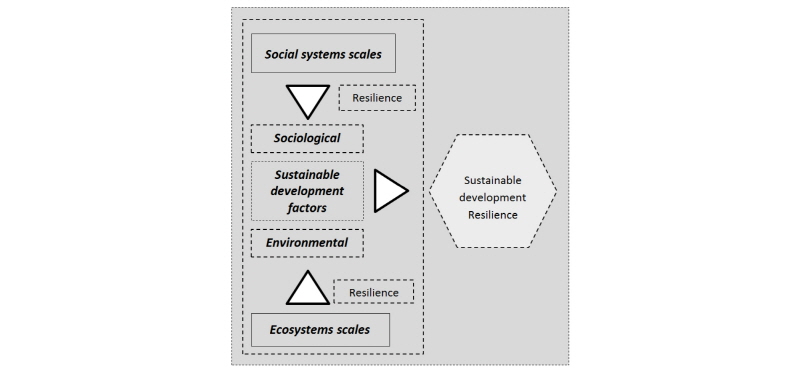
The sustainable development factors are determined between the continuums of ecosystems scales and social system scales interrelationships. From a social system scale perspective, the sustainable development factor is best described by sociological. This also refers to the multi-level scaled social systems by the need for social connection, which set a next step in the search for similarities. From an ecosystem scale perspective the related sustainable development factor is best described by environmental. Sociological scales and environmental scales relate both to resilience within all ELSEPT factors and form together the two main scale systems of incorporated resilience, within which the other factors are subdivided from the field of sustainable development resilience (see Figure 3).
Qualitative systems characteristics
|
Figure 4. Scheme of polarities and product and process relationship with the dualistic legality factor. |
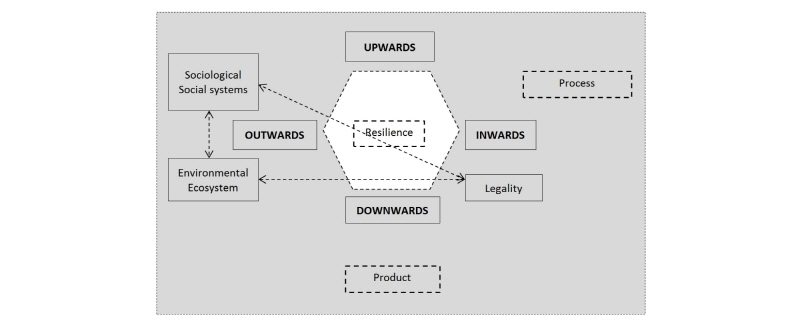
To enhance sustainable development balance it is important to consider this from the point of view whether their context is more stable or unstable. Xu, Marinova & Guo argue that balance can be reached by paying more attention to sociological and ecological factors [26]. The social system relates to the sociological sustainable development factor, and to the human need for social connection. The ecosystem relates to the environmental factors and the human need for certainty. Hence, both systems relate to each other whereby the factor legality can ensure a certain minimal level of, for example security, safety and trust, to balance the systems, using the constraints of minimal legislation rules and high ambitions. From this point of view the factor legality relates strongly to the need for variety. The sustainable development factor legality thus also functions into this position as resilience for the social system and ecosystem. Gunderson & Holling state that “a variety of arrangements and rules that have evolved in different societies to harmonize the relation between people and nature” [44], which states how variety is connected to social systems and ecosystems. The factor legality should contribute into stabilizing ecosystems to protect humanity from nature disasters, such as from the collapse of ecosystems. In this way so far all these three factors contribute to stability. The two sustainable development factors of environmental, and sociological seem to be related more to the product factors, the legal factor switches dualistically between steady stated product design based legislation, from design quality guidelines to process decision-maker based undefined preferences by a variety of different multi-level scaled ambitions (see Figure 4).
The other factors, such as politics, economic and technology are more related to the process factors due to their influences, such as political influences at legislation rules. For example, the crisis we face today is often seen as a result of primarily the financial system, but also of our political systems. The unstable factors, economic, political, and technological, are the factors which cause instability when crossing the borders of resilience, but also the legal factor when ambitions are fluctuating too much by stakeholder decision-making processes. This point also relates to the fulfilment of human needs, such as caused by wanting to be too significant, to contribute too much, and to grow too fast. Within this pattern polarity mechanism of striving for balance, hierarchically and mutually, these interrelated similarity factors (stated as entities), can be derived from the social system by human needs, and their impact at ecosystems derived by the sustainable development factors human impacts.
In order to position ‘the term’ sustainability within the context of sustainable development, sustainability in fact can be considered as the stability of the whole of ecosystems and social systems, and within it a certain natural resilience. Multi-level scaled the ELSEPT factors itself also have resilience, but within the constraints of all balanced factors, as well as the human needs have. When ecosystems are influenced by social system interventions, the ELSEPT factors can be used to influence the social and ecosystems, so that they can rehabilitee and the systems become stable again. That also means, when resilience constraints are exceeded, sustainable development is out of control and social and ecosystems becomes unstable, possible ending into a new stable ecosystems with new conditions or collapse suddenly see [31] and thus might be simplified stated as an unpredictable and a situation of future uncertainty. To illustrate the relationship between the instability of the social systems and ecosystems, the need for certainty (downwards directed needs), which relates to the ecosystems, creates uncertainty, such as by means of the unknown effects of climate change such as melting artic ice, or fast distinction of living species. The three stability factors of human needs seems to satisfy the needs slowly but long by their impacts, while in comparison the three instability factors satisfy fast and short. Sustainability is thus, from this point of view, a stable system that can be determined especially by the factors Environmental (certainty), Legal (variety) and Sociological (social connection), but becomes unstable by Economic (significance), Political (contribution), and Technological (growth) when crossed the resilience boundaries. For example, when social systems are too much influenced by environmental (e.g. changing road traffic near the school building), legal (e.g. unbalanced school building requirements by different governmental ministries) changed and sociological (e.g. demographic changes), the local community will search for compensation to balance this unstable situation by adding impacts from the other factors, such as new policy (e.g. establishing new integrated child-centers instead of multi-functional accommodations, new economic (e.g. change schools into townhouses), and new technology (e.g. use augmented reality in classrooms), which destabilizes the situation even more by upwards interventions. This all means that current sustainable development system factors from this perspective are ‘top-heavy’ due to increasing possibilities to use these exiting and stimulating economic, policy and technology to compensate the deeper unbalance of needs for certainty, variety and (social) connection (see Figure 5). Both systems now can be related integrative to building construction products and processes, such as to primary school building design (see Figure 6).
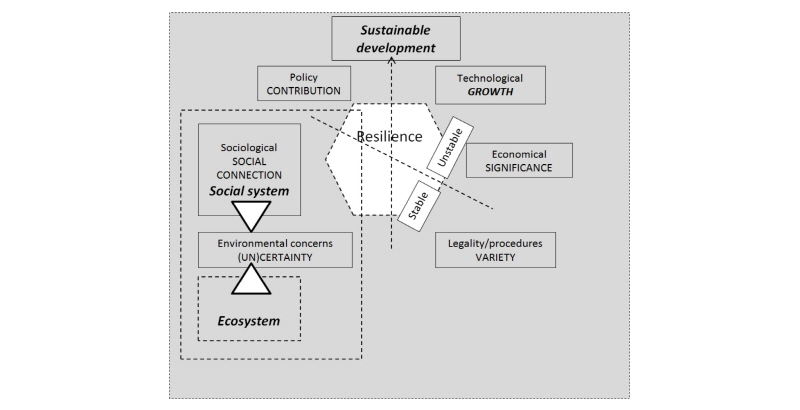
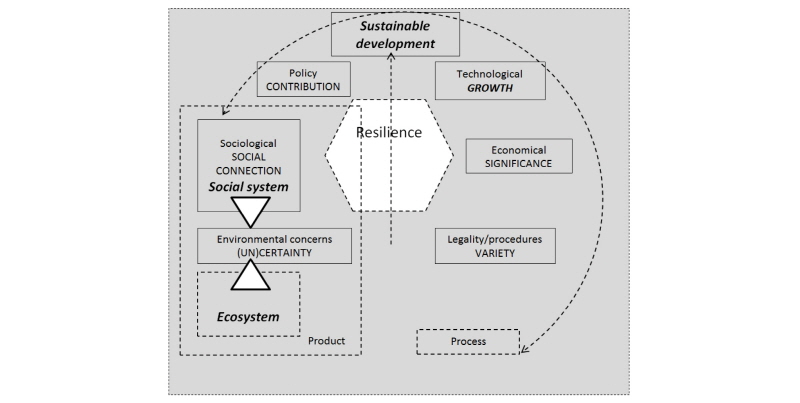
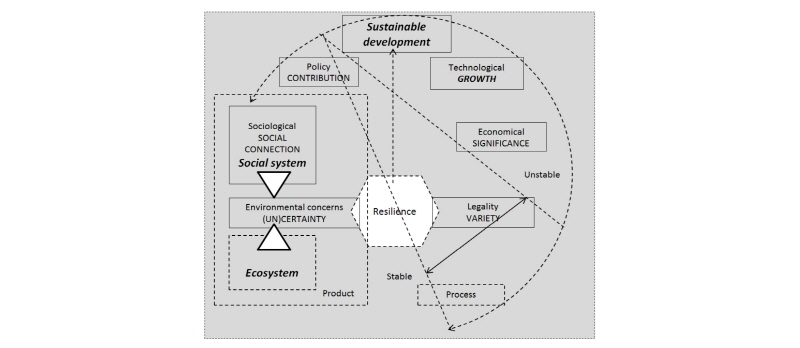
Considering the resilience between both, the ecosystems and human systems (described as the field of environmental concerns and (un)certainty when exceed), it is recognizable how resilience as an single entity made by the factors legality and variety relates to the product by the field of minimal legislation and ambitions, and the process by the field of the relationship with the downwards polarity of environmental and inwards polarity of economic constraints (see Figure 7).
Similarity patterns are recognized between human systems, sustainable development and the ecosystems from different perspectives, that indicates that stable ecosystems can be associated with continuity; variety with diversity, and connection with coherence. Subsequently, the other factors can be associated as significance with (sub)species, contribution with wealth, and growth with extension (see Figure 8). Ecosystems are becoming environmental concerns (uncertainty) when the stability is deteriorated and threatened by means of human exceeding interventions, expressed in terms of association with (un)certainty by scarcity; variety with singularity; connection with dis-connection; which also relates to increasing the instability by the association of significance with domination; contribution with withdraw effects of species; and growth with extinction. Although, this way of reasoning gains a lot of generalizing, the point here is that there is a mutual relationship between the ecosystem human-built structure impacts and environmental concerns whether sustainable development or a human needs approach is used (see Figure 9).
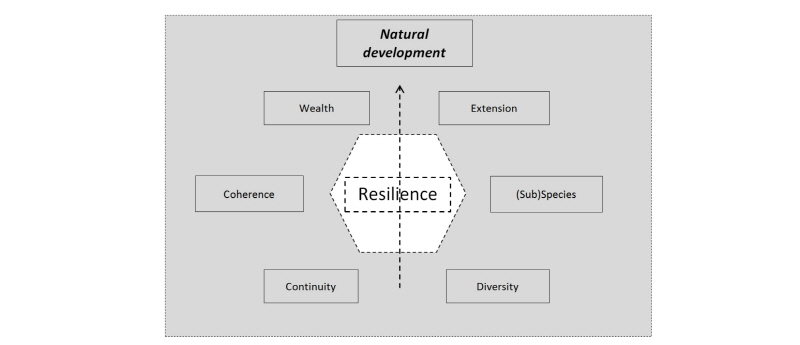
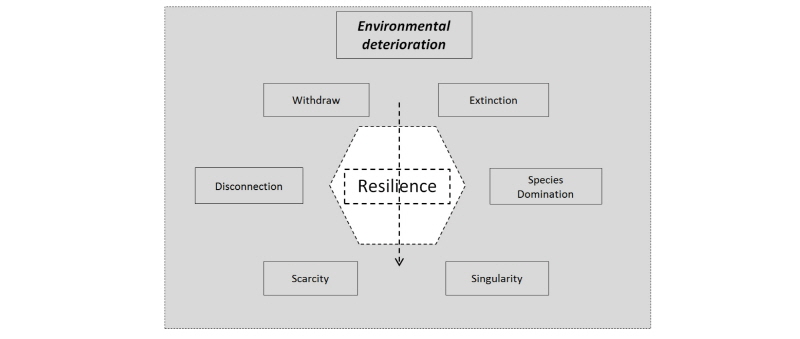
Primary school building design is an iterative process of brief specifications and design stages. In general it starts with a conceptual level of collecting functional specifications, the initiation phase. This inventory of requirements and opportunities contain the first steps of client briefs, that is growing bigger by filling more detailed and iteratively the functional specifications, by describing more precisely the functionality; the aesthetical and social-cultural values; the financial constraints; the sustainability ambitions; and the technical facilities. Human- built structures, such as a primary school building, are approached regularly as an one-time event of designing a building that can be used unchanged for many years. Although in present design of school buildings fast changes will affect by new born specifications, the structure, its flexibility, its expandability, its connection with surroundings, and its adaptability. When buildings are considered to be modified periodically, such as by trends related ELSEPT factors of economic, political, and technological influences such as the Dutch report ‘Horizon scan 2050’ presents 150 signals for change [24], decision-makers of school building processes should consider these building rather better as living organisms. Referring to McGinley buildings become more intelligent than their occupants and designers, and a morphogenetic architecture framework for intelligent buildings is proposed [46]. This future prediction seems to be a logical pathway when primary school building morphology, in relationship with ecosystems and social system similarity patterns, should be balanced optimally. In relationship with standard client briefs, the aesthetical, social, functional, technical, sustainable and financial sections show a remarkable self-similarity, like a fractal, with human needs, sustainable developmental and ecosystems factors of stability/instability and product/process. Considering the different values, Ott suggested a better ethical focus on human made worlds and nature through the use of Hannah Arendt’s theory of the vita activita [47]. As in briefs prescribed regularly, for example, sustainable development related environmental values, legal values, sociological values, economic values, political values, and technological values, it links to functional (certainty); aesthetical (variety); social (connection); financial (significance); sustainable (contribution); and technical (growth) factors. Hence, it is a small step to link these brief sections to the sustainable development ELSEPT factors. The recognized unbalance between the stable and unstable ELSEPT factors are considered to be influencing school building design functionality similarly.
To relate the ELSEPT factors to school building design, a number of options are deduced to optimize the balance by (1) enlarging the stability factors of development by enhancing (and control) the environmental values, legal values, and sociological values; (2) curb the economic, political, and technological influences (e.g. influencing consumer behavior); (3) optimizing all sustainable development factors and gain more balance by reconsidering all factors integratively; and (4) staying on current pathway, which means choosing for a total collapse or entering a new system. Economic factors relate as described earlier to the need for significance, and are yet main fulfillers of the need for certainty. In fact the false fulfillers of the need for certainty affects indirectly all human needs. It is not expected that this will be changed by political interventions as long as our monetary system exists. A sustainable society will however not arise spontaneously, due to slow responding ecosystems, such as climate change effects. Environmental problems should not be solved by technophylic design [48]. Fiksel states that “there is an urgent need for a better understanding of the dynamic, adaptive behavior of complex systems” and states that “the resilience in the face of disruptions, recognizing that steady-state sustainability models are simplistic” [45]. Hence, only option (3) sustains, which incorporates an adjusted approach that considers the dynamic (e.g. polarity characteristics), adaptive behavior (human needs) and complex systems (e.g. the similarity patterns), and it recognizes that current models (e.g. LCAs) are too steady-state.
Quantitative systems characteristics
The social system related human needs, sustainable development factors and ecosystem, as well as a building construction related entities that show similarities such as by client brief sections, does not only relate qualitatively, but also quantitatively by their ratio similarities. Weighting factors can be recognized by their qualitative similarities of hierarchical and mutual relationships. The strongest need for certainty, for example, relates to the environmental factor of sustainable development, and to the ecosystem of continuity as most important entity for keeping the ecosystem stable. Although the used figures illustrate a hexagonal model without a ratio, the profound principle describes a more or less spiral dynamic mechanism due to the mechanism of upwards polarities, which relates also quantitatively by their similarities of importance. In order to quantify the sustainable development factors, the golden ratio divine proportion, or golden mean, is used as a theoretical hypothesis to consider its value for this purpose. Also considered is the Integrative Sustainability Triangle by Kleine & Hauff, which describe the relationship of society, ecology, and economy, and generates a triple bottom line approach for the collection, systematization, quantification, and evaluation of all the relevant issues found within corporate environment [49]. However, this approach lacks an theoretical base of political, technological and legal influences. Therefor we used a ‘natural’ approach by using the golden mean reciprocal values, determined by the Fibonacci integer sequence +5+8+13+ 21+34+55, which makes a total of 136 et cetera. The calculated value for certainty, for example, makes 55/136×100% = 40%. The characters of 1+1+2+3 although are not used because of the inaccurate break (see Figure 10).

When added the calculated values as weighting factors to the qualified entities. Remarkable complex links illustrate the complexity of the dynamics between these factors when they all relate hierarchically and mutually, and also become substitutes (such as false certainty). For example, the need for certainty can be fulfilled without taken into account the environmental factors influences at the ecosystem continuity. The entity factors that relate to the brief sections at multi-level scales, means that (inter)subjective and (inter)objective needs and interests from end-users, school management boards, society should be considered at all these levels in the different sections of the brief by their quantified impacts (see Table 2).
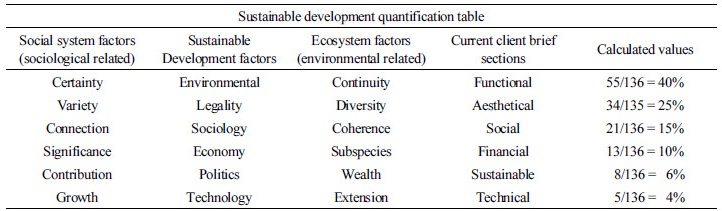
The table shows the percentages relationship with the entities. For example, the 40% calculated ratio relates to the first entity weighting the experienced fulfilment of the need for certainty, the environmental factor impact, and ecosystem continuity, which means a balance of ratio’s should establish the product primary school building, that involves all multi-level scaled factors (e.g. by their different stakeholders, the time related whole-life stages of spaces, and places, and impacts) in balance with the other entities. Therefore it is needed to distinguish only from this perspective the physical from the social environment because they always remain interrelated connected. For example, a child who is afraid for the teacher (a social experience) and hide itself into a corner of the classroom (a physiological sensory experience). In order to distinguish the physical environmental shells a social system of human needs is used for the (inter)subjective experiences of learning place/desk, classroom, interior rooms, exterior, playground, surroundings, see [28], and for the material elements that makes the scale levels of places for the (inter) objective ecosystem related entities are used the levels of scales of: bodily, furniture, indoor partitioning, building elements, outdoor constructions and roads. Habraken distinguishes: Configuration (e.g. interior arrangement, floorplan), Nominal classes (e.g. building elements) and Spaces within (e.g. room) [50]. Recognizable is (1) the objective ecosystem relationship with the places (material and energy related values of building construction components made by local, regional and global manufactured resources), and (2) the subjective human system relationship with the spaces (sensory effects, emotions, thoughts experiences). Because of these multi-level scaled patterns, every factor relates also to the decision-making process stakeholders, which might give a glimpse of why current processes due to its complexity should not give too much room for own interpretations, such as by dialogues and consensus, when underlying patterns exist.
Remarkable is the similarity of the calculated 10% for the economic factor, which comes close to Brundtland Commission in 1987 calculated 5-10%. Although a polarity of contradictions has been identified by Daly, such as he described by: “Since the release of the Brundtland Commission Report in 1987, the Commission needed to maintain unity of political interests, and it sacrificed critical attention to "glaring contradictions" in its own report” [32]. Daly “argues that it is impossible to respect ecological limits and to have growth in the world economy by a factor of 5 or 10” [32]. But, recognizable is how the resilience within the dynamic of sustainable development polarities still gives room for 10% economic growth when all other factors together are balanced well (see Table 2). And, also remarkable is that the three bottom line factors of environmental, legal, and sociological together are 80% which is close to common sense rule of 80-20 stable/instable.
This approach makes also clear why current client briefs are unbalanced when these ratios are not considered from a multi-level scale and integrated perspective. For example, school buildings are designed for at least 40 years economic value, whereby the technical value of the school building structure is more than 100 years, the education policy seems to be changed regularly by every four years political elections, and the building functionality might be less than 10 years (for offices the period is reduced to 5 years). This advocates also a quantitative calculated balance, that also can be used for quantifying the flexibility in new school building designs to enlarge the school building usability period, and at least to balance the brief sections more rationally and adjusted to each other. That also touches the building morphology, its design, and decisions-makers preferences.
Synthesis of systems characteristics
Common used terms in building construction design relate to the ELSEPT factors and their specific entity. For example, environmental factors relate to building construction ecology or ecological buildings. Technological factors relate to building construction technology or intelligent buildings. Hence, it is recognizable that the ecological related entity provides a stable product from ecosystem perspective (e.g. a circular natural system approach), and the technological related entity provides an instable product, due to the fast technological changes during its whole-life process. When both of these two extremes (from a polarity perspective) are related to human built structure knowledge disciplines (product) and to innovation directed disciplines (process), it illustrates how the disciplines interrelate with the system products and processes. This gives interesting insights in current processes and stakeholders positions and impacts. For example, the urban planning policy always had a dominant top-down position that framed the school building location and situation, and its morphology by prescribed constraints. When building construction terms and domains are related to the knowledge discipline domains, similarity patterns can be recognized well (see Figure 11 and Figure 12).
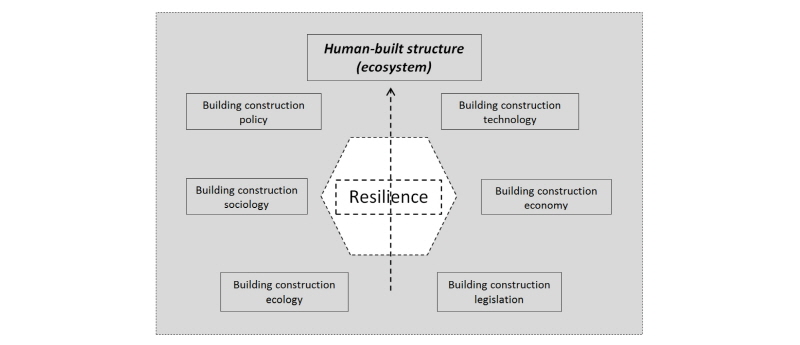
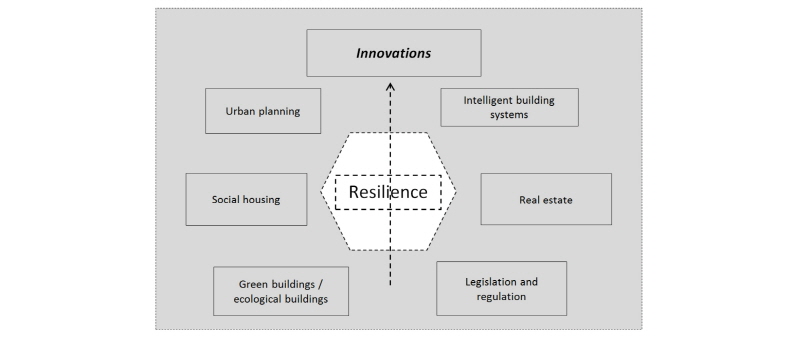
Besides these material and energy related factors, that makes the places and spaces seen as (inter)objective and (inter)subjective spatial design, also time related effects, such as whole-life approaches, should be involved during their whole-life of decision-making stages such as initiative, design, construct, operation and maintenance, refurbishment, reuse, rebuilt, and demolition stages. Beadle et al. state “that changes, such as future values are, might be social, environmental or economic, all elements of sustainability, but they will affect the way we construct and use buildings at the moment the majority of buildings are designed and constructed to suit a particular use at a certain time, with no thought for the future” [51]. These stages also can be distinguished further by daily operation activities, yearly maintenance, short time preventive or long time technical maintenance et cetera. This perspective makes clear how product and process are interrelated by place/space and time, and should be considered more integrated multi-level scaled also from the smallest buildings elements. That is, that the different physical learning environmental related indoor and outdoor shells, such as defined by the desks, (class)rooms, interior spaces, exterior building, play garden and surroundings, should be considered separately, as well as a whole approach by their objective place and subjective space, time and impact relationships from the underlying polarity to balance. Furthermore these place and space levels of scales of structure, morphology, building elements and materials relate to the scales of bodily, indoor, local and regional (and global) ecosystems conditions, and its own time related circumstances and changes, such as by weather, fungi, moisture, and pollen. Hence, the building interact with the multi-levels social systems, its impact at the environment, and the impacts of the environmental circumstances and conditions affecting the learning environment scales. It might not be the question whether buildings should interact with their environment but how they can strengthen each other (e.g. by using permaculture). In order to verify this synthesis on the pathway to guidelines that can realize real sustainable primary schools, the definition of Clements-Croome is used, although that describes intelligent buildings and surely meant as an all factor balanced approach by: “they should be (1) sustainable, (2) healthy, (3) technological aware, (4) meet the needs of occupants and business, and that they should be (5) flexible and (6) adaptable to deal with change” [52]. In fact Clements- Croome [52] defines the need for a stable system of sustainable development factors by (1) environmental factors (certainty), that takes into account (2) more attention for the smallest (e.g. cell/body) ecosystems (certainty), (3) give room for the less instable determinants, such as new technological innovations (growth), (4) give more attention to sociological factors (connection), (5) pay attention to flexibility (variety), and pay attention to adaptable (contribution). Intelligent buildings themselves are special to represent this needs (significance), and the shift from sustainable building (ecosystem related) to intelligent buildings (human and ecosystem related). The term resilience bridges sustainability to building construction by different terms, such as flexibility and being adaptive to deal with changes, which considers from this perspective the definition as that it comes close to the recognized similarity patterns.
The established pattern similarities and synthesis offer yet ground for to state an integrative perspective and method to define real sustainable primary school building design as a perspective that considers the material systems (e.g. structure, morphology, elements and materials) and the energy system (e.g. using passive solar power, natural ventilation systems) more integrated with the recognized entities, such as human needs and the ELSEPT factors. The similarity can be recognized by using the six entities, such as flexibility relates to variety, adaptability to contribution (to create new opportunities) and so on. These examples show how human-built structures, in this case primary school buildings, relate to the morphological factors, that can be used for improving and enhancing a model such as for systems engineering to achieve a theoretical based set of functional specifications. This opportunity illustrates how human-built structures relate to the fractal similarities as entities that enables the opportunity to change its morphological existence, when social systems change within ecosystems adaption, biotic or abiotic, as a living organism (see Figure 13).
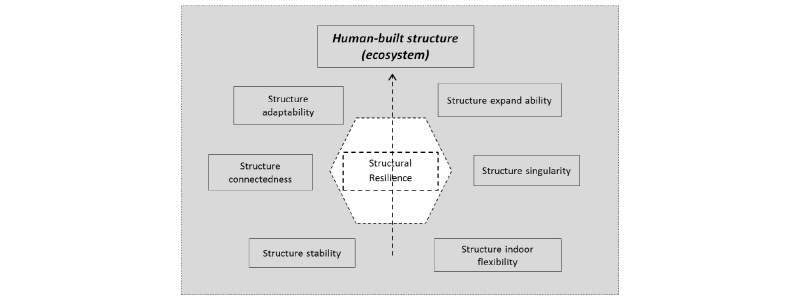
When relating the human-built structure to all entities and underlying system factors it provides a coherence synthesis of mutual related factors for primary school building morphology. For example, internal changeable flexibility should be incorporated into the design for 25%, and the relationship with aesthetical factors here means a creative architectural synthesis that relates to the (inter)subjective social system experiences of variety, and (inter)objective materialization by a diversity of building elements. During the development of the design configuration (interior arrangement, floorplan, building) all multi-level scaled characteristics should also be involved such as how desks setting arrangement can change. This example illustrates a simplified method of how systems engineering approaches, and Building Information Modelling (BIM), might be welcome to mprove current system shortcomings. An overview of integrative functional specifications based on morphological factors is illustrated in Table 3 (see Table 3).
Table 3. Overview of entities integrative specifications for human-built structure based morphological factors |
|
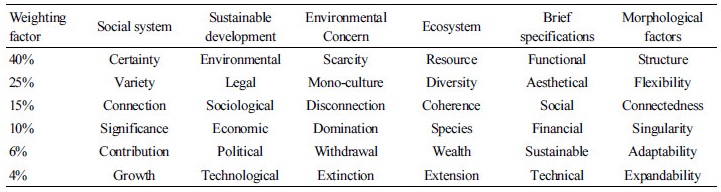
These entities establish balance by weighting all factors. The results show that the stable system factors ‘structure’, ‘flexibility’ and ‘connectedness’ frames together are 80% of its functional specifications. More specific, for example considering the need for certainty, it fulfils 40% of the human need factors, and it relates 40% to the environmental factor, which relates for 40% to the environmental concern of scarcity, and increases the awareness of 40% to use real sustainable resources. Hence, in this example the calculated 40% of the factor relates to primary school building design that should contribute school management boards into the decision-making processes, with which the process can be finished by only some little dialogues and consensus. In the perspective of the presented research, school management boards should take into account thus integrated attention to the functional specifications of the building structure by analyzing the physical learning environmental shells characteristics. The summarized entities relate to the multi-level scales of (1) the social system related stakeholders needs (e.g. end-users, school management boards, society); (2) the whole-life building stages (e.g. design & construct; operation & maintenance; reuse & demolition); (3) the six spaces of (inter)subjective human system related mainly psychological and physiological experienced learning places (e.g. desks, classrooms, interior rooms, exterior, playground, surroundings; (4) the six places of (inter)objective ecosystem related mainly biological/ecological elements, materials and energy systems considering the ecosystem scales (e.g. bodily requirements, indoor, local, regional and global); and (5) its relationship with the multi-level scaled process stakeholders (e.g. disciplines from social sciences such as positive psychology, sociological ecology), and natural sciences (e.g. from ecology to organismic biology, to neurology, to cellular biology, and molecular biology studies). Two perspectives are considered to use: (1) a societal perspective of mainly outdoor directed to indoor, and (2) an end-user perspective of mainly indoor directed perspective to outdoor, as two defined distinguished approaches to use. Within this two perspectives a basic framework is established.
Results
The main result is the development of a theoretical framework that recognizes the underlying pattern of multi-level scaled similarity patterns, which are called entities. These social systems, ecosystems, and sustainable development related entities, and their mutual interrelationship with design brief sections, and the building morphology, determine theoretically the value of real sustainable primary school buildings by using all the described characteristics. These entities give room for defining the primary school building design brief specifications and school building morphological requirements to realize more balance than in current approaches.
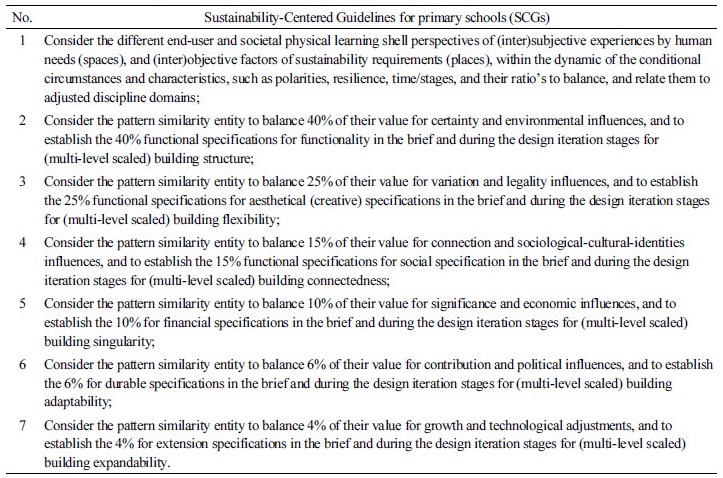
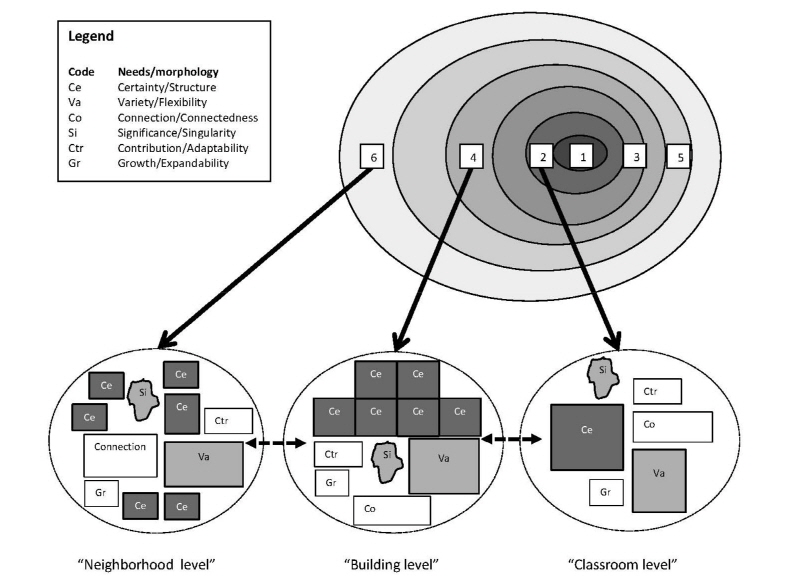
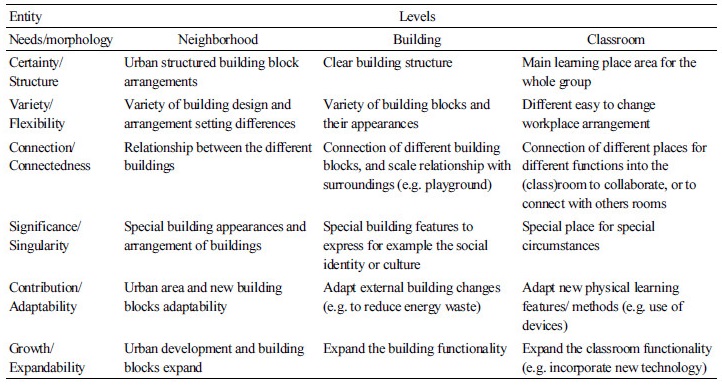
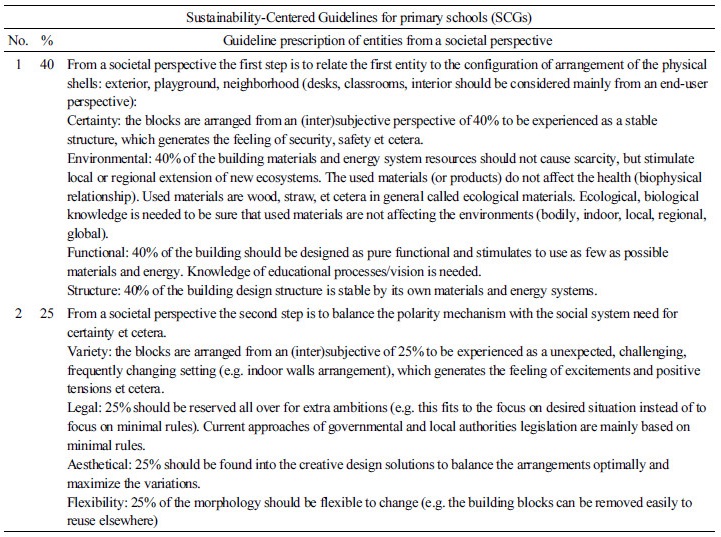
In order to state the practical application a step-plan is introduced by means of a questionnaire (see Table 4). The elaborated Sustainability-Centered Guidelines for primary school building design (SCGs) are described into a Table (see Table 5). An illustrative example shows the practical usage of the developed conceptual framework of design morphology. To show the practical application an illustrative example clarifies conceptually the value for primary school design. The functional specifications are balanced by the entities, which action should be taken place into the decision-making stages of the process. The elaborated example shows three levels of scales (micro-meso-macro), which illustrates the systems thinking approach and recognizes the self-similarity pattern, in this case based on human system factors by the configuration of a (class)room, a school building, and a neighborhood arrangement. This fictive example illustrates how a societal perspective and its ratio percentages relate to each other by 40% certainty (Ce); 25% variety (Va); 15% connection (Con); 10% significance (Si); 6% contribution (Ctr); 4% growth (Gr). We note that different scales also can intervene each other by substitutional factors which each other (between end-user, management board and societal perspective), and that different entities can intervene (between human needs factors and sustainable development factors), and different factors interrelate with each other by their polarities all multi-level scaled from individual workplaces to urban development and vice versa. For example, (1) a work desk; (2) a classroom; (3) the building layout/rooms; (4) the exterior of the building; (5) the surroundings/play-garden; and (6) the urban area/neighborhood. An illustrative example shows their mutual relationships (see Figure 14 and Table 6). Another illustrative example shows how the two main polarity entities of 40% and 25%, and how the involved factors relate as a substantive translation of the guidelines from a societal perspective (see Table 7).

Discussion
The used method recognizes the similarity patterns derived from human needs, sustainable development factors, and ecosystem concerns and services. This approach connects all different multi-levels of scales by social interventions on ecosystems. Multi-level scaled social interventions affect per definition multi-level scaled ecosystems and vice versa, due to their interrelationship. Subsequently human needs relate also to the translation of the needs to client briefs and building morphology. The multi-levels of scales of interventions are from this perspective unbalanced in current exceeded design system. The sustainable performance of school building design in current approaches is affected by a complex of especially process related problems, with which current steady stated approaches are more related to the product than to the process. Metric data systems and assessment tools constrain the design approaches that lack the dynamics of changes and social interactions. Also sustainable development factors are not balanced in current methods, and lack the polarities, resilience and impacts. Current systems are, without be wanting too pretentious, incomplete for application in current school building construction design approaches, simply due the fact that these systems are functioning too statically. The dynamic balance is a most important factor to discuss whether the presented idea of stating the universal human needs as a self-similarity pattern language for considering ecosystems interventions, and derive the entities, whether this pattern can be used consistently for defining the resilience of sustainable development, and by using the golden mean as a weighting system.
A number of most exciting studies, such as stated by Xu, Marinova & Guo [26] that emphasise the ecological aspects of resilience, but exclude the human activities, are also researched, whether we could find support for our own hypothesis. Although different methods use different principles, indeed all studies lack an integrative system of social and ecosystems dynamics, and their qualitative and quantitative relationships. For example, the Framework for Strategic Sustainable Development (FSSD), also known as ‘The Natural Step’ developed by Robèrt [53], defines a systems thinking based method, but which lacks the integration of combine ecosystems and social systems. Missimer [54] researched the possibility of a systemic and generic approach to social sustainability, also known Framework for Strategic Sustainable Development (FSSD), and they proposes a way forward to make the social dimension on the FSSD more cohesive as well as operational, which thus point into the direction of searching for connection between the human systems and ecosystems as we assume. Natural Capitalism [55] uses recognizable sociological, economic, technological and environmental factors, but these four factors remain positioned as separated independent entities. However, Baden & Zaffos, who reviewed the book Natural Capitalism [55], identified growing agreements that economic prosperity and environmental quality are complementary aspects of progress [56]. The Cradle to Cradle system, developed by Mc Braungart & McDonough [57], uses biological and technological circles, which does not involve integration of human development into the system. Clements-Croome states that Braungart & McDonough believe form follows evolution rather than function, but in reality both apply [52]. Hence, Clements-Croome [52] in fact identifies the morphological relationship as a polarity between upwards directed need for evolution (growth) and downwards directed need for functionality (certainty). From this point of view other polarity morphological links exist by stating that form follow also the inwards directed need for an individual end-user, such as a pupil, and outwards directed need for connection such as peer groups, a teacher, parents, the local community, society. Perhaps it is better to state form follows polarities (or possibilities). The Panarchy theory, see [43], [44], takes into account double, apparently paradox, dualistic characteristics, and uses thus the polarity mechanism of complex systems. Although the system describes the complexity of balancing the antagonistic strive for stability and instability of changes, this integrative framework which connects ecological, economic, and social models together, and considering their stable and instable system interactions, and its multi-level scales, lacks an operational system to use for practical application such as for school building design. Harzog states in his ‘Governance in the network Age’, that the term Panarchy emerges at the intersection of three core concepts: (1) ecology and complex systems, (2) technology, and (3) politics, see [58], which show the dynamic relationship between stable and unstable systems, and the vulnerability of ecosystems resilience. Baudains et al. state that buildings are complex systems and systems engineering and complex modelling can help address failures of existing practices during the process and during the whole life cycle of the building which might be achieved through further research of the complex components of both physical subsystems and building users [59]. The presented article might provide into this paradigm.
Using the golden mean as a calculated weighting system to regulate the complexity of interrelated factors for practical application needs more introduction and accompaniment. There are some benchmarks that state the quantitatively similarity of the patterns. For example, the calculated 10% for the economic part is rather equal to the Brundtland Commission calculated 5-10% space for economic growth. The main factors of stability form together 80%, and the unstable factors 20%, which is a rule of common sense. The reduction of the complexity to define Sustainability-Centred Guidelines for primary schools (SCGs) in this holistic approach, to consider the bigger picture and underlying patterns by connecting social and ecosystems to human-built structures, needs a lot of generalisation and practical reasoning to become credible. It demands more theoretical knowledge of different fields of disciplines how to connect to current primary school design processes. Although the theoretical framework should be tested and proven for practical application, students already experiment with it during their final thesis. Their preliminarily experiences are positive considering the translation of the human needs, sustainable development, ecological factors, and building morphology ratios for weighting the balance into their building designs.
Conclusion
The aim was to develop a theoretical framework to find ground for recognizing the whole picture and underlying code and the relationships to untangle the complexity of interwoven primary school building design failures of existing practices during the process and during the whole life cycle of the buildings, and to deliver sustainability- centred guidelines for real sustainable primary schools (SCGs). To untangle the complexity of interwoven failures a theoretical framework is elaborated that incorporates qualitative and quantitative factors, and uses social system and ecosystem linked similarity patterns to define a stable set of entities to frame the decision-making processes. The development of this approach lead to an integrative synthesis of social system and ecosystems based patterns of sustainable development relationship, and its similarities patterns with client briefs and primary school building morphology. The method involves a number of elaborated characteristics and considered multi-level scales that generate new guidelines for practical application. The identification of recognized patterns is a theoretical approach that needs to be tested for practical application.

