


Introduction
Mechanism of Microbiological Induced Calcite Precipitation:
Materials and Test Program
Cement and sand
Bacterial strains
Preparation of bio-based agent
Casting of specimens and preparation of concrete cubes.
Compressive strength testing of bio-remediated concrete cubes.
Compressive strength testing of bio-remediated fly ash concrete cubes
Water absorption test
Scanning electron microscopy (SEM)
Results
Compressive strength of bio-remediated concrete cubes
Compressive strength of bioremediated fly ash concrete
Water absorption of bioremediated fly ash concrete
SEM of concrete specimens
XRD of concrete specimens
Discussions
Conclusions
Introduction
Concrete is a strong and a low cost construction material [1]. However concrete can easily be cracked and has a limited lifespan [1]. Concrete structures are often reinforced with steel. In order for the reinforcement to take over tensile forces, concrete has to crack [2]. Existence of cracks results in increase of pore size. As a result of this, water or any other aggressive substances such as CI– and water or any other elements may enter easily into cracks [3]. If these cracks developed further, these substances may reach the reinforcement [23]. These cracks have to be repaired in time to enhance the service life of concrete [4]. Traditional repair systems such as epoxy systems, acrylic resins or silicon based polymers are based on unfriendly environment [1, 5]. This does lead to restrained volume changes due to drying shrinkage or differential thermal expansion induces surface cracking in the repair system [4]. Currently repair agents are being applied from outside and it will penetrate into the cracks [4]. These agents are environment and health hazard. It is estimated that in the United States alone the annual direct cost for maintenance and repair of concrete highway bridges due to reinforcement corrosion amounts to 4 billion dollars. Hence requirement of environmentally friendly sustainable construction materials is becoming a crucial issue in construction industry. One way to clean, repair or protect concrete or mortar surfaces is to use a new research domain which is called biomineralization. A bio-based agent is prepared manually. The idea is to apply bio-based agent to cracks or tiny cavities in the concrete. Bio-based agent heals the cracks in concrete by the phenomena of biomineralization. Biominerlization is a process by which microorganism deposits inorganic solids inside pores or cavities inside the matrix of concrete [6]. These minerals are quite dense and block the cracks [7]. In addition to the ability to continuously grow upon itself it is insoluble in water and is pollution free and natural. Due to its inherent ability to precipitate calcite continuously bacterial concrete can be called as “Smart Bio Material”. Certain bacteria have an ability to produce the endospore, dormant form of the cell, to endure extreme environment. To date research works have been reported in self-healing of cracks in normal concrete. However, it is common phenomena to use fly ash in concrete which offers holistic approach to meet rising demand of concrete and improvement in concrete properties with minimum cost [8].
Fly ash utilization in concrete improves workability of concrete and is being recommended as a partial replacement for cement in construction industry. Utilization of fly ash has dual benefit. Primarily its use reduces the high cost of cement and burden of disposal of fly ash is minimized as it occupies large amount of space [9]. The work reported in this paper focuses on applying a novel approach of biotechnology tool (Biomineralization) to repair cracks in fly ash concrete. This biological tool is being utilized to fill the cracks and thus seal the cracks .
Addition of prepared bio-agent into the cracks or cavity requires minimum maintenance which would save money and is environmentally friendly. No major work has been reported till date on repairing cracks in fly ash concrete. The engineering properties of bio-remediated fly ash concrete are reported.
Mechanism of Microbiological Induced Calcite Precipitation:
Bacteria are relatively simple and unicellular organisms. There are around 40 millon bacterial cells in a gram of soil [3]. Bacterial have the ability to grow at a very high rate and even double at optimal conditions in 9.8 min [3]. Chemistry of concrete is alkaline. In view of this the selected microbe should have the ability to survive in this highly alkaline medium for longer interval of time. Bacillus species however, has an ability to produce the endospore, dormant form of the cell, to endure extreme environment. Bacillus species produces urease which acts as a biocatalyst in converting urea to ammonia and CO2.This causes increase in pH where mineral ions precipitate as CaCO3 [11]. The possible biochemical reaction is presented below
Ca2+ + Cell → à Cell-Ca2+
Cell- Ca2+ + CO32- → à Cell-CaCO3
These species have enough resistance to survive in strong alkaline environment and high temperature even after mixing in cement mixture. These types of species can survive without food for over 100 years [5, 9]. Hence, these types of material are called as smart materials. When micro cracks or minute openings are developed, water diffuses into the pores of concrete [12]. The water awakens the bacteria and causes the bacteria to germinate and start producing calcium carbonate [7]. This process results in self-healing of fly ash concrete.
Materials and Test Program
Cement and sand
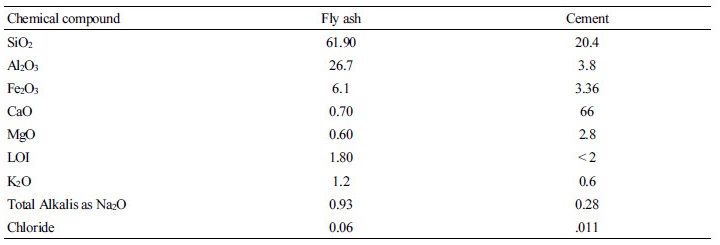
An ordinary Portland cement (Table 1) having fineness of 248 m2/kg and specific gravity of 3.15 was used throughout the experiment. Natural river sand meeting the requirements of zone-II of IS 383:1970 was used as fine aggregates. The specific gravity of natural river sand is 2.48. Natural gravel having maximum size of 20mm and a specific gravity of 2.64 was employed as coarse aggregates. Fly ash (Table 1) employed in this test was procured locally having a density of 2.4 gm/cm3. The specific surface of fly ash (FA) is 478.6 m2/kg.
Bacterial strains
Two types of bacterial strains used in current research work were Bacillus sphaericus NCIM NO 2478 and Bacillus .pasteruii NCIM NO 2477. Both the strains were obtained from National Collection of Industrial Microorganisms, Pune. These strains are alkaliphilic (alkali-resistant) spore-forming bacteria [13]. These species appear promising intrinsic agents as their spores, specialized thick –walled dormant cells have been shown to be viable for over 100 years under dry conditions [12]. The liquid medium composition required for growth of culture includes nutrient broth solution supplemented with urea [7].
Preparation of bio-based agent
The bio-based paste was prepared by mixing cement, sand, bacterial solution of various dosages and water. As of now there is no standard procedure as per IS or European standard for deciding bacterial solution to water ratio. In the current research work bacterial solution to water ratio was maintained to be 0.5. Controlled specimen was prepared by mixing cement, sand and water only.
Casting of specimens and preparation of concrete cubes.
Concrete mixture design was done in compliance to IS10262-2007 for M25 grade of concrete. Cement, fine aggregate and coarse aggregate as per required quantity were mixed properly according to mix proportion for M25 grade of concrete i.e. 1: 1.81: 2.99. Cement to water ratio was maintained 0.5.Fly ash was incorporated with replacement levels of 0, 10, 20 and 30% by mass of cement. Four series of concrete mixes were deigned. Series 0, comprising of only cement with 0% FA and varying bacteria dosage of 0, 103, 105 and 107 cells/ml. Series 1 consists of 10% FA as cement replacement with varying bacteria dosage of 0, 103, 105 and 107cells/ml. Similarly series 2 and 3 comprising of 20 and 30% FA as cement replacement respectively. The three series were prepared at varying bacteria dosages of 0, 103, 105 and 107cells/ml for both strains. All mixtures were mixed in a mixer for certain duration in dry conditions (20min). The moulds of dimensions 150 mm × 150 m × 150 mm were used for testing compressive strength and water absorption. Initially the moulds were lightly coated with an oil to avoid concrete getting stick to the moulds. All the specimens were cast in two layers and compacted on a vibrating table. These was done until air bubbles stopped appearing on the surface. The specimens were kept under moist conditions for 24 hours. After 24 hours the specimens were demoulded and transferred to curing tank wherein they were allowed to cure for 28days in tap water only depending up on the type of test. No additional supplements were provided during curing of concretes in tap water. Concrete specimens without addition of fly ash and bacteria serves as normal concrete.
Compressive strength testing of bio-remediated concrete cubes.
The cubes obtained after 24 hour above were drilled to develop cracks .The width of the crack was approximately 4cm and depth was varied between 0.6 to 1.6 inch. The bio-based agent of bacterial dosage 105 cells/ml was filled in a cut. The control cube was filled with sand, cement and water. The cubes were transferred to curing tank wherein they were allowed to cure in tap water for two test ages, viz. 7 and 28 days. Compressive strength test of all the specimens was done in accordance to IS 516:1959. Tests for compressive strength were performed in triplicates and average value is reported.
Compressive strength testing of bio-remediated fly ash concrete cubes
The cubes of dimension 150 × 150 × 150 mm were drilled to a depth of 1.2inch. The cracks developed were filled with bio-based agent of sufficient quantity. Fly ash concrete was prepared with replacement levels of 10, 20 and 30% fly ash. Experiments were conducted for bacteria of varying dosage of 103, 105 and 107 cells/ml. The controlled specimens were filled with natural sieve sand, cement and water. The control and bacterial remediated specimens were cured for 7, 28 and 60 days. They were tested on 2,000 kN capacity compression testing machine in compliance to IS 516:1959.
Water absorption test
The water absorption tests were performed to determine resistance for penetration of water into the concrete matrix. The cubes of dimensions 150 × 150 × 150 mm were drilled to a depth of 1.2 inch. The bio-based agent of sufficient quantity was applied. Experiments were conducted for varying dosages of bacteria. Fly ash concrete was prepared with replacement levels of 10, 20 and 30% fly ash. After 28 days of curing in tap water, concrete specimens were dried in an oven at a temperature of 105°C to constant mass. The corresponding weight was noted. The specimens were immersed in water till the weight become completely saturate. The saturated weight was measured. The difference between water saturated mass and oven dried mass gives the saturated water absorption (SWA) [3].
Saturated water absorption (SWA) = [(W2-W1)/W2] ×100
Where, W1 = oven dried weight, (kg); W2 = saturated weight, (kg)
Scanning electron microscopy (SEM)
The broken samples from cracks healed with addition of bio-based agent and control concrete after 28 days of curing were dried for two days in oven. These broken samples were analyzed for calcite precipitation by scanning electron microscope (SEM). The scanning electron microscope analysis was done at Shivaji University, Kolhapur. Concrete samples were examined by SEM, Model-JEOl-SEM 6360.
Results
The average values of all properties are shown together with the standard deviation which is represented by means of error bars.
Compressive strength of bio-remediated concrete cubes
Compressive strength of bacterial remediated and control concrete at various depths are graphically represented in Figure 1 and 2. As expected compressive strength decreases with increase in depth. Depths filled with bio-based agent showed higher strength with respect to control specimen at all ages. Highest gain in strength for bacterial remediated concrete was observed at a depth of 1.2 inch in comparison with control specimen. Highest increment in strength property was observed to be 15.6% with respect to control specimen at a depth of 1.2inch at 7 days of curing. At deeper depth percentage increase was very less compared to shallow depth due to the fact that there was no proper oxygen supply which leads to poor biomineralization process. Near the surface calcite precipitation may be more because of the fact that microbes grows faster in presence of oxygen which leads to higher gain in strength at shallow depth.
Compressive strength of bioremediated fly ash concrete
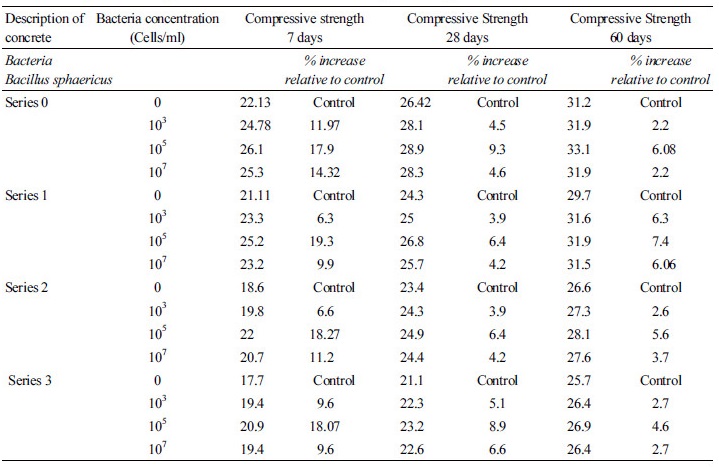
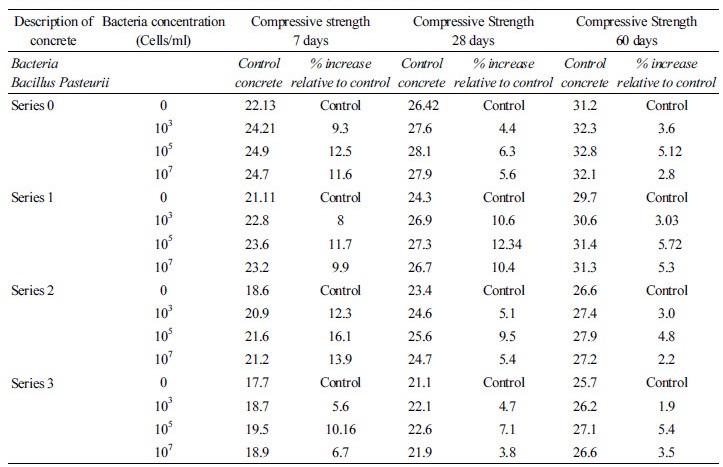
The potential of two strains on self-healing of cracks in fly ash concrete at a depth of 1.2 inch at 7, 28 and 60 days of curing were studied. Tables 2 and 3 summarize the compressive strength of bacterial remediated and control specimens. At all dosages bacterial remediated concrete showed significant improvement in strength in comparison with the control specimen. The highest gain in terms of percentage for Bacillus sphaericus strain was observed to be 19.3% (7 days of curing) in comparison with control specimen for bacterial remediated fly ash concrete. Repairing of fly ash concrete with B.pasteruii showed improvement of 11.79% (23.6 Mpa) in compressive strength at 7 days with respect to control (21.11 Mpa) at cell concentration of 105 cells/ml.
Water absorption of bioremediated fly ash concrete
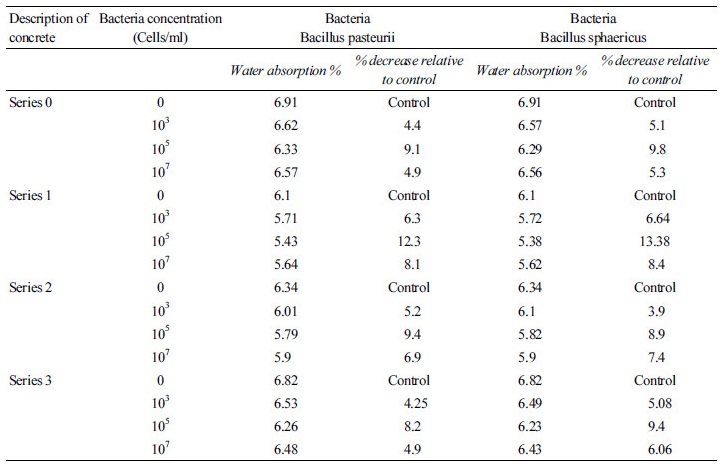
The performance of bio-based agent was assessed by measuring water absorption property of bacterial remediated fly ash concrete. Table 4 shows the influence of bio-based agent on water absorption property of bacterial remediated fly ash concrete. Moreover there were no significant differences in both the strains. The increase in resistance towards the penetration of water can be seen for all cases of bacterial remediated concrete with respect to control concrete. The most pronounced reduction in water absorption for bioremediated concrete compared to control specimen was found to be 13.38% (5.38%) for 10% fly ash concrete with respect to 6.1% of control concrete. This may be attributed to the presence of bacteria (Bacillus .pasteruii and Bacillus sphaericus) which resulted in less water uptake. Bacterial CaCO3 had a positive impact on decreasing water permeability. An experimental finding suggests bio-based agent has positive effect in increasing the resistance towards water absorption depends upon dosages of the bacteria. Test results from figure 3 suggest that bio-based agent has the potential to produce calcite based products which leads to minimize the permeability of the fly ash concrete [9]. At cell concentration of 105 cells/ml, both the bacteria showed maximum resistance towards diffusion of water in both the type of concrete (With and without fly ash). The presence of 10% of fly ash also enhances resistance to the diffusion of water. The trends for both the bacterial strains were nearly the same.
SEM of concrete specimens
The SEM analysis of 28 days bio-remediated and control specimens is illustrated in Figure 3 and 4. SEM observations clearly distinguish between control and bacterial remediated concrete. In case of bio-remediated concrete calcite crystals of irregular shape can be seen pores near the bioremediated surface areas of cracks in the concrete. These microscopic observations confirm the mechanism of microbial calcite precipitation in concrete. Due to this porosity of the concrete decreases and results in less penetration of liquids in the concrete. In case control concrete opening spaces can be seen this facilitates movement of water or any other harmful substances.
XRD of concrete specimens
The concrete samples inside the cracks healed with addition of bio-based agent (Bacillus sphaericus) were subjected to XRD analysis. It was observed from Figure 5 that more calcite is precipitated with higher intensity which is due to bacterial activity. Similar observations were noted by and Kirti Kanta Sahoo [17] and Wasim Khaliq [18]. Figure 6 shows analysis for control concrete. No extra peaks are observed for control concrete.
Discussions
In this study biomineralization concept was employed to study the capacity of bio-based agent in self-healing of cracks in fly ash concrete. Biomineralization technique prompts precipitation of calcite [19]. Alkaliphilic (alkali- resistant) spore-forming bacteria B.pasteruii and Bacillus sphaericus were used to study the effect of healing the cracks in concrete (with and without fly ash). Presence of both the bacteria resulted in better performance in comparison with control. At young age, 7 days of curing higher gain in strength was observed. During initial curing period the concrete cubes are still in porous condition. There may be enough supply of oxygen and water into pores of concrete matrix which may lead to higher biomineralization process [3, 10]. Up to 28 days of curing a major change in strength property is observed with respect to control specimen. The result indicates no major differences during 60 day observation. At longer duration of age the pores may get plugged due to which there may not be sufficient inflow of nutrients, air and water. The cells eventually may either die or may get turned into endospores [4]. Thus it can be concluded that increase in compressive strength in comparison with control is due to deposition of calcite which results in filling of pores [14]. The improvement in compressive strength may be attributed to deposition of calcite near the surface of bacterial cell. Deposition of calcite is due to MICP biochemical process. Deposition of calcite would result in crack-plugging and substantially improves properties of bacterial remediated concrete specimens. Bacterial CaCO3 had a positive effect on improving concrete properties [4]. CaCO3 may minimize capillary pores and this causes increase in strength and durability property [15]. The presence of fly ash does not hinder the bio mineralization process and addition of fly ash reduces the demand for cement which contributes to CO2emissions [16]. This biomineralization process appears to be promising in healing of fly ash concrete which is evidenced by test results and SEM /XRD analysis. Application of bio-based agent is applicable where longer service life and durable property are more important. Moreover this approach requires lower inspection and maintenance cost.
Conclusions
This paper has attempted to repair the cracks in fly ash concrete. Based on the experimental results presented in this study, the following conclusions can be drawn:
1.The general trend observed from the test results is that bacterial dosage of 105 cells/ml gave increment in strength and durability property of bacterial remediated cracked specimen.
2.Both the strain followed the same trend in improving the properties of bio-remediated fly ash concrete specimens. Improvement in property was remarkably high for 7 and 28 days of curing. However no significant gain was observed for 60 day of curing.
3.SEM examination confirms the precipitation of calcite and filling of pores for the specified microorganisms. It can be concluded that strength gain was due to precipitation of calcite in the pores of concrete.
4.At shallow depth major improvement in property of concrete was observed rather than at deeper depth. This would be due to less amount of oxygen supplied at greater depth.
5.Both the Alkali-resistant spore-forming bacteria are eco friendly candidates and are a promising candidate as self-healing material to improve property of concrete specimens.
6.Use of bio-based agent in healing of cracks in concrete would significantly promote sustainability in concrete sector.

