


Introduction
Literature Review
Material and Methodology
Analysis of Green Building–Related Regulations under Regulatory Framework
Analysis of Green Building-Related Systems and Mandatory Requirements
Results
Discussion
Conclusions
Introduction
Global climate change, driven by persistent increases in average global temperatures and the intensifying frequency of extreme weather events, has emerged as one of the most critical challenges of the 21st century [1]. In response, the international community has established climate agreements and cooperative frameworks aimed at reducing greenhouse gas (GHG) emissions, prompting many nations to expand investments in efficient energy systems through sustained research and development (R&D) and strong policy support [2].
In line with these global efforts, the Republic of Korea has declared low-carbon green growth as a central national agenda, seeking to balance economic development with environmental sustainability. The building sector, accounting for a significant portion of national energy consumption and GHG emissions, has been identified as a priority area for mitigation and adaptation measures [3].
A pivotal policy milestone was the enactment of the Framework Act on Low Carbon, Green Growth in 2013, which mandated the development of a National Green Building Master Plan every five years, setting sector- and region-specific GHG reduction targets for both existing and new buildings [4]. Based on this Act, more than ten eco-friendly building certification systems have been implemented in Korea, including the Green Standard for Energy and Environmental Design (G-SEED, a complete revision of the former Environment-Friendly Building Certification), Zero Energy Building (ZEB) certification, Intelligent Building System (IBS) certification, and the Energy Performance Index (EPI). However, the complexity and overlap of these systems make it difficult for stakeholders to fully understand and comply with the obligations, often resulting in cases of unintentional non-compliance or unnecessary certifications [5, 6, 7, 8].
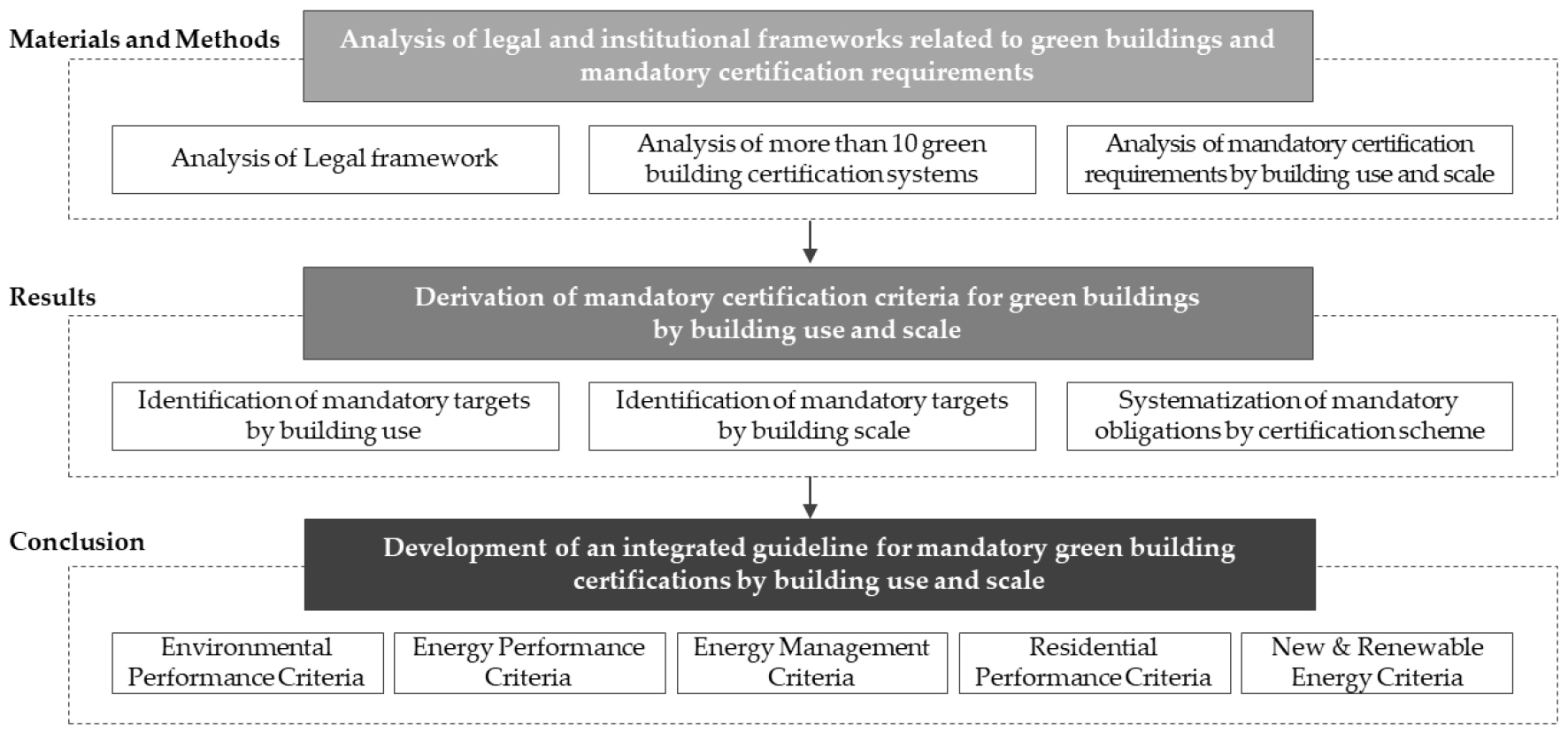
Therefore, this study aims to develop an integrated guideline that consolidates the diverse eco-friendly building certification systems currently enforced in Korea. To this end, all relevant legal frameworks were analyzed, and a tabulated standard was developed that classifies the requirements by building size and use, providing a clear and graded structure. The final guideline enables construction stakeholders to easily determine whether certification obligations apply from the early design and planning stage. The overall research flow of this study is illustrated in Figure 1.
Literature Review
Internationally recognized green building certification systems have played a crucial role in promoting sustainable construction practices. Among these, the United Kingdom’s BREEAM (Building Research Establishment Environmental Assessment Method), the United States’ LEED (Leadership in Energy and Environmental Design), and Japan’s CASBEE (Comprehensive Assessment System for Built Environment Efficiency) are widely adopted frameworks with distinct evaluation methodologies and market impacts [4].
BREEAM, developed in 1990 by the Building Research Establishment (BRE), is one of the earliest and most influential environmental assessment methods for buildings. It is currently implemented in over 70 countries and holds approximately 80% of the green building certification market share in Europe. The system evaluates projects across nine categories: management, health and wellbeing, energy, transport, water, materials, waste, land use, and ecology. The total score is 110 points, calculated by applying specific weightings to each category. Similar to LEED, BREEAM assigns the highest weighting to the energy category (19%), with energy efficiency—evaluated using energy simulation—accounting for half of the energy score (15 points). As a result, achieving high performance in energy efficiency significantly influences the overall certification rating [9, 10].
LEED, developed in 1998 by the U.S. Green Building Council (USGBC), is a voluntary, consensus-based certification system that evaluates the environmental performance of buildings in design, construction, operation, and maintenance. It is applicable to new commercial buildings, high-rise residential projects, educational facilities, major renovations, and neighborhood developments. LEED assessments are based on a life-cycle approach, encompassing six main categories and 34 subcategories: sustainable site planning, water efficiency, energy and atmosphere, materials and resources, indoor environmental quality, and innovation in design. Certification levels are determined by total points achieved: Certified (40–49), Silver (50–59), Gold (60–79), and Platinum (80 or more). LEED certifications are valid for five years, after which recertification is required to assess operational and maintenance performance. Buildings achieving the highest scores may also receive the annual “Green Building of the Year” award [11, 12].
CASBEE, developed in Japan, is a comprehensive assessment method for evaluating and rating the environmental performance of buildings. Initially designed for single-building evaluations, CASBEE was later expanded to assess larger-scale developments, such as urban blocks and districts, through CASBEE-UD (Urban Development). CASBEE-UD evaluates the integrated environmental performance of multiple buildings and associated infrastructure within a coordinated development plan, supporting enhanced environmental measures in urban regeneration and regional development projects. CASBEE offers four primary assessment tools corresponding to the building life cycle: CASBEE-Pre-Design, CASBEE-New Construction, CASBEE-Existing Building, and CASBEE- Renovation. This structure enables flexible evaluation tailored to project type, scale, and development stage [11, 12].
Collectively, these certification systems have advanced sustainable building practices by providing standardized, performance-based metrics for design and operation. While BREEAM and LEED have achieved broad international recognition and market penetration, CASBEE has contributed significantly to integrating environmental performance considerations into urban-scale development in Japan. Comparative analyses of these systems highlight differences in assessment categories, weighting schemes, and applicability across building types and development contexts, providing valuable insights for policymakers and practitioners aiming to enhance building sustainability frameworks.
Material and Methodology
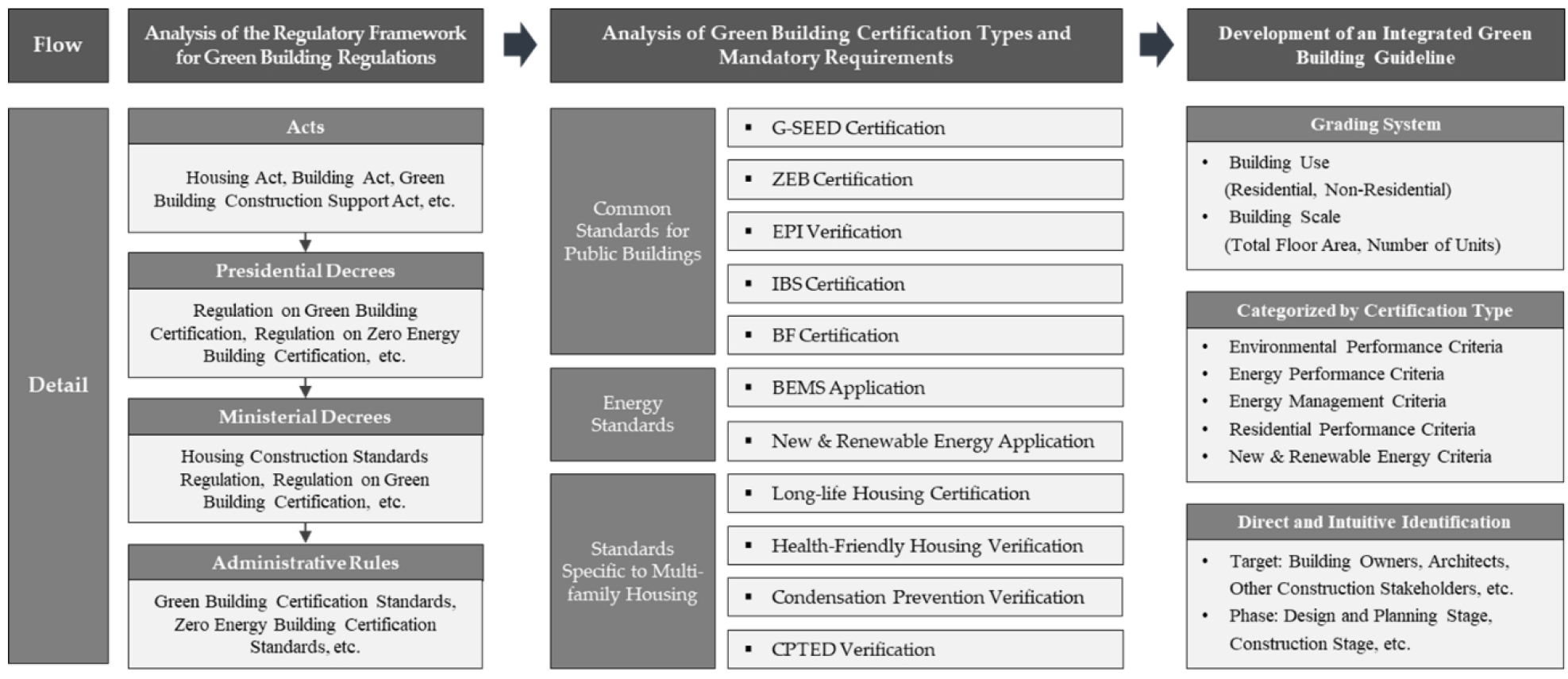
In this section, the study first analyzes Korea’s regulatory framework for green building, encompassing laws, presidential decrees, ministerial decrees, and administrative rules. Next, more than ten major certification systems are reviewed, and their mandatory requirements are examined by building type (residential vs. non-residential) and scale (total floor area, number of units). The analysis then identifies common standards for public buildings, energy-related obligations, and requirements specific to multi-family housing. Based on this comparative review, the study systematizes the scope of mandatory certification across different categories. Finally, an integrated guideline is developed, structured by grading system, certification type, and user-oriented applicability. The scope and procedure of this study are presented in Figure 2.
Analysis of Green Building–Related Regulations under Regulatory Framework
This study aims to establish an integrated guideline for sustainable low-carbon buildings by analyzing and consolidating the Green Building Construction Support Act—enacted in 2013—and its associated instruments, together with major laws such as the Housing Act and the Building Act.
The guideline integrates dispersed regulatory frameworks and provides a systematic foundation for nationwide implementation of carbon-neutral building policies. To develop this integrated guideline, it is essential to understand Korea’s legal hierarchy—Acts → Presidential Decrees → Ministerial Decrees → Administrative Rules—each playing a complementary role in shaping the green building policy landscape. The relevant legal instruments concerning green buildings within this framework are as follows:
·Acts: Housing Act [13], Building Act [14], Green Building Construction Support Act [15], Act on the Guarantee of Convenience Promotion of Persons with Disabilities, Senior Citizens, Pregnant Women and Nursing Mothers. [16], and Act on the Promotion of the Development, Use, and Diffusion of New and Renewable Energy [17].
·Presidential Decrees: Enforcement Decree of the Housing Construction Standards Act [18], Enforcement Decree of the Building Act [19], Enforcement Decree of the Green Building Construction Support Act [20], Enforcement Decree of the Act on the Guarantee of Convenience Promotion of Persons with Disabilities, Senior Citizens, Pregnant Women and Nursing Mothers. [21], and Enforcement Decree of the Act on the Promotion of the Development, Use, and Diffusion of New and Renewable Energy [22].
·Ministerial Decrees: Housing Construction Standards Regulation [23], Enforcement Rule of the Green Building Construction Support Act [24], Regulation on Green Building Certification [25], Regulation on Zero Energy Building (ZEB) Certification [26], Regulation on Intelligent Building System (IBS) Certification [27], and Regulation on Barrier-Free (BF) Certification [28].
Table 1.
Legislation for the Development of an Integrated Green Building Guideline
·Administrative Rules: Green Building Certification Standards [29], Zero Energy Building (ZEB) Certification Standards [30], Long-life Housing Construction and Certification Standards [31], Healthy Housing Construction Standards [32], Crime Prevention Architectural Design Standards [33], Design Standards for Condensation Prevention in Multi- family Housing [34], Energy-Saving Design Standards for Building [35], Regulations on the Support for Renewable Energy Facilities [36], Regulations on Energy Use Rationalization for Public Institutions [37], and Barrier-Free (BF) Certification Assessment and Fee Standards [38].
The target building types are categorized into residential and non-residential buildings, with classifications defined in Annex 1 of Article 3-5 of the Enforcement Decree of the Building Act. The analysis results are summarized in Table 1.
Analysis of Green Building-Related Systems and Mandatory Requirements
This section introduces the definitions and institutional backgrounds of Korea’s diverse green building–related systems. The analysis examines the legal frameworks governing each certification and identifies the specific building types and thresholds subject to mandatory certification. Through a comparative legal and regulatory review, this study clarifies the scope of mandatory requirements according to building use (residential vs. non-residential) and building scale (total floor area and number of units).
·G-SEED (Green Standard for Energy and Environmental Design): This system evaluates the environmental performance of buildings throughout the life cycle, aiming to reduce energy and resource consumption, minimize pollutant emissions, and ensure a comfortable environment. Under the Green Building Construction Support Act, public buildings over 3,000 m² must obtain certification, with office buildings achieving at least “Excellent” (Green Grade 2) [29].
·ZEB (Zero Energy Building) Certification: ZEB assesses the ratio of primary energy produced to consumed, targeting energy self-sufficiency. Based on the Zero Energy Building Certification Standards, public buildings over 500 m² must obtain certification. Since 2020 it has applied to public buildings, and from 2025 will extend to private multi-family housing with 30 or more units [26, 30].
·EPI (Energy Performance Index) and Energy Saving Plan: Grounded in the Building Energy Saving Design Standards, this system requires submission of energy-saving plans for buildings exceeding 500 m² when applying for permits [15].
·IBS (Intelligent Building System) Certification: Designed to encourage integration of intelligent technologies in design, services, and management, this applies mainly to large-scale and technologically advanced facilities [15, 28].
·BF (Barrier-Free) Certification: Institutionalized under the Act on Promotion of Convenience and related laws, this is mandatory for all new public buildings and public-use facilities since July 29, 2015, and since December 4, 2021, for all public parks [16, 21, 28, 38].
In addition, supplementary obligations apply to public buildings:
·BEMS (Building Energy Management System): Public buildings ≥10,000 m² must install BEMS under the Regulation on the Promotion of Rational Energy Use by Public Institutions. For those ≥500 m², advanced remote electronic meters may substitute [37].
·Mandatory renewable energy ratio: Public buildings ≥1,000 m² must meet renewable energy supply obligations under the Regulation on the Support for Renewable Energy Facilities. In 2024 the minimum ratio is 34%, rising by ~2% annually [17, 22, 36]. Exclusive requirements also apply to residential buildings, particularly multi-family housing:
·Long-life Housing Certification: Evaluates durability, adaptability, and repairability. Projects with ≥500 units must obtain certification [31].
·Healthy-Friendly Housing: Ensures safe indoor environments by limiting emissions from materials and ensuring ventilation. Mandatory for multi-family housing with ≥500 units [32].
·Condensation Prevention Performance Evaluation: Establishes criteria to minimize condensation, required for multi-family housing projects with ≥500 units [34].
·CPTED (Crime Prevention Through Environmental Design): Defines design standards to prevent crime and improve safety, mandatory for all multi-family housing [33].
Collectively, these frameworks demonstrate that Korea’s green building policies extend beyond environmental sustainability to encompass energy management, renewable energy adoption, durability, occupant health, safety, and social inclusivity. The integrated guideline proposed in this study consolidates these legal and regulatory requirements into a clear and comprehensive decision-making tool for stakeholders.
Results
The results of this study highlight a comprehensive analysis of Korea’s regulatory framework for green buildings, including acts, decrees, ministerial regulations, and administrative rules. Based on this analysis, more than ten green building certification systems were systematically reviewed, and their mandatory application thresholds were identified. The findings indicate that certification requirements vary significantly according to building use (residential vs. non- residential) and building scale (total floor area or number of units).
For public buildings, certifications such as G-SEED, ZEB, and BF are legally mandated once the floor area exceeds specific thresholds. For residential buildings, additional requirements such as Long-Life Housing, Healthy-Friendly Housing, Condensation Prevention Assessment, and CPTED apply, particularly to large- scale multi-family housing developments. Energy- related obligations, including EPI submission, BEMS installation, and renewable energy supply ratios, were also found to be critical determinants of compliance.
The results further reveal that some certifications are legally mandatory (●), while others are strongly recommended (△), ensuring both flexibility and rigor in policy implementation. By classifying obligations into categories of environmental performance, energy performance, energy management, residential performance, and new and renewable energy, the study provides a structured framework for evaluation. Accordingly, the integrated guideline proposed here enables stakeholders to determine certification obligations at the design and planning stage with clarity. The detailed classification of certification requirements by building use and scale is summarized in Table 2 to 3.
Table 2.
Classification System for Mandatory Requirements by Building Use and Scale
Discussion
The findings of this study reveal that Korea operates a wide range of green building regulations and certification systems as part of its broader strategy to achieve carbon neutrality in the building sector. While these frameworks provide important institutional support, a critical gap remains: there is no system in place to quantitatively evaluate carbon emissions and reductions across the full life cycle of buildings. To move toward net-zero carbon performance, future policy must establish methodologies and certification schemes that can rigorously assess life cycle greenhouse gas (GHG) emissions and the actual mitigation effects of buildings.
Another challenge is the overlapping and fragmented nature of existing systems. Programs such as the Energy Performance Index (EPI), Zero Energy Building (ZEB) certification, and Building Energy Management System (BEMS) share substantial similarities in evaluation criteria. Integrating these schemes could enhance administrative efficiency while providing clearer compliance pathways for stakeholders.
Furthermore, current certification systems in Korea predominantly target new construction, focusing on predictive assessments conducted during the design and planning stages. While such prospective evaluations are essential, the absence of post-occupancy certification mechanisms limits the ability to verify actual building performance. Establishing operational and post-built verification systems would therefore be a necessary step to ensure that predicted outcomes translate into real carbon reductions.
Table 3.
Development of an Integrated Green Building Guideline
Conclusions
This study was conducted with the objective of developing an integrated green building guideline through a comprehensive analysis of Korea’s regulatory and institutional frameworks related to sustainable construction. Based on this analysis, the following key conclusions were obtained:
1.Korea’s legal and regulatory framework for green buildings, including acts, decrees, ministerial regulations, and administrative rules, was systematically reviewed to establish a unified basis for green building policies.
2.More than ten certification systems were examined, and their mandatory application thresholds were identified by building use (residential vs. non- residential) and building scale (total floor area and number of units).
3.Public buildings are required to obtain certifications such as G-SEED, ZEB, and BF once specific thresholds are exceeded, while residential buildings—especially large-scale multi-family housing—must additionally comply with requirements such as Long-Life Housing, Healthy-Friendly Housing, Condensation Prevention Performance Assessment, and CPTED.
4.The integrated guideline developed in this study introduces a four-grade classification system and categorizes certification obligations into five evaluation areas: environmental performance, energy performance, energy management, residential performance, and renewable energy.
Collectively, the findings provide a structured, practical, and comprehensive decision-making tool that can support Korea’s transition toward carbon-neutral and sustainable buildings. Furthermore, by incorporating ordinances individually enforced by local governments, the guideline is expected to provide construction stakeholders with a more efficient and advanced framework.

