


Introduction
Material and methods
Material
Environmental impacts
Life cycle stages
Evaluation of target project
Result
Discussion
Conclusions
Introduction
The construction industry has been cited as a major factor in global environmental problems, accounting for 40% of the world’s energy use and more than 30% of carbon emissions [1, 2]. Currently, the construction market continues to develop buildings to respond to external changes such as demographics, and in this process, environmental impacts occur [3, 4]. As interest in the environment increases around the world, various aspects of research are being conducted in the construction field to reduce the environmental impact [5]. In particular, in order to quantitatively grasp the environmental impact occurring in the construction industry and to prepare an alternative, a number of studies on the environmental impact evaluation on buildings were conducted [6, 7, 8, 9]. As the result of such studies the construction stage is found to release the most carbon emission after the operation stage, that assumes long periods of time and are analyzed through simulation [6, 8, 10]. Therefore, in order to reduce the environmental impact caused by the building, it is necessary to minimize the impact of the construction stage.
Reinforced concrete (RC) structures, which account for 78.4% of South Korean buildings, are not efficient in terms of productivity, construction period, and safety. Moreover, in the case of RC structures, the work in the construction stage accounts for the majority of the total, as on-site work is the majority [11, 12, 13]. As a construction method that complements these shortcomings and minimizes the impact of the construction stage, a modular construction is considered to be widely applied to improve the construction productivity in the construction industry [12, 13]. The modular method has advantages related to quality, time, and reuse [14, 15]. Since modular buildings are assembled by skilled workers at the factory, the risk in terms of quality occurs significantly less than that of the RC method [16]. In addition, since only minimal work is performed on the site after pre-fabrication, and the site work is minimized, the impact of climate risk is relatively small, it is possible to shorten the construction period by 50% or more [17]. Modular buildings can be moved easily by unit, so they can be reused in response to various demands without discarding or rebuilding the building [4, 18].
With such numerous advantages, the application of modular construction method is expanding in the construction industry as an alternative to the conventional one [19]. As the global interest in the application of the modular construction method increases, many related studies are being conducted [20]. In order to expand the application of the modular construction method, it is necessary to prove the feasibility of the sustainability aspect, and to do so, it is necessary to evaluate the environmental impact quantitatively [21, 22].
Kim [23] analyzed the environmental impact of material acquisition, module fabrication, site assembly, and occupancy stages for single-story households located in the United States. The researcher compared the modular unit with a timber building and a conventional building, and as a result of the analysis, it was analyzed that the modular timber building has about 3% less carbon emissions than the conventional construction method. Quale et al. [24] evaluated the environmental impact of material acquisition, module fabrication, site assembly, occupancy, and waste management in a two-story household in the US. When comparing the carbon emission analysis results between a modular timber building, an off-site construction, and an on-site building, it was possible to reduce about 30% of carbon emissions in the modular building. Monahan and Powell [25] analyzed the embodied energy and carbon emissions in the material acquisition, module fabrication, and site assembly stages of a two-story residential modular timber building located in the UK. As a result of the evaluation, the carbon emission of the modular construction method was analyzed to be 34% less than that of the conventional construction method.
According to such studies on environmental impact assessment of modular construction methods, it was quantitatively analyzed that modular construction methods also have advantages in terms of environment than conventional construction methods. However, the structure of the modular building analyzed in most studies is focused on timber. In the case of a modular wood building, it is difficult to apply it to a wider variety of buildings because it is mostly used for small and single-story and low-rise buildings [26]. Therefore, in Korea, steel structure is mainly applied to modular building in consideration of structural aspect. However, studies on environmental impact analysis on modular steel buildings are insufficient.
Therefore, this study aims to conduct an analysis focusing more on the carbon emission in the material production stage of a modular steel building, which is a modular structure that is mainly applied in South Korea. Through the analysis results of this project, it is believed that the basis for proving the sustainability of a modular building with a steel structure can be laid.
Material and methods
Material
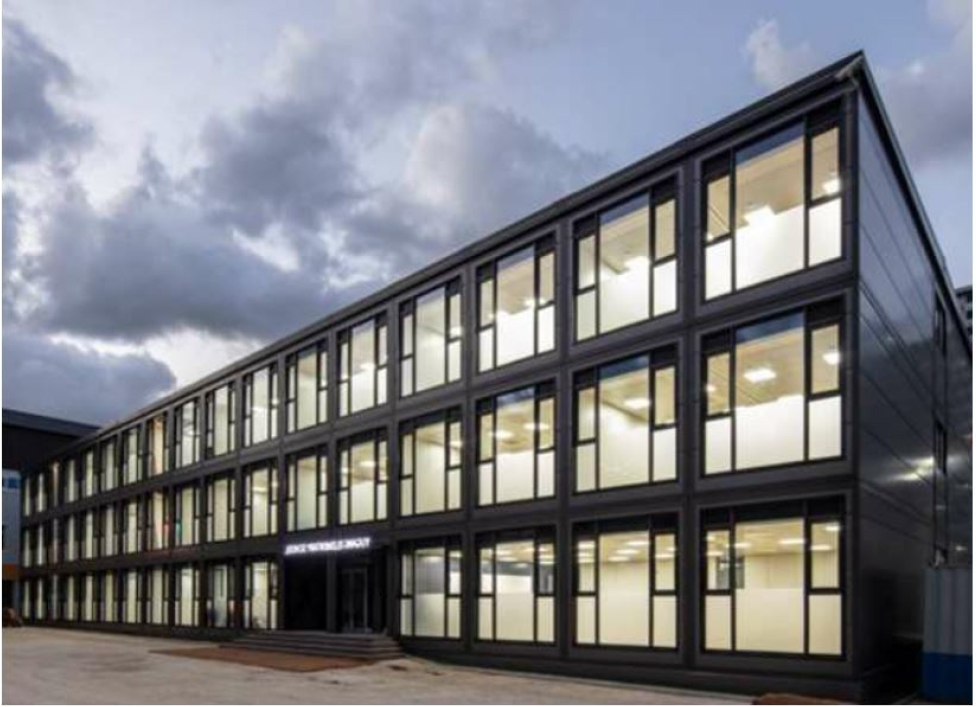
The target project of this study is a modular school building with a floor area of 3,575.32 m2, built for temporary use during school remodeling, in South Korea. This is differentiated from other cases in that it is a steel frame modular unit school building with 100% factory production rate including the envelope. The modular units utilized in this project are all made of steel structures, consisting of three layers.
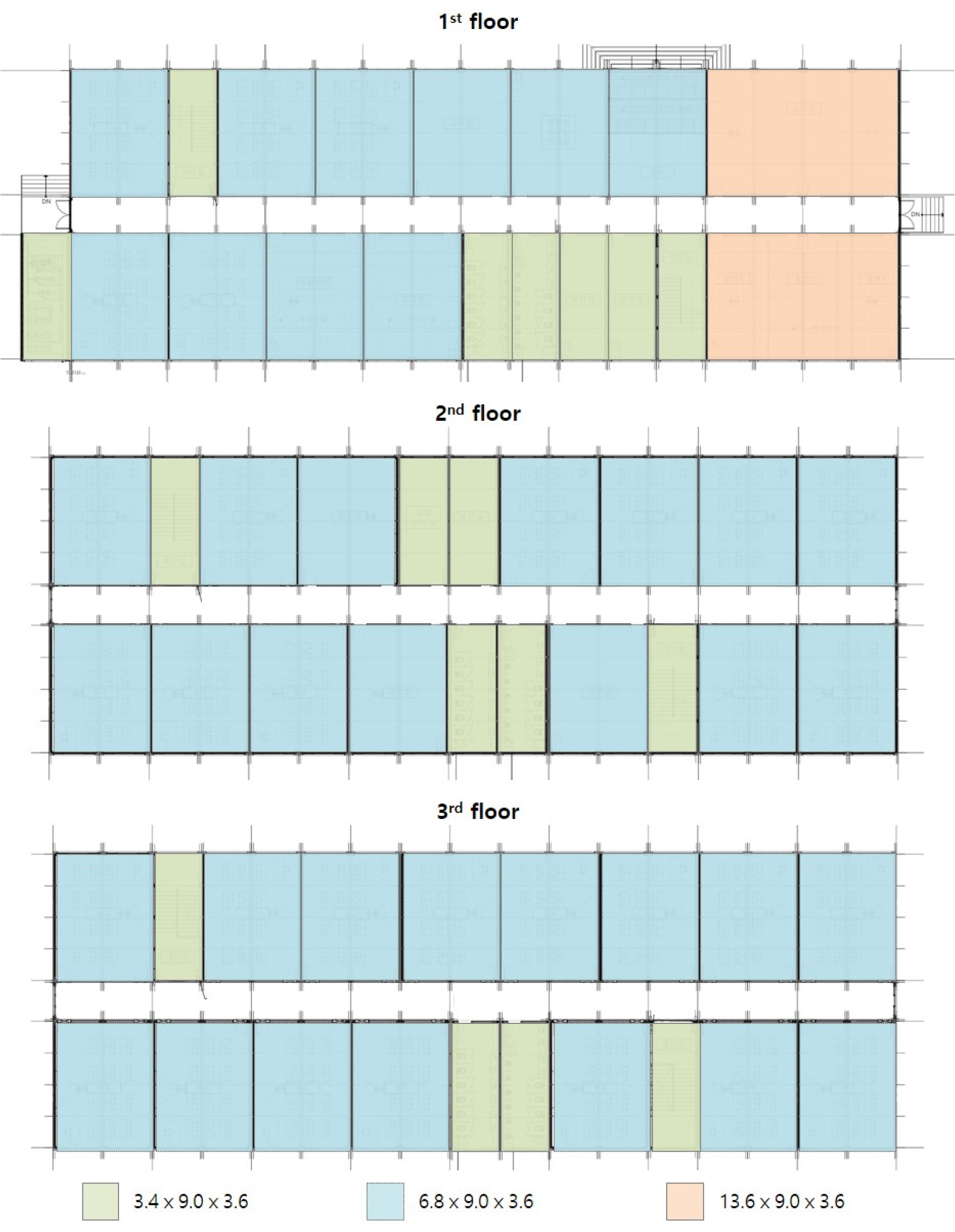
The function of the module space is largely divided into five categories: classrooms, teachers’ administrative rooms, stair rooms, toilets, and auditoriums. Three types of modules were utilized in total, as shown in Table 1. The modules are divided into three types, all of which are standardized based on a basic module, 3.4 m x 9.0 m x 3.6 m. The other two types of module units are units made of two or four basic modules, respectively. Considering the number of basic module units, the target building was constructed with 103 basic module units. Table 1 provides an overview of the target project.
Table 1.
Overview of target project
As shown in Figure 1, each floor basically includes two stairwells on the left and right, and two toilets. Other spaces include classrooms, teachers’ rooms, auditoriums, and lobby. Spaces with relatively small areas, such as stairwells and toilets, consist of a single basic module. In the classroom or teacher’s room, a combined module was used to accommodate about 30 students. For spaces where physical or musical activities take place, such as auditoriums, four basic modules are combined and designed to have a large area. Figure 1 shows the floor plan of the target building divided by module unit size type.
Environmental impacts
The Life Cycle Assessment (LCA) methodology is a method that enables quantitative evaluation of environmental impacts on a variety of materials utilized in different industries. LCA is being used more actively in the manufacturing industry, and recently, environmental impact analysis research using LCA methodology is being conducted in the construction field. The LCA in the construction industry assesses the environmental impact of a building throughout its life cycle based on international regulations in ISO 14040. The evaluation procedure consists of defining goal and scope, life cycle inventory analysis, life cycle impact assessment, and interpretation of results.
Goal and scope steps define objectives, functions and system boundaries. The life cycle inventory analysis stage is the process of collecting all data related to inputs, processes, and emissions based on the entire life cycle. In the life cycle impact assessment stage, the magnitude of the potential environmental impact and the input resources are quantified. The interpretation step is to interpret the results calculated in the impact assessment step and recommend appropriate remedial measures in relation to the scope of the study [27].
In LCA analysis, the environmental impact categories mainly consider six categories, including global warming potential, abiotic resource deposition potential, ozone deposition potential, acidification potential, eutrophication potential, photochemical ozone formation potential [9]. According to the results of previous studies, in the field of construction, the category with the highest value of environmental impact units is global warming potential, which corresponds to embodied carbon emissions [28, 29, 30]. In this study, the evaluation was conducted focusing on embodied carbon emissions, the most influential category among the six environmental impacts.
Life cycle stages
The life cycle in the construction field is divided into production stage, construction stage, operation stage, and disposal stage [8, 31, 32]. The production stage includes extraction, transportation, and manufacturing of raw materials that are put into the building. The construction stage includes the transportation and construction process, and the operation stage refers to the stage from use of the building to the stage of maintenance. Finally, the disposal stage includes the dismantling of the building, transportation, and waste treatment.
The LCA methodology can be classified in various ways according to the scope of analysis. First, “Cradle-to-Gate” includes only the material production stage, and “Cradle-to-site” includes the analysis range from the material production stage to the construction stage. “Cradle-to-grave” refers to analyzing the entire life cycle of a building [6, 10, 33, 34].
In some studies, modular buildings have been reported that the environmental impact of the material production stage during the entire life cycle is relatively high [35, 36]. Therefore, in this study, considering the results of previous studies, the analysis was conducted by focusing on the material production stage of the modular school building corresponding to “Cradle-to-gate” among LCA analysis.
Evaluation of target project
Design documents and quantity take-off documents related to the target project were provided by the company that produced and constructed the modular unit. This evaluation selected 57 building materials excluding construction methods and auxiliary materials among 79 items listed in the construction quantity take-off document. Based on the provided construction document, the amount of construction material input was unified into one mass unit, ton, so that it can be compared [37]. Using the details and quantity information of construction materials specified in the document, the major construction materials of this project were derived by applying the cumulative total of 99% as the cut-off criteria. The cumulative mass information according to the input material is shown in Table 2.
Table 2.
Input quantity of construction material
The environmental impact of construction materials in the material production stage was analyzed using the main construction materials and inputs derived above. Carbon emission is calculated by multiplying the amount of material input quantities by the carbon emission factor for each material as shown in the equation below.
Carbon emissions [kg-CO₂] = Quantities × Carbon emission factor
The carbon emission factor database used the values specified in the Korea’s national life cycle inventory database and the Ministry of Land, Infrastructure and Transport’s building material environmental information database [38]. Table 3 shows the carbon emission factor values for major construction materials.
Result
The embodied carbon emissions for the material production stage of the modular school project are shown in Table 4. The total embodied carbon emission of this project was calculated as 646,409.64 kg-CO2eq, which is 180.80 kg-CO2eq/m2 in terms of per unit area. This can reduce the environmental impact by 62.25% when compared with the results of the previous study on school building constructed with RC method (478.92 kg-CO2eq/m2) [39]. This result is due to the difference in structural materials between the two projects. Based on the carbon emission factor presented in Table 3, among construction materials, the environmental impact factor value of cement is significantly higher than that of other materials. In the case of the target modular school project, no cement was added at all. For this reason, it is considered that there is a significant difference in the overall environmental impact value when compared to the RC structure school building where cement and concrete are used as main materials.
Table 4.
Results of embodied carbon emissions assessment
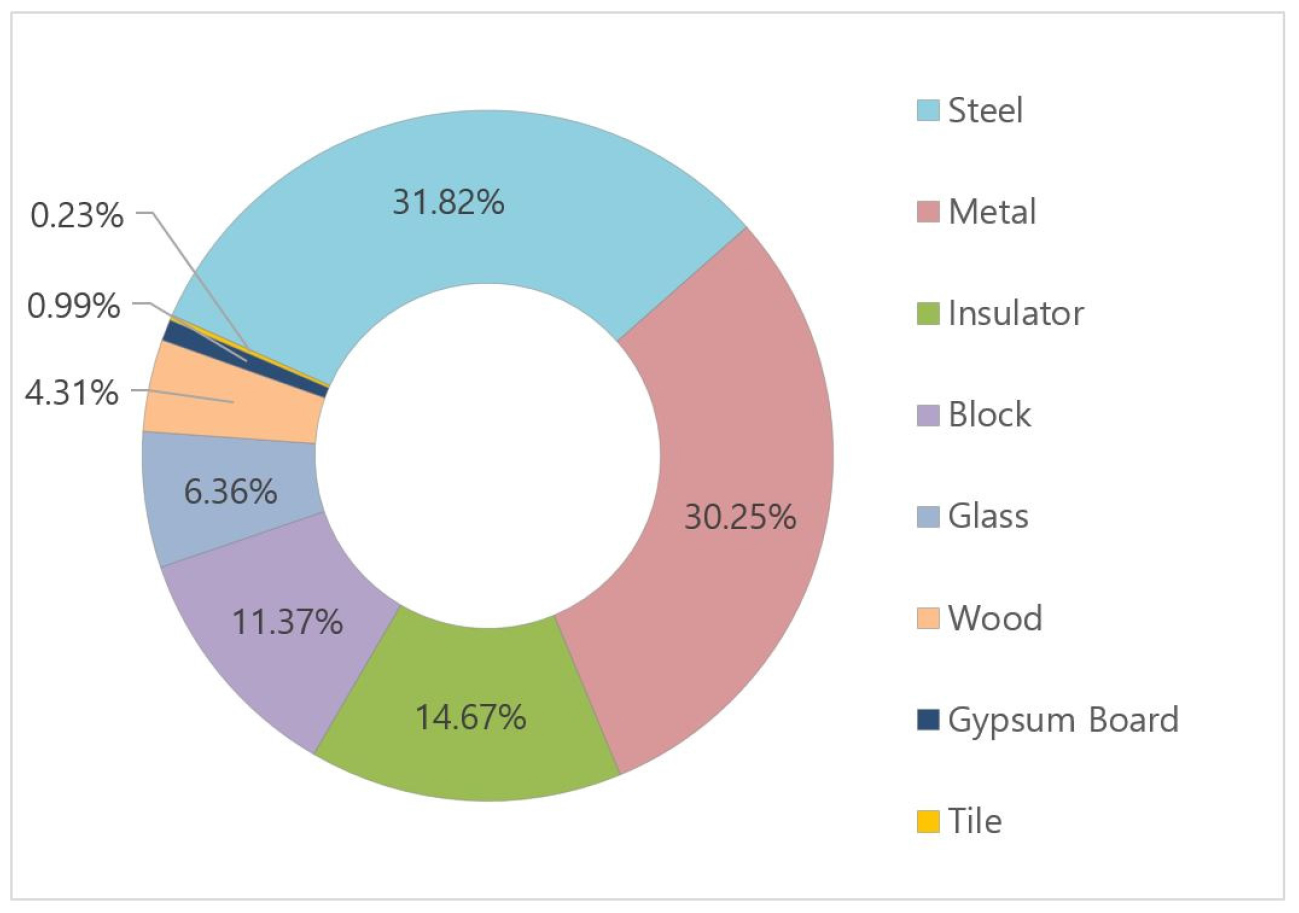
When analyzing the major construction materials, steel frame (205,681.73 kg-CO2eq) and metal (195,552.61 kg-CO2eq) accounted for a relatively high percentage of of embodied carbon emissions, 31.82% and 30.25%, respectively. The reason the steel frame was the highest proportion of embodied carbon emissions is thought to be affected by the fact that the structure of the modular unit is a steel. Figure 2 shows the percentage of embodied carbon emissions from the production stage of the materials put into the target project.
Discussion
As the construction industry is mentioned as a major factor in the global environmental problem, research to reduce the environmental impact of the construction field is continuously being conducted. However, in the case of RC structures that are mainly used in Korea, the proportion of on-site work is large, and for this reason, the rate of occurrence of environmental impacts at the construction stage is high. In order to supplement the conventional construction method and reduce the environmental impact of the construction stage, the application of the modular construction method that can minimize the procedure in construction stage at the site is expanding.
As interest in modular buildings increases due to the advantages of various aspects, including the environment, various analyses of related studies are under way. However, the structure of the modular building analyzed in most studies is focused on timber, which is difficult to expand and apply to a wider variety of buildings because it is mainly used for small-scale buildings.
In this study, embodied carbon emissions were evaluated for a modular steel building. The sustainability of the construction industry is considered an important issue. In this respect, it is meaningful in that modular construction methods that can improve the problems of existing construction methods have been objectively and quantitatively evaluated from an environmental perspective. Through the results of this study, it was confirmed that modular steel buildings can reduce carbon emissions when compared with the environmental impact values of RC structures retrieved from the result of previous studies [39]. These results are consistent with previous studies that a modular timber building has an environmental advantage over the conventional construction method. Such research results can be used as a reference tool to prove the validity of the application of the modular construction method in line with the trend that consideration of sustainability in the construction field is important.
However, this study focused on the material production stage of the modular construction method, and did not consider the end-of-life stage in which the modular units are transported to other places and recycled. This does not reflect the contents of recycling, which is the greatest advantage of the modular construction method, so it will be possible to prove the sustainability of the modular building more accurately if the whole life cycle analysis that reflects the contents is carried out later.
Conclusions
The purpose of this paper is to prove that the modular steel building can reduce the embodied carbon emissions, which contributes to indicating the sustainability of modular construction. The following summarizes the conclusions of this study.
1. The target school building is made of steel frame, and carbon emission at the production stage was evaluated by applying 99% cumulative mass contribution as the cut-off criteria using detailed type and quantity information of building materials specified in the quantity calculation form.
2. According to the results of the evaluation of embodied carbon emissions, the total amount of carbon emissions was analyzed as 180.80 kg-CO2eq /m2. When compared with the results of the previous study (478.9173 kg-CO2eq /m2) that analyzed the carbon emission per area in the material production stage of the school building to which the RC method was applied, it is a value equivalent to 37.75%, and it is possible to reduce carbon emissions compared to the RC method.
3. When analyzing the embodied carbon emissions by major construction materials, steel frame (205,681.73 kg-CO2eq) accounted for a relatively high percentage of 31.82%. This result is considered to be affected by the fact that the structure of the modular unit is a steel structure.
4. The results of this study quantitatively show that modular buildings are advantageous in terms of environmental impact compared to conventional building. In addition, the sustainability of modular steel buildings has been revealed through the results of this study, as well as modular timber buildings, which have already proven sustainability due to a number of previous studies.

