


Introduction
Methodology
Aim and scope
Search process
Selection criteria
Cataloging process
Analysis
Limitations identified during the literature review process
Results
The research and publications
The knowledge about straw-cement-based composites
Discussion
Conclusions
Introduction
Since ancient years, fibers have been used to reinforce earthen construction materials. In recent decades, cereal straw and other agro-waste materials have been constantly studied as reinforcement and enhancement for various types of composites to be used as construction materials [1, 2, 3, 4]. As mentioned in the literature, already since the early 1940s, cellulose was used in fiber-reinforced cement-based composites [2], but it was 20 years later, in the early 1960s, that concrete reinforcement with fibers got more attention of academic and industry researchers [1, 2]. Since then, many types of fibers, such as steel, glass, synthetic, and natural fibers, have been used for research and commercial production of concrete and other cement-based composites [1, 2]. In the 1980s the focus was on achieving a low-cost production process for cheaper products [2], that is why natural fibers became the more suitable option. Natural fibers not only are cheaper than steel, glass, or synthetic fibers but also are smaller and can be processed physically and with chemicals to enhance their properties or facilitate the processing methods of composites [2]. Although natural fiber-reinforced cement- based composites have been constantly studied and developed over the last decades, and many products are now available, optimization remains to be conducted.
On the other hand, the use of natural fibers, especially the use of crop wastes, not only improves the composites’ properties but also gives a sustainable alternative to the disposal of these wastes instead of burning, reducing hazards. World cereal annual production as at July 2023 was estimated at around 2 819 million tonnes [5], which means that there was also a large amount of crop waste around the world needing correct management. Given this situation, the use of cereal straw fibers to reinforce concrete and other cement-based composites acquires greater relevance. And not only for the reinforcement but for the enhancement of other properties of composites and the possibility of the replacement of cement with straw, preventing the impacts generated by cement production [3, 6, 7, 8].
Cereal straw fibers may not be suitable for high performance structural concrete [9], but there are many possibilities of application as ordinary concretes, mortars, and other matrices. The lower cost of cereal straw fibers is an important benefit but there are also other benefits such as the lower degree of industrialization requirement, their strength and that they are environmentally friendly [8]. Furthermore, as mentioned, reinforcement is not the only property to be enhanced with cereal straw fibers. Straw fibers make an important contribution to cement-based composites by optimizing their thermal properties [e.g. 10, 11, 12]. For a construction material, optimizing its thermal properties provides an opportunity to improve the comfort in buildings which leads to a reduction in energy consumption and its consequent reduction of CO2 emissions.
This study is a systematic literature review on cereal straw-cement-based composites for use as construction materials to provide an enhancement of the understanding of the research works on the optimization of these composites.
Methodology
This section provides the description of the whole process of achieving the systematic literature review. The description starts with the definition of the aim and scope, continues with the details of the search process and the selection criteria, then the cataloging process and the analysis are explained, to finish the section with a brief description of the limitations identified during the review process.
Aim and scope
This study aims to provide an enhancement of the understanding of the research works on the optimization of straw-cement-based composites for use as construction materials. Therefore, the main research question is: How has research been performed for the optimization of straw-cement-based composites for use as construction materials? To help answer this main question other specific research questions have been formulated: How and where has the research topic been developing? How and for what research has been done? Which properties of the straw-cement- based composites are the most and less studied and why? What are the main findings? What are the limitations of the existing research? The purpose is to identify key trends and patterns in research performance for providing guidance for future research and practical applications in the field.
The study is specifically limited to works focused on cereal straw-cement-based composites, leaving aside works in which other fibers or other binders are used.
Search process
To ensure acquiring high-quality articles the most important databases were selected to search: Web of Science (WoS) and Scopus. Based on the focus on straw-cement-based composites, the search keywords were “straw cement”, “straw concrete” and “straw block”. In both databases, the search was performed by article title, abstract, and keywords. The type of document was limited to only peer-reviewed articles excluding conference articles, book chapters, and others. The main search language was English, but were also included the results in Spanish, French, Italian, and Portuguese, to identify a wider amount of research, especially in Latin countries.
Due to the history of research on cement-based composites with the addition of natural fibers of probably more than 80 years, for this study was taken a short period that allows a more detailed analysis, but not too short that allows to see trends. That is why the research period was set for the last 20 years, from January 2003 to July 2023.
The search process began with a pilot search to define the optimal keywords to cover the main body of the targeted literature. It was found that too general keywords, such as “bio-based composites”, “bio-based construction materials”, and “agro-waste cement-based composites”, lead to research on a broad number of composites for other uses and construction materials of many possibilities of raw materials. On the other hand, the use of too specific keywords as “straw-cement- based composites” results in a very limited number of records closing the possibilities for research that uses different wording to name the composites, such as mortar or concrete or specific construction materials as blocks. It was decided to use as the main keyword the two required raw materials of the studied composites: “straw” and “cement”. The other two set keywords were used to incorporate the records that do not use the word “cement” on the title, abstract, or keywords, but there is a high probability of the use of cement as the raw material for concrete or blocks.
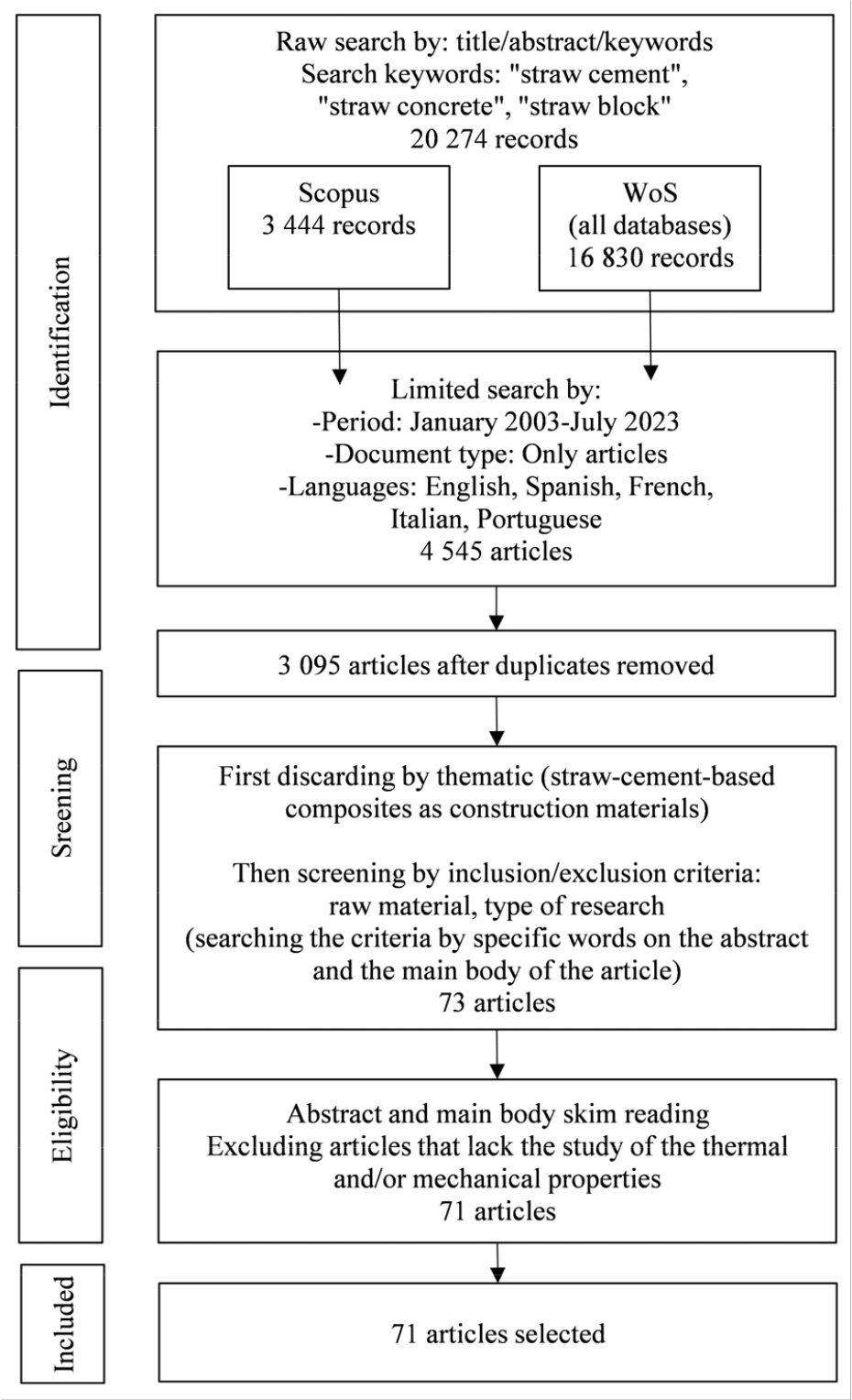
After the definition of the optimal keywords, the actual raw search began with each of the three keywords on both databases resulting in a total of 20 274 records. With the help of the filters of the databases, the number of records was limited by period, type of document, and language to 4 545. That number of records was processed to remove duplicates, resulting in a total of 3 095.
Selection criteria
As defined before, after selecting the databases and the search keywords, the first selection criteria were: the period of publication, the type of document and the publication languages. After those general criteria were used to limit the raw search, more specific criteria were applied to select the expected documents for the analysis. Due to the large number of resulting records after the filtering of the database, the first decision was to leave aside all the articles with no straw-cement-based composites for construction materials for properly screening the ones with. For not performing double screening, i.e., the one for discarding and the other one for properly screening the articles about straw-cement-based composites for construction materials, the processes were conducted together.
The specific inclusion and exclusion criteria were the raw materials and the type of research. The two required base raw materials are cement and straw. The inclusion criteria consider only Ordinary Portland Cement of any type, excluding other cementitious binders, geopolymers, and other binders. The selection of straw fibers was limited to cereal straw, only to those derived of wheat, rice, barley, and oat because they are not only among the most widely cultivated cereal crops globally, but also share similar characteristics, such as the hollow stem structure, the fiber lengths, and the lignocellulosic composition [13, 14, 15]. Other cereal straws like corn, sorghum, as well as other natural fibers, such as sisal, hemp, kenaf, and others, were excluded because of a greater structural and compositional variability that could affect the processing properties and the behavior of the composites, hindering meaningful comparison across studies. Also, other cereal wastes were excluded like husk or straw ashes, which are likewise commonly used as replacements for cement or other aggregates for cement-based composites. In addition, the exclusion criteria consider the composites that include straw and cement, but their main raw material is earth (soil, clay, sludge). Micro or nanofibers from cereal straws were also excluded. The type of research targeted was experimental. Theoretical research, literature reviews, and other types of studies were excluded (see Table 1).
Table 1.
Inclusion and exclusion criteria
To perform the discarding and the screening of the 3 095 articles the process began by reading the article title and the journal in which it is published. The databases provide the possibility of filtering by source or by main subject area or category, but during the pilot search some targeted articles were found on sources with not so evidently related focus, like multidisciplinary journals, or with a wide subject, like sustainability. That is why these database filters were not used and the discarding and screening processes were performed manually. The discarding process required reading the title and journal. The screening process, after the title seemed the right way, consisted of searching the criteria by specific words on the abstract and the main body of the article. This is where the inclusion and exclusion criteria about the raw material and the type of research were applied. A total of 73 articles were selected and downloaded labeled by author and year.
To achieve the final selection the eligibility criteria were searched on the 73 articles by reading the abstracts and, if necessary, searching the criteria by specific words on the main body of the article. The eligibility criteria were the studied properties of the straw-cement-based composites. Due to the role of the composites as construction materials, mechanical and thermal properties were selected as eligibility criteria. At least one of the two mentioned properties was required to make an article eligible. Only 2 articles were discarded, remaining a final selection of 71 articles. The final selection represents 2.3% of the articles obtained by the limited search (3 095). Figure 1 summarizes the process from the search to the final selection.
Cataloging process
After the final selection was defined a synthesis process was needed. The synthesis consisted of data collection and processing. Data were extracted from the articles similarly to survey research [16, 17] The variables of interest were of two types. The first type was the data relating to the publications and general characteristics of the studies reported in the articles (no. 1 to 13 of Table 2). The second type was the data relating to the materials used for the studies and to the properties studied (no. 14 and 15 of Table 2).
Table 2.
Criteria for data extraction of the selected articles
As shown in Table 2, the data relating to the publications include the authors, the year of publication, the title of the article, the name of the journal, the times cited, the study site, the authors’ countries, and the research groups’ countries and continents. The purpose of this data collection is to describe how and where the research topic is developing. The general characteristics of the studies reported include the tests performed (mechanical, thermal, acoustic, economic), the type of straw (wheat, rice, barley, or oat), and the type of composite (mortar, concrete, block, brick, board or non specified). Their purpose is to describe how research is been doing and the targeting implementation trends.
The data relating to the raw materials used for the studies were the type of material (cement, sand, gravel, water, straw, and other) and their quantities. This data collection enables to analyze the proposed composites by each study. The data relating to the properties studied were the type (physical, mechanical, thermal, acoustic, and other) and the results, which enable to analyze and compare between studies.
In summary, in this study, 15 criteria of interest were defined, some of them with four or more categories and subcategories for extracting data from the articles. It should be mentioned that the first 13 criteria could be extracted directly from the databases and for criteria 14 and 15 the entire body of the articles was needed. A Microsoft Excel spreadsheet was created for the classification and processing of the data extracted from each article.
Analysis
To answer the formulated research questions the analysis was performed to evaluate the synthesized data and to extract meaningful information to be shown in the results report [16]. Descriptive statistics were used to calculate and show the trends of publications and general characteristics of the studies reported. For the data relating to the materials used for the studies and to the properties studied a classification by type of composite was firstly done. A comparative analysis between the classified composites was carried out to highlight the main findings of the analyzed studies.
Limitations identified during the literature review process
One of the first limitations was the accessibility of the publications. Four articles, representing 5.5% of the downloaded articles to be elected, were inaccessible. It was decided that they were included in the first part of the analysis (the descriptive statistics), but it was necessary to remove the inaccessible publications for the second part of the analysis.
During the cataloging process it was found that “each paper, each way”, there is no uniformity in the presentation of methodology and results. For example, the units for the amounts of raw materials, like cement, are expressed in g, kg, kg/m3, ton, cm3, percentages or proportions by weight or by volume. To compare it was necessary to convert, when possible, leaving some articles out of the analysis. Another example is that in some articles the data are only presented in figures, graphically, and not in numbers which made the data hard to process and made it difficult to have precision to compare.
The lack of information was also a limitation. For example, some articles reported the amount of straw in percentage, but they did not state the percentage of what, i.e. if it was by weight or volume, of cement, of binders, or of the complete mix. Some articles do not report the amount of straw, and some others do not report the details of the mixes. All this caused the exclusion of some articles of a part or the whole second part of the analysis.
Around 27% of the corpus are articles reporting experiments with not only cereal straw fiber, but other natural, synthetical, or steel fibers or other lightening materials. Furthermore, other wastes are added to the mixes as binders or fine or coarse aggregates. All this makes it difficult to compare between studies. That is why many of the studies use a control sample to compare their results, but there are studies, around 32%, with no control sample, further complicating data processing and comparing.
Worth special mention that while this manuscript was being written, one of the selected articles was retracted by the publisher. Therefore, it was decided to keep the article in the part of the statistics of the publications, but it was excluded from the comparative analysis between the studies, causing to repeat the comparative and correlating analysis to make the adjustments.
Results
In this section the results are reported. The report is divided into three parts. The first part reports the results of the analysis of the data relating to the publications and the general characteristics of the studies reported in the articles. The second part reports the results of the analysis of the data relating to the materials used for the studies and of the data relating to the properties studied. The third part is a discussion of the main findings and the limitations of the existing research.
The research and publications
From the data relating to the publications and general characteristics of the studies reported in the articles, the first two specific research questions can be responded. The questions are: how and where has the research topic been developing? And how and for what research has been done? The following subsections seek to provide the answers.
The development of the research topic
The data relating to the publications include the authors, the year of publication, the title of the article, the name of the journal, the times cited, the study site, the authors’ countries, and the research groups’ countries and continents. The results are presented graphically to show the main trends and some other data are also given in the textual description to emphasize relationships or give more accurate details.
Even though literature reviews from around 20 years ago [e.g. 1, 2] mention the increasing interest since the 1980s in the reinforcement of cement-based composites with natural fibers, cereal straw seems not to be a first choice for researchers during the first decade of the 21st century. Figure 2 shows scarce publications during the first studied decade from 2003 to 2012. A total of 7 articles were published, representing 10% of the studied corpus. Three of them were from the same research group based in the United States [18, 19, 20]. The other three were from Egypt, and the same research center [21, 22, 23]. And the last one was from China [24].
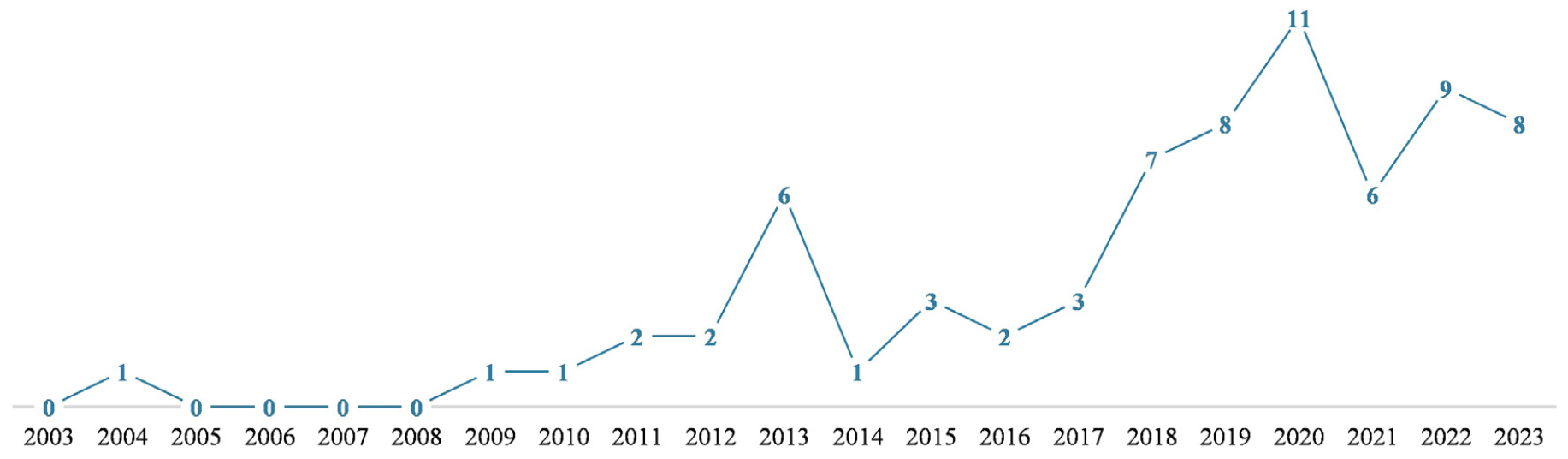
The other 64 articles –90% of the corpus– were published during the last studied decade from 2013 to July 2023. It could be seen the increasing interest (Figure 2). The year 2020 has the most significant percentage of publications (15%). Although the trend seems to decrease for the year 2023, it should be taken into account that the number of articles considered for this study has been published only during the first half of the year.
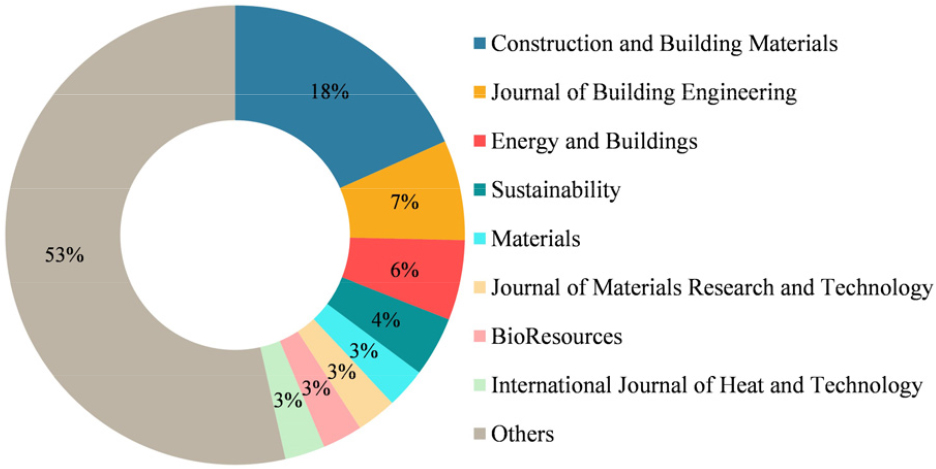
The articles were published in journals from around the world mainly specialized in materials, construction materials, or building engineering, but there are some others (13%) published in journals with other focus, such as ecology, forestry, energy, or other journals with a very wide subject like sciences or sustainability. The most recurrent journal is Construction and Building Materials (Elsevier) with 18% of the publications, followed by the Journal of Building Engineering (Elsevier) with 7%, and Energy and Buildings (Elsevier) with 6%. Figure 3 shows the trends of the publication journals. The journals listed in the categories of Figure 3 are the ones with two or more articles published, the category “others”, representing 53%, corresponds to the group of journals with a single published article.
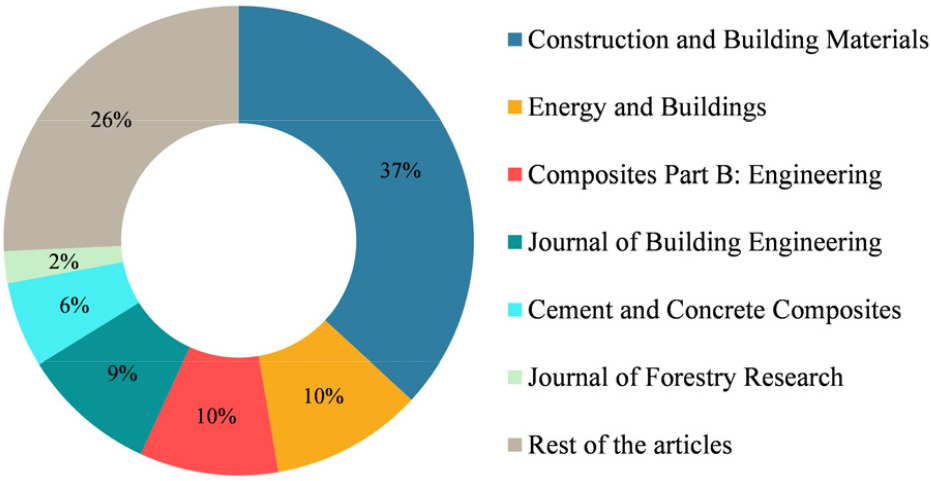
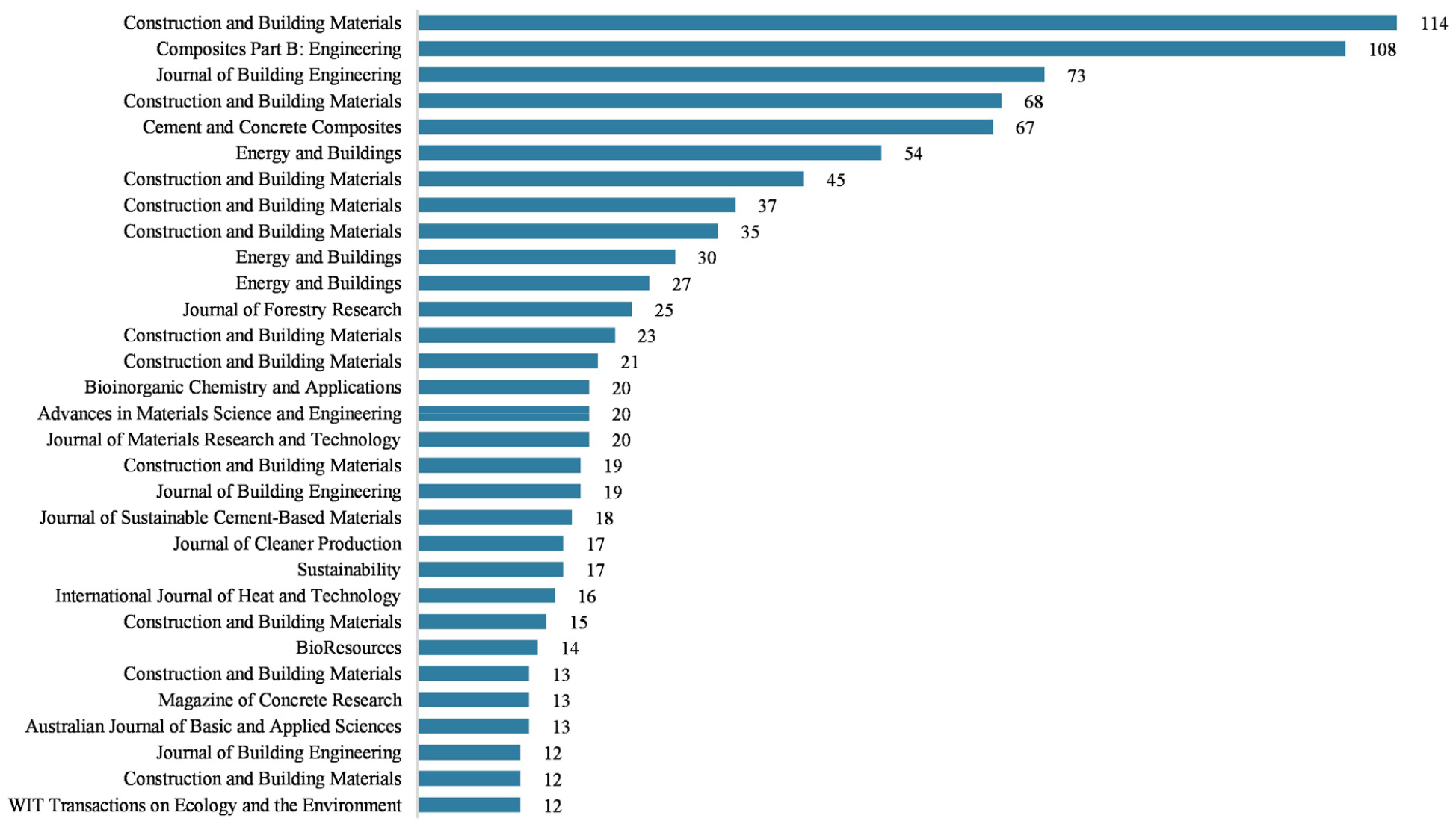
With the aim of measuring somehow the research interest in straw-cement-based composites the number of citations as at July 2023 where analyzed. A total of 1 131 citations were obtained by the corpus of the articles reported only by the Scopus and WoS databases. The most cited article, with 10% of the total citations, is published in Construction and Building Materials (Elsevier), which together with the other articles published in the same journal achieves 37% of the total citations (see Figure 4). The second most cited article, with also around 10% of the total citations, is published in Composites Part B: Engineering (Elsevier), a journal with a single published article of the corpus. On the other hand, 14% of the articles have no citations, but 60% of them were recently published during the first half of 2023. Figure 5 shows the articles with more than 10 citations, a total of 31, listed by journal of publication.
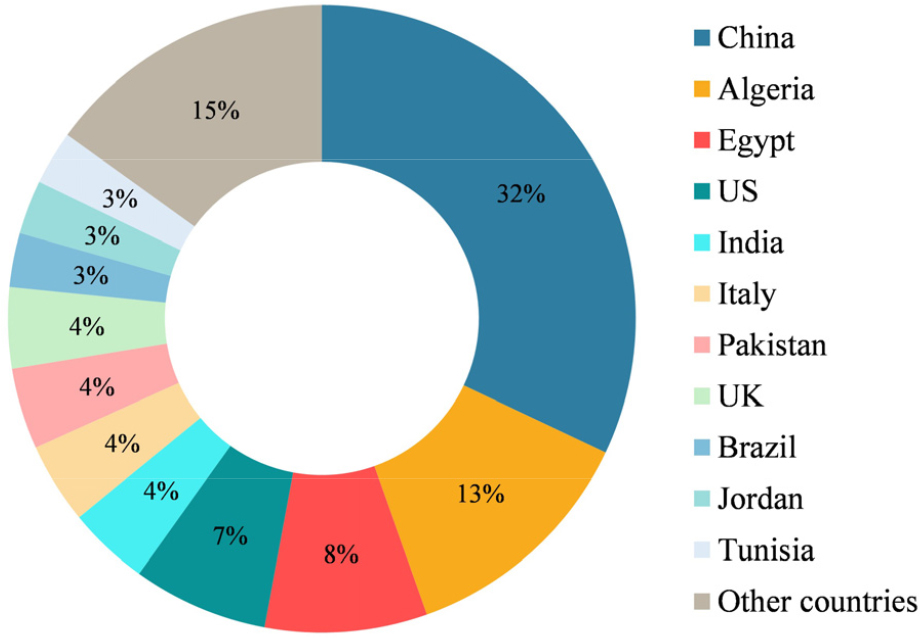
The study site, where the research is conducted, was recorded by country. The research on straw-cement- based composites was conducted in a total of 22 countries. Figure 6 shows the recurrent countries with China at the head with 32% of the published research, followed by Algeria with 13%, Egypt with 8%, the United States with 7%, and other countries. The listed countries in Figure 6 have at least 2 representatives. The “other countries” category groups the various countries with only one representative.
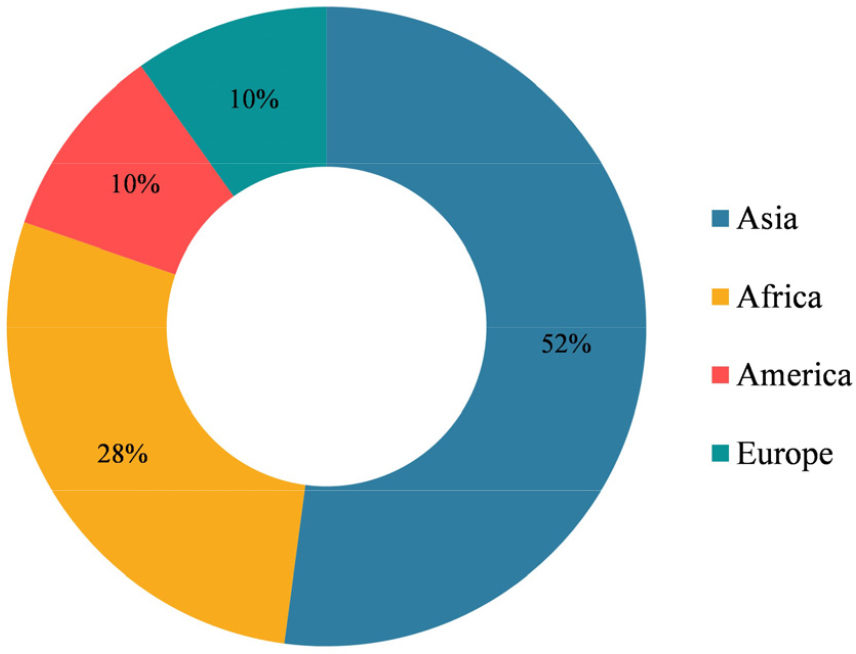
Most of the research groups, 72%, are composed of members from the same country, but not necessarily from the same university or research center. 28% of the research groups are international, with coauthors from 2 to 5 different countries. The location of the research groups, for the international groups, was defined by joining data from the study site and of the first or most of the authors. The location of the research groups is shown in Figure 7 by continent. It can be seen that Asia, with only one representative during the first studied decade, increased the research production achieving more than half of the worldwide production during the last decade. Most of the Asian groups, 89%, are purely Asian, and only 11% are coauthoring with American, African, and European researchers. Instead, 50% of African groups are coauthoring with Europe-based researchers mainly from France.
Some research groups (11) are repeated in the publications. 51% of the published research was done by those 11 research groups, 5 Asians, 3 Africans, 2 Europeans, and 1 American. The rest have 1 publication per group. Those groups have from 2 to 8 articles published. A total of 8 publications are from the same research group from Algeria, the group has publications since 2014, have 22% of the total citations, and 5 articles published in Construction and Building Materials, the most recurrent journal. A total of 6 publications are from the same first author with various collaborators, all of them from China.
General characteristics of the research
The data relating to the general characteristics of the studies reported in the articles include the tests performed, the type of straw, and the type of composite, with the aim of responding how research has been done and to describe the targeting implementation trends. In this subsection the results are presented graphically to show the main trends and some other data are also given in the textual description to emphasize relationships or give more accurate details.
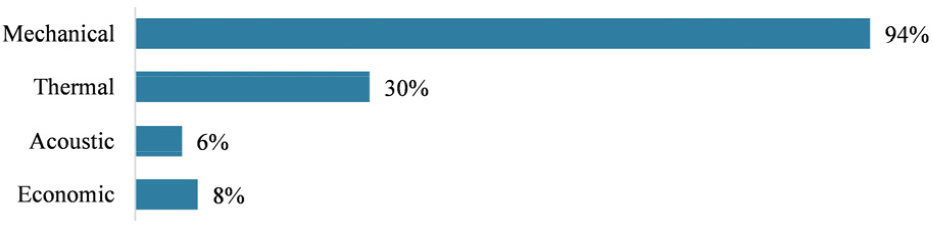
The tests performed on the composites studied by each published research give an idea of the methodology used. The original tests to be identified by this study were mechanical, thermal, and acoustic, because of their importance on the composites as construction materials. But, during the reading process, it was noticed that some of the articles reported economic analysis, that is why it was included in this criterion. Most of the articles, 94%, report the performance of mechanical tests. A total of 30% of the articles report the performance of thermal tests, 24% together with the mechanical tests, and the other 6% focused only on the thermal test. Only 6% of the articles report the performance of acoustic tests, always in addition to mechanical and thermal tests. 8% of the articles report an economic analysis of the production cost.
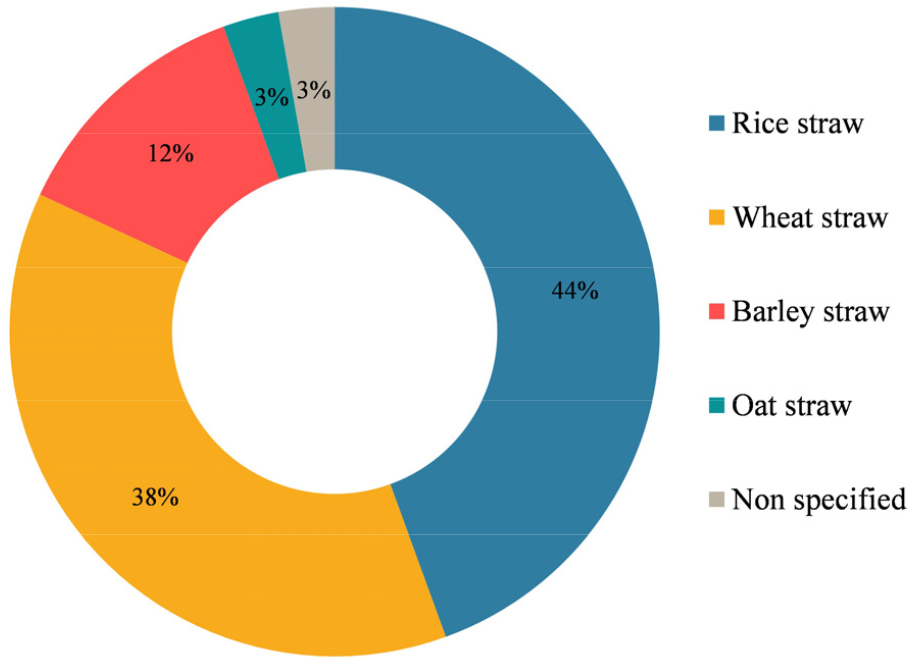
As reported in the articles, the cereal straw used as raw material to experiment with the composites was from wheat, rice, barley, or oat. 3% of the articles only mention “straw” without specifying the cereal, but the articles were still selected because it was clear from the images that any of the mentioned cereal straw was used. Rice and wheat straws were the most used. 44% of the articles reported experiments with rice straw and 38% of the articles reported experiments with wheat straw. Barley straw was used in 13% of the experiments reported in the articles. Oat straw was used only in 3% of the experiments.
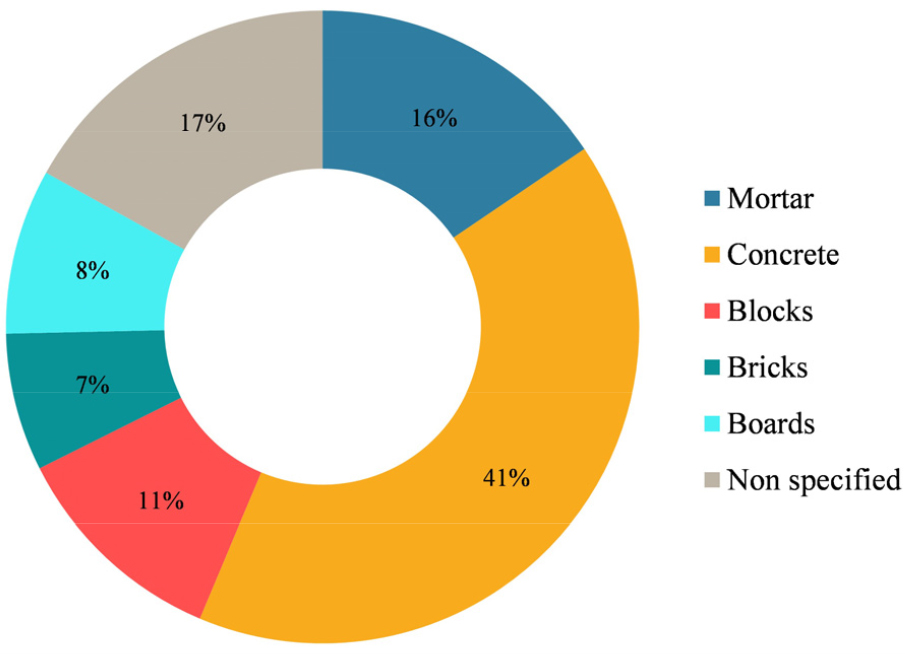
The type of composite helps describe the targeting implementation trends. 83% of the research studies a specific type of composite, grouped in this study as mortars, concretes, blocks, bricks, and boards. Only 17% of research studies generic composites for different possibilities of use. The category “non specified” listed in Figure 10 corresponds to those composites without a targeting implementation. Concrete reinforced with cereal straw is the most studied type of composite. 41% of the articles report experiments with concrete, 16% with mortar, and 26% with masonry products such as blocks and bricks, and other prefabricated as boards (see Figure 10).
The knowledge about straw-cement-based composites
From the data relating to the raw materials used for the studies and the data relating to the studied properties, the third and fourth specific research questions can be responded. The questions are: which properties of the straw-cement-based composites are the most and less studied and why? What are the main findings? To start answering it was necessary to understand what had been done in the studies reported in the articles. Then, to understand the composites studied and find similarities to compare.
The studied properties of the composites
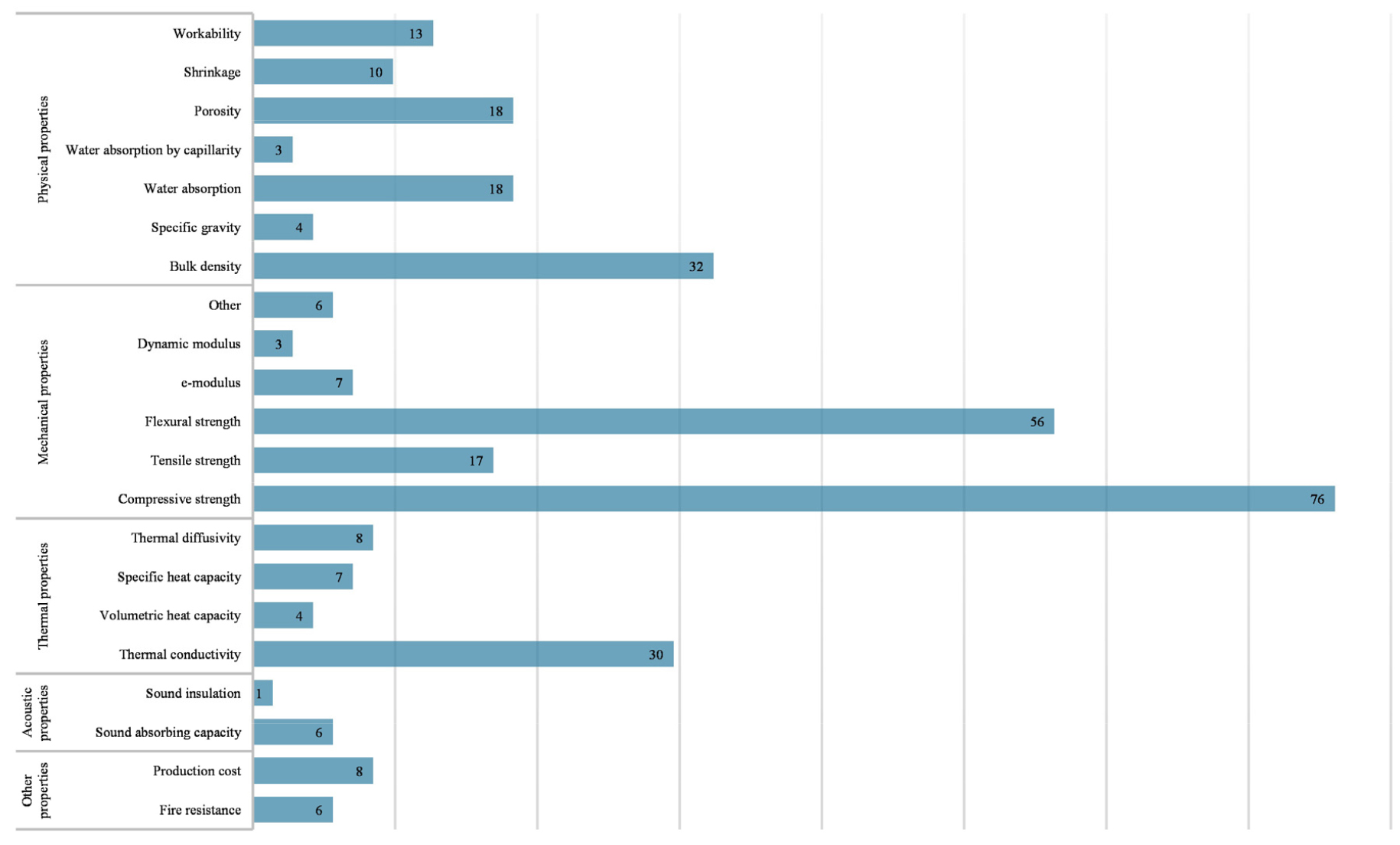
In this section, the analysis of the most relevant studied properties is presented. The studied properties are grouped by type in physical, mechanical, thermal, acoustic, and others. Figure 11 shows the most recurrent studied properties. Of the physical properties bulk density is the most reported with 32%, followed by water absorption (18%) and porosity (18%). As shown in Figure 8, 94% of the studies reported mechanical properties of the composites. 76% reported compressive strength and 56% reported flexural strength, sometimes together and other times one or the other. All the studies reporting thermal properties, 30%, report thermal conductivity, sometimes together with thermal diffusivity, specific heat capacity, or volumetric heat capacity. All the studies reporting acoustic properties, 6%, report sound absorbing capacity. The other properties found reported are production cost, by 8% of the studies, and fire resistance, by 6% of the studies.
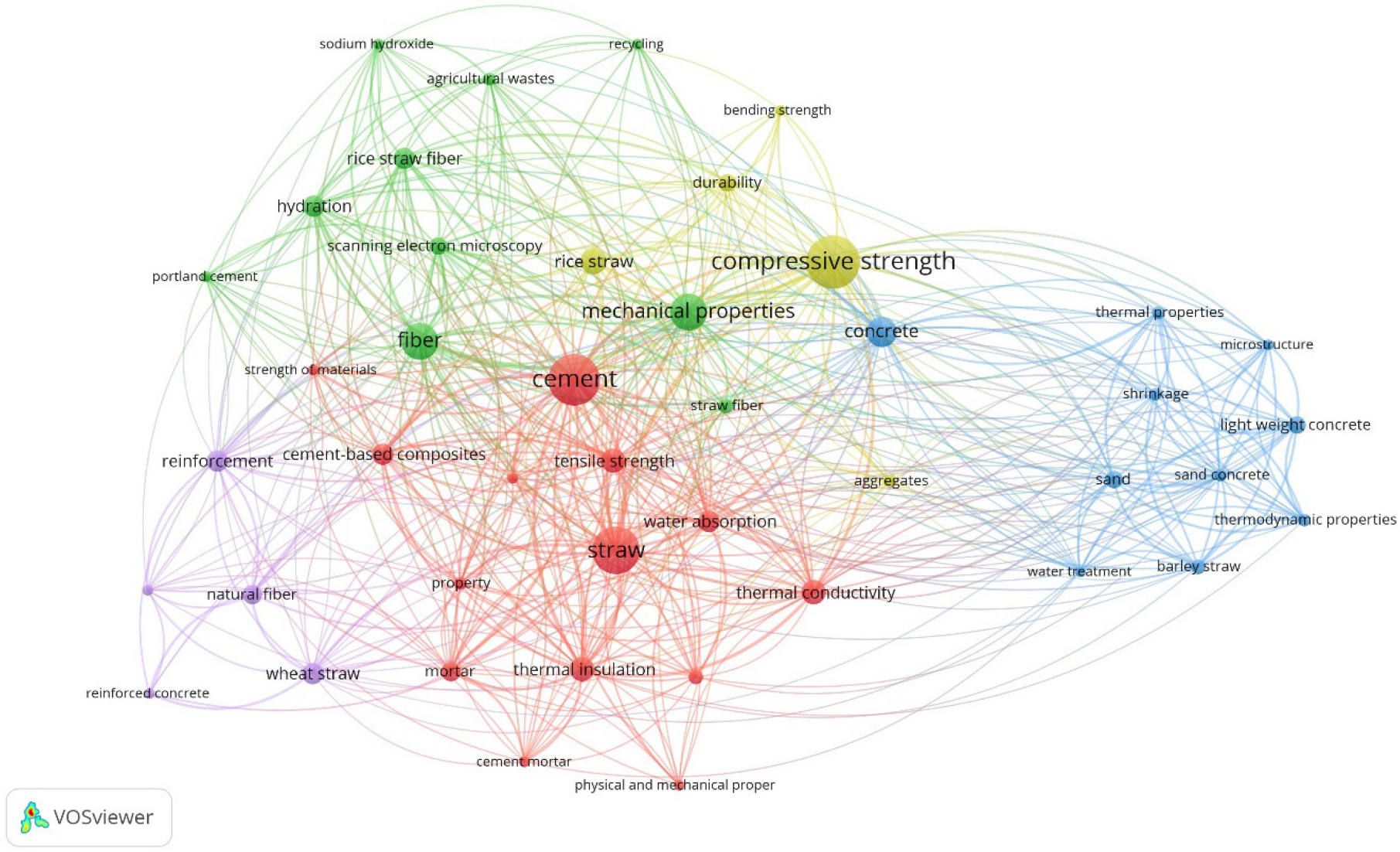
A semantic graph (Figure 12) was created with the keywords of the corpus of articles using VOSviewer. The sizes of the circles represent the weight of the keyword repetition. It can be seen in Figure 12 that compressive strength is the most significant concept corresponding to the highest percentage of the studies reporting it, only followed by the main raw materials of the studied composites: cement and straw.
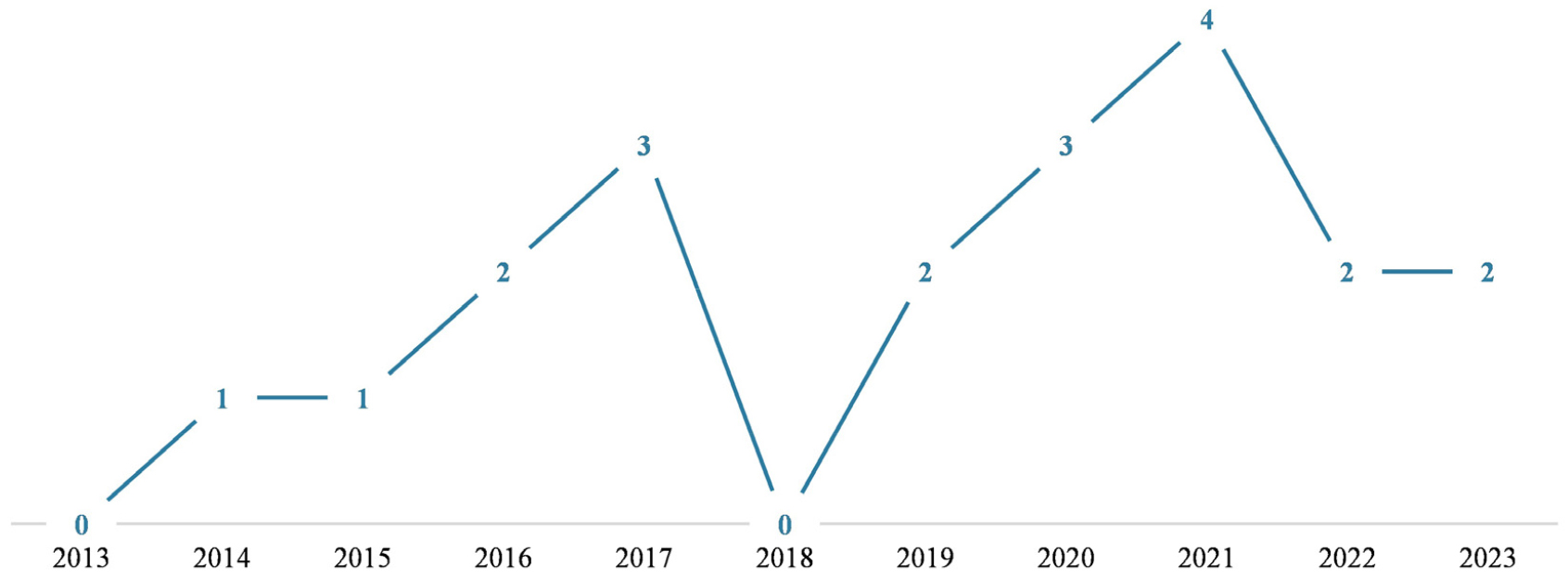
Clearly, the mechanical performance was what interested the most when optimizing straw-cement- based composites for construction materials. In this corpus, optimization is mainly conceived as mechanical reinforcement, as can be seen from the studied properties, but there is a trend that shows that in the last decade, since 2014, researchers are also including the study of thermal performance (see Figure 13). Acoustic performance was more recently included in research since 2019, always as a complementary study.
On the other hand, physical properties are studied as a complement to better understand the performance of the other properties. Bulk density and porosity are frequently related to compressive strength and thermal conductivity because the first ones directly affect the second ones. The effect of straw fibers on cement- based composites manifests in reducing bulk density and increasing porosity, properties of the composites that reduce thermal conductivity but also compressive strength. Another physical property frequently studied is water absorption because of the hydrophilic nature of straw fibers. The increase of straw fibers tends to increase water absorption, which may represent a limitation for durability.
The main findings of the studied research
The most relevant findings of the studied research are presented in this section. Some tables and graphics are presented summarizing the findings. In the textual description are discussed and presented some additional data to highlight trends. Due to the focus of this study on the articles reporting the mechanical and thermal properties of the straw-cement-based composites, the data were grouped to compare by type of composite and by mechanical and thermal results.
Eight tables summarizing the available and comparable results of compressive and flexural strength of composites are presented. The tables are organized by concrete, mortar, masonry, and composites with a non specified matrix. Given that most of the articles report results of composites with different amounts of straw in the mixes, for these tables, the results of the mixes with the largest amount of straw are presented. This was decided based on that, for construction materials, high mechanical performance is not always required, for example, for masonry, regulations establish lower requirements than the potential performance of cement-based composites. On the other hand, a high thermal performance is desirable. Therefore, with the premise that the higher the amount of straw addition on cement-based composites, the lower the thermal conductivity, it was decided to analyze the results with the largest amount of straw even if that represents a weaker mechanical performance. The percentages represent the straw by weight of cement or binders according to the available information.
From the available information on the control sample, for the eight tables, it can be said that the straw fiber addition, in most cases, reduces the compressive and flexural strength, but it cannot be estimated a reliable trend because it can be distorted by the effect of additional binders, aggregates or straw treatments.
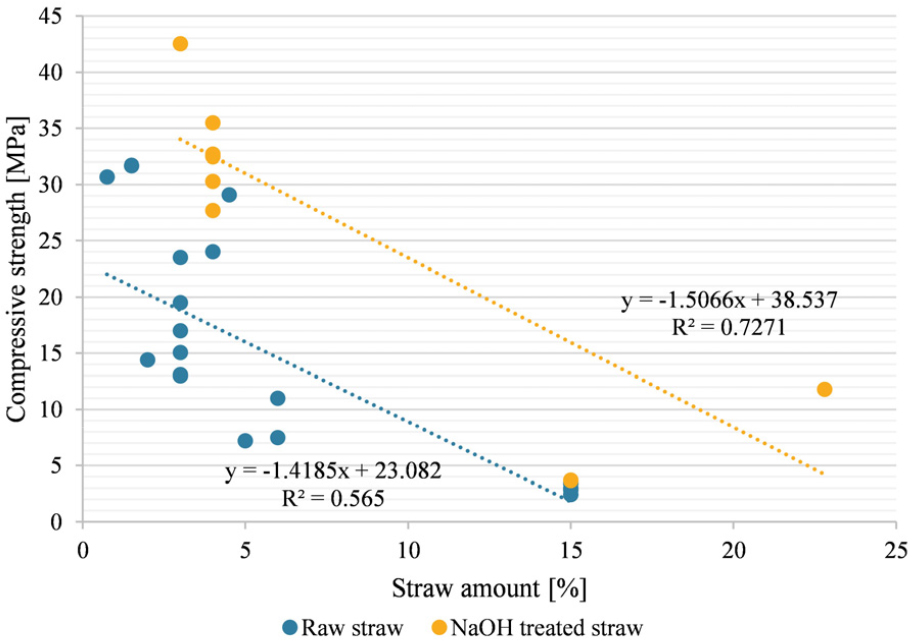
Table 3 shows the influence of the cereal straw fibers on the compressive strength of concrete. It can be seen that the straw amounts could be very different between the studies, from 0.75% to 22.8%. Data show that in the same study, with the same amount of straw, the treatment can make a difference. For example, Ashour et al. [25] and Zhang et al. [26], using the same amount and characteristics of straw, compare the use of raw straw with sodium hydroxide (NaOH) treated straw achieving a mechanical enhancement of 7.6% and 81% respectively with the treatment. Liu et al. [27] boost the enhancement of sodium hydroxide by adding silicon dioxide (SiO2) achieving 28% mechanical enhancement over the plain sodium hydroxide treated straw. Farooqi & Ali [28] found that treatments with water are 38% more effective than with sodium hydroxide due to better bonding of uncracked surfaced soaked straw with the surrounding matrix. On the other hand, other researchers change the length of the straws. For example, Kammoun & Trabelsi [29] use a hot water treatment for three different lengths: 20 mm, 30 mm, and 50 mm. They found 14.6% more effective the mechanical enhancement of the 20 mm length over the 50 mm length.
Table 3.
Influence of cereal straw fibers on compressive strength of concrete
| Authors | Cereal straw | Straw concrete | Control sample | ||||||
| Type | Length | Amount | Treatment | Bulk density | Compressive strength** | Bulk density | Compressive strength** | ||
| [mm] | [%]* | [kg/m3] | [MPa] | [kg/m3] | [MPa] | ||||
| [30] | Ammari et al., 2020 | Barley straw | 35 | 3 | Hot water | 1961.2 | 15.59 | - | - |
| [31] | Ammari et al., 2020 | Barley straw | 35 | 3 | Hot water | 1961.2 | 16.27 | - | - |
| [25] | Ashour et al., 2021 | Rice straw | 1-30 | 15 | - | - | 3.44 | - | 32.00 |
| Rice straw | 1-30 | 15 | NaOH | - | 3.70 | - | 32.00 | ||
| [32] | Ataie, 2018 | Rice straw | 5 | 3 | - | - | ~19.50 | - | ~32.50 |
| Rice straw | 5 | 3 | Washed | - | ~20.80 | - | ~32.50 | ||
| Rice straw | 2 | 3 | - | - | ~17.00 | - | ~32.50 | ||
| Rice straw | 2 | 3 | Washed | - | ~18.00 | - | ~32.50 | ||
| [33] | Bederina et al., 2016 | Barley straw | 20-35 | 3 | - | 1895 | 13.00 | - | - |
| Barley straw | 20-35 | 3 | Hot water | 1922 | 20.55 | - | - | ||
| Barley straw | 20-35 | 3 | Gasoil | 2036 | 19.48 | - | - | ||
| Barley straw | 20-35 | 3 | Varnish | 2059 | 21.60 | - | - | ||
| Barley straw | 20-35 | 3 | Waste oil | 2076 | 20.78 | - | - | ||
| [34] | Belhadj et al., 2014 | Barley straw | 20-35 | 2 | - | ~1880 | ~14.40 | ~2050 | ~20.70 |
| [35] | Belhadj et al., 2015 | Barley straw | 20 | 3 | - | 1895 | 13.00 | 2042 | 21.00 |
| [36] | Belhadj et al., 2016 | Barley straw | 20-35 | 3 | - | 1975 | 13.07 | ~2004 | ~20.50 |
| [37] | Deng et al., 2023 | Non specified | 5-10 | 3 | - | - | 15.06 | - | 42.44 |
| [28] | Farooqi & Ali, 2019 | Wheat straw | 25 | 22.8 | Soaked | 1763 | 16.30 | 2270 | 19.20 |
| Wheat straw | 25 | 22.8 | Boiled | 1801 | 14.30 | 2270 | 19.20 | ||
| Wheat straw | 25 | 22.8 | NaOH | 1921 | 11.80 | 2270 | 19.20 | ||
| [38] | Farooqi & Ali, 2023 | Wheat straw | 18 | 7.6 | Soaked | - | 21.90 | - | 23.70 |
| [39] | Ghannam, 2019 | Wheat straw | - | 4.5 | - | - | 29.10 | - | 38.40 |
| [40] | Kammoun & Trabelsi, 2018 | Oat straw | 20 | 4 | - | 2310 | ~24.00 | 2460 | ~39.00 |
| Oat straw | 20 | 4 | Hot water | 2350 | ~27.00 | 2460 | ~39.00 | ||
| Oat straw | 20 | 4 | Bitumen | 2280 | ~25.50 | 2460 | ~39.00 | ||
| [29] | Kammoun & Trabelsi, 2020 | Oat straw | 20 | 4 | Hot water | 1650 | 35.40 | 2470 | 134.90 |
| Oat straw | 30 | 4 | Hot water | 1650 | 33.50 | 2470 | 134.90 | ||
| Oat straw | 50 | 4 | Hot water | 1640 | 30.90 | 2470 | 134.90 | ||
| [41] | Li et al., 2013 | Rice straw | ~10-20 | 6 | - | - | ~11.00 | - | ~35.00 |
| Rice straw | ~1-10 | 6 | - | - | ~7.50 | - | ~35.00 | ||
| [27] | Liu et al., 2022 | Rice straw | 20-30 | 4 | NaOH | - | ~27.70 | - | ~38.20 |
| Rice straw | 20-30 | 4 | NaOH-SiO2(1%) | - | ~32.70 | - | ~38.20 | ||
| Rice straw | 20-30 | 4 | NaOH-SiO2(3%) | - | ~35.50 | - | ~38.20 | ||
| Rice straw | 20-30 | 4 | NaOH-SiO2(5%) | - | ~32.50 | - | ~38.20 | ||
| Rice straw | 20-30 | 4 | NaOH-SiO2(7%) | - | ~30.30 | - | ~38.20 | ||
| [42] | Mahdy et al., 2023 | Rice straw | 8 | 0.75 | - | - | ~30.70 | - | ~31.50 |
| [43] | Merta & Tschegg, 2013 | Wheat straw | 40 | 1.5 | - | - | 31.70 | - | 42.20 |
| [44] | Mulok et al., 2018 | Rice straw | 15-40 | 5 | - | - | ~7.20 | - | ~25.00 |
| [11] | Pachla et al., 2021 | Rice straw | 10 | 15 | - | 727.44 | 2.44 | 745.64 | 2.85 |
| Rice straw | 20 | 15 | - | 709.59 | 2.84 | 745.64 | 2.85 | ||
| Rice straw | 30 | 15 | - | 733.58 | 3.01 | 745.64 | 2.85 | ||
| [45] | Rihia et al., 2019 | Wheat straw | 35 | 2 | Hot water | 2360 | ~23.80 | - | - |
| [26] | Zhang et al., 2023 | Rice straw | 20 | 3 | - | - | ~23.50 | - | ~42.00 |
| Rice straw | 20 | 3 | NaOH | - | ~42.50 | - | ~42.00 | ||
| [12] | Zhang et al., 2023 | Rice straw | 80-120 | 10 | Soaked | 214 | ~5.30 | 294 | ~8.20 |
Theoretically, the higher the amount of straw in concrete, the lower the compressive strength. This is not completely happening majorly because of the role of the straw treatments and the diversity of the mixes. Correlations were not found with the whole data of concrete together. Then, the Table 3 data were classified by treatment and processed in search of correlations. The strongest correlation found was in the mixes with sodium hydroxide (NaOH) treated straw with an R2 value of 0.72 (see Figure 14). Another strong enough correlation found was the one with no treated straw with an R2 value of 0.56 (see Figure 14). The not so high correlations may be due to the effect of the additional binders and/or the diverse fine and coarse aggregates in the mixes or to the various straw lengths with the same straw amounts, for the case of the no treated straw concretes. These two correlations prove that, with a stable treatment condition, the trend is clearer and can be confirmed that the higher the straw amount, the lower the compressive strength.
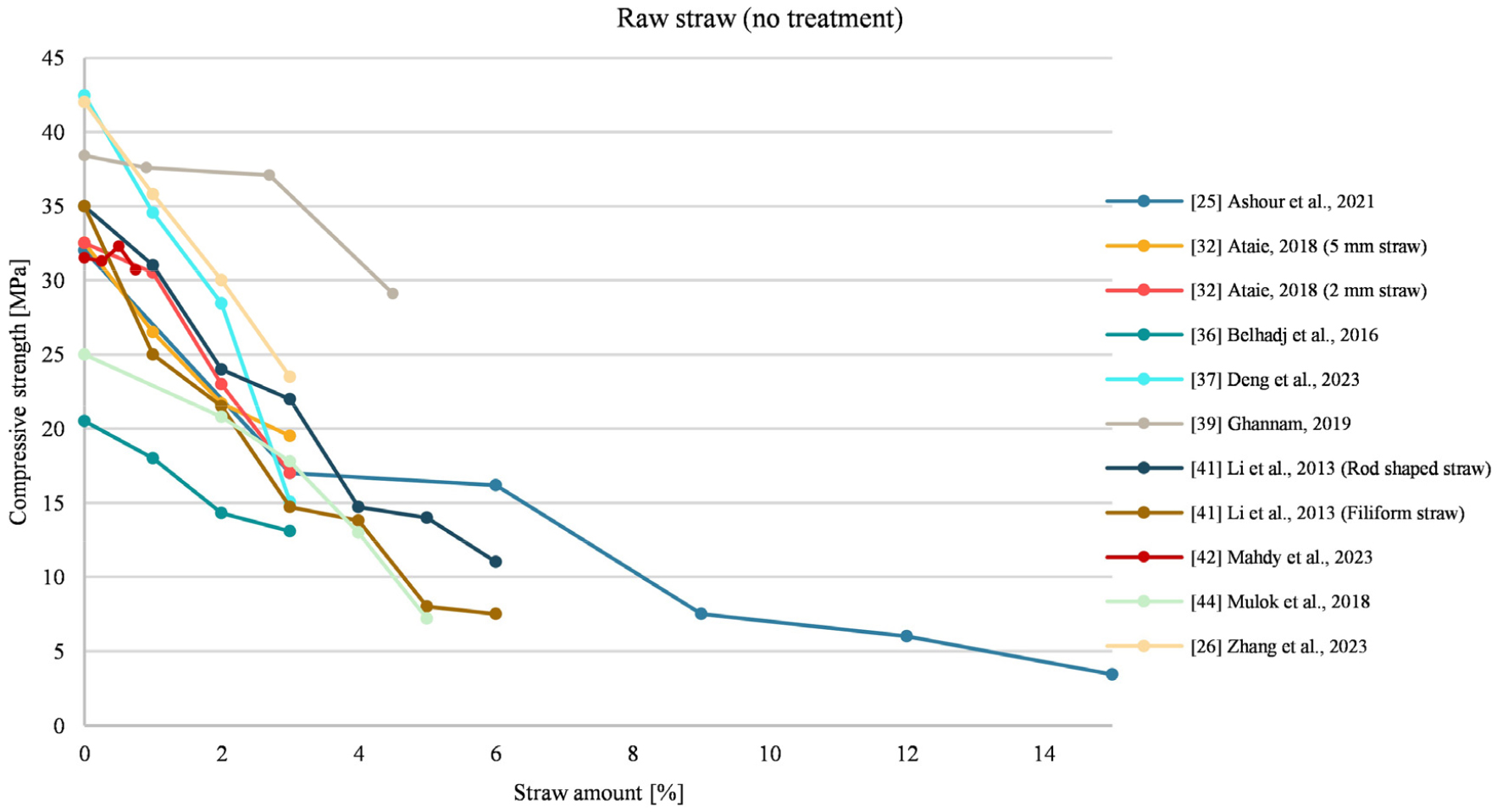
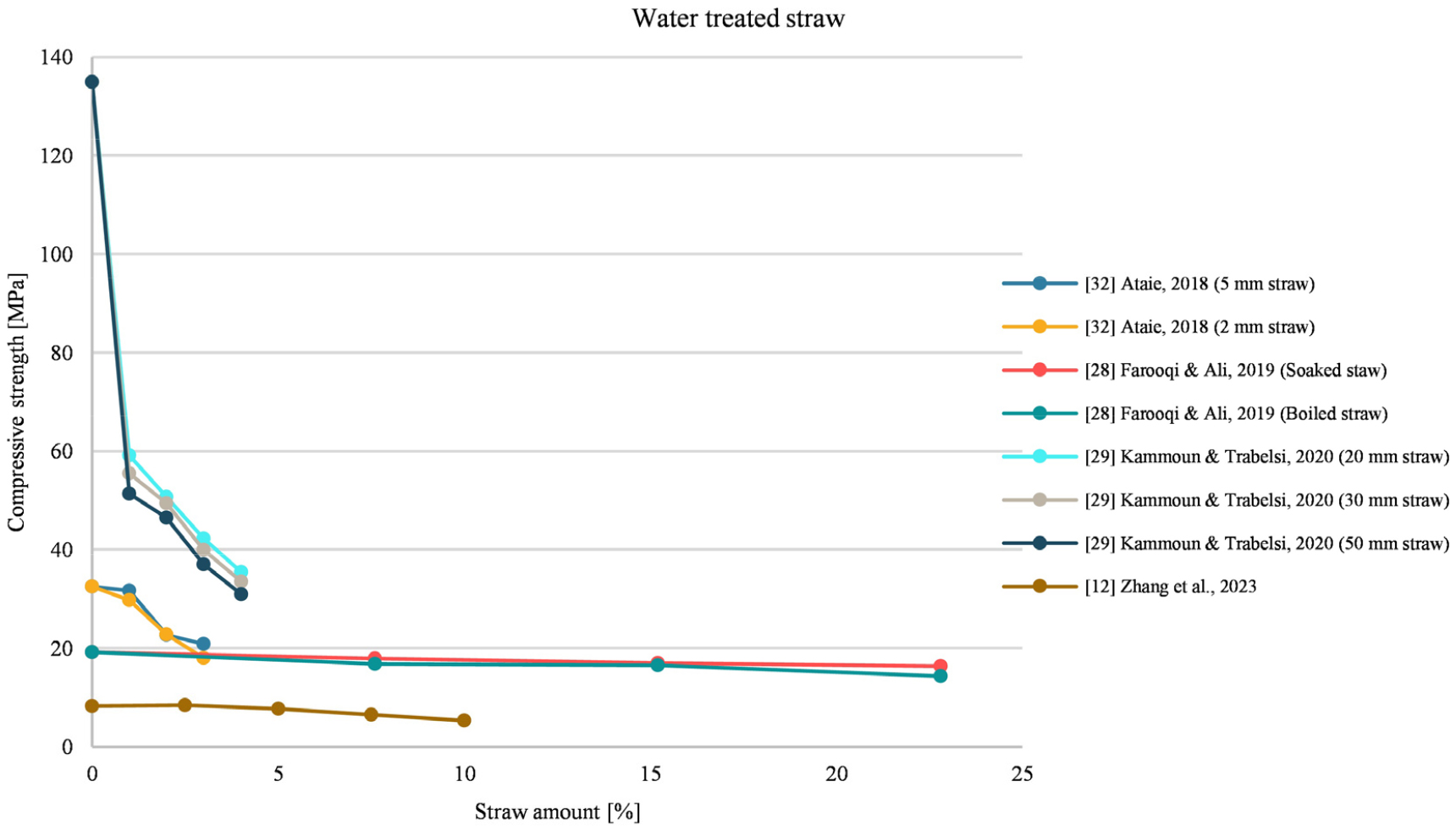
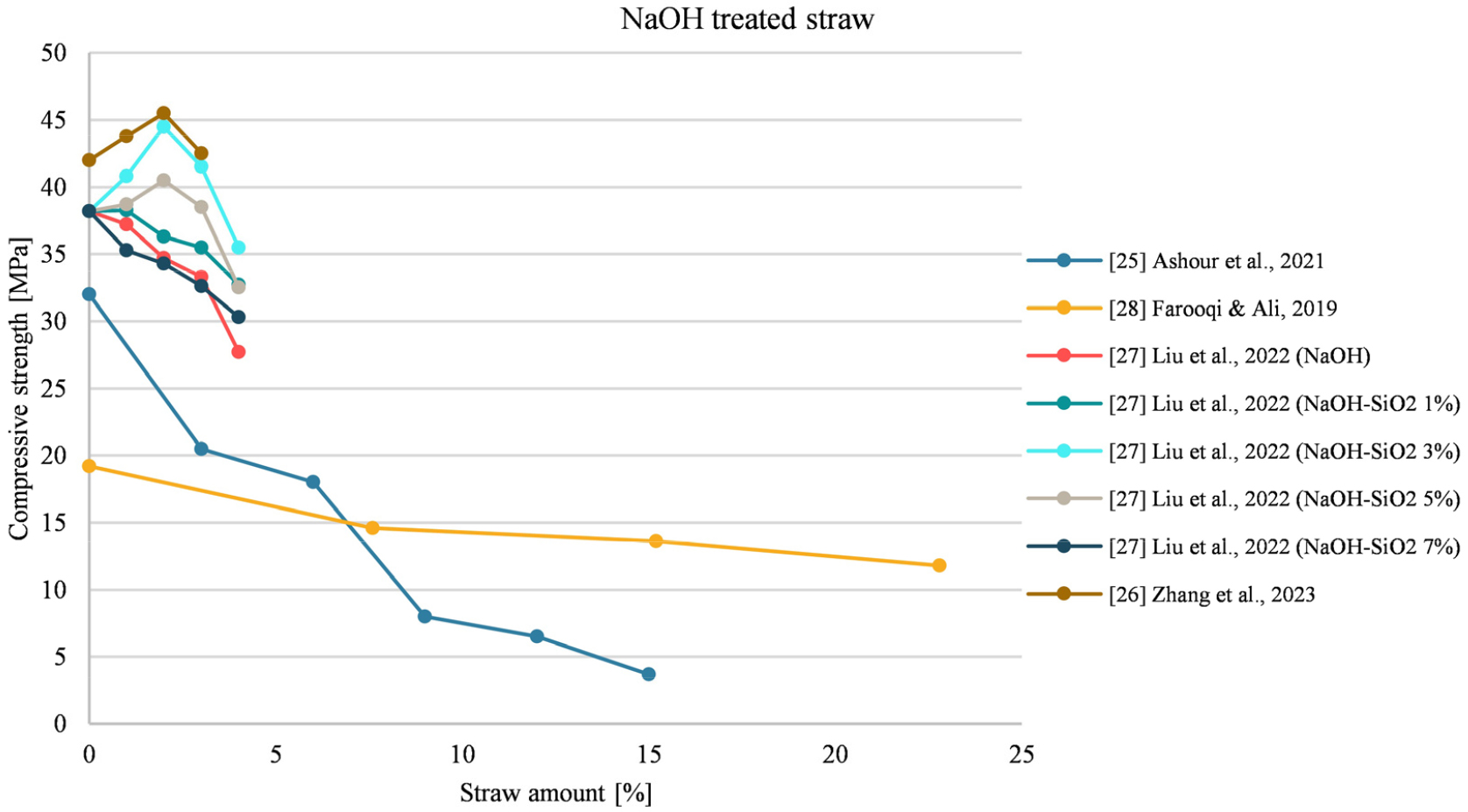
A comparison between studies using different straw amounts for concrete is also carried out to confirm that the higher the straw amount, the lower the compressive strength. The comparisons were grouped by treatment of straw. For concretes with raw straw (with no treatment) and with water treated straw the theory can be confirmed (see Figures 15 and 16), but concretes with sodium hydroxide (NaOH) treated straw work a little bit different (see Figure 17). The general trend works as the theory states, but the studies of Liu et al. [27] and Zhang et al. [26] show that, with a small straw amount and its correct treatment, the compressive strength can be enhanced, but the limit seems to be 2% of straw (by weight of cement) because with a higher straw amount the compressive strength decreases, following the trend.
The influence of the cereal straw fibers on the compressive strength of mortars is shown in Table 4. Correlations between mortar studies results were searched, but not found, they were weak. With the small amount of available data cannot be achieved a strong analysis of the mortar studies together or by subclassification. For mortars, there is a clear trend of using a larger amount of straw for the mixes from 2% to 50%, mostly over 10%. Some studies compare the addition of straw with the addition of other fibers or lightening materials. Jiang et al. [46] are the only ones comparing between two cereal straws: wheat and rice. The mixes are identical the only variation is the straw. They found that the rice straw-cement-based mortar is 21% more optimal than the wheat straw one. Although with a single study it is not possible to generalize, the type of straw may be considered as an influential variable in the performance of the composites.
Table 4.
Influence of cereal straw fibers on compressive strength of mortar
| Authors | Cereal straw | Straw mortar | Control sample | ||||||
| Type | Length | Amount | Treatment | Bulk density | Compressive strength** | Bulk density | Compressive strength** | ||
| [mm] | [%]* | [kg/m3] | [MPa] | [kg/m3] | [MPa] | ||||
| [47] | Awoyera et al., 2022 | Rice straw | 10 | 10 | Soaked | ~1974 | ~8.50 | ~1973 | ~9.20 |
| Rice straw | 10 | 30 | Soaked | ~1974.5 | ~8.10 | ~1973 | ~9.20 | ||
| Rice straw | 10 | 50 | Soaked | ~1975 | ~8.60 | ~1973 | ~9.20 | ||
| [48] | Cardinale et al., 2017 | Wheat straw | 20 | 2 | - | 1512.5 | 2.78 | 1646.36 | 7.35 |
| [49] | Feng et al., 2023 | Rice straw | 10 | 15 | NaOH | - | ~42.20 | - | ~42.20 |
| [46] | Jiang et al., 2020 | Wheat straw | 3-11.8 | 15 | Pure acrylic emulsion | - | ~14.00 | - | - |
| Rice straw | 3-11.8 | 15 | Pure acrylic emulsion | - | ~17.00 | - | - | ||
| [10] | Petrella et al., 2018 | Wheat straw | 30 | 11 | - | 736 | ~2.00 | 1990 | ~53.00 |
| [50] | Petrella et al., 2022 | Wheat straw | 5 | 12 | - | 960 | 1.60 | - | - |
| [51] | Qamar et al., 2019 | Rice straw | 50 | 5 | Boiled | - | 6.00 | - | 9.30 |
| [52] | Zhang et al., 2013 | Wheat straw | 2-15 | 4 | Alkali | - | 18.72 | - | 45.77 |
| Wheat straw | 2-15 | 40 | - | - | ~0.18 | - | ~1.15 | ||
Table 5 shows the influence of the cereal straw fibers on the compressive strength of masonry: blocks and bricks. For masonry studies results’ correlations were searched, but not found. The available data do not allow a reliable analysis for masonry together or for blocks or bricks separately. For masonry, researchers also use a large amount of straw, from 10% to 33% (see Table 5). Some treatments for straw are tested and compared with raw straw. Liu et al. [24] apply some treatments (or additives) to the whole mixes achieving optimization of the straw blocks as well as the control samples. Even with treatment optimization, the compressive strength of straw blocks was low. In Liu et al. [53] they doubled the dosage of treatments achieving a higher optimization.
Table 5.
Influence of cereal straw fibers on compressive strength of masonry
| Authors | Cereal straw | Straw masonry | Control sample | |||||||
| Type | Length | Amount | Treatment/additive | Bulk density | Compressive strength** | Bulk density | Compressive strength** | |||
| [mm] | [%]* | [kg/m3] | [MPa] | [kg/m3] | [MPa] | |||||
| [54] | Al-Kheetan, 2022 | Wheat straw | 2 | 33 | - | - | ~2.90 | - | 11.10 | Blocks |
| Wheat straw | 2 | 33 | Na2SiO3 | - | ~5.90 | - | 11.10 | |||
| [55] | Li et al., 2019 | Wheat straw | - | - | - | 2000 | 19.70 | - | - | |
| [24] | Liu et al., 2012 | Rice straw | 10-40 | 15 | - | - | ~1.50 | - | ~7.20 | |
| Rice straw | 10-40 | 15 | CaCl2 | - | ~1.80 | - | ~19.00 | |||
| Rice straw | 10-40 | 15 | Al2(SO4)3 | - | ~2.00 | - | ~16.50 | |||
| Rice straw | 10-40 | 15 | CaCl2-Al2(SO4)3 | - | ~2.50 | - | ~27.70 | |||
| [53] | Liu et al., 2013 | Rice straw | 10-40 | 15 | - | - | ~1.50 | - | ~7.00 | |
| Rice straw | 10-40 | 15 | CaCl2 | - | ~2.50 | - | ~16.00 | |||
| Rice straw | 10-40 | 15 | Al2(SO4)3 | - | ~2.50 | - | ~26.00 | |||
| Rice straw | 10-40 | 15 | CaCl2-Al2(SO4)3 | - | ~4.00 | - | ~34.50 | |||
| [56] | Sathiparan & De Zoysa, 2018 | Rice straw | 25 | 19 | - | ~1180 | 1.20 | ~1980 | ~9.50 | |
| [21] | Allam & Garas, 2010 | Rice straw | 15-25 | 10 | - | - | 11.28 | - | 18.30 | Bricks |
| [22] | Allam et al., 2011 | Rice straw | 15-25 | 10 | - | - | 11.28 | - | 18.30 | |
| [23] | Basta et al., 2011 | Rice straw | 25 | 10 | - | 1360 | 0.65 | - | - | |
| Rice straw | 25 | 10 | Gelatin-Hexamine mixture | 1320 | 3.10 | - | - | |||
| Rice straw | 25 | 10 | Linseed oil | 1500 | 4.90 | - | - | |||
| Rice straw | 25 | 10 | Sodium silicate-Aluminum sulphate | 1038 | 1.10 | - | - | |||
| [57] | Garas et al., 2015 | Rice straw | 15-25 | 10 | - | - | 11.28 | - | 18.30 | |
For the composites with a non specified matrix (see Table 6), the focus of the research is on comparing the use of raw straw with treated straw. The studies of Jiang et al. [58, 59] stand out because of the remarkable effect of the straw treatments over the compressive strength of the composites. Those studies also offer the possibility of comparing between types of straw because the mixes and the straw treatments are the same, but one adds rice straw and the other adds wheat straw. It can be seen that water is the most effective treatment for both straws. With water treatment, the rice straw composite presents a compressive strength 40% higher than the wheat straw composite. Rice straw composites with calcium chloride and triethanolamine treatments also present higher compressive strength than the wheat straw composites, 92% and 46% respectively. But wheat straw composites with sodium silicate solution and flame retardant treatments present a slightly higher compressive strength than the rice straw composites, 10% and 3% respectively.
Table 6.
Influence of cereal straw fibers on compressive strength of composites with a non specified matrix
| Authors | Cereal straw | Straw composite | Control sample | ||||||
| Type | Length | Amount | Treatment | Bulk density | Compressive strength** | Bulk density | Compressive strength** | ||
| [mm] | [%]* | [kg/m3] | [MPa] | [kg/m3] | [MPa] | ||||
| [61] | Jiang et al., 2020 | Rice straw | 0.15-0.30 | 20 | - | - | ~0.35 | - | - |
| Rice straw | 0.15-0.30 | 20 | Sodium silicate solution | - | ~0.48 | - | - | ||
| Rice straw | 0.15-0.30 | 20 | Pure acrylic polymer emulsion | - | ~0.50 | - | - | ||
| Rice straw | 0.15-0.30 | 20 | Organosilicon waterproof emulsion | - | ~0.30 | - | - | ||
| Rice straw | 0.15-0.30 | 20 | Water | - | ~0.45 | - | - | ||
| Rice straw | 0.15-0.30 | 20 | Lye | - | 4.76 | - | - | ||
| [62] | Jiang et al., 2020 | Wheat straw | 0.15-0.30 | 15 | - | - | ~0.20 | - | - |
| Wheat straw | 0.15-0.30 | 15 | Sodium silicate solution | - | ~0.40 | - | - | ||
| Wheat straw | 0.15-0.30 | 15 | Pure acrylic polymer emulsion | - | ~0.30 | - | - | ||
| Wheat straw | 0.15-0.30 | 15 | Organosilicon waterproof emulsion | - | ~0.17 | - | - | ||
| Wheat straw | 0.15-0.30 | 15 | Water | - | ~0.21 | - | - | ||
| Wheat straw | 0.15-0.30 | 15 | Lye | - | 3.90 | - | - | ||
| [58] | Jiang et al., 2021 | Rice straw | 0.30-1.18 | 15 | - | - | - | - | - |
| Rice straw | 0.30-1.18 | 15 | Polycarboxylic acid superplasticizer | - | ~5.00 | - | - | ||
| Rice straw | 0.30-1.18 | 15 | Calcium chloride | - | ~5.00 | - | - | ||
| Rice straw | 0.30-1.18 | 15 | Triethanolamine | - | ~23.00 | - | - | ||
| Rice straw | 0.30-1.18 | 15 | Water | - | ~34.00 | - | - | ||
| Rice straw | 0.30-1.18 | 15 | Pure acrylic polymer emulsion | - | ~22.20 | - | - | ||
| Rice straw | 0.30-1.18 | 15 | Sodium silicate solution | - | ~20.70 | - | - | ||
| Rice straw | 0.30-1.18 | 15 | Flame retardants | - | ~19.50 | - | - | ||
| [59] | Jiang et al., 2021 | Wheat straw | 0.30-1.18 | 15 | - | - | - | - | - |
| Wheat straw | 0.30-1.18 | 15 | Polycarboxylic acid superplasticizer | - | ~4.80 | - | - | ||
| Wheat straw | 0.30-1.18 | 15 | Calcium chloride | - | ~2.60 | - | - | ||
| Wheat straw | 0.30-1.18 | 15 | Triethanolamine | - | ~15.70 | - | - | ||
| Wheat straw | 0.30-1.18 | 15 | Water | - | ~24.30 | - | - | ||
| Wheat straw | 0.30-1.18 | 15 | Pure acrylic polymer emulsion | - | ~21.20 | - | - | ||
| Wheat straw | 0.30-1.18 | 15 | Sodium silicate solution | - | ~22.80 | - | - | ||
| Wheat straw | 0.30-1.18 | 15 | Flame retardants | - | ~20.03 | - | - | ||
| [60] | Jiang et al., 2023 | Wheat straw | 0.6 | 15 | - | - | 0.23 | - | - |
| Wheat straw | 0.6 | 15 | Silicone acrylic polymer emulsion (MT-8000) | - | ~0.75 | - | - | ||
| Wheat straw | 0.6 | 15 | Water-based epoxy resin emulsion (DY-128-50) | - | ~0.97 | - | - | ||
| Wheat straw | 0.6 | 15 | Ethylene - ethyl acetate copolymer emulsion (EVA-102) | - | ~0.65 | - | - | ||
| Wheat straw | 0.6 | 15 | Silane coupling agent (KH-550) | - | 1.39 | - | - | ||
| [63] | Serifou et al., 2020 | Rice straw | 20 | 5 | - | ~1585 | ~9.00 | ~1765 | ~48.00 |
| [64] | Shang et al., 2020 | Rice straw | 1-2 | 2 | - | - | ~20.00 | - | ~33.50 |
| [65] | Silva et al., 2019 | Wheat straw | - | 15 | - | 880 | 0.42 | 1799 | 18.56 |
| Wheat straw | - | 15 | NaOH (30°C) | 936 | 0.27 | 1799 | 18.56 | ||
| Wheat straw | - | 15 | NaOH (60°C) | 889 | 0.44 | 1799 | 18.56 | ||
It can be seen a big difference in the compressive strength among the various studies even with similar characteristics. For example, the studies reported by Jiang et al. [59, 60] have the same mix and type of straw, except for the straw length and the straw treatments. Those studies present a large difference between the compressive strength results, which may be given by the purpose of treatment optimization. The first study pursues optimizing composites for fire resistance and the second study to solve the technical difficulties of high water absorption. That is why the second study neglects compressive strength because it focuses on water absorption.
Table 7 shows the influence of the cereal straw fibers on the flexural strength of concrete. It can be seen that straw treatments and straw length influence the flexural performance of concrete. From the studies of Ataie [32], Kammoun & Trabelsi [29], and Li et al. [41], it can be extracted the conclusion that there is an optimal length of straw around 5 mm to 20 mm because the flexural performance is reduced with shorter or longer straw. Pachla et al. [11] also experimented with different straw lengths but, in this case, a foaming agent for creating cellular concrete seems to be causing a greater influence than the straw length. A correlation between flexural and compressive performance of concrete was searched but an R2 value of 0.27 was found. Straw treatments work differently to enhance mechanical properties. For example, Bederina et al. [33] found that a straw treatment with hot water gives the best result for flexural strength, instead, a straw treatment with varnish gives the best result for compressive strength. Kammoun & Trabelsi [40] also found a clear difference between two straw treatments: hot water and bitumen. They found the best flexural performance with bitumen and the best compressive performance with hot water.
Table 7.
Influence of cereal straw fibers on flexural strength of concrete
| Authors | Cereal straw | Straw concrete | Control sample | ||||||
| Type | Length | Amount | Treatment | Bulk density | Flexural strength** | Bulk density | Flexural strength** | ||
| [mm] | [%]* | [kg/m3] | [MPa] | [kg/m3] | [MPa] | ||||
| [30] | Ammari et al., 2020 | Barley straw | 35 | 3 | Hot water | 1961.2 | 4.32 | - | - |
| [25] | Ashour et al., 2021 | Rice straw | 1-30 | 15 | - | - | 1.41 | - | 5.90 |
| Rice straw | 1-30 | 15 | NaOH | - | 1.66 | - | 5.90 | ||
| [32] | Ataie, 2018 | Rice straw | 5 | 3 | - | - | ~3.10 | - | ~4.20 |
| Rice straw | 2 | 3 | - | - | ~2.95 | - | ~4.20 | ||
| [33] | Bederina et al., 2016 | Barley straw | 20-35 | 3 | - | 1895 | 4.00 | - | - |
| Barley straw | 20-35 | 3 | Hot water | 1922 | 5.21 | - | - | ||
| Barley straw | 20-35 | 3 | Gasoil | 2036 | 4.45 | - | - | ||
| Barley straw | 20-35 | 3 | Varnish | 2059 | 4.74 | - | - | ||
| Barley straw | 20-35 | 3 | Waste oil | 2076 | 4.51 | - | - | ||
| [34] | Belhadj et al., 2014 | Barley straw | 20-35 | 2 | - | ~1880 | ~3.45 | ~2050 | ~4.35 |
| [36] | Belhadj et al., 2016 | Barley straw | 20-35 | 3 | - | 1975 | ~4.10 | ~2004 | ~4.35 |
| [28] | Farooqi & Ali, 2019 | Wheat straw | 25 | 22.8 | Soaked | 1763 | 6.02 | 2270 | 7.69 |
| Wheat straw | 25 | 22.8 | Boiled | 1801 | 5.61 | 2270 | 7.69 | ||
| Wheat straw | 25 | 22.8 | NaOH | 1921 | 4.58 | 2270 | 7.69 | ||
| [40] | Kammoun & Trabelsi, 2018 | Oat straw | 20 | 4 | - | 2310 | ~6.05 | 2460 | ~10.20 |
| Oat straw | 20 | 4 | Hot water | 2350 | ~6.95 | 2460 | ~10.20 | ||
| Oat straw | 20 | 4 | Bitumen | 2280 | ~8.30 | 2460 | ~10.20 | ||
| [29] | Kammoun & Trabelsi, 2020 | Oat straw | 20 | 4 | Hot water | 1650 | 3.17 | 2470 | 10.67 |
| Oat straw | 30 | 4 | Hot water | 1650 | 2.85 | 2470 | 10.67 | ||
| Oat straw | 50 | 4 | Hot water | 1640 | 2.63 | 2470 | 10.67 | ||
| [41] | Li et al., 2013 | Rice straw | ~10-20 | 6 | - | - | ~2.07 | - | ~4.25 |
| Rice straw | ~1-10 | 6 | - | - | ~1.80 | - | ~4.25 | ||
| [27] | Liu et al., 2022 | Rice straw | 20-30 | 4 | NaOH | - | ~3.63 | - | 4.87 |
| Rice straw | 20-30 | 4 | NaOH-SiO2(1%) | - | ~4.14 | - | 4.87 | ||
| Rice straw | 20-30 | 4 | NaOH-SiO2(3%) | - | 4.67 | - | 4.87 | ||
| Rice straw | 20-30 | 4 | NaOH-SiO2(5%) | - | ~3.93 | - | 4.87 | ||
| Rice straw | 20-30 | 4 | NaOH-SiO2(7%) | - | 3.34 | - | 4.87 | ||
| [42] | Mahdy et al., 2023 | Rice straw | 8 | 0.75 | - | - | ~5.40 | - | ~5.15 |
| [43] | Merta & Tschegg, 2013 | Wheat straw | 40 | 1.5 | - | - | 3.50 | - | 3.74 |
| [44] | Mulok et al., 2018 | Rice straw | 15-40 | 5 | - | - | ~2.40 | - | ~2.50 |
| [11] | Pachla et al., 2021 | Rice straw | 10 | 15 | - | 727.44 | 1.39 | 745.64 | 1.37 |
| Rice straw | 20 | 15 | - | 709.59 | 1.42 | 745.64 | 1.37 | ||
| Rice straw | 30 | 15 | - | 733.58 | 1.4 | 745.64 | 1.37 | ||
| [26] | Zhang et al., 2023 | Rice straw | 20 | 3 | - | - | ~3.27 | - | ~5.40 |
| Rice straw | 20 | 3 | NaOH | - | ~5.77 | - | ~5.40 | ||
The influence of cereal straw fibers on the flexural strength of mortar is shown in Table 8. The straw amounts could be very different between the studies, from 2% to 50%, however, the flexural performance does not change according to the straw amount, correlations were not found.
Table 8.
Influence of cereal straw fibers on flexural strength of mortar
| Authors | Cereal straw | Straw mortar | Control sample | ||||||
| Type | Length | Amount | Treatment | Bulk density | Flexural strength** | Bulk density | Flexural strength** | ||
| [mm] | [%]* | [kg/m3] | [MPa] | [kg/m3] | [MPa] | ||||
| [47] | Awoyera et al., 2022 | Rice straw | 10 | 10 | Soaked | ~1974 | ~1.15 | ~1973 | ~1.37 |
| Rice straw | 10 | 30 | Soaked | ~1974.5 | ~1.00 | ~1973 | ~1.37 | ||
| Rice straw | 10 | 50 | Soaked | ~1975 | ~0.99 | ~1973 | ~1.37 | ||
| [48] | Cardinale et al., 2017 | Wheat straw | 20 | 2 | - | 1512.5 | 1.38 | 1646.36 | 2.84 |
| [49] | Feng et al., 2023 | Rice straw | 10 | 15 | NaOH | - | ~8.00 | - | ~7.20 |
| [46] | Jiang et al., 2020 | Wheat straw | 3-11.8 | 15 | Pure acrylic emulsion | - | ~5.80 | - | - |
| Rice straw | 3-11.8 | 15 | Pure acrylic emulsion | - | ~6.00 | - | - | ||
| [10] | Petrella et al., 2018 | Wheat straw | 30 | 11 | - | 736 | ~2.35 | 1990 | ~9.25 |
| [50] | Petrella et al., 2022 | Wheat straw | 5 | 12 | - | 960 | 1.30 | - | - |
| [52] | Zhang et al., 2013 | Wheat straw | 2-15 | 4 | Alkali | - | ~5.00 | - | 8.70 |
Correlations between flexural strength and bulk density of concrete and mortar were found with an R2 value of 0.7 and 0.68 respectively (see Figure 18). The lower the density, the lower the flexural strength of concrete. Conversely, for mortar the lower the density, the higher the flexural strength. This may mean that fibers are effectively reinforcing mortars allowing a better flexural performance, even with low bulk density.
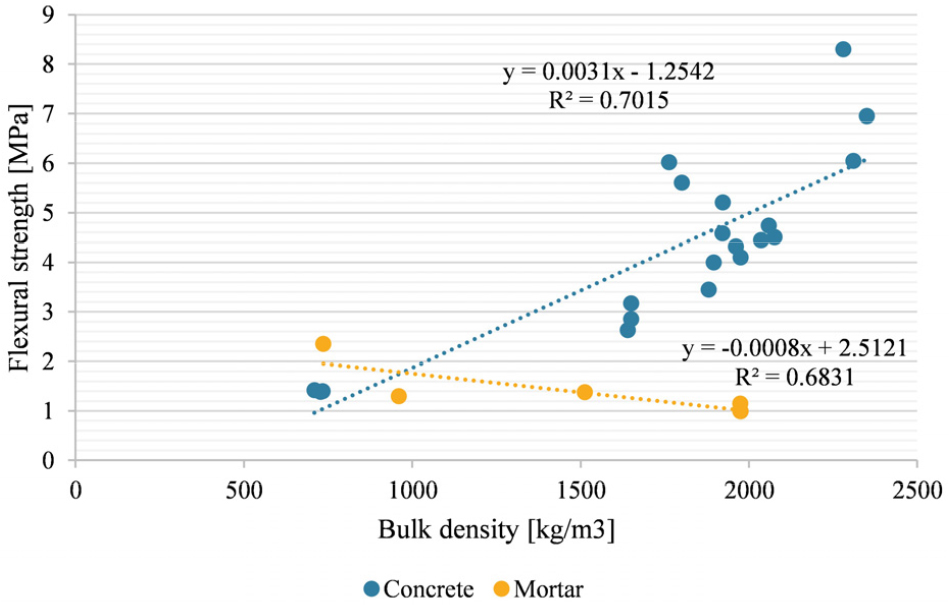
Table 9 summarizes the influence of cereal straw fibers on the flexural strength of blocks, bricks, and boards. As already mentioned, the available data do not allow a reliable analysis for masonry together or separately. The used straw amounts are mostly large from 15% to 31%, with only one study using a smaller amount. It is not clear if the straw amount is influencing flexural performance because it can be hidden by the influence of other variables such as the treatments, the mixes, etc. A clear example is given comparing the flexural strength results of the studies of Sathiparan & De Zoysa [56] and Soroushian & Hassan [20] with a very similar straw amount of 19% and 18% respectively. Their bulk density results are not so distant, but the flexural strength for the first study is around 0.20 MPa and around 13 MPa for the second one.
Table 9.
Influence of cereal straw fibers on flexural strength of masonry
| Authors | Cereal straw | Straw masonry | Control sample | |||||||
| Type | Length | Amount | Treatment/additive | Bulk density | Flexural strength** | Bulk density | Flexural strength** | |||
| [mm] | [%]* | [kg/m3] | [MPa] | [kg/m3] | [MPa] | |||||
| [24] | Liu et al., 2012 | Rice straw | 10-40 | 15 | - | - | ~0.70 | - | ~2.70 | Blocks |
| Rice straw | 10-40 | 15 | CaCl2 | - | ~1.00 | - | ~2.80 | |||
| Rice straw | 10-40 | 15 | Al2(SO4)3 | - | ~0.60 | - | ~2.95 | |||
| Rice straw | 10-40 | 15 | CaCl2 - Al2(SO4)3 | - | ~0.60 | - | ~3.40 | |||
| [53] | Liu et al., 2013 | Rice straw | 10-40 | 15 | - | - | ~0.60 | - | ~2.80 | |
| Rice straw | 10-40 | 15 | CaCl2 | - | ~1.35 | - | ~5.00 | |||
| Rice straw | 10-40 | 15 | Al2(SO4)3 | - | ~1.40 | - | ~4.15 | |||
| Rice straw | 10-40 | 15 | CaCl2 - Al2(SO4)3 | - | ~1.50 | - | ~5.90 | |||
| [56] | Sathiparan & De Zoysa, 2018 | Rice straw | 25 | 19 | - | ~1180 | ~0.20 | ~1980 | ~1.70 | |
| [66] | Nazerian & Sadeghiipanah, 2012 | Wheat straw | 3-30 | 2.25 | Ca(OH)2 | - | 5.99 | - | - | Boards |
| 3-30 | 2.25 | CaCl2 | - | 6.13 | - | - | ||||
| 3-30 | 2.25 | MgCl2 | - | 8.23 | - | - | ||||
| 3-30 | 2.25 | CaCl2 | - | 18.98 | - | - | ||||
| 3-30 | 2.25 | Ca(OH)2 | - | 9.78 | - | - | ||||
| [18] | Soroushian et al., 2004 | Wheat straw | 6 | 30 | Hot lime saturated water | 1200 | ~10.50 | - | - | |
| [20] | Soroushian & Hassan, 2012 | Wheat straw | 10 | 18 | Hot lime saturated water | ~1360 | ~13.30 | - | - | |
| Wheat straw | 10 | 18 | Soaked/washed (30 days) | ~1360 | ~12.45 | - | - | |||
| [67] | Zhang et al., 2023 | Rice straw | - | 31 | - | - | 4.41 | - | - | |
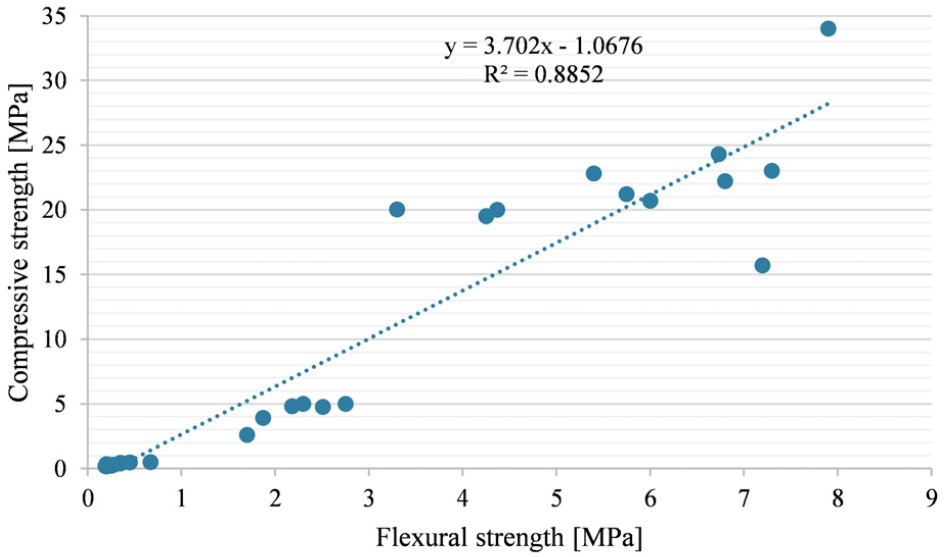
Table 10 shows the influence of cereal straw fibers on the flexural strength of composites with a non specified matrix. The straw treatment influence is very similar for the flexural and compressive performance of these composites. A correlation between compressive and flexural strength was found with an R2 value of 0.88 (see Figure 19).
Table 10.
Influence of cereal straw fibers on flexural strength of composites with a non specified matrix
| Authors | Cereal straw | Straw composite | Control sample | ||||||
| Type | Length | Amount | Treatment | Bulk density | Flexural strength** | Bulk density | Flexural strength** | ||
| [mm] | [%]* | [kg/m3] | [MPa] | [kg/m3] | [MPa] | ||||
| [61] | Jiang et al., 2020 | Rice straw | 0.15-0.30 | 20 | - | - | ~0.20 | - | - |
| Rice straw | 0.15-0.30 | 20 | Sodium silicate solution | - | ~0.45 | - | - | ||
| Rice straw | 0.15-0.30 | 20 | Pure acrylic polymer emulsion | - | ~0.67 | - | - | ||
| Rice straw | 0.15-0.30 | 20 | Organosilicon waterproof emulsion | - | ~0.28 | - | - | ||
| Rice straw | 0.15-0.30 | 20 | Water | - | ~0.35 | - | - | ||
| Rice straw | 0.15-0.30 | 20 | Lye | - | 2.51 | - | - | ||
| [62] | Jiang et al., 2020 | Wheat straw | 0.15-0.30 | 15 | - | - | ~0.19 | - | - |
| Wheat straw | 0.15-0.30 | 15 | Sodium silicate solution | - | ~0.35 | - | - | ||
| Wheat straw | 0.15-0.30 | 15 | Pure acrylic polymer emulsion | - | ~0.24 | - | - | ||
| Wheat straw | 0.15-0.30 | 15 | Organosilicon waterproof emulsion | - | ~0.20 | - | - | ||
| Wheat straw | 0.15-0.30 | 15 | Water | - | ~0.25 | - | - | ||
| Wheat straw | 0.15-0.30 | 15 | Lye | - | 1.87 | - | - | ||
| [58] | Jiang et al., 2021 | Rice straw | 0.30-1.18 | 15 | - | - | - | - | - |
| Rice straw | 0.30-1.18 | 15 | Polycarboxylic acid superplasticizer | - | ~2.30 | - | - | ||
| Rice straw | 0.30-1.18 | 15 | Calcium chloride | - | ~2.75 | - | - | ||
| Rice straw | 0.30-1.18 | 15 | Triethanolamine | - | ~7.30 | - | - | ||
| Rice straw | 0.30-1.18 | 15 | Water | - | ~7.90 | - | - | ||
| Rice straw | 0.30-1.18 | 15 | Pure acrylic polymer emulsion | - | ~6.80 | - | - | ||
| Rice straw | 0.30-1.18 | 15 | Sodium silicate solution | - | ~6.00 | - | - | ||
| Rice straw | 0.30-1.18 | 15 | Flame retardants | - | ~4.25 | - | - | ||
| [59] | Jiang et al., 2021 | Wheat straw | 0.30-1.18 | 15 | - | - | - | - | - |
| Wheat straw | 0.30-1.18 | 15 | Polycarboxylic acid superplasticizer | - | ~2.18 | - | - | ||
| Wheat straw | 0.30-1.18 | 15 | Calcium chloride | - | ~1.70 | - | - | ||
| Wheat straw | 0.30-1.18 | 15 | Triethanolamine | - | ~7.20 | - | - | ||
| Wheat straw | 0.30-1.18 | 15 | Water | - | ~6.73 | - | - | ||
| Wheat straw | 0.30-1.18 | 15 | Pure acrylic polymer emulsion | - | ~5.75 | - | - | ||
| Wheat straw | 0.30-1.18 | 15 | Sodium silicate solution | - | ~5.40 | - | - | ||
| Wheat straw | 0.30-1.18 | 15 | Flame retardants | - | ~3.30 | - | - | ||
| [64] | Shang et al., 2020 | Rice straw | 1-2 | 2 | - | - | ~4.37 | - | ~6.32 |
| [68] | Xie et al., 2015 | Rice straw | 0.9 | 19 | - | 1260 | ~9.20 | 2010 | ~11.00 |
| [69] | Xie & Li, 2021 | Rice straw | - | 11 | - | - | ~0.70 | - | ~11.00 |
| Rice straw | 0.35 | 11 | Steam explosion | - | ~6.60 | - | ~11.00 | ||
| Rice straw | 0.58 | 11 | Steam explosion, hydrogen peroxide, ozone | - | ~8.80 | - | ~11.00 | ||
| Rice straw | 0.47 | 11 | Steam explosion, hydrogen peroxide, ozone | - | ~8.60 | - | ~11.00 | ||
Due to the smaller number of thermal studies, the available and comparable results of thermal conductivity are summarized together, divided by matrices like the compressive and flexural strength results but in the same Table 11. Correlations between straw amount and thermal conductivity were weak because of the effect of the other variables already mentioned, such as straw treatments, additional binders, and the variety of aggregates. However, the results presented in Table 11 show that any addition of straw in cement-based composites always improves thermal conductivity compared to control samples. The studies of Jiang et al. [58, 59] make evident the influence of the straw treatments. This can also be corroborated by the study of Bederina et al. [33] in which, with a small amount of straw, 3%, an important optimization can be achieved with the right treatment, the composite with straw treatment with varnish results 76% more optimal over the one with raw straw. The study by Kammoun & Trabelsi [29] shows the influence of the straw length since the compared mixes are the same only changing the straw length from 20 mm to 50 mm. The trend found is a smaller thermal conductivity with a longer straw length.
As shown in Tables 3 to 10, there is a variable that can play an important role in modifying the straw-cement-based composites’ mechanical performance: the straw treatment. The available data show from a slight to a major optimization with the treated straw use, compared with the raw straw use or between treatments. For thermal performance, the treatments seem not to play such an important role. The highest percentage for thermal performance optimization does not arrive at 150% and for mechanical performance optimization some rates are higher, even surpassing 1200%. An example is the study of Jiang et al. [59] in which the composite with wheat straw treated with water achieves a higher compressive strength, 834% over the one with calcium chloride treatment (see Table 6). Conversely, the composite with calcium chloride treatment achieves a lower thermal conductivity than the one with water treatment, achieving 112% optimization (see Table 11).
Table 11.
Influence of cereal straw fibers on thermal conductivity
| Authors | Cereal straw | Straw composite | Control sample | |||||||
| Type | Length | Amount | Treatment | Bulk density | Thermal conductivity | Bulk density | Thermal conductivity | |||
| [mm] | [%]* | [kg/m3] | [W/mK] | [kg/m3] | [W/mK] | |||||
| [30] | Ammari et al., 2020 | Barley straw | 35 | 3 | Hot water | 1961.2 | 1.3430 | - | - | Concrete |
| [33] | Bederina et al., 2016 | Barley straw | 20-35 | 3 | - | 1895 | 1.3200 | - | - | |
| Barley straw | 20-35 | 3 | Hot water | 1922 | 1.1500 | - | - | |||
| Barley straw | 20-35 | 3 | Gasoil | 2036 | 1.2500 | - | - | |||
| Barley straw | 20-35 | 3 | Varnish | 2059 | 0.7500 | - | - | |||
| Barley straw | 20-35 | 3 | Waste oil | 2076 | 1.1800 | - | - | |||
| [34] | Belhadj et al., 2014 | Barley straw | 20-35 | 2 | - | ~1880 | 0.8000 | ~2050 | 1.4000 | |
| [35] | Belhadj et al., 2015 | Barley straw | 20 | 3 | - | 1895 | 1.3200 | 2042 | 1.4000 | |
| [36] | Belhadj et al., 2016 | Barley straw | - | 3 | - | 1975 | 1.3200 | 2004 | 1.4000 | |
| [15] | Belhadj et al., 2020 | Barley straw | 20 | 7.2 | - | 1470 | 1.0000 | - | - | |
| [37] | Deng et al., 2023 | Non specified | 5-10 | 3 | - | - | 0.3893 | - | 1.2357 | |
| [29] | Kammoun & Trabelsi, 2020 | Oat straw | 20 | 4 | Hot water | 1650 | 0.8000 | 2470 | ~1.9200 | |
| Oat straw | 30 | 4 | Hot water | 1650 | ~0.7600 | 2470 | ~1.9200 | |||
| Oat straw | 50 | 4 | Hot water | 1640 | ~0.7100 | 2470 | ~1.9200 | |||
| [11] | Pachla et al., 2021 | Rice straw | 10 | 15 | - | 727.44 | 0.2563 | 745.64 | 0.2756 | |
| Rice straw | 20 | 15 | - | 709.59 | 0.2549 | 745.64 | 0.2756 | |||
| Rice straw | 30 | 15 | - | 733.58 | 0.2133 | 745.64 | 0.2756 | |||
| [12] | Zhang et al., 2023 | Rice straw | 80-120 | 10 | Soaked | 214 | 0.1420 | 294 | 0.3140 | |
| [47] | Awoyera et al., 2022 | Rice straw | 10 | 10 | Soaked | ~1974 | 0.2640 | ~1973 | 1.0000 | Mortar |
| Rice straw | 10 | 30 | Soaked | ~1974.5 | 0.2600 | ~1973 | 1.0000 | |||
| Rice straw | 10 | 50 | Soaked | ~1975 | 0.2460 | ~1973 | 1.0000 | |||
| [48] | Cardinale et al., 2017 | Wheat straw | 20 | 2 | - | 1512.5 | 0.2700 | 1646.36 | 0.2780 | |
| [46] | Jiang et al., 2020 | Wheat straw | 3-11.8 | 15 | Pure acrylic emulsion | - | ~0.2120 | - | - | |
| Rice straw | 3-11.8 | 15 | Pure acrylic emulsion | - | ~0.2000 | - | - | |||
| [10] | Petrella et al., 2018 | Wheat straw | 30 | 11 | - | 736 | 0.1600 | 1990 | 2.0600 | |
| [50] | Petrella et al., 2022 | Wheat straw | 5 | 12 | - | 960 | 0.1700 | - | - | |
| [70] | Ren et al., 2019 | Wheat straw | - | 67 | - | 222 | 0.0745 | - | - | Blocks |
| [71] | Zhang et al., 2017 | Wheat straw | - | 67 | - | - | 0.0745 | - | - | |
| [72] | Torun & Korkut, 2017 | Barley straw | - | 73 | Boiled | - | 0.0980 | - | - | Boards |
| Barley straw | - | 73 | Soaked | - | 0.0980 | - | - | |||
| [58] | Jiang et al., 2021 | Rice straw | 0.30-1.18 | 15 | - | - | - | - | - | Composites with a non specified matrix |
| Rice straw | 0.30-1.18 | 15 | Polycarboxylic acid superplasticizer | - | ~0.1370 | - | - | |||
| Rice straw | 0.30-1.18 | 15 | Calcium chloride | - | ~0.1550 | - | - | |||
| Rice straw | 0.30-1.18 | 15 | Triethanolamine | - | ~0.1980 | - | - | |||
| Rice straw | 0.30-1.18 | 15 | Water | - | ~0.2750 | - | - | |||
| Rice straw | 0.30-1.18 | 15 | Pure acrylic polymer emulsion | - | ~0.3320 | - | - | |||
| Rice straw | 0.30-1.18 | 15 | Sodium silicate solution | - | ~0.2420 | - | - | |||
| Rice straw | 0.30-1.18 | 15 | Flame retardants | - | ~0.2470 | - | - | |||
| [59] | Jiang et al., 2021 | Wheat straw | 0.30-1.18 | 15 | - | - | - | - | - | |
| Wheat straw | 0.30-1.18 | 15 | Polycarboxylic acid superplasticizer | - | ~0.1110 | - | - | |||
| Wheat straw | 0.30-1.18 | 15 | Calcium chloride | - | ~0.1140 | - | - | |||
| Wheat straw | 0.30-1.18 | 15 | Triethanolamine | - | ~0.2430 | - | - | |||
| Wheat straw | 0.30-1.18 | 15 | Water | - | ~0.2420 | - | - | |||
| Wheat straw | 0.30-1.18 | 15 | Pure acrylic polymer emulsion | - | ~0.2370 | - | - | |||
| Wheat straw | 0.30-1.18 | 15 | Sodium silicate solution | - | ~0.2290 | - | - | |||
| Wheat straw | 0.30-1.18 | 15 | Flame retardants | - | ~0.2150 | - | - | |||
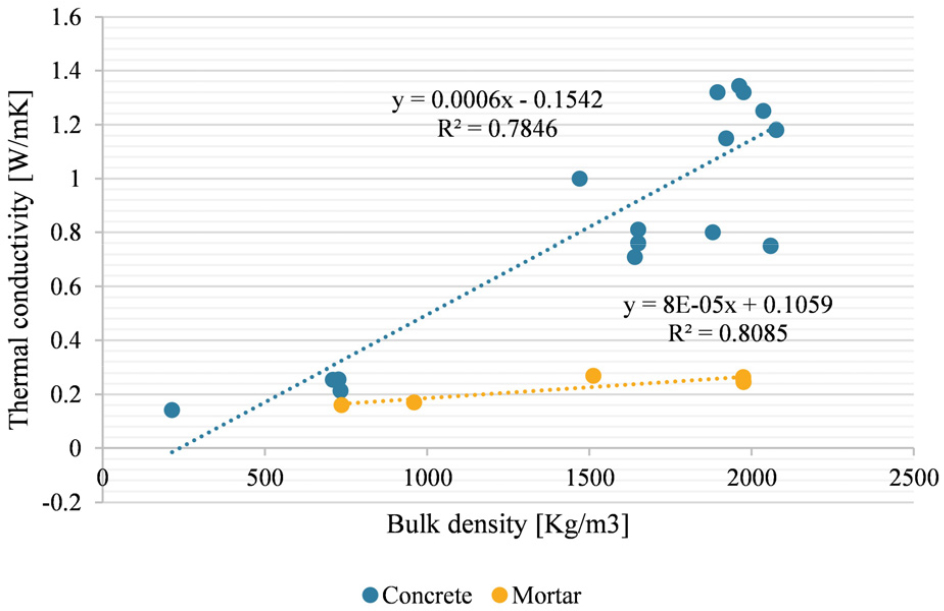
Strong correlations were found between bulk density and thermal conductivity. Figure 20 shows the correlations found with the available data on concrete and mortar. An R2 value of 0.78 was obtained correlating thermal conductivity and bulk density of concrete and, for mortar, the obtained R2 value was of 0.8. Both correlations corroborate that the lower the bulk density the lower the thermal conductivity.
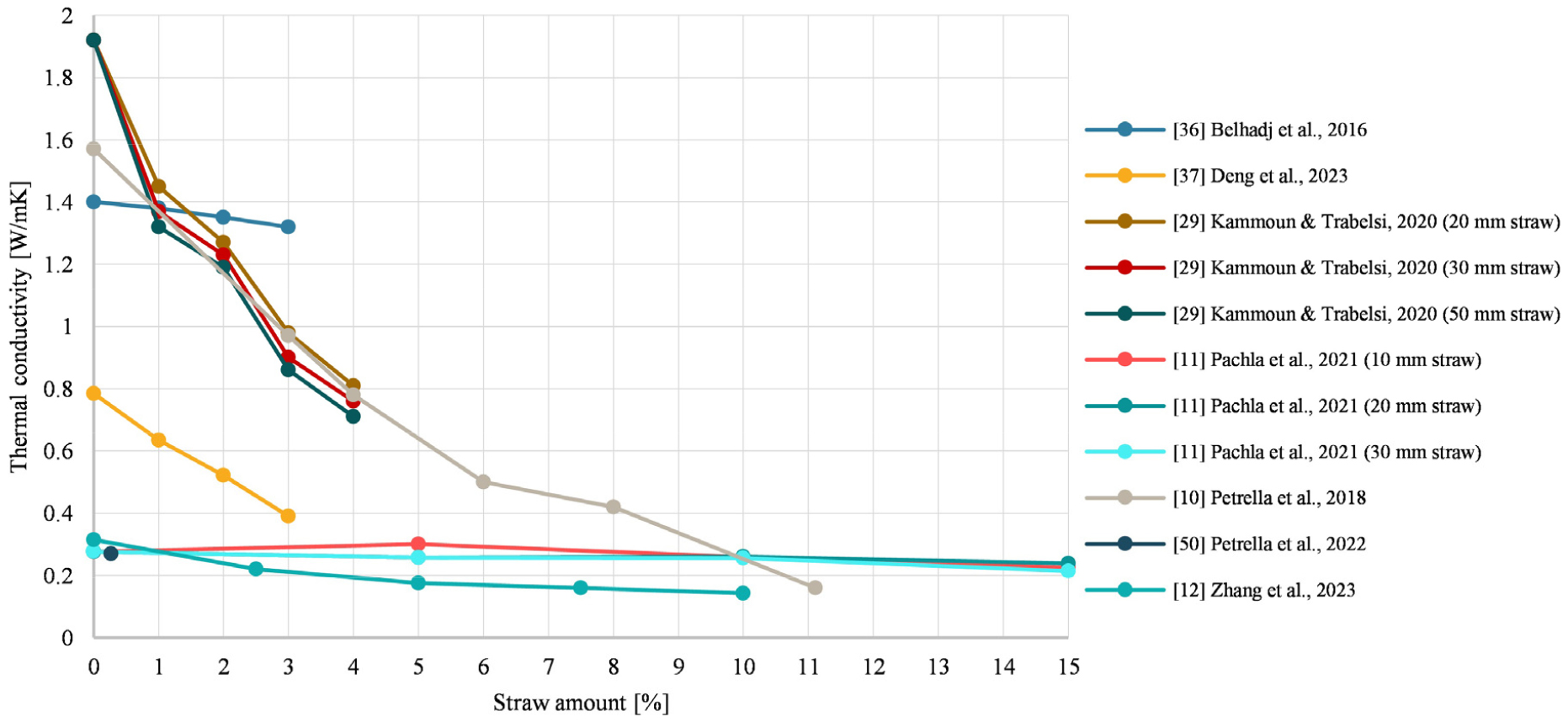
The studies presenting thermal conductivity results and utilizing different straw amounts show that the higher the straw amount the lower the thermal conductivity. Figure 21 shows a comparison between studies in which it can be seen that this is mostly happening, except for the study of Pachla et al. [11] because of the use of a foaming agent to make cellular concrete that seems to be causing a greater influence.
Mechanical and thermal properties are the focus of the studied research. Together with them, stand out other physical properties studied as a complement, like the bulk density stated in the tables and already discussed as a correlated variable with the mechanical and thermal properties. 32% of the studied articles present bulk density results. Many other articles mention performing the bulk density test and also some of them correlate it with the mechanical or thermal properties of composites but do not report the data. Another property is the porosity, that is related to the bulk density. 18% of the studied articles report porosity data of the studied composites.
The addition of cereal straw fibers to cement-based composites usually increases their porosity and decreases their bulk density, causing them to absorb more water. This can be a critical issue for durability, that is investigated with less frequency. Water absorption rate or capacity and water absorption by capillarity are the most studied physical properties after bulk density. Around 20% of the articles present water absorption results. Table 12 presents the available and comparable results about water absorption rate.
Table 12.
Influence of cereal straw fibers on water absorption of composites
| Authors | Cereal straw | Straw composite | Control sample | ||||||||||||
| Type | Length | Amount | Treatment | Bulk | Compressive | Flexural | Thermal | Water | Bulk | Compressive | Flexural | Thermal | Water | ||
| density | strength** | strength** | conductivity | absorption | density | strength** | strength** | conductivity | absorption | ||||||
| [mm] | [%]* | [kg/m3] | [MPa] | [MPa] | [W/mK] | [%] | [kg/m3] | [MPa] | [MPa] | [W/mK] | [%] | ||||
| [23] | Basta et al., 2011 | Rice straw | 25 | 10 | - | 1360 | 0.65 | - | - | 49.00 | - | - | - | - | - |
| Rice straw | 25 | 10 | Gelatin-Hexamine mixture | 1320 | 3.10 | - | - | 27.70 | - | - | - | - | - | ||
| Rice straw | 25 | 10 | Linseed oil | 1500 | 4.90 | - | - | 11.90 | - | - | - | - | - | ||
| Rice straw | 25 | 10 | Sodium silicate-Aluminum sulphate | 1038 | 1.10 | - | - | 45.00 | - | - | - | - | - | ||
| [46] | Jiang et al., 2020 | Wheat straw | 3-11.8 | 15 | Pure acrylic emulsion | - | ~14.00 | ~5.80 | ~0.2120 | ~5.90 | - | - | - | - | - |
| Rice straw | 3-11.8 | 15 | Pure acrylic emulsion | - | ~17.00 | ~6.00 | ~0.2000 | ~5.00 | - | - | - | - | - | ||
| [60] | Jiang et al., 2023 | Wheat straw | 0.6 | 15 | - | - | 0.23 | - | - | 197.00 | - | - | - | - | - |
| Wheat straw | 0.6 | 15 | Silicone acrylic polymer emulsion (MT-8000) | - | ~0.75 | - | - | 93.00 | - | - | - | - | - | ||
| Wheat straw | 0.6 | 15 | Water-based epoxy resin emulsion (DY-128-50) | - | ~0.97 | - | - | 136.00 | - | - | - | - | - | ||
| Wheat straw | 0.6 | 15 | Ethylene - ethyl acetate copolymer emulsion (EVA-102) | - | ~0.65 | - | - | 62.00 | - | - | - | - | - | ||
| Wheat straw | 0.6 | 15 | Silane coupling agent (KH-550) | - | 1.39 | - | - | 120.00 | - | - | - | - | - | ||
| [24] | Liu et al., 2012 | Rice straw | 10-40 | 15 | - | - | ~1.50 | ~0.70 | - | ~8.60 | - | ~7.20 | ~2.70 | - | ~3.10 |
| Rice straw | 10-40 | 15 | CaCl2 | - | ~1.80 | ~1.00 | - | ~7.95 | - | ~19.00 | ~2.80 | - | ~3.20 | ||
| Rice straw | 10-40 | 15 | Al2(SO4)3 | - | ~2.00 | ~0.60 | - | ~7.95 | - | ~16.50 | ~2.95 | - | ~1.35 | ||
| Rice straw | 10-40 | 15 | CaCl2-Al2(SO4)3 | - | ~2.50 | ~0.60 | - | ~7.20 | - | ~27.70 | ~3.40 | - | ~1.50 | ||
| [70] | Ren et al., 2019 | Wheat straw | - | 67 | - | 222 | - | - | 0.0745 | 29.60 | - | - | - | - | - |
| [45] | Rihia et al., 2019 | Wheat straw | 35 | 2 | Hot water | 2360 | ~23.80 | - | - | ~8.80 | - | - | - | - | - |
| [68] | Xie et al., 2015 | Rice straw | 0.9 | 19 | - | 1260 | - | ~9.20 | - | 32.60 | 2010 | ~11.00 | - | 13.60 | |
These findings highlight several practical and technical considerations for further research and applications of straw-cement-based composites as construction materials. Beyond the base raw materials –cereal straw and cement– and their proportions, numerous variables, such as the straw treatments or additives, and the aggregates, can significantly influence the properties of the composites. This suggests that mixes formulation can be tailored to meet different functional requirements. For instance, composites with higher straw content tend to have lower density, which improves thermal insulation, making them suitable for non-load-bearing insulating elements. However, a straw treatment, an additive or another aggregate can also enhance mechanical and/or other physicochemical properties, thus broadening their range of potential applications. The enhancement of thermal properties of composites with straw, which is a consistent finding, suggests promising potential of comprehensively optimized construction materials for an optimum building performance, contributing mainly to reduce energy consumption and improving indoor thermal comfort, particularly beneficial in regions with extreme climates where there is high demand of energy for heating or cooling. Moreover, beyond their advantages for enhancing building performance, the straw-cement-based composites offer a sustainable alternative to conventional construction materials through the use of agricultural waste and the potential reduction of CO2 emissions, supporting circular economy and promoting sustainable construction practices.
Discussion
In this section, from the data and analysis presented previously, the following argumentation seeks to provide an answer to the fifth specific research question: what are the limitations of the existing research?
Similar reviews often focused on concrete, highlight the optimization of the diverse properties such as ductility, tensile and flexural strength [4, 8, 73], the need for attention on aspects related to workability, shrinkage, durability, permeability, abrasion resistance, etc. [3, 4, 8, 73, 74], and the great contribution to the agro-waste management [3, 4, 8, 74, 75, 76]. However, most reviews are focused on exposing findings and benefits of the addition of agro-waste to construction materials for optimization, not considering the limitations of the existing research. Only some reviews expose those limitations. Here are presented the main limitations found for the corpus analyzed in this systematic literature review and, when possible, a comparison with the findings and/or the limitations found by similar reviews.
It is clear that optimization of straw-cement-based composites is the aim of the studied articles. However, the optimization goal to be achieved is not so clear. Most of the articles perform characterizations of the composites with a variety of straw amounts, treatments, additives, additional binders, fine and coarse aggregates, other fibers or wastes, etc., without an optimization standard, only finding the optimal one among the proposed composites tested. On the other hand, a complete characterization never happens. For building materials, at least thermal, mechanical, and durability properties must be investigated. Acoustic properties are also desirable to be included for a complete analysis. Only around 4% of the articles [e.g., 10, 11, 50] investigate three of the four desirable groups of properties. Mechanical properties are the most studied, with 94% of the studied articles. Thermal properties are gaining ground with 30% of the studied articles reporting them. Acoustic properties (6%) are recently being included. But physical properties to determine durability (around 20%) are not being widely studied despite the limitation to durability caused by the addition of natural straw fibers to cement-based composites.
Turco et al., [4] made a review of compressed earth blocks (CEBs) optimized with natural origin materials, natural fibers among them. Compared to the current study (see Figure 11) they found a similar proportion of studied properties with 77.8% of their corpus analyzing compressive strength and 33.3% thermal conductivity. Instead, for CEBs, bulk density is more studied, with 55.6%, and flexural strength is less studied, with 37.8%, compared with 32% and 56% respectively for the cereal straw-cement-based composites.
Each research group seems to make an approach according to its possibilities and expertise rather than to the needs of optimization to develop a high-quality green construction material, which could be positioned as a profitable and competitive product, with the extra benefit of valorizing crop wastes. Very specific studies can make important contributions to the topic knowledge, it is not necessary a wide study to solve together the remaining optimization issues, however, a holistic approach is required to place the contribution on the right path to achieve the needed optimization. One of the limitations of the topic research is, precisely, the lack of placement on the general context, leading to repeating findings and leaving aside other issues needing attention.
Probably also due to the variety of possibilities and expertise, there is a wide variability in studying and reporting data, making the comparison of results hard, which is a limitation not only for this study but also for the new research on the topic because researchers cannot have a clear starting base. Some detailed and accurate articles allow the reproduction of the experimentation process providing reliability, but the lack of information creates uncertainty about the results. Turco et al., [4] also highlight the wide variability of data available and the difficulty involved, recommending to clearly and exhaustively explain data and procedures aiming to standardize for future research. Pandey & Kumar [74], agreeing with Turco et al. [4], emphasize that the purpose of research is to create a better product for contractors or designers, but the lack of technical guidelines and the significant disparity between recommendations cause uncertainty, making these products commercially unreliable.
For the proposed composites’ mixes, optimization may be valid only under experimental conditions, but for real applications may be not affordable because of the treatments and additives’ local availability and cost, the curing process, and other process issues that raise the production cost. 8% of the studied articles present an economic analysis all agreeing with the reduction of the production cost of straw-cement-based composites compared to cement-based composites on the market, but the particularity of those studies is that all of them propose simple mixes and use raw straw. To effectively introduce straw-cement-based composites to the market, performance optimization is not enough, it is also necessary to position them as competitive construction materials. Pandey & Kumar [74] highlight that pretreatment methods can significantly increase the overall cost reducing the cost-effectiveness at the commercial stage, not only because of the additives cost but also because of the considerable amount of energy consumed by some pretreatment techniques, reversing the benefits of waste management and valorization.
In the current review, sustainability aspects, such as indicators or life cycle assessments, were not analyzed due to the few recurrences of those analyses in the studied corpus. Turco et al. [4] mention that, in their review, the scarcity of sustainability analyses was unexpected because those analyses are turning into a primary decision-support tool for the adoption of construction products. The concern is not so much the lack of sustainability analysis, but the fact that optimization may not be heading toward sustainability.
Conclusions
Cement-based composites optimized with the addition of cereal straw to be used as construction materials are not a novelty in research. However, the optimization focus was exclusively on the mechanical properties but, in the last decade, new approaches have emerged also focusing the optimization to enhance the thermal performance taking advantage of the insulation properties of cereal straw. More recently, acoustic performance has also been included in the studies. With this trend, it can be said that the optimization goal is taking shape as the search for a construction material that covers the complete aspects required for optimum building performance. But, for new research, it is still needed to frame the specific contribution toward the overall goal. A multidisciplinary and holistic approach is needed.
Further investigation including all aspects of straw-cement-based composites’ performance is required because optimization remains to be achieved. However, although the use of crop wastes is contributing to their sustainable management, the sustainability aspects of the construction materials production processes cannot be neglected, as well as the commercial aspects because it would make no sense to develop a non-competitive product.

