


Introduction
Background
Method and Data Presentation
Data collection and presentation
Criticality index
Analysis Results and Discussions
Comparison of productivity performance
Comparison of factor criticality
Conclusions and Recommendations
Introduction
Green buildings and green construction have the greatest opportunity to reduce the greenhouse gas (GHG) emissions since the global buildings are responsible for up to 30% of GHG [1]. Along with the growing awareness of sustainable development, many governments in different countries have been adopting or setting green building standards and regulations as well as financial incentives for sustainable development [2]. To facilitate the green building movement, the Building and Authority of Singapore (BCA) has introduced three Green Building Masterplans from 2006. Owing to Green Building Masterplans and other green initiatives, such as the Green Mark certification and green retrofitting scheme, the number of Singapore’s green building stock increased from 17 in 2005 to 2155 in July 2014, accounting for about 25% of Singapore buildings [3].
The government also targets to green 80% of the buildings in Singapore in 2030 [4]. To achieve this target, green buildings must be constructed in a more productive manner because the current development of green buildings encountered some great barriers such as the high initial cost and bad schedule performance [5]. Moreover, the existing project management techniques struggle to handle the high levels of complexity of green building construction projects [6]. Thus, identifying specific adjustments to traditional project management practices is necessary and useful to improve the construction productivity of green buildings.
Therefore, the objectives of this study are to: (1) investigate and compare the productivity performance of green and traditional construction projects; and (2) identify the critical factors affecting the productivity of green construction projects with comparison against traditional construction projects. The results of this study significantly added to the project management knowledge of green construction. Furthermore, the findings of this study help practitioners identify specific adjustments to traditional project management practices.
Background
A green building is the creation of structures that are environmentally responsible and resource-efficient throughout a building’s life-cycle [7]. Due to the special characteristics of green buildings, the construction of green buildings would be different with that of traditional building projects in terms of the design, project management practices and processes [8-10].
First, an integrated design is usually adopted in green construction projects because green construction projects need to consider the impact between different building systems and the environment so as to optimize each system [9, 11]. Moreover, in contrast to a traditional building construction, a green building construction usually needs to follow an additional set of requirements to help a building gain a green recognition [12]. For instance, In Singapore, the use of sustainable construction practices, such as the use of recycled concrete aggregates, has been factored in as areas which can help a building to gain points for the consideration of Green Mark [12]. In addition, the commission closing out of a green construction project is usually more complicated than those of a traditional construction project [13].
Moreover, the construction industry of Singapore has recorded a low productivity for a long period of time. A 3.1% average increase every year was recorded from 1982 to 1992, lagging behind the whole economy of 4.2% [14]. From 2007 to 2013, the labour productivity declined from 7.0% to -2.7% [15]. In light of this, BCA has launched the first and second construction productivity roadmaps in 2011 and 2015, respectively, to improve construction productivity through equipping construction sector with skilled workforce by 2020 and high technologies [16, 17].
In light of the above, identifying the specific adjustments to traditional project management practices is necessary. A lot of research on evaluating factors affecting the productivity in the construction industry has been done. After a literature review, this study identified 26 factors that could affect the productivity of green construction projects and grouped them into five major categories which are project factors, manpower factors, management factors, technical factors and external factors. These factors and their criticality of affecting the productivity of green construction projects are shown in the analysis and discussion section.
Method and Data Presentation
Data collection and presentation
The questionnaire survey technique is a systematic and widely used method of collecting data [18]. Therefore, this study adopted the questionnaire survey technique to collect professional views in the productivity of green and traditional construction projects. Based on a comprehensive literature review, this study first developed a questionnaire to investigate the productivity performance of green and traditional construction projects, and the critical factors affecting the productivity performance of green construction projects with comparisons against traditional construction projects. Then this study conducted a pre-survey with three professionals who had several years’ experience in the local construction industry and green construction project to finalize the questionnaire. Changes were made based on feedback from these professionals.
During the survey, the respondents were first asked to indicate the numbers of green and traditional construction projects carried out by the company in the past five years, projects experienced productivity issues and projects delayed caused by these issues to investigate the current productivity performance, respectively. Afterward, using a five-point scale, the respondents were asked to assess the likelihood (1 = least likely and 5 = most likely) and impact (1 = very low impact and 5 = very high impact) of the 26 factors affecting the productivity in green and traditional construction projects. Finally, the post-survey interviews were also conducted with three industry experts who possess the experience in both traditional and green construction projects to validate the findings.
All the professionals who were from companies under BCA directory of registered contractors and licensed builders, professionals who were from firms under the Singapore Institute of Surveyors and Valuers and project managers with the relevant Green Mark Certification such as Green Mark Managers and Green Mark Professionals forms the population of this study. The questionnaires were randomly sent out to these professionals and received 32 responses. Statistical analysis could still be performed because the central limit theorem holds true when the sample size is no less than 30 according to the generally accepted rule [19, 20].
The profiles of the respondents and companies are summarized in Table 1. The respondents consisted of 16 project managers, 13 quantity surveyors and 3 team members from 8 contractors, 12 consultants and 12 developer firms, respectively. All respondents have experience in green building projects.
Table 1. Profiles of respondents and companies 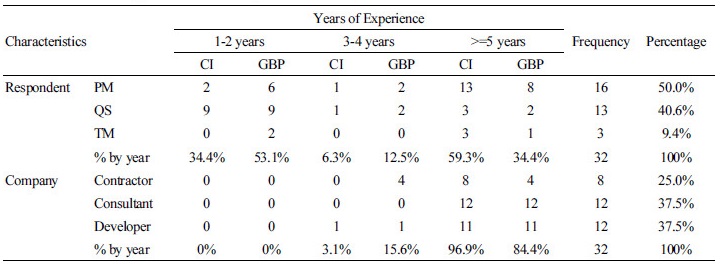 | |
CI: Construction Industry; GBP: Green Building Projects; PM: Project Manager; QS: Quantity Surveyor; TM: Team Member. | |
Criticality index
This study adopted the ‘criticality index’ to evaluate the criticality of each factor. Criticality is recognized as the function of likelihood and impact [21-23]. The average score of the criticality index of each factor is calculated using Eq. (1).
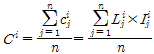
where  ,
,  and
and  denote the likelihood, impact and criticality score, respectively, assessed by respondent j for factor i; Ci denotes the average score of the criticality index.
Analysis Results and Discussions
Comparison of productivity performance
In order to compare the productivity performance, the recorded projects were analysed by considering the frequency of occurrence (hereinafter referred to FO) of productivity issues. The Chi-square test was used to test whether FO is equally distributed between green and traditional construction projects. The test was conducted on the number of projects experiencing productivity issues and the number of projects delayed caused by these issues. The confidence level was 95% with a p-value of 0.05. The analysis results are summarized in Table 2.

In terms of projects with productivity issues, the percentage of green construction projects that had experienced productivity issues (42.8%) was much higher than that of traditional construction projects (22%). This result could be first because the two types of project have significant differences in several aspects, such as design and construction, as explained above. Moreover, compared with traditional construction projects, green building concepts presents for a much shorter period. Therefore, firms undertaking green construction project would have less knowledge and experience in them, which would lead to unproductive during the construction. For instance, the mistakes because of unfamiliarity with green requirements would cause rework [24]. Experts in the post-survey interview also claimed that a lot of professionals’ were still unfamiliar with green construction projects.
In terms of projects delayed caused by productivity issues, the percentage of green construction projects (77.3%) was also much higher than that of traditional construction projects (54.2%). [5] also found that the frequency of green construction projects experiencing delays caused by productivity issues was higher than that in traditional construction projects. Moreover, the FO of projects with productivity issues and projects delayed caused by productivity issues were both statistically not equally distributed between green and traditional construction projects since the p-values were less than 0.05.
Comparison of factor criticality
Using Eq., this study calculated the criticality indices of all factors as shown in Table 3.
Table 3. Comparison of factor criticality between green and traditional construction projects 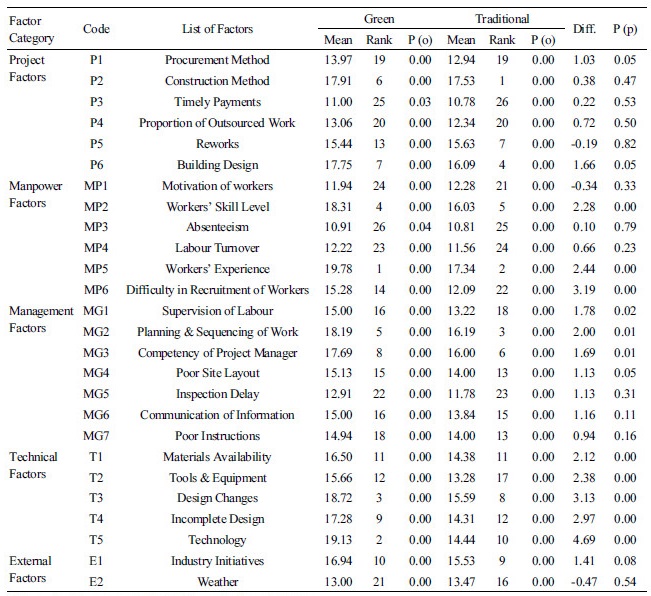 | |
P(o): p-value for one sample t-test; P(p): p-value for paired t-test. | |
After conducting the paired t-test to test the equality of the means of the criticality index of each factor for green and traditional construction projects, the results showed that there were 11 factors whose criticality indices were statistically different for green and traditional construction projects. Among these factors, “technology” has the largest difference (Diff. = 4.69) as it was ranked second and ten in green and traditional construction projects, respectively. From a technical perspective, green construction projects are inherently different from traditional construction projects. Unfamiliarity with green technologies and technical difficulty during the construction process were also identified as two of the main challenges faced in green construction projects by [25].
After conducting the one sample t-test to test the mean scores of the criticality of the factors against the mean value of nine, the results showed that all factors were statistically critical to affecting the productivity of both types of projects because all mean values were greater than nine and all p-values were less than 0.05. As for green construction projects, ‘workers’ experience’, ‘technology’ and ‘design changes’ were ranked as the top three most critical factors.
‘Workers’ experience’ was ranked first. This could be because the use of casual workers in green construction projects. Workers’ inexperience can affect productivity through mistakes leading to reworks, changes and delays in projects [24, 26, 27]. Moreover, the post-survey interviewees disclosed that the market was still lack of workers with the experience of green building projects and with a green certificate. In addition, the experience of green construction projects is hard to come by due to such projects being relatively new.
‘Technology’ received the second position. The criticality of technology to increase the productivity of construction industry was also supported by [28]. Although green technologies can offer plenty of sustainable solutions, practitioners still need time to get proficiency in these technologies. Moreover, as the design and construction practices of green buildings being more complex, practitioners of green construction projects need to actively adopt the new green technologies. Furthermore, experts in the post-surveys explained that companies and professionals were still unfamiliar with the complicated green technologies and encountered technical difficulties during the construction process. [29] and [25] also indicated that these causes were main challenges faced in green construction projects.
‘Design Changes’ was ranked third. The criticality of design changes to the construction productivity was also supported by [30] and [31]. The integrated design method should be adopted and considered earlier in the development stage. Otherwise, the high number and type of design changes can invariably result in a drop in efficiency in construction and lead to a reduction in productivity [32]. To mitigate the design changes, Building Information Modelling (BIM) was suggested to be widely adopted in green building projects [33].
Conclusions and Recommendations
This study conducted a questionnaire survey to identify productivity improvement strategies for green construction projects. The findings first revealed that green construction projects experienced productivity issues and that the delays caused by these issues occurred more frequent in green construction projects. The findings further showed that “technology” had the largest difference in criticality between green and traditional construction projects. In addition, this study identified ‘workers’ experience’, ‘technology’ and ‘design changes’ as the top three critical factors. This study not only fills the gap in the knowledge area of the productivity of green construction projects but also points out the right directions for practitioners to deliver green construction projects in a more productive manner. Future studies could develop productivity benchmarks for different trades of green construction projects.

