


Introduction
Background
Problem Statement
Objectives of the study
Significance of the study
Literature Review and Theoretical Foundation
Literature review and related works
Hallucination, faithfulness, and numeric drift
Multi-Agent Systems in Software Engineering
Tool augmentation and multi-agent orchestration
Decomposition analysis and identity closure
Reproducibility and auditability in the proposed framework
Research Gap
Methodology
Design philosophy: separation of concerns and fail‑closed auditing
Proposed system Architecture and Trust Protocol
Mathematical foundations: additive LMDI identity
Narrative Audit Protocol
Experimental modes: deterministic, hybrid, and agentic pipelines
Results and Discussions
Quantitative Comparison, Mathematical Accuracy
Qualitative analysis and hallucinations
The anchoring of performance in multi-agent reports
Proof-of-concept insight reproduction
Smart city and urban development implications
Limitations and future research
Conclusions
Introduction
The role of quantitative reports in consolidating complex data into brief stories is becoming more important in decisions concerning sustainability of the sector by the government. In emissions policy, agencies must justify claims about drivers, progress, and priority actions to multiple audiences represented by regulators, ministries, investors, and the public. The trust in these reports lies in the fact that their numbers can be reproduced, and their interpretations can be retracted to verifiable evidence. Nevertheless, LLMs do not support accounting systems. They are probabilistic generators that are strained to generate convincing context, and their failure mode is default, when missing evidence. In the case of the task retrospective policy analysis, that mode of failure is unacceptable since it can lead to drawing wrong policy conclusions and allocating resources.
A particular example of that larger risk is the subject of study in this paper. We consider the reporting of emissions decomposition of the manufacturing sector in Kyrgyzstan during 2012-2023. The decomposition analysis has been employed to assign alterations in emissions attributed to economic activity, production structure, energy intensity, and fuel mix. Identity- closed, the additive Logarithmic Mean Divisia Index (LMDI) method is especially appealing as an auditing technique since it is identity-closed: the change in emissions realized is the sum of effects that have been decomposed (there is no residual term). Due to the strict identity, it gives a good test of consistency and a narrative claim concerning dominant drivers can be verified directly against the decomposition table. But when the LLMs are requested to produce multi-section reports (calculation summary, interpretation, policy implications) they lose track of the verified artifacts, which means that there is more likely to be a tendency to introduce convincing statements that are not supported by verified artifacts into the generated model.
The practical question is then focused on whether it is possible to develop reporting workflow with the use of LLMs with audit-grade constraints. Our point is that it is not enough to act by instructions and prompts and the limitations have to be architectural. We plan to make a Trust Protocol that decouples deterministic computation and narrative generation and injects gates that check claim-level consistency and will not release a report until they do.
Background
The climate crisis is pushing the international community to pledge and fulfill commitments under the Paris Agreement, and thus actively seeking ways to digitally transform environmental monitoring systems [1]. These systems, developed through the digitization of public management, require tools capable of processing large amounts of data with accuracy, making artificial intelligence (AI) an attractive solution for energy efficiency analysis and carbon accounting [2] so called “green AI systems” [3].
Presently software programs and traditional techniques are best in achieving rapid error free calculation of emissions inventories and energy efficiency tests. Nonetheless, AI is not limited to simply computer calculations, specifically, LLMs might be useful in adding value by interpreting the results and providing clear and actionable reports. Numerical data analysis can replace gut feelings with the feeling of context, causality, and even develop the results in a logical story when AI is used to support the findings.
The application of LMDI for policy analysis is limited due to the labor-intensive nature of the calculations although this method has been well- established for understanding the structural changes in carbon emissions [4]. In contrast, AI technologies have the potential to enable governments to continuously verify emissions data as part of a dynamic policy feedback loop, helping to ensure that policy interventions are based on an accurate approach.
The fact that AI is being widely used in policy- making processes is crippled by an underlying issue that is rooted in the idea that LLMs produce information that is not factual or is a hallucination [5]. This effect is observed through the fact that models generate plausible yet incorrect statements particularly when dealing with numerical data [6]. When it comes to sectors that demand no mistakes in calculations (e.g., emissions inventories and program evaluation), they can cause wrong inferences and a lack of trust in the governance systems.
Problem Statement
Thus, the increasing role of data in public sustainability management becomes part of a regulatory infrastructure, where the acceptability of a result is determined not by the expressiveness of the interpretation, but by the strict reproducibility and verifiability of numerical conclusions [7]. Unlike the tasks of “explanation” or “summarization,” public calculations in the climate and energy agenda are subject to a regime of minimal error tolerance [8].
Thus, the fundamental issue could be the lack of reliability between the generative text systems and audit grade reporting requirements. The literature points to a methodological gap between the high capability of the LLMs to produce logically coherent text and a lack of a mechanism to provide a guarantee of strictly quantitative and qualitative accuracy of tasks. Existing literature of the LLM hallucinations perceives them as a systemic risk of the generative paradigm, when the model is capable of making its plausible statements with a weak connection to the data being validated, which is essential in quantitative domains [9].
This is greater in a multi-step situation where errors at one step compound to the next step, i.e., data extraction to computation all the way to interpretation [10]. Furthermore, there is another body of work that demonstrates that despite the profound advances in the facility to prompt and reason, mathematical solidity is limited and inconsistent on more complicated problems as indicated by special benchmarks [11, 12]. The current state of generative AI models is characterized by excellent natural language processing, although their implementation in challenging mathematical modeling operations is a major concern. The mathematical calculation in audit-grade situations is presumed not to be entirely dependable with such a current model as the Deepseek-r1 that has a score of 97,3 in MATH-500 [13].
This is the architectural incompatibility of generative AI with the needs of verifiable calculation in the event that the computations of the LLM are done via probability distributions and not algorithmic computations, so that the computational process itself is impossible to audit [14, 15].
Within this context the following two research questions were developed based on the relationship between them:
Question 1. Is it possible for a multi-agent system to decrease mathematical mistakes more successfully than a single LLM?
Question 2. Is it possible to ensure audit-grade narrative correctness (evidence-based reporting) with policy-relevant interpretability by a Trust Protocol?
These questions address the main reliability gap in retrospective auditing according to which, although a model can give out fluent explanations, the report cannot be used in audit environments unless all the quantitative claims can be verified as being based. This requirement is formalized in the Trust Protocol below, which states that any numeric statement and any quantitative comparison in the narrative must be anchored to values known in verified output artefacts; any unanchored number is treated as a failure condition.
In this protocol, interpretive freedom is restricted to the extent of authenticated evidence, say the interpretation of the hierarchy of drivers, or time trends that are based directly on the results of the decomposition, and causal or situational extrapolations must be backed up by strong evidence rather than plausibility.
Objectives of the study
The research objective articulated from two research questions above and aimed at providing a theoretical and engineering justification for an architectural strategy that minimizes mathematical errors and ensures procedural reliability of results in computational problems. Because in the environmental sciences, the aim is not just to conceptualize but to provide practical, real-world solutions. A clear link between theory (e.g., LMDI) and application (e.g., AI-driven analysis in Kyrgyzstan) will make the research more accessible and impactful. The objectives are (i) to design an implementable Trust Protocol with clear gates and validation variables; (ii) to define “hallucination processing” as a measurable pipeline failure mode; (iii) to empirically evaluate the protocol using trace logs and numeric extraction metrics; and (iv) to provide reusable implementation patterns (artifacts, anchor registries, and validation certificates) for broader sustainability analytics.
These objectives require the development of an architectural framework in where special agents will perform various tasks (e.g., data collection, LMDI calculation, analysis, report generation). Its architecture will be based on deterministic core calculations and only uses large language models in certain tasks (e.g., generating text explanations), not in any of the critical computations of arithmetic. Architectural concepts will be developed to separate functions between parts, assigning specialized functions (e.g., calculation, verification, interpretation) and formalizing gatekeeping locations where the result cannot advance to the next phases without passing through validators, as defined in reference [80].
Additionally, the study involves implementing and testing three computational “modes” for LMDI decomposition on the same source dataset. The first mode is a classic, traditional Python calculation without the use of AI (manual Python script developed for Kyrgyzstan’s manufacturing sector). It will serve as the “standard” for accuracy verification. The second mode is a hybrid method. Here, the main calculations are performed deterministically, and the descriptive portion of the report is generated using a single, large language model to develop explanatory text of the results.
Significance of the study
The theoretical and practical implications of the proposed study are rather significant. The practical value of it is especially relevant to digital governance since it presents the accountability architecture of managing digital environmental data. The work adds a system-based reliability framework of the generation of quantitative-narrative output, based on an agentic artificial-intelligence system. The novelty lies in an auditable Trust Protocol that outlines fail-closed behavior and creates a three-gate process (identity- closed calculation, validation, and claim-level anchoring). The claim-anchoring system associates all numeric assertions in the report with a known artefact key and can be used to verify it automatically. The theoretical significance lies in the fact that there are currently no empirically validated frameworks integrating LMDI decomposition and agent-based workflows for environmental analysis. All existing works either focus on tool implementations (Python-LMDI [4], LMDIR [16] or on concepts of machine-learning for prediction models on energy efficiency [17]. The proposed concept of an agentic AI for LMDI represents a qualitatively new class of systems, where AI is used for retrospective policy analysis.
Literature Review and Theoretical Foundation
Literature review and related works
The systematic literature review concentrates on two key areas: (i) the reliability of large language models (LLMs) research where hallucinations, grounding, and faithfulness-enhancing methods are investigated, and (ii) emissions accounting and decomposition analysis where identities and invariants (domain-specific) are acquired. In turn, the review puts hallucination mitigation, tool-enhanced LLMs, and multi-agent orchestration first, and considers the emissions decomposition an area of application with highly constrained conditions.
Since the contribution is architectural, the focus is on work that promotes overt limitations, provenance and identity closure in reporting pipelines, as opposed to work that aims to optimize average-case benchmark performance. In this connection, two concepts of trust are identified. To begin with, there is epistemic trust which deals with the truth of a statement. Second, audit trust relates to the ability of a statement to be traced in an evidence chain agreed upon. Audit trust demands more artifacts, such as fixed datasets, deterministic computations and conservative validation rules, whereas sometimes LLM systems can augment epistemic trust by accessing external sources.
The Trust Protocol targets audit trust. It is intentionally conservative and rather than attempting to infer the correct answer from the world, the system attempts to ensure that whatever it states is derivable from the provided evidence and is clearly labeled when it is not.
Hallucination, faithfulness, and numeric drift
LLMs have become a practical layer for coordinating complex analytical work because they can translate between natural language, code, and structured outputs [18]. This is partly why they are becoming popular in environmental science and sustainability governance, where workflows often combine data preparation, quantitative modeling, and narrative interpretation getting a new terminology of green artificial intelligence [50]. Yet they are constrained by a central reliability problem expressed by “hallucinations.” Hallucination means the generation of fluent statements that are not grounded in the provided evidence, inputs, or correct derivations [19]. Survey work in natural language generation (NLG) treats hallucination as a cross-task phenomenon (summarization, QA, dialogue, data-to-text) and emphasizes that it is often tied to factuality concerns [20].
Hallucination has been widely defined as the content which cannot be supported by the input or verifiable external facts. Hallucination can take several forms in quantitative reporting: a model can end up giving a different number than the source table, explaining a trend that is not there, or an explanation that lacks support. The prevalence of such phenomena and the challenge of their prevention through instruction-following alone have also been reported in survey work in natural language generation and LLMs [21].
Numeric shift may still take place although grounded. Long reports are usually drafted through several stages, and this involves calculating summaries, re-writing sections, executive summary and policy implications [22]. The model can paraphrase numbers, change units or simplify ranges at every pass. The over-confident style of LLM outputs is also a risk factor to failure. Within the framework of environmental analytics and governance, two types of hallucinations can be useful, namely, factual and quantitative hallucinations. These hallucinations are methodologically unsafe in the areas of emissions inventories, energy-efficiency cheques, and decomposition studies, and can present invented drivers, wrong quantities, or erroneous policy suggestions even though it may look convincing to a reviewer [23].
Factual hallucination describes hallucinatory assertions concerning the world through constructing events, mistaken institutional specifications, created policy devices, or a invented causal circumstance [24]. In environmental reporting, this may be in the form of explanations that see a change in emissions due to a macroeconomic shock even though the data shows otherwise.
Quantitative hallucination is the inaccurate number, units, magnitudes, derived quantities [25]. The model is allowed to maintain a total, but to misrepresent the contribution of factors, to misrepresent share reports, or give a decomposition narrative which is internally consistent but not consistent with the computed terms. This type of change is not surprising. Research in abstractive generation has shown that likelihood- trained models can make fluent statements that are not actually supported by the input. The problem becomes clearer when the evaluation requires exact preservation instead of “reasonable” paraphrase [26].
These differences are significant due to the fact that the mitigation techniques tend to lower the level of one of the types of hallucinations and leave the other relatively unaffected. In knowledge-intensive contexts, retrieval grounding can reduce factual hallucination [27], although does not insure numerical accuracy on multi-step computations or identity-constrained attribution (e.g. additive closure in LMDI).
Hallucinations in this case are caused by the lack of congruency between the prevalent training goal (prediction of the next token) and the need to achieve truth-conditional accuracy at inference time. The model is also optimized to obtain statistically plausible continuations, which does not require one to certify that every statement is based on a single piece of evidence or a valid derivation, which can give fluent but man-made statements in case of underspecified prompt or missing evidence [28].
Deterministic calculation, conversely, may remove arithmetic error, but more interpretive hallucination may occur in the narrative layer, particularly when the writing is requested to provide reasons instead of providing an accurate reflection of verified results.
The hallucination literature pays much attention to epistemic correctness in relation to world knowledge or to reference documents. In audit grade reporting standards are high and a statement of fact may be considered unacceptable when it cannot be provenanced to the artefacts used in doing the analysis. As a result, traceability is being raised as a major constraint as opposed to an optional guideline. Hallucination, thus, is conceptualized as systemic reliability problem. To reduce it requires architectural constraints, specifically (i) restricting the arithmetic to deterministic code and (ii) requiring the narrative layer to refer solely to values which occur in known output artefacts.
Multi-Agent Systems in Software Engineering
Multi-agent systems (MAS) have been used as a conceptual model of breaking down complex tasks into interacting entities, pursuing partial objectives, communicating and coordinating. Classical research on MAS focuses on autonomy, interaction and social ability, commonly represented as agent communication languages and organizational models [29]. The contemporary language-model agents or agentic AI shares the division-of-labor-intuition, only to be differed with the classical agents in a critical manner. Mostly, they are text-generative and probabilistic, hence the reliability has to be designed by constraint, and verification [30].
Multi-agent systems have long been studied as software architecture in which multiple autonomous computational entities interact to accomplish goals that are difficult to solve by a single component [31]. Classic MAS research frames an agent as a self- governing entity that perceives its environment, maintains internal state, and selects actions to achieve objectives, often under constraints of partial information and distributed control [32]. In early MAS, coordination depended on engineered communication protocols and decision logic, including negotiation rules and agent communication languages like ACLs, KQML or FIPA-ACL [33, 34], which improved interpretability but also made systems expensive to design and brittle under changing task conditions [35].
In software engineering, MAS development is already distributed, and the architecture is often understood as a role-based process involving analysis, design, coding, testing, review, and deployment by different agents and validated through structured handoffs [36]. Recently, LLM-based agentic systems have attracted interest in the research community because they provide a flexible mechanism for role simulation, natural language communication between agents, and generation of artifacts such as code, tests, documentation, and patches [37].
The vision of agentic AI is increasingly used as a generalized name to describe AI systems that are designed as systems of interacting agents that can make plans, give out tasks, exploit instruments and engage in recursive development toward a shared goal [38].
The term “Agentic AI” has become commonly utilized to describe AI systems composed of interacting agents capable of planning, delegating tasks, using tools, and iterating toward a common goal [38]. The modern use of the term defines agentic AI as a multi-component, goal pursuit, where specialized agents cooperate and coordinate to perform complex tasks that cannot be performed reliably by a single end-to-end prompt [39]. The study of collaborative systems also focuses on both interaction design, which includes routing, shared memory, stopping rules and tool permissions, and the model behind them [40]. The change in approach in agentic structures is generally represented as broadly producing a text to accurately achieve a goal. The system divides the goals into sub-tasks, sends them to specific functions, calls external instructions, and refines the intermediate artifacts in relation to explicitly defined termination conditions [41].
In the case of software-engineering processes, this structural arrangement is consistent with the conventional quality-insurance methods of code review, unit testing, and gradual handover. In a reliability viewpoint, the most significant assertion deals with an orchestration system where deterministic tools are the origin of truth to calculations, restricted to coordination and explanation.
Tool augmentation and multi-agent orchestration
In agentic systems, tool augmentation is the capability of LLMs to enhance factuality by making external queries or computing functions, as opposed to using internal parametric memory [42]. A spreadsheet or a cell on a code that calculates the emissions and the effects of drivers is a common tool used in sustainability reporting. Analysis reliability requires tool augmentation but not sufficiency since the resultant final report is produced by a probabilistic model [43].
Agentic workflows address part of this issue by assigning distinct roles (e.g., calculator, writer, reviewer). The system is able to isolate high-risk steps and introduce verification checks between successive stages. As a result, the overall process becomes governable, since each stage has inputs, defined and outputs and could be validated independently [44].
Still, role decomposition alone cannot guarantee numeric fidelity unless the writer is constrained to a verified value set. Accordingly, we combined orchestration with oracle anchoring, such that the report-writing component is restricted to using only values that can be directly mapped to verified tool outputs.
ReAct-style reasoning-and-action patterns are commonly used to combine tool calls and reasoning actions, therefore enhancing grounds in interactive activities [45, 46]. The current environment is, however, different, since it is necessary to produce the output audit-grade meaning that it needs fail-closed enforcement and clear validation of artefacts as opposed to relying on improved average-case performance.
Similar strategies are based on structured output constraints, like a schema or a JSON format, to minimize ambiguity [47]. As much as these may increase syntactic validity, it is not true that numeric values should provide verified artefacts. That is precisely the need for anchoring.
Decomposition analysis and identity closure
Emissions accounting methods are reviewed here to motivate the choice of the Logarithmic Mean Divisia Index (LMDI) as an identity-constrained testbed for audit-grade reporting. The paper follows standard inventory logic in which activity data (e.g., fuel consumption, electricity and heat use) are combined with emission factors to estimate CO2 emissions from stationary combustion, consistent with widely used greenhouse-gas inventory guidelines [48]. This inventory foundation is important for the present study because the Trust Protocol does not aim to improve emissions science itself; instead, it evaluates whether an AI reporting workflow can preserve numerical integrity and traceability when translating verified accounting outputs into a policy-ready narrative [49].
Emissions accounting methods are reviewed here to motivate the choice of LMDI as an identity- constrained auditing testbed. The dissertation follows standard emissions accounting logic where activity data and emission factors are combined to estimate CO2 emissions for stationary combustion, consistent with IPCC inventory principles [50]. Decomposition analysis attributes change in emissions to interpretable factors (e.g., activity, structure, intensity, fuel mix). The Logarithmic Mean Divisia Index is widely used among index decomposition methods because it provides exact decomposition with desirable properties such as time-reversal and, in the additive form, zero residual. For this dissertation, the zero-residual property is technically important because it provides an identity constraint that can serve as an automated unit test. If the system fabricates or mutates numbers, the additive closure condition fails and the error becomes detectable.
Energy efficiency and carbon emissions are critical components of sustainable development. Energy efficiency refers to the reduction of energy consumption without compromising the quality of service [51], while carbon emissions are a primary contributor to climate change [52].
Measurement and calculation of energy efficiency and carbon emissions are fundamental components in the pursuit of global sustainability goals. The various models have been developed to track and decompose changes in energy consumption and associated carbon emissions [53] over the past few decades. These models allow policymakers, businesses, and researchers to understand the factors driving energy consumption and carbon emissions in various sectors, enabling targeted interventions for reduction [54].
Gao and Yang identify four major approaches that show up repeatedly in carbon accounting work: emission factors, mass balance, direct measurement, and decomposition analysis [53, 55]. Each has its own logic, and none is universally “best,” and it depends on availability of data and what kind of assumption is made.
Emission factor method is used involving multiplication of activity data (the amount of activity that causes emissions) by an emission factor (the number of emissions per unit of activity). For example, to calculate emissions from burning coal, the amount of coal burned is multiplied by the emission factor for coal combustion [56]. This method is relatively simple and widely applicable, but its accuracy relies heavily on the accuracy of the emission factors used.
Mass balance methods are built on the conservation principles of emissions by tracing the carbon inputs and outputs in a defined area; these methods may be scientifically justifiable when the material flows and compositions are well characterized but become problematic in complex or poorly instrumented processes [57, 58]. High-fidelity estimates can be obtained using direct measurement methods such as atmospheric or sensor based. However, they are expensive and difficult to operate, which tend to restrict realistic coverage [59].
Decomposition methods differ from these approaches because they are not primarily intended to estimate emissions from first principles. Instead, they attribute changes in emissions over time to interpretable drivers, which is often the type of evidence required for policy analysis [60]. Index decomposition analysis is used to attribute changes in emissions or energy use to interpretable drivers such as activity, structural composition, and energy intensity. Here, the Logarithmic Mean Divisia Index (LMDI) is particularly attractive for policy applications because it yields an exact decomposition in additive form and avoids residual terms under typical conditions [61]. In additive LMDI, the observed change in an aggregate quantity (e.g., CO2 emissions) across two periods equals the sum of driver effects [62]. This identity can be checked mechanically and therefore supports proposed auditing protocol.
Within the architectural framework we treat LMDI identity as an invariant. If a workflow produces driver effects whose sum does not equal the observed change in emissions, the workflow is considered to have failed and can be used to certify correctness of a class of outputs. Many LLM reliability methods lack such invariants [63], which is one reason they rely on statistical evaluation. In our setting, the identity enables deterministic checks that can be executed on every run.
Reproducibility and auditability in the proposed framework
Auditability requires provenance expressed by structured record of how artifacts were produced, by whom, and from which inputs. The W3C PROV family [64] provides a vocabulary for expressing provenance of entities and activities agents [65]. Under the proposed framework, source logging is combined with enforceable constraints. A provenance trace is only meaningful for auditing when the report content is explicitly tied to traceable entities, such as artifact outputs, and the workflow is designed to fail when those entities are missing or inconsistent.
In computational science, reproducibility is often used to mean that code and data are sufficient to produce a repeat [66]. This assumption is not true in the case of LLM-assisted reporting since the same prompts run twice can produce two different narrative outputs. Thus, a system of audit grade must regard the report as a derived artefact which is validated and traceable. This provenance and validation certificates allow further reviewers to know the limitations of which the narrative was produced.
Practically, the techniques can be combined. Retrieval procedures can be designed to make sure that the textual part retrieves the individual tables and associated oracle identifiers. The fields that are constraint-laden could ensure that critical summary statements are included. This is done through anchoring and the numbers given in such statements become consistent with the verified artefacts. The Trust Protocol is also made to work with hybrid reliability stacks.
The constrained generation techniques limit the generation to meet syntactic constraints, e.g., generating valid JSON or choosing words with minimal vocabulary [67]. These are applied in extraction and filler of templates that are organized. However, when writing a long form report, inflexible constraints may make things bulky especially in cases where the report needs to justify domain specific explanations and other ad hoc narrative forms [68]. Anchoring offers a more lenient way of constraint through which one can write at will, but there is a strict rule which is applied to quantitative tokens only.
Verification approaches, including post hoc fact checking against a reference document, add another layer of reliability. A checker model or a rule-based system can flag potential inconsistencies. However, when verification is not embedded in a fail-closed workflow, flagged issues may be ignored or addressed inconsistently [69]. The Trust Protocol treats verification as a gate so that a report that fails anchoring does not pass and cannot be published until it is corrected.
There is a large literature that aims to minimize the occurrence of hallucinations through increased access to evidence or narrowing the scope of potential products [70]. The main challenge in audit-style contexts lies not just in the fact that the evidence might be out of context, but also in the fact that the model will rephrase or summarize quantitative material in such a way that its meaning is distorted.
Retrieval decreases the likelihood of these errors, by rendering the correct values salient, but probabilistic generators can produce another number, particularly when summarizing many values, or across units [71]. This approach can be effective when the main issue is missing information, but it does not guarantee that the model will use the retrieved evidence faithfully. Such a strategy would work well when the main problem is the lack of information, though there is no guarantee that the model will put the retrieved evidence to good use.
Research Gap
The existing multi-agent and multi-LLM-based processes, as has been revealed above, do not include error-control tools to provide un-attended strict retrospective auditing activities. When analyzing policy in a retrospective approach, a correct policy is gauged by the ability of all numeric statements to be verifiable to some artefact that has been calculated and the ability of identity constraints to close without any remainder.
The forecasting of carbon-emission, and scenario- modelling, such as LEAP and EKC-style analytical systems, represent a large portion of the AI corpus related to the sustainability [72, 73, 74]. Conversely, in this paper, attention is paid to analytical pipelines based on generative AI which can create interesting narratives, but cannot be trusted in numbers or meet the necessary variables. As the bibliographic survey conducted in the context of the current inquiry indicates, several works suggest hallucination- mitigation measures or multi-agent processes; yet, hardly any of them assigns auditability as a strict requirement to the safety property in software engineering [75, 76].
Particularly, agentic systems are often assessed in terms of task completion or apparent quality, and do not require reported values to be derived only out of verifiable outputs or accounting identities to be maintained during extraction, computation, and reporting. In addition, since the model is normally motivated to assume more than the evidence presented by input artefacts, queries that encourage explanations and arguments tend to make situations even more uncertain [77].
This gap is what motivates the design of the Trust Protocol, a constraint-based architecture in which anchored reporting connects textual arguments to stored assets, gate validation ensures data schemas and tool outputs, and deterministic tools are the only source of numerical output. LMDI is not the only method that has the ability to decompose observed changes in emissions, but it is also the tool that provides a practical oracle of closure tests to identify inconsistency in a calculation as well as reporting.
Methodology
Design philosophy: separation of concerns and fail‑closed auditing
We adopt a separation of concerns design philosophy to prevent qualitative and quantitative hallucinations during the retrospective policy analysis. The central constraint is that any number or factual claim appearing in the report must be traceable to a stored artifact, a dataset field, or a cited source. Because general-purpose large language models are probabilistic generators, they can produce fluent but unverifiable statements when asked to be comprehensive [78]. To address this risk, a division of labor was enforced, deterministic tools used to compute all numeric outputs, language model is limited to orchestration and narrative composition under validation gates.
When the LLM’s explanation is closely linked to calculated outcomes and supporting data, it can be beneficial. Separation of concerns enforces this requirement by ensuring that numerical claims come from deterministic computation and that textual claims are either clearly expressed as uncertainty or anchored to verified numerical artifacts. This framing considers hallucination processing to be a system-failure mode as opposed to writing quality. This is why the system establishes a modularity-based structural requirement, putting to work operating rules which act as a synchronizing layered restriction associating agent behavior with verifiable results [79].
This system combines two different workflows under one reporting process and is not cross- contaminated. The former workflow is the measurement which converts the statistical data into activity data, uses the emission factors to create emission time series, and finally converts the latter into attribution measurements through the decomposition outcomes.
The second workflow is the interpretive stage, which investigates the breakdown and determines the prominent factors, and links them to developments within institutions, technology, and policies. These activities are performed by human analysts on a regular basis along with traditional policy reporting and this arrangement works well when the analyst is an individual who should be in charge of judgement and calculation.
In this design philosophy, the language model has the full burden of qualitative thinking and writing, which includes synthesis, narrative structure, and assimilation of verified findings into interpretive structures. Language models can only clarify the implications of certified figures, but it is strongly prohibited to produce or manipulate numerical values. Such a demarcation is motivated by a failure mode cycle in which despite the strong models used, there is always a lack of reliability when extracting and using the highly constrained numbers [80].
These failures often include small errors, such as small arithmetic failures, hidden failures in unit conversion, and table-reading errors. Therefore, even though the outsourcing of calculations is undertaken, the issue of reliability is not eliminated, and the narrative layer is open to hallucination. A report can look audited but implicitly re-reads the implications of the decomposition by adding contextual elaborations which have not been substantiated or exaggerates cause and effect relationships.
Through this way, the system architecture reflects the principles of modularity, which jointly create the overall structural condition that aligns the behavior of agents with verifiable results.
Three principles form the design philosophy, which maintain interpretive flexibility and the ability of quantitative claims to reach audit-grade quality. The stratified principles are shown in Figure 1. Theory architecture decoupling (1) deterministic data and computation, (2) agentic orchestration and tool use and (3) output and presentation artefacts.
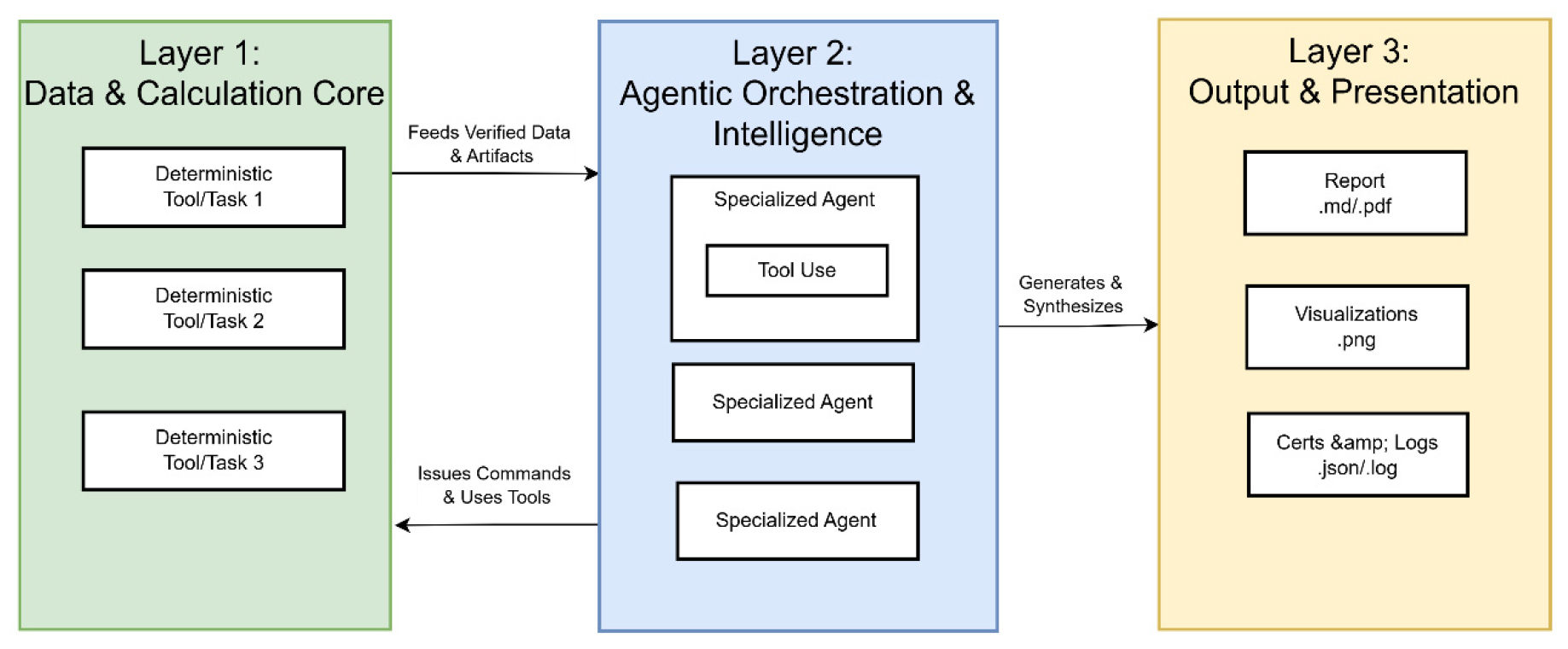
According to the first principle, a large language model isn’t permitted to generate numerical values; as such, it can be used for qualitative tasks such as analysis, narrative alignment, and interconnecting confirmed findings. This division has been driven by a pattern of failure where despite the models being seemingly competent, subtle quantitative errors such as minor slips in arithmetic, silent unit-conversion errors, and table-reading errors, all aggravated by realistic perturbations like reordered columns or changed table organization [81].
In addition, narrative hallucinations can still occur even when computation is outsourced, meaning a report may appear credible while quietly changing what the decomposition implies, and instruction-tuned models do not reliably remain correct on cases that seem easy to supervise [82]. The system therefore treats writing as a controlled interpretive layer that must be verifiable, and it prioritizes the ability to halt when a claim cannot be justified rather than optimizing for uninterrupted polished output [83].
Second, all calculations are carried out in a deterministic manner in the code. The LMDI equations and checks for consistency are coded in Python, which is embedded in the framework as an LLM tool, so the same inputs yield the same outputs, providing an anchor against probabilistic generation [43].
This methodology aids the needs of this study since it is possible to show how every number was derived through executable code, version control, and repeatability through executable code which results in proving the provenance of each numerical value, and thus, reproducible research [66]. Also, additive LMDI provides an identity closure, under which the observed emissions change has to correspond to the value of contributions of factors, making closure a small correctness property, and not a feature. This is through generating structured artefacts which include a decomposition table and machine-readable summaries, and then the validation that the summaries are identical to the table and closure is within a tolerance range; finally, the reporting layer is limited to certified artefacts but not to creation of new quantities.
The third principle requires the agents to use tools with all quantitative content. None of the agents can inject a numeric value, unless it is produced by a deterministic tool execution or read verbatim off a certified artefact, and this is a hard constraint that is imposed in the execution graph. In case of the absence of a valid tool output or approved artefact reference, the pipeline is a failure under a fail-closed policy. The design achieves this by conserving the boundary provided by the preceding two principles, removing a vast category of quantitative hallucination failures, and allowing a complete audit trail where any given reported number can be tracked to a particular tool executable, its inputs and its the validation result.
Proposed system Architecture and Trust Protocol
The proposed system is implemented as a hierarchical, multi-agent orchestration pipeline. At the top of the architecture is a centralized supervisor agent that sequences tasks and enforces gatekeeping protocols. Beneath this layer, a series of specialized agents, each equipped with tools executing discrete phases of the computation.
The target analytical method is the Logarithmic Mean Divisia Index (LMDI) decomposition. LMDI is used in energy and emissions studies because it supports “perfect decomposition” (i.e., no residual term) under appropriate conditions and provides consistent aggregation properties proposed by Ang [84]. These desirable mathematical properties also impose strict engineering requirements. If the computed factor effects do not reconcile with the observed change in emissions within floating point tolerance, then the inconsistency must originate from the data, the implementation, or the boundary conditions.
In this regard, the system is structured as a layer- based, gate-driven workflow which is a separation of deterministic computation and probabilistic text generation. A three-layer conceptual model is presented. In the bottom is an information and computational core which serves as the sole numeric authority. On top of it is an agentic orchestration and intelligence layer that synchronizes tools, authenticate artifacts and assemble evidence. An output and display layer at the top provides machine-readable logs, narrative reports, and visualizations.
This conceptual view is supplemented by Figure 2 which identifies the agents and tools (as well as shared artefacts) implementation by stating the implementation level graph. These two figures are not to be read independently since Figure 1 identifies the separation- of-concerns approach of the system, whereas Figure 2 identifies the operational interfaces to the system and its verification loops.
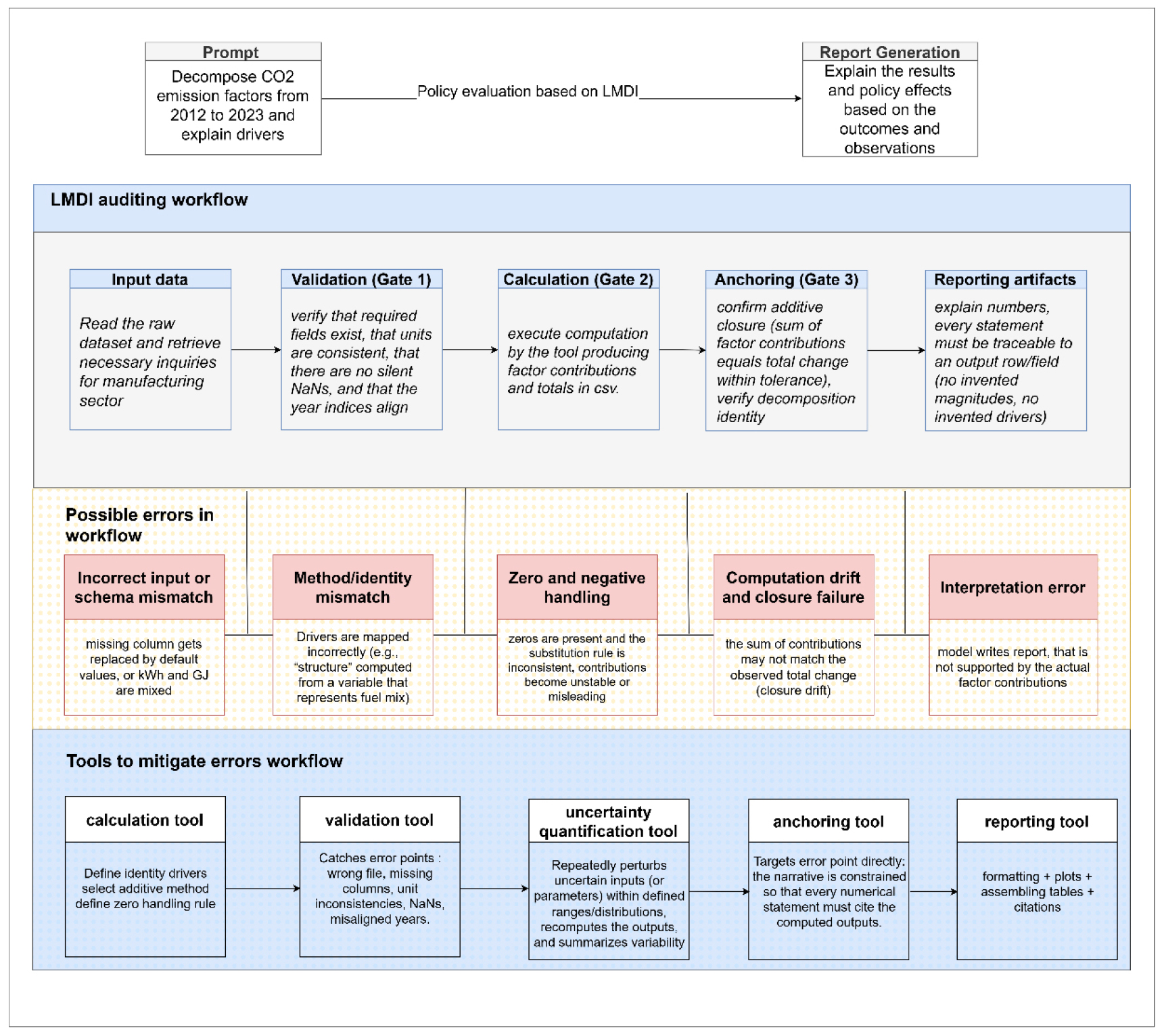
The execution of the pipeline takes place through an orchestrator, which sequentially schedules agents and logs all tool calls and outputs. There are gates applied at the end of each stage. Contrary to the conversational workflows, the orchestrator considers intermediate artifacts to be authoritative and immutable. Enforcement at the gate will make sure that a downstream stage does not go further in the absence or inconsistency of upstream evidence.
The Trust Protocol has three compulsory gates that make up the pipeline of the Input Validation (Gate 1), Deterministic LMDI Calculation (Gate 2), and Data Anchoring (Gate 3), each having an agent and the associated tool. The design of this, being orchestrated and artefact-driven, is so that all numerical computations are done by code and that all outputs are traceable to known inputs.
The first stage is an input validation agent which has the duty to cheque the integrity of the raw data. It does the schema cheques, and unit consistency, and enforces strict policies in the use of missing values and ensures that the data passed meets the requirements of decomposition, including the absence of negatives in the logarithmic operations.
The second step involves deterministic LMDI calculation. This can be done by a specific agent that calls a pure Python tool which calculates the additive LMDI formulas. At this point, a critical identity test is used which assumes that the sum of the worked-out effects should be equal to the observed overall change in emissions within a very small numerical tolerance.
The last phase imposes data anchoring in order to avoid narrative hallucination. The reporting agent cannot just create numerical values but has to make reference to particular ones which are taken out of the authorized output files created in the process of calculation. This limitation guarantees that all of the numeric claims that have been included in the final report can be traced to an established computational artefact. This design based on artefact may be reproducible as well as consistent with provenance thinking [85].
One important design decision is that the LLM can conduct tool executions and producing textual narrative but not approving progression between gates since it is not placed as some form of gatekeeper to numeric validity. This removes a circular dependency of trust whereby, the model would be requested to authenticate itself. Peer-inspecting style cheques are applied through secondary agents, which are limited to the same rules of anchoring.
The orchestration layer is the executive controller of the pipeline that maintains a verifiable operational log on a step by step basis, ensures the required sequence of gates and synchronizes the work between the agents and tools. It guides the inputs with schema validation, deterministic computation in the computational core and, finally anchors and post-hoc validates before producing any narrative output.
The orchestration layer is not authoritative by design as far as quantitative content is concerned. It does not compute or convert numerical values and adds new numbers into free text. Instead, each quantitative aspect is addressed individually. Rather, every quantitative content may only be put into the report with certified artefacts created by deterministic tools and passed through the gate cheques. Metadata is also captured in the orchestration layer of every artefact that underlies claims.
Mathematical foundations: additive LMDI identity
The additive LMDI identity We have created a new dataset on the manufacturing sector in Kyrgyzstan (20122023), containing national economic and energy data, which is fuel-specific consumption, production volumes, and purposely irrelevant variables, aimed at testing agentic data selection properties. Though the data is brought together at the national level of manufacturing, the industrial value added and energy consumption is concentrated in few urban and peri-urban areas. Therefore, the findings of the decomposition can be used as a proxy of the industrial fraction of the urban emissions in the main cities of Kyrgyzstan and can thus be directly applied directly to the planning of the smart city and smart urban development.
Based on the Kaya identity, we employed the Logarithmic Mean Divisia Index (LMDI) to disaggregate total emission changes (ΔCO2) into five additive determinants: (1) production scale (output volume variation), (2) economic structure (value- added-to-output ratio shifts), (3) energy intensity (energy consumption per unit output), (4) fuel mix composition (alterations in energy carrier shares), and (5) emission coefficients (fuel carbon intensity) [86].
Using a Kaya-type identity, total manufacturing CO2 emissions can be expressed multiplicatively as:
where is total CO2 emissions, is physical production output, GVA is gross value added, is total final energy use, is energy use of fuel , and is the emission factor of fuel . The terms correspond respectively to the Production Effect, Economic Efficiency Effect (GVA per unit output), Energy Intensity Effect (energy per unit GVA), Fuel Mix Effect (share of each fuel in total energy use), and Emission Factor Effect (carbon intensity of each fuel).
The additive LMDI decomposition of the change in emissions between year and is +1 :
where each subscript i denotes fuel type and calculation of each effect is conducted as follows:
Production effect:
Economic efficiency effect
Energy intensity effect
Fuel mix effect:
Emission factor effect:
and is the logarithmic mean. This formulation preserves the desirable properties of LMDI, including perfect decomposition and path independence. In other words, the identity is multiplicative in the level of emissions, but the decomposition is additive in the change between two periods. LMDI is favored for its theoretical consistency, path independence, and policy interpretability [87]. Its additive property is particularly valuable for policy analysis, providing quantified contributions of each factor to emission increases or reductions [88]. LMDI is primarily backward-looking, analyzing historical data to understand what drove past changes in emissions. However, it can also be adapted for predictive purposes when combined with other models.
Table 1 contains emission coefficients. Since there are no officially approved national emission coefficients in the Kyrgyz Republic, factors on coal, natural gas, and petroleum products are reconciled with the Tier 1 default values in the 2006 IPCC Guidelines to National Greenhouse Gas Inventories [89]. The coal coefficient is calibrated to reflect lignite properties that dominate the country’s energy mix, thereby representing the most carbon-intensive fuel in this assessment.
Table 1.
Fuel-Specific Emission Coefficients and Energy Content for Kyrgyzstan Manufacturing LMDI Analysis
Note: The emission factor for district heat is set to zero to avoid double counting. Primary fuel combustion emissions are attributed directly to coal, gas, and oil inputs in line with IPCC carbon mass balance principles. When heat is treated as a secondary energy carrier, this is standard practice in decomposition analysis (see Ang, 2015 [86]).
The electricity emission factor is estimated from the national generation mix which was characterized by a high share of hydropower—based on data from the IRENA Country Profile and the Kyrgyzstan Energy Balance [90]. This value is interpreted as an operational emissions intensity, excluding transmission losses and upstream or lifecycle impacts to represent the direct carbon content per unit of electricity consumed. The emission factor for district heat is intentionally set to zero, since heat is considered a secondary carrier of energy and all the resulting emissions are already classified as primary fuel combustion (coal, gas, oil). This method eliminates the possibility of counting the same number twice and maintaining the internal consistency of the carbon mass balance in the disintegration model.
Narrative Audit Protocol
The Narrative Audit Protocol is the protocol that provides an outline of the assessment of narrative output based on the evaluation of hallucination and overreach. It forms up a taxonomy of hallucination indicators, specifies acceptable related rules (tolerance limits and unit manipulation), and creates an oracle of numerical claims based on deterministic artefacts. Such audit procedures detect cases of hallucinations and misinterpretations in reports produced. The main premise is that the numeric decomposition is deterministic and it is performed by Python applications but the narrative layer, which is text produced by an LLM, is likely to be drifted, overinterpreted, and out of context. Thus, the protocol regards the problem of narrative reliability as an instance of traceability, where interpretive assertions may be connected either to validated computational artefacts which may be used as the oracle or to external sources through explicit citation.
Previous research on text-generation evaluation tends to focus on superficial similarity of a candidate and a reference that is convenient but cannot be used to make audit grade assertions. ROUGE makes formal correspondence to overlap-based evaluation and it is still an established baseline for comparisons of the summarization-style [91].
This paper, on the contrary, must not only have a similarity, but fidelity to certain proven quantities. This focus is consistent with findings of a body of factuality research on summarization that neural generators are capable of fluent text generation that is unfaithful of the source [26]. It is as well compatible to data-to-document research where fluent generation and faithful reproduction of underlying records are differentiated, thus providing motivation to explicitly examine record grounding. The audit applies an oracle to represent the deterministic LMDI results (e.g., cumulative totals and per-period factor contributions).
The oracle is constructed from the canonical artifacts produced by deterministic computation: the normalized dataset snapshot, the results CSV, and derived plots. Numeric truth is defined as exact equality to artifact values (or equality within a declared tolerance after unit normalization). This oracle does not claim that the dataset is perfect; it asserts that, given the dataset and deterministic tool, the system must not deviate from the computed outputs. Data-quality assumptions are therefore explicitly enumerated (e.g., completeness of required fields, unit correctness).
The audit uses an oracle as a reference representation of the deterministic LMDI results (e.g., per-period factor contributions and cumulative totals). The oracle characterizes admissible numeric space of ΔCO2 and factor impacts within known units and tolerances.
This design consists of conservative audit philosophy where the main risk in the narrative verification is not the loss of the stylistic variety, it is the acceptance of the untraceable claims. The oracle artefacts are listed in the attachment.
The accuracy of the oracle is conditional according to the quality of input data (garbage in, garbage out). This reliance is not discussed as a drawback of the protocol since the oracle can only facilitate narrative verification to the extent that the upstream data is accurate, consistent and fit-the-purpose as underlined in traditional information-quality models.
To minimize false positives, as well as to keep the anchoring gate feasible to compute, numeric matching rules are specified. The policy that can be used is defined as an e tolerance of floating-point roundoff, allowable unit conversions like Mt to kt or ktoe to GJ, a rule to maintain a consistent roundoff policy on displayed tables like three decimal places, and sign-preservation policies on effects of decomposition. The matching of an oracle value under such rules to a claim makes it pass, although it must also contain an explicit reference to the artefact to which it applies. Since narrative text can represent the same number in various scales, numeric tokens extracted are normalized to a canonical unit, e.g. tones, and then are matched against oracle. Types of experimental: deterministic, hybrid and agentic pipelines.
Experimental modes: deterministic, hybrid, and agentic pipelines
The assessment contrasts three of the modes that separate the point of delusion introduction in the workflow. Deterministic mode is the mode that generates the numeric oracle. The hybrid mode is an application that uses an LLM to generate narrative when the outputs are deterministic and no gates are strict. The agentic mode uses the complete Trust Protocol, specialization and validation gates. A comparison between these modes will show whether the reduction of hallucination comes as an architectural or domain generation process.
Mode A (Deterministic baseline) runs the entire analysis in Python: validation checks, LMDI calculation, tables, and figures. Narrative is either absent or written manually by the specialist outside the system. Mode A establishes the numeric ground truth under the chosen identity and parameters.
Mode B (Hybrid mode) uses Python for calculation and an LLM for narrative drafting. The LLM receives deterministic outputs as context and writes academic text. Mode B reflects common practice in AI-assisted writing, but it is vulnerable to numeric hallucination and misquoting because constraints are mainly instructional rather than enforced.
Mode C (Agentic mode) is the proposed architecture, including a multi-agent pipeline with gates, anchoring, and internal review. Mode C enforces that all numeric claims are grounded in deterministic artifacts and checks protocol adherence mechanically. The key outcome of interest is not different numbers; it is improved auditability and reduced incidence of unanchored numeric claims.
Method 1: Traditional LMDI Calculation Python Implementation
The first approach corresponds to a conventional workflow that an energy analyst would implement in Python to perform additive LMDI decomposition. Figure 3 schematically presents this process. The analysis begins by loading the dataset (e.g., a CSV file with annual observations of manufacturing output and fuel-specific energy use), which in our case was obtained from the national statistical authority via formal data request.
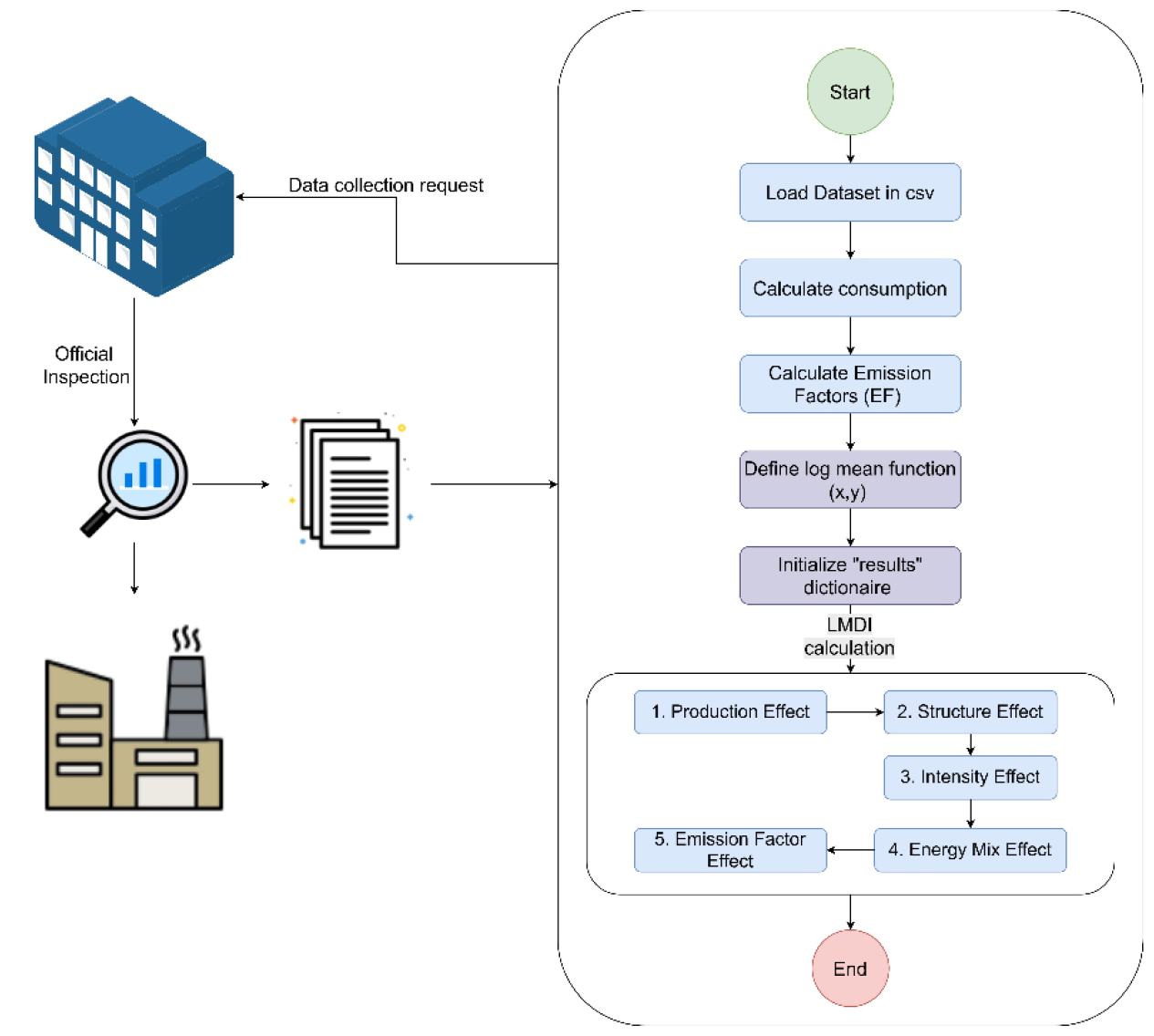
In a second step, the script derives intermediate variables that are not directly reported. From the raw series on energy use by fuel and total output, it computes total final energy consumption, fuel shares, and verifies the emission factors and net calorific values for each fuel based on the 2006 IPCC Guidelines [89]. A log-mean function is defined in the code to implement the logarithmic mean for any pair of values and . Data structures (Pandas DataFrames) are then initialized to store the decomposition results for each year.
The core of the program is a loop over the analysis period (2012-2023), in which the standard LMDI formulas are applied to obtain annual production, economic activity, intensity, fuel-mix, and emission- factor effects. After iterating overall years, the script also computes the cumulative change between 2012 and 2023 and checks that the sum of yearly effects matches the single-period decomposition, thereby confirming the additive LMDI identity. The outputs of this Python-based method are purely numerical: a table reporting, for each year, the factor effects and total change in CO2 emissions.
Method 2: Hybrid Python + LLM Interpretation
The second approach implements a hybrid workflow in which the Python-based LMDI code remains the core computational engine, while a large language model (LLM) is used to generate explanations and policy-relevant insights. The process is as shown in Figure 4. All procedures up to the decomposition phase are like traditional approaches: the data is loaded, the LMDI factor contributions are computed on an annual basis with Python, and provide the production, structure, intensity, energy-mix, emissions factor effects, and cumulative change of CO2 in numbers.
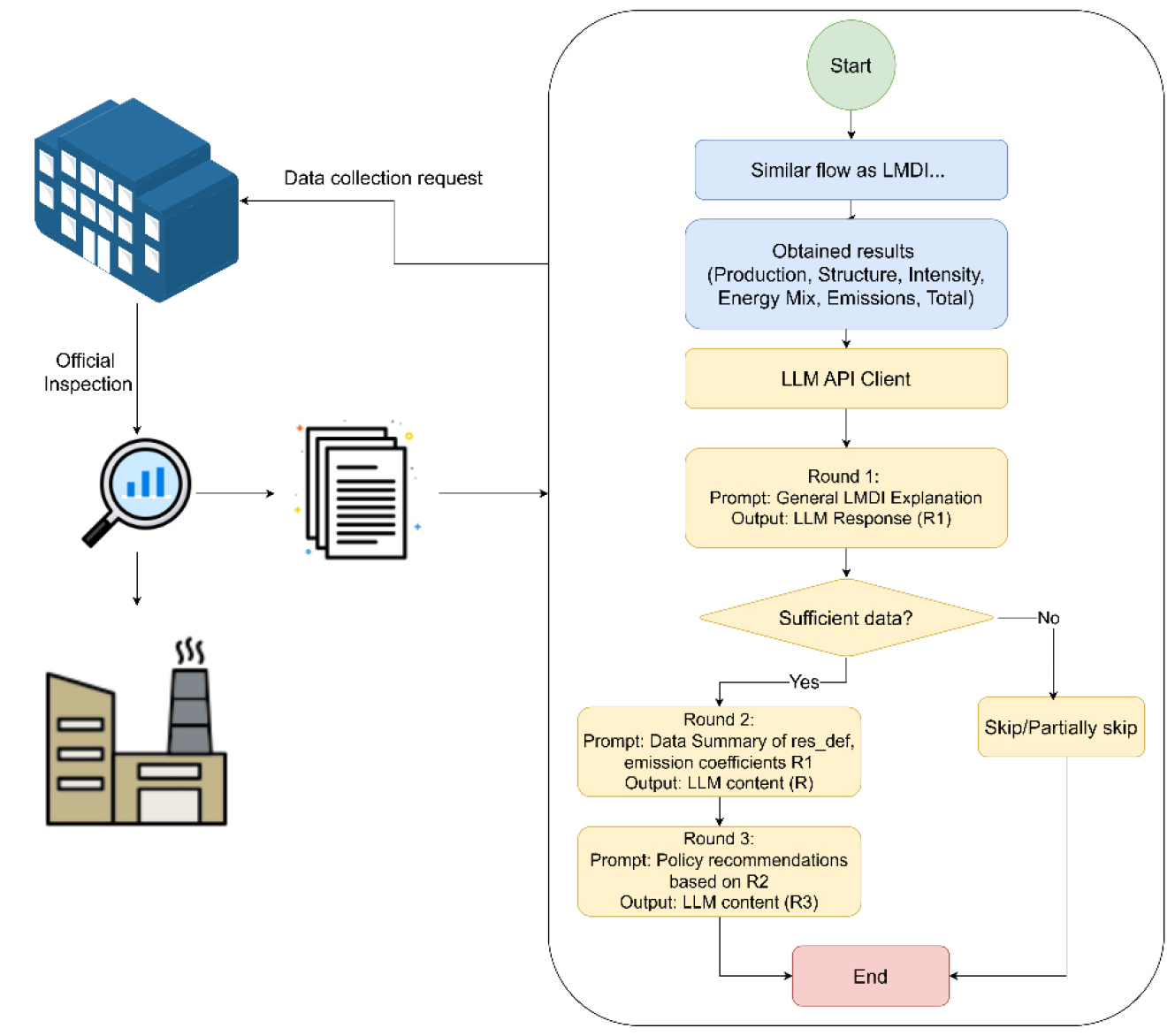
These numerical results are then passed to an LLM through a local API client and processed using a sequence of prompts to produce interpretive text. In our implementation, we employ the Deepseek model. In this Hybrid mode there is only one LLM prompted sequentially in three prompt rounds (methodology → results → policy). Table 2 summarizes the three prompt roles and their core instructions.
Table 2.
Prompt roles and core instructions in the hybrid LLM workflow
Each round can be viewed as a virtual “agent” with a distinct role and prompt template. In the first round the model provides structured explanation of the five- factor LMDI framework (production, economic efficiency, intensity, fuel mix, emission factor) for the manufacturing sector over 2012-2023.
The model is also trained using the CSV generated summary statistics and the last year of data in the second round, organizing key drivers, common periods, and the pattern of fuel-mix in varying ways.
The third round is a policy-level conversation, where the model, as an expert in energy policy, determines the effectiveness of the Kyrgyzstan 2015-2017 interventions in terms of energy efficiency and suggests priorities in decarbonizing the sectors. Each of the prompts clearly asks the LLM to base on LMDI factors and summary tables created by the Python in order to reduce the risk of making unreasonable statements.
Method 3:Mulit-agent AI execution
The third approach is applied as a modular multi- agent system based on the CrewAI framework [92], where several agents based on the LLM autonomously handle each phase of the LMDI analysis.
As presented in Figure 5, the system is structured in role-based agents having well-defined inputs, tools and outputs. The Data Retrieval Agent simulates access to a national statistics site via loading the manufacturing energy and output data to an online data warehouse, in which a future reporting regime will encompass the firms reporting the standardized consumption and production data to a common repository. This agent loads the corresponding series into a database-query tool and transfers them to the Preprocessing Agent which converts the raw records into the variables needed to do the decomposition including energy use by fuel, emission factors, and derived quantities.
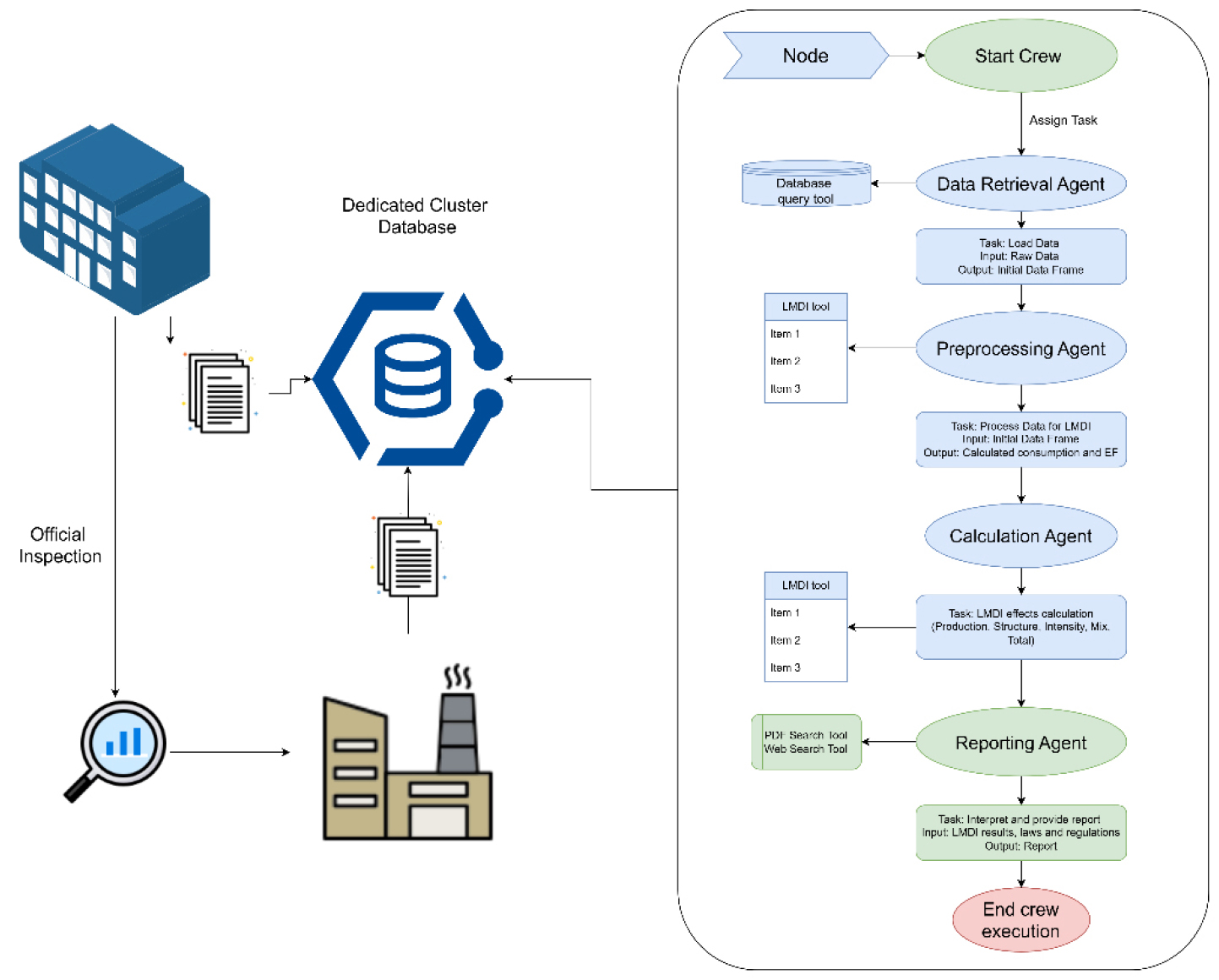
The Calculation Agent further calculates the annual production, structural, intensity, fuel-mix, and emission-factor effects and the overall change in emissions using the LMDI formulas, which are coded as a special tool. These numeric outputs are passed to the Reporting Agent which can access shared memory and accessed context and produces an interpretation report of the decomposition results to the applicable policies, regulations and relevant contextual data.
DeepSeek model is used by each agent through API calls. The approach allows agents to scan complex analytical processes and user specifications more intuitively and personification is accomplished by advanced prompt engineering alongside contextual memory storage.
This mechanism enables agents to navigate complex analytical workflows and user specifications more intuitively, with personification achieved through sophisticated prompt engineering and contextual memory retention. As an illustration, the design of LLM prompts by defined agent characters like an analyst or researcher makes the AI system bias the generation of more contextually relevant and methodologically complementary insights [30].
There are two outputs of the agentic workflow: (i) numeric decomposition output of the Calculation Agent (ii) a narrative analytical report output of the Reporting Agent. To compare this method with the conventional and hybrid, regarding the accuracy appraisal and similarity of the results, we focus on the numeric results. To guarantee an equal comparison and to avoid the possibility of fake computations, all agents were bound with right LMDI formulas, tested on a test dataset, and given with certain data processing and computing tools, although left to act independently in the IDE environment.
Trust Protocol maintains data quality by using data-validation agents and bias-detection agents which ensures that the schema is consistent, decomposed and that the AI model is impartial. An agent of uncertainty-quantification is responsible for performing Monte Carlo simulations in order to derive honesty regarding uncertainty, and there exists a peer-review agent who does not take into account the evidence put forth. A reporting analyst agent then reorganizes these mediating artefacts into reportable context and visual products. These intermediate artifacts are then reframed into structured narratives and graphical outputs by a reporting analyst agent. Lastly, real time monitoring agent will be used to monitor the pipeline execution and closure to produce monitoring logs and final pipeline reports.
Results and Discussions
Quantitative Comparison, Mathematical Accuracy
Results of the three experiments can be found: (E1) reproduction of insight proof-of-concept; (E2) results of the hallucination; (E3) completion of the workflow and trace overhead.
There are four complementary measures used. Mean Absolute Error (MAE) and Root Mean Square Error (RMSE) provide a numerical measurement of numerical deviation, scale-independent variance is given by Mean Absolute Percentage Error (MAPE), and consensus within the entire time-series profile is given by the Intraclass Correlation Coefficient (ICC). A non-zero residual indicates an arithmetic drift due to the misuse of tools, errors in data-mapping or errors in formula implementation.
The first experiment discusses mathematical similarity of workflows. Even the small arithmetic inaccuracies in environmental decomposition can derail the proper driver attribution and later interpretation of policies. Even computations of the additive LMDI measure up to the theoretical requirement of perfect decomposition (zero residual), when deterministic and consistent computations are used. Hence, numerical precision is looked on as a rigorous condition in the analysis: the multi agent system should recreate the deterministic baseline with machine accuracy at the level of sums of drivers and cumulative balances.
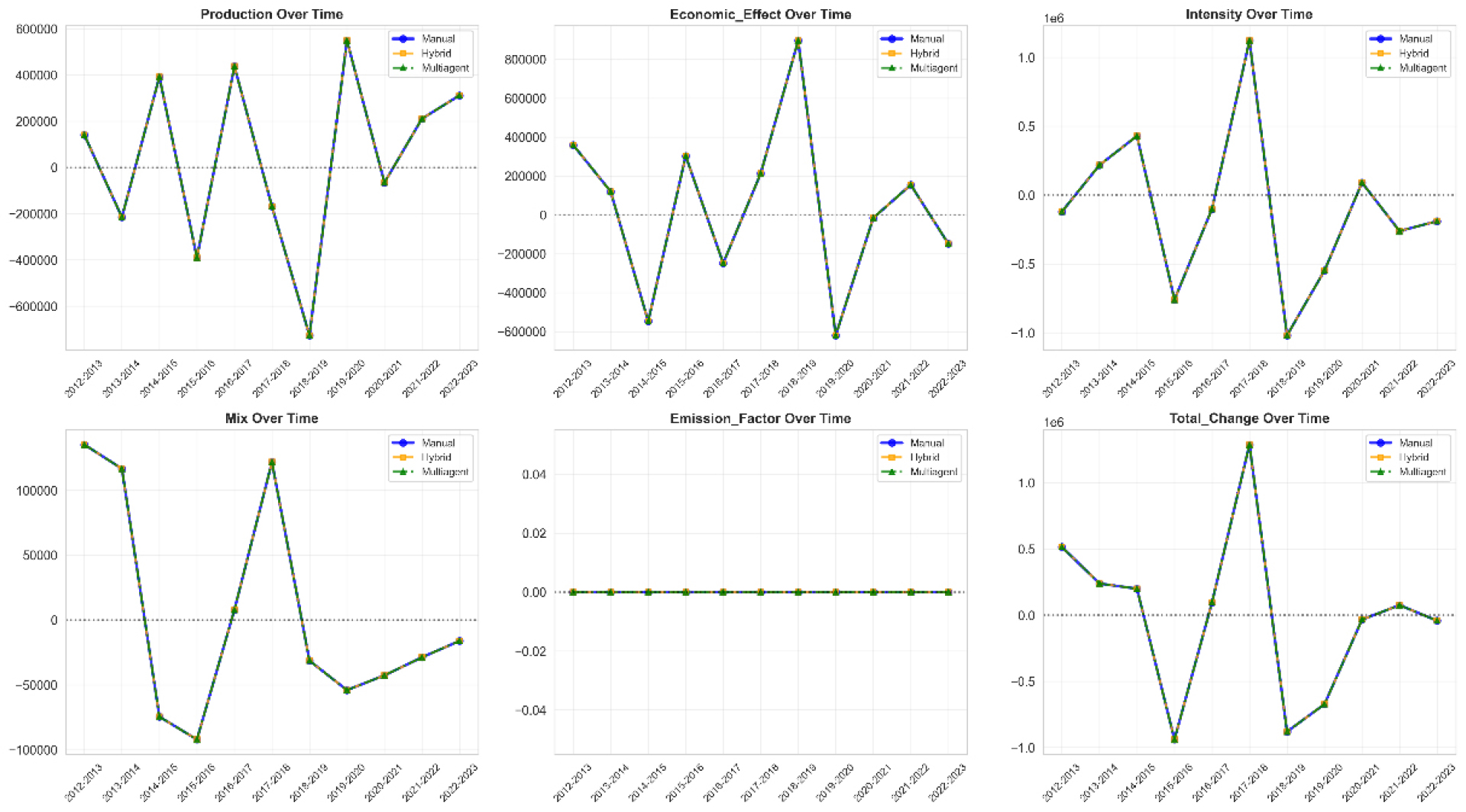
As can be seen in Table 3 and Figure 6, the multi-agent workflow was numerically identical to the deterministic baseline over the entire period of 2012-2023. As would be expected, the deterministic baseline and the multi-agent workflow coincide in that all numeric values have a common origin i.e. the same deterministic artefacts and do not get lost in the oracle API transaction. This gives support to the fact that the protocol does not reduce the numeric accuracy even though it implements a layer of orchestration and validation.
Table 3.
Numerical equivalence between workflows (summary metrics)
The hybrid workflow has a non-zero MAE (0.0023 Mt CO2). Such deviations are not acceptable in any audit environment notwithstanding the fact that they are numerically insignificant, but when they occur, they might be hard to spot in large reports and when they are discovered they can be misunderstood as substantive differences. As can be inspected, the deviations are most prominent in restatement, where after the model has summarized the results, subsequent sections of the narrative rewrite the results and reformat numbers in some other cases. A model can also regenerate a lost value based on memory or approximate it to make it easier to read even where the original tool output is available in context.
In the Trust Protocol, such events are converted into explicit failures. The validator either rejects the draft or forces the writer to reinsert the correct value from Ω. In effect, the system treats numbers like code constants: they may be referenced but not rewritten.
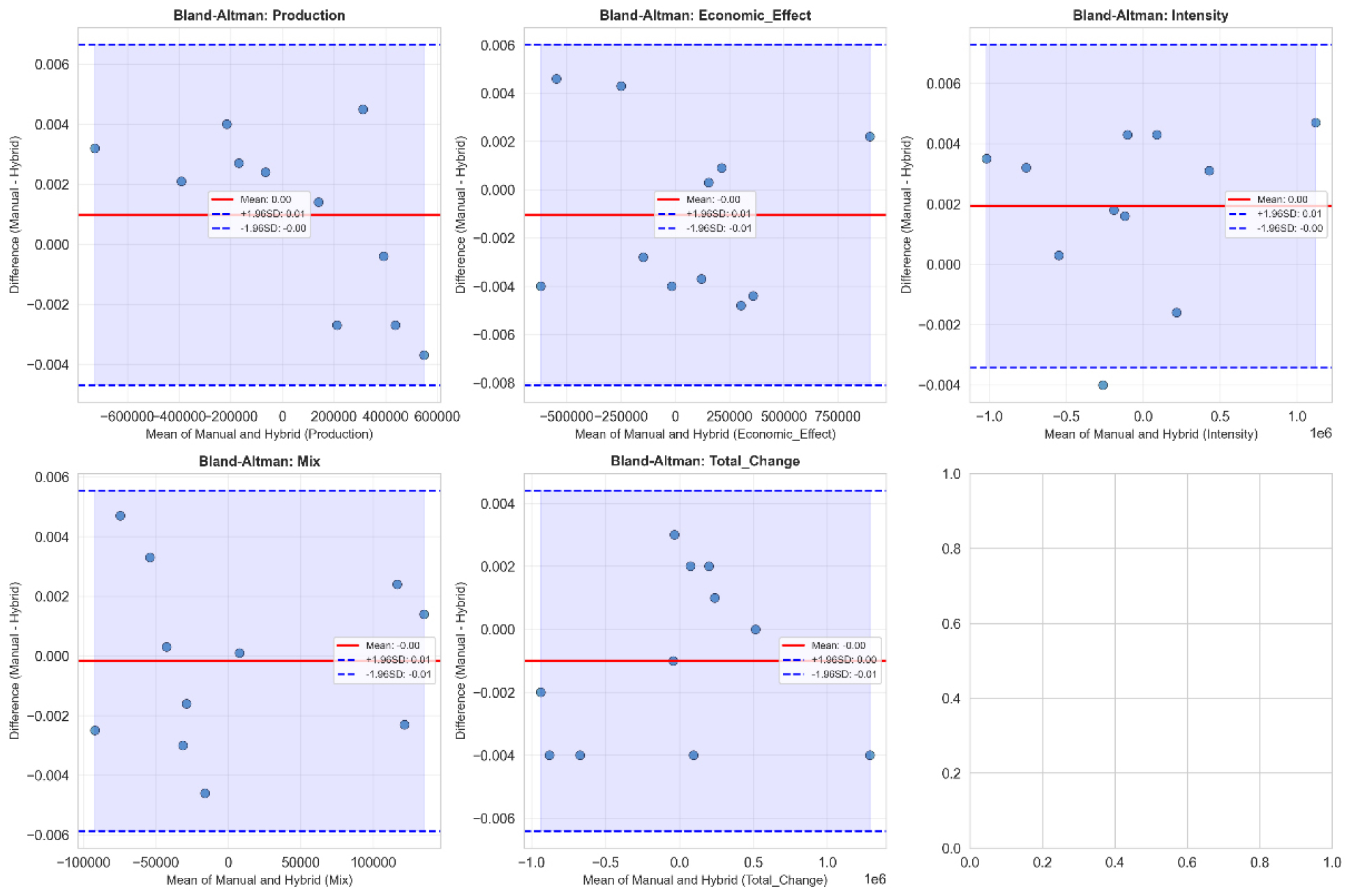
A Bland-Altman analysis (Figure 7) was conducted to visually inspect the differences between manual and hybrid calculations for any systematic bias or heteroscedasticity. In Bland-Altman plots (difference vs. mean of each pair of measurements for each factor), the points for all factors were tightly clustered around zero difference. The mean difference (manual minus hybrid) for each factor was essentially zero (on the order of 10-3), and the 95% limits of agreement were very narrow relative to the factor magnitudes, entirely within a ±0.01 Mt band for all factors.
Qualitative analysis and hallucinations
The second experiment is used to measure interpretive reliability, which is concerned with the plausibility bias of an unconstrained LLM to create plausible, but unsubstantiated explanations. In this paper, a hallucination is defined as a textual statement that (i) asserts a specific factual claim about the data, the model outputs, or the real-world context, but (ii) cannot be traced to the dataset, the computed outputs, or a verifiable external source. Hallucination is a well-known and well-documented failure mode in neural generation systems and remains a central challenge for deploying LLMs in high-stakes analytical settings.
Hallucination outcomes of presented in Table 4. The hybrid workflow produced interpretive inconsistencies when the analysis was extended beyond direct numeric summarization. A representative failure pattern makes the pattern of failure arrive at an incorrect report that energy intensity has a large negative impact on emissions change, but subsequently provides an explanation, such as slowdown in the economy or tightening in policies, although these ideas are not supported by evidence found in the artefacts. The outcomes of decomposition are descriptive and hence, these explanations to contexts cannot be justified by simply computing them.
Table 4.
Hallucination outcomes by workflow (qualitative coding)
The multi-agent workflow helps to overcome these failures by combining three mechanisms. Workflow is based on closed-failure policy where the validation checks fail, all numbers are allowed to have oracle- verified values, and a peer-review step is used to ensure that any external context is justified by citation. The reviewer phase has also been shown to serve a vital social purpose of imposing the rule that the boundaries of uncertainty and exegeses should be clearly spelt, which in turn yield plots that are more cautious and, thus, more believable.
There is an apparent difference in verbosity in the results of profiling shown in Table 5. The hybrid report contains many more (3433 words, 206 sentences) words than the multi-agent report (1252 words, 65 sentences). This indicates that the hybrid method generates a more expansive narrative that is closer to an explanatory tutorial style, while the multi-agent method produces a more compact synthesis.
Table 5.
Structural and lexical profile comparison between the multi-agent report and hybrid report
Although the multi-agent report is shorter, it has a greater lexical diversity (TTR=0.395) compared to the hybrid report (TTR=0.273) as illustrated in Table 5. An increased type-token ratio indicates that the multi-agent narrative is probably of the kind which uses a more diverse conceptual vocabulary per text unit, though this is the influence of role specialization (e.g., a calculation-oriented agent versus a reporting agent) which diminishes redundant paraphrasing. The lower TTR of the hybrid model, on the contrary, corresponds to a longer, more repetitive explanatory mode, in which the definitions and framing are repeated in different parts.
Similarity metrics in Table 6 indicate that there is a distinction between such overlaps as observed on the surface and such overlap as is based on meaning. The cosine similarity of TF-IDF (0.651) demonstrates a moderate degree of lexical convergence.
Table 6.
Semantic and syntactic similarity analysis between the multi-agent report and hybrid report
This demonstrates that the two reports underline several terms with high significance (e.g., intensity effect, production effect, fuel mix, total change), as one would likely anticipate since they summarize the same decomposition outputs.
Classic information retrieval metrics (ROUGE) penalize lexical diversity, whereas deep semantic embeddings reward conceptual fidelity. ROUGE-L F1 (0.117) shows that the direct phrase or sequence overlap is low meaning that the two reports are not using the same sentence structures and longer wording and are therefore truly paraphrasing each other rather than redundancy which is copy-like.
The placement of the cosine similarity (0.840) shows that the degree of semantic compatibility is high. These reports vary in style and length; however, both present strikingly consistent conceptual results in terms of dominance of intensity related gains, the attenuating impact of production and structural effects and the relatively minor impact of fuel-mix differences.
The balance in the moderate TF-IDF scores, low ROUGE scores, and high similarity of the embedding are mainly explained by the statement that the multi-agent system is not a compacted version of the hybrid narrative. Instead, it seems to be a syntactically matching but best-formatted synthesis that is able to preserve central meaning and remove the redundancies that are intrinsic to single-LLM explanatory products.
In Table 7 the hybrid system produced a longer narrative (114 sentences) than the multi-agent system (39 sentences). The hybrid report also contained more interpretation sentences in absolute terms (65 vs. 29). As a proportion of total sentences, interpretation content comprised 57.0% of the hybrid narrative (65/114) and 74.4% of the multi-agent narrative (29/39), indicating higher interpretive density in the multi-agent output despite its shorter length.
Table 7.
Narrative-audit summary
| System | Sentences | Interpretation sentences | Anchored interpretations | Anchored rate | Total flags |
| Multi-agent | 39 | 29 | 3 | 0.103 | 82 |
| Hybrid | 114 | 65 | 5 | 0.077 | 111 |
Thus, analyzing the ratio of the interpretive content, the multi-agent system devotes a greater percentage of its output to analytical assertions than the hybrid one. It means that the hybrid system produces more content in general, but the multi-agent system creates an analytically denser narrative with each unit of the text.
Anchored interpretations were defined as interpretation sentences containing a factor term and at least one numeric reference matching the oracle within tolerance. Using this definition, the multi-agent report had an anchored interpretation rate of 10.3% (3/29) as compared to 7.7% (5/65) of the hybrid report.
This difference is directionally consistent with the design objective of the multi-agent pipeline, which aims at imposing numeric gates. It can be said that either system can adopt oracle-matching figures, due to deterministic tool outputs being integrated into the narrative.
In addition, the percentage of statements of analysis that are supported by evidence has risen by 34 percent as an effect of the improved multi-agent anchor rate. This observation implies that the multi-agent architecture uses stronger validation or checking procedures and therefore increases the barricade to the claims of understandings that are not directly connected to empirical associations.
The systems also diverged in their propensity to flag potential issues. In total the hybrid report produced 111 total flags, compared to 82 for the multi-agent report. This higher flag count aligns with the hybrid system’s generally more expansive output.
The relationship between flagging and interpretation also differed between systems and can be seen in Table 8. The numeric mismatch flags were similar in magnitude (53 hybrid vs. 50 multi-agent), while the largest difference occurred for unanchored interpretation (52 hybrid vs. 25 multi-agent). Contextually, uncited flags were comparable (6 hybrid vs. 7 multi-agent). These results indicate that under the current audit heuristics, the primary divergence between systems lies in the prevalence of interpretive sentences not locally supported by oracle-matching numeric evidence.
Table 8.
Flag counts by type (lower is better)
| Flag type | Multi-agent | Hybrid |
| Numeric mismatch | 50 | 53 |
| Unanchored interpretation | 25 | 52 |
| Context uncited | 7 | 6 |
Table 9 below presents representative examples of the hybrid narrative patterns that triggered audit flags to complement the aggregate audit metrics reported the flag-type distribution in Table 8.
Table 9.
Illustrative hybrid narrative issues detected by the audit (examples from comparison with oracle)
These examples are not intended to claim that the hybrid report has numeric inaccuracies in its deterministic computation but to illustrate the capability of narrative generation to add statements which are hard to verify by an audit-grade provenance requirement. The sentence level flag in this assessment is used to imply that a claim can be not locally verified against the oracle based on the definitions of the narrative audit protocol. Therefore, the term flagged does not imply falsity, but signals a greater load of verification, since the supporting evidence is inaccessible, scattered, undocumented or represented by derived quantities which are not identified to be a part of the permitted provenance space.
Even though the deterministic LMDI outcome is universal between pipelines, the hybrid text has (i) derived articulated arithmetic written in prose and (ii) contextual statements that lack anchors or references, which further increases audit risk. Thus, the multi-agent architecture isn’t actually about making arithmetic more efficient in a broad sense. It’s more about tightening the source and keeping the interpretation centered in what the data truly shows.
The hybrid pipeline gave several unsupported explanatory statements. In particular, single-LLM reports drew invalid conclusions about economic phenomena and had the alleged claim that this or that macroeconomic shock or reform had a direct effect on observed changes in manufacturing emissions in particular years. The dataset did not support these claims, and, thus, they were not cited in the input to the report. That is, the model made a compelling narrative that allowed the data to be related to external contexts when the context expanded beyond the available information. This observation can be attributed to the results of surveys that show that LLMs can generate believable, but not factual context, particularly when asked to elaborate on their answers.
The anchoring of performance in multi-agent reports
Reporting in multi-agent mode did not reveal hallucinated numeric statements or unsubstantiated economic-event-statements. Numeric fabrication was alleviated through the anchoring process by limiting all numeric statements to a predetermined scaffold based on deterministic productions. It also inhibited explanatory hallucination by making sure that the narrative agent references only material which is manifested in the run artefacts and goes ahead with validation warnings and uncertainty notes.
The report can therefore still consider possible interpretations, but must do so comprehensively, and with accuracy differentiating what the decomposition is able to say and what cannot be determined by the system.
The result supports the dissertation’s claim that anchoring is not a stylistic choice but a safety mechanism. Without anchoring, a model can still be prompted to “be careful,” but surveys show that instruction alone does not eliminate. Anchoring changes the system’s affordances: it makes fabrication detectable and therefore preventable.
This metric is the core quantitative measure of narrative reliability (grounding or faithfulness). It directly answers the question: When the report makes an interpretive or causal claim about the LMDI decomposition results, how often does it back that claim with an actual number that matches the verified (oracle) data?
Interpretation sentences that go beyond pure description and contain interpretive language (e.g., words like “driven by”, “dominant”, “primarily due to”, “mitigated by”, “indicates”, “reflects”) or discuss the decomposition factors (Production, Economic, Intensity, Fuel Mix). An interpretation sentence is counted as “anchored” only if it contains both a reference to one of the decomposition factors, and at least one numeric value in the same sentence that matches the deterministic oracle (after unit conversion, e.g., 475,091 tones ≈ 0.475 Mt, and minor rounding tolerance).
The results of narrative metrics comparing multi- agent and hybrid reports are given below in Table 10 and show overall sentence counts, interpretation sentences, anchoring performance, and total flags.
Table 10.
Narrative Audit Summary Metrics Comparing Multi-Agent and Hybrid Reports
Multi-agent report (14.3%): out of 42 sentences that made interpretive claims about the drivers of emissions change, 6 of them (≈1 in 7) explicitly tied the claim to a correct oracle number in the same sentence. Example of an anchored sentence:
“The intensity effect was the primary mitigating factor, contributing -1.141 Mt CO2 over the period.”
Hybrid report (2.5%): Out of 79 interpretive sentences, only 2 included a matching oracle number in the same sentence. Example of interpretive claims floated without immediate numeric evidence, e.g.:
“Energy intensity improvements played a key role in reducing emissions” (no specific quantity given in the sentence and counted as unanchored).
There are more than five times higher chances that the multi-agent report will base its interpretative utterances on verifiable numbers. This good result shows that systematic delegation among specialized agents is an efficient inbuilt restriction against interpretative shift. This strong performance of the multi-agent workflow shows that structured delegation across specialized agents acts as an effective built-in constraint against interpretive drift. Even though both reports had the same correct LMDI numbers, the multi-agent version was very disciplined on the ability to directly associate causal interpretive language with the numbers.
On the other hand, the more narrative-based and longer hybrid report presented many interpretive claims but rarely gave the matching numerical figures in the same sentence, thus maximizing the chances of exaggeration or misrepresentation. The largest difference is the fact that the hybrid report generates two times as many unsupported interpretive assertions (without numerical support) (33 and 63).
This measure is an empirical measure that the multi-agent system can be set to generate more scientifically informed narratives as compared to the less complex or monolithic LLM-based reporting chains. Multi-agent architectures that have sufficient validation and review layers produce high-quality and more trustworthy narratives than both monolithic and hybrid LLM chains despite both probably operating based on the same underlying computations.
The Trust Protocol causes a high operation overhead due to the inclusion of cheques, review steps, and the required artefact generation. Table 11 demonstrates it by providing sample traces where more spans indicate explicit activities like token validation activities and revision loops. Audit wise, this overhead is not just an expense but an investment in traceability, the spans and validation results are documented to give the evidence needed by the third party to review. When it involves high responsibility, it is not speed that should be compared with latency but rather unconstrained narrative generation and conservative, verifiable narrative production.
Table 11.
Metrical comparison of two workflow execution traces
A practical implication is that organizations should plan and budget for reliability. When a reporting task is used for compliance or funding decisions, the additional time and marginal cost are small compared with the downstream risk of publishing an incorrect report.
Proof-of-concept insight reproduction
The last experiment investigates whether the gated workflow can produce policy-relevant narrative without losing the verbatim results of the verified decomposition outputs. It is not aimed at purporting the new environmental outcome but at certifying that the system can recreate the driver hierarchy and annual-to-annual change depicted by the deterministic calculation without having to characterize unsupported clarifications. The evidence of the concept is aimed at the major driver that was determined by the decomposition, especially whether the energy intensity was the predominant factor that minimized emissions during the implementation of the Energy Efficiency Program of 2015-2017 by the Government of Kyrgyz Republic [93]. This is a validation that the system retrieves the same driver structure as the deterministic analysis and presents it in a policy-ready format without hallucinations rather than a new econometric claim.
The proof of concept is defined by a constraint that the narrative must reproduce the same dominant factor ordering as the deterministic decomposition. If the deterministic results identify energy intensity as the primary reducing factor over the study horizon, the report must state this and must not attribute the reduction to unrelated macro events unless those explanations are explicitly supported by citation.
The multi-agent workflow creates a context that would match Table 12. It also identifies areas where intensity effect is dominant, explains increases when there is a positive change in the emissions and does not provide causal explanations. Although the economic component is negative and it counteracts the growth in production, the text is purely descriptive showing that the economic component decreased at that point in time as opposed to assuming external factors.
Table 12.
Short explanation from the report of multi-agent system
While the economic component is negative and counteracts production growth, the text stays descriptive, indicating that the economic component reduces from that time rather than hypothesizing about external factors.
This reflects the desired result of the Trust Protocol, which is a report that can be discussed at policy level as it summarizes the accounting outputs in a faithful way but it is also careful on unsubstantiated claims.
The protocol’s safety profile relies on iterative correction loops with deterministic checkpoints rather than attempting to generate a flawless report in a single pass. This reflects audit practice where draughts are acceptable if there is a process that is specified of how to identify and rectify mistakes before publicizing. Similar is the case with contextual hallucination. When the writer provides an explanation like it is possible that a decline is a recession, the reviewer will recognize it as an external context which is not cited in the book. The writing gets later corrected with a citation added in case there is evidence or the speculative part is eliminated and the narrative reduced to the artefacts. Practically, this process is more likely to be drawn to conservative, evidence- based writing.
Anchoring also drives corrections for numeric precision. A hybrid draft may state that emissions decreased by 0.94 Mt in 2015 to 2016 due to efficiency improvements, even though the artifact value is negative 0.939 Mt and the intensity contribution is negative 0.760 Mt. Under Gate 3, the validator extracts the token 0.94 and attempts to match it to the oracle for the correct period and unit. Because the sign is missing, the token becomes ambiguous and fails anchoring, and the validator returns a failure record that identifies the sentence, the extracted token, and the closest oracle candidates.
The writing agent then edits the sentence with anchored additions, i.e. saying that total emissions changed by negative 0.939 Mt in 2015 to 2016 with the intensity effect contributing negative 0.760 Mt. Since these values are inserted directly from the oracle, the revision remains consistent with the artifacts and with the identity check for that period.
In addition to the ability to correct errors, the certificate-workflow also promotes communication among the stakeholders because each claim can be traced. The analysts are able to use an artefact identifier and a given CSV entry instead of having to rebuild the reasoning in their memory. This is especially significant when it comes to the sustainability policy when the parties can disagree on the emission factors, accounting limits, or definitions of sectors. Such disagreements are not resolved through the protocol but made clear and reviewable by focusing on inputs and assumptions and not on the accuracy of transcription.
Anchoring also eliminates intra-sectional contradictions. When substantial reports are involved, the same amount may be referenced in different sections of the findings, discussion, and executive summary, and hybrid drafting can cause minor contradictions between the two. The report is internally consistent in case the same oracle provides all the numbers; hence, the executive summary cannot report a different total change to the results section.
Finally, anchored reporting affects drafting incentives in a way that encourages more analytical integrity. The freedom of unrestricted writing may result in the presentation of inconsistent year-on-year patterns into a raw setting that is linguistically appealing but potentially deceiving. Instead, anchoring facilitates a narrative that values variation, hence, making sure that high and low values are presented as they arise in the authenticated results instead of lumping them in a single direction.
Presentation of verified patterns within a policy- relevant frame is also shown in the proof of concept of the system nor making any claim of causal attribution other than what the evidence provides. The report writes about the years 2015 to 2017 as a time with a significantly negative contribution of the intensity and correlates this trend with the Energy Efficiency Program in Kyrgyzstan [94]. This association is not put forward as a causal econometric finding but as an interpretation of the decomposition findings. The difference is significant since in audit scenarios, it is not necessary to create new causal stories but to make sure that any narrative is anchored to computed driver signals and that the contextualization of any outside source is backed by an explicit reference.
Smart city and urban development implications
The empirical results in this paper prove that the multi-agent architecture of the Trust Protocol with the suggested approach to the quality of qualitative reporting significantly outperforms a hybrid single- agent baseline. The Trust Protocol is optimistic on safety with a systematic overhead, such as role specialization, validation gates which are mandatory, and anchored reporting. Such mechanisms highly minimize the probability that ungrounded or internally inconsistent outputs are ever passed to the final report, at the expense of increased orchestration latency, increased token usage, and sometimes fail and closed halts which must be fixed by human intervention.
This trade-off of a retrospective audit environment is not merely acceptable, but even desirable, since the cost of undetected mistakes, such as misattributed effects, or fraudulent statements of compliance with regulations, is greater than the incremental cost of computation, it is preferable to raise uncertainty than to generate a fluent but unverifiable report.
The reliability need imposes the latency which could be stated in terms of a safety tax [94] as extra time, computation, and complexity of workflow to decrease the probability of unsafe or unverifiable outputs. The safety tax does not particularly impair the capability of models, rather, it is represented as operational overhead generated by the Trust Protocol gates, such as data validation, deterministic computation, oracle anchoring, and verification. This overhead is purposeful since the retrospective auditing process will tolerate the almost nonexistent error margin, and the main danger is the silent acquiescence to the untraceable figures or unsubstantiated contextual assertions.
In the urban-governance perspective, the suggested system architecture consisting of agentic AI architecture may be placed as a reusable analytics service in a smart-city stack. In Kyrgyzstan, the manufacturing operations that are being studied in the given research are clustered around the large urban centers where the use of industrial fuel can be a contributor not only to the national igneous of carbon dioxide but also to the air quality in this area and urban development carbon [95, 96].
The highly adverse effect of energy intensity can be attributed to the Trust Protocol and the artefact-based reporting layer since the summation of arguments behind the historical efficiency gains led to a decrease in the emission caused by the implementation of the corresponding policy. At the same time, the comparatively positive impact of the fuel mixes in balance with the active use of coal and residual oil implies the presence of long-term emission hotspots in both industrial zones and downstream residential areas. Since these statements are based on deterministic artefacts and are limited to them, they can be traced and do not create speculative causal situations.
This system can be embedded into municipal data environments with ease in terms of operations within the suggested architecture. With new energy and output data being received (annually, quarterly or whatever the reporting cycle can allow), schema integrity and unit consistency can be imposed by Gate 1 (Input Validation); factor contribution can be re-calculated by Gate 2 (Deterministic LMDI Core); and dashboard-ready indicators and narrative summaries can be recalculated by Gate 3 (Anchoring and Narrative Control) and refer only to verifiable outputs or a clearly cited external source. This will turn the workflow into a living decomposition service which regularly updates smart city dashboards with new intensity, activity and fuel -mix indicators.
The ecological modernization framing can be viewed as the policy implications and adaptive governance where better information capacities will make environmental management more responsive and accountable [97] and [98]. The rise in the investment in ICT and network infrastructure in the manufacturing sector of Kyrgyzstan illustrated in Figure 8 can be incorporated into the system model as an enabling factor of implementing analytical agents, either on-premises or in clouds.
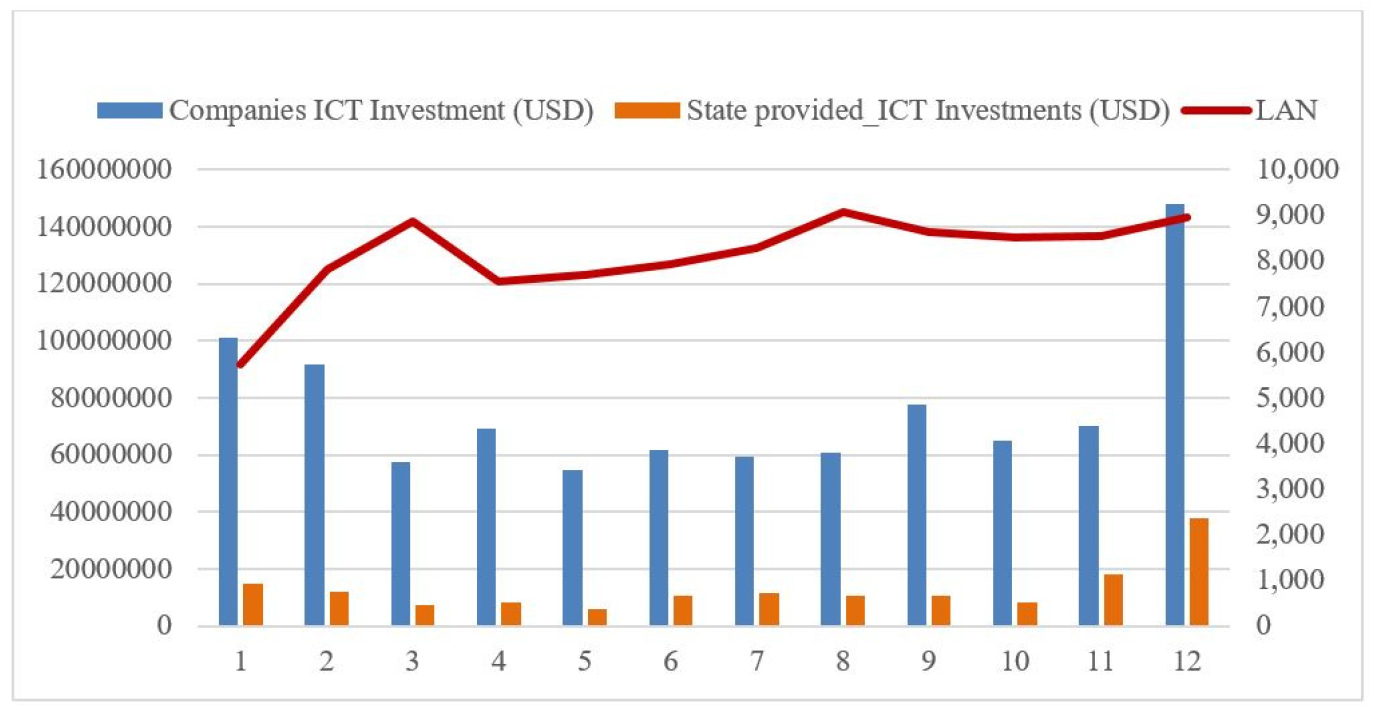
Urban planners can, therefore, associate such decomposition indicators with decisions about buildings and infrastructure, e.g., by prioritizing low-carbon procurement or material replacement in subsectors with the activity profile and fuel mix suggest high embodied emissions, e.g. cement production or metallurgy.
The main architectural solution of the current work is the idea that a trust-gate-based pipeline, which was originally created to serve national-level accounting, could be reused at the municipal one to provide a reliable evidential base to the decarbonization of cities and the built environment planning.
In this regard, agentic workflows have the potential to automate the standardized processes that usually hinder sustainability analytics, such as consuming structured data, validation, deterministic breakdown, and subsequent indicators and brief summaries publication. Although the Trust Protocol automatically creates trusted evidence, this is not the case with the formulation of the relevant policies.
Alternative to relying on periodic manual reports, workflow can provide analysts and decision- makers with more frequent and consistent assessments by delegating lower-level tasks to the workflow, such as data cleansing, calculation, consistency checks, and initial screening of narratives bound by the verified artifact. This system enables a continuous governance cycle in which validated decomposition outcomes may flow directly into industrial emissions policy, medium- term planning, and scenario-based debate, while maintaining complete traceability.
Limitations and future research
The limitations of this work are understood as boundaries of the current implementation. The former limitation is that of the evidence controls which are not restricted to mere numbers. Although numeric claims have an anchoring on deterministic artifacts, non- numeric claims of fact like policy descriptions, legal references and contextual events are harder to validate where there is no structured retrieval layer. This means that the system works best when the heart of the report is identity-bound and quantitative, and poorly when policy narratives, which extend to other documentary documents, are needed.
One of the secondary weaknesses is the lack of configurability. The existing implementation assumes hard coded filenames, column names, tool interfaces, and is implemented through templates which predetermine unchangeable agent roles and instructions. These limitations make it difficult to reproduce and decrease cross-dataset portability. The more advanced implementation must be introduced with the schemas, thresholds and templates in configuration files, and automated regression-testing to discover evaluation drift (when a model update changes discourse behavior but orchestration logic is held constant) [99].
The third limitation is the reliance on the sound integration of tools. The errors can be the tool-call or passing of the wrong parameters as well as the mismatch of the artefact formats and the parsers. These failures are revealed in the Trust Protocol logs, although the continued operation would require regular engineering maintenance, interface testing, and version management of both tools and prompts.
The fourth factor relates to the level of corresponding behaviors demonstrated. The tests only show performance against a small set of prompts and artifacts, not generic reliability across prompt distributions and policy situations. The objectivity of long-form text is challenging to determine since the supported and non-supported statements can both be made co-occurring within a text, and agentic systems have already demonstrated evaluation drift in circumstances of fixed task logic [100].
Others that may lead to failure are missing caveats, the slightest mischaracterization of numerical implications, and terminological inconsistencies between different versions of a report, which are all plausible.
Lastly, the problem of production security and institutional governance are not discussed in depth. All government deployments need a strong access control, retention policy, and delineation between development and production environment. Although this study focuses on methodological reliability, but not security hardening, other aspects of the practice would need both [101].
Future work should strengthen opposition to hallucination and maintain human responsibility. The nearest extension is the retrieval augmented generation of documentary grounding [102], which is a retrieval-augmented generation by associating each policy or legal assertion with a relevant retrieved passage with fixed identifiers, and storing the retrieval traces including query and top result as audit artefacts [43]. Since retrieval has its own dangers, such as irrelevant passages, excessive reliance on weak evidence and silent failures when essential documents are not available, they should be regarded as gated evidence rather than optional context.
A second direction can be based on introducing configuration and specification into layers by removing hard-coded parameters. This would be a layer that contains schemas, file paths, tolerance levels, agent role definitions and reporting templates. The orchestration layer would then create the specification into prompts and validation rules and manage configuration changes via versioning and testing to avoid unintentional changes that cause new delusion channels [103].
A third direction will focus on improving correction policies based on reinforcement learning or style optimization, to allow the agents to learn when to revalidate, rerun tools, request missing evidence, or stop and bring an issue to human attention. An example of reward signals would include the decrease in unanchored interpretations, minimization of failure flags produced by an audit, and the safety constraints (e.g. no numeric invention, no mandatory artefact linkage) as a strict requirement [104].
The methodology of evaluation also has to change. Present comparisons might be generalized to claim- level scoring and adversarial testing by breaking reports into atomic numeric claims which are verified against stored artefacts as well as to atomic factual or policy claims verified against read texts. This would provide an interpretable delusion rate, which would be used in regression testing across different versions of the models, updating, and revision of the datasets.
Generalization is supposed to be an evidence- management issue, and not a mere transition to new areas. Only by the maintenance of the same discipline of constraints by specified and validated schema, deterministic tools which generate canonical artefacts and domain invariants which may be reasoned about is extension of other domains of interest. In case external documents are mandatory then curated retrieval corpora with stable identifiers should be utilized to ensure traceability.
Conclusions
We propose a Trust Protocol for LLM-assisted sustainability reporting at the auditing level. In the context of retrospective emissions decomposition, the protocol reduces qualitative hallucinations and eliminates numerical hallucinations by enforcing separation of concerns, identity closed deterministic computation, and oracle-based anchoring with validation. Its key finding is architectural in the sense of suggesting that restrictions and accountability are more effective than rapid tuning. Future study may include expanding the evaluation to additional domains, improving provenance export, integrating uncertainty management, and conducting blinded human studies to see how successfully audits can be utilized.

