


Introduction
The construction industry is experiencing a structural shift driven by Building Information Modeling (BIM), Internet of Things (IoT), artificial intelligence, robotics, and other digital technologies. This transformation is often described as Construction 4.0 and is reshaping the way buildings are planned, designed, manufactured, delivered, and operated [1, 2, 3]. The need for such transformation is intensified by persistent productivity problems, skilled labor shortages, rapid urbanization, housing demand, and carbon-neutrality requirements. Compared with the wider economy and manufacturing sector, construction productivity has remained relatively stagnant, which has encouraged governments and firms to seek more industrialized production models [3, 4].
Modular construction, as a major form of off-site construction, has emerged as one of the most promising approaches to overcome the limitations of conventional site-based construction. By manufacturing building components or volumetric modules in a factory and assembling them on site, modular construction can shorten project duration, improve quality consistency, reduce waste, and decrease site disturbance [5, 6, 7, 8]. Prior studies cited in this research report that modular construction can reduce construction time by approximately 20-50% compared with conventional methods, while also enabling more standardized quality control and environmental benefits. Recent market forecasts also indicate continued global growth, with modular construction positioned as part of national housing and industrial productivity strategies [9, 10].
The design stage is particularly important in modular construction. In conventional construction, some design changes can be absorbed during site execution. In modular projects, however, design decisions are directly translated into factory production, module transport, lifting strategy, interface details, and assembly sequence. Late design changes can therefore generate substantial cost, schedule, and quality impacts. Modular construction designers must internalize manufacturing constraints, transportation limits, crane capacity, dimensional tolerances, connection details, and site logistics at the earliest stages of design. In this sense, the modular construction designer’s role extends beyond conventional architectural design into production-oriented and digitally coordinated design.
Despite this practical importance, the competencies required of modular construction designers have not been sufficiently systematized. Existing competency studies in construction have tended to focus on project managers, construction managers, BIM specialists, or general construction professionals rather than designers working specifically in modular and off-site construction contexts [11, 12, 13, 14]. Moreover, many studies rely heavily on literature review, expert interviews, Delphi surveys, or questionnaire methods. These approaches are valuable, but they may reflect expert assumptions, selection effects, and method-related bias more strongly than real-time market demand [15]. This study therefore defines a need for a framework that derives competencies from job-market evidence while remaining interpretable for education, recruitment, and professional development.
This study addresses that gap by deriving a data- driven competency framework for modular construction designers using job posting text as the empirical source. Job postings are treated as market-facing descriptions of the competencies that firms actually request. The study integrates BERTopic text mining, hierarchical clustering, domain refinement, Korean cross-validation, and a competency maturity model design. In line with the research design, the completed empirical portion of the study focuses on Phase 1 and Phase 2: data-driven competency extraction and framework structuring. The subsequent Fuzzy Decision-Making Trial And Evaluation Laboratory (DEMATEL), DEMATEL-based Analytic Network Process (DANP) and Competency Maturity Model (CMM) stages are incorporated as a structured maturity model architecture and validation pathway rather than overstated as finalized expert-weighted results.
The institutional context also supports the need for such a competency framework. This study considers several national trajectories in which modular construction has moved from experimental building technology to a policy-linked delivery strategy. Singapore has institutionalized Prefabricated Prefinished Volumetric Construction (PPVC) and Prefabricated Bathroom Unit (PBU) as part of its productivity agenda; Hong Kong uses Modular integrated Construction (MiC) terminology and guidance to promote public-sector applications; the United Kingdom frames modular and off-site production within Modern Methods of Construction; and the United States and Canada maintain large and diverse modular and panelized construction markets. These national trajectories create different technical vocabularies, but they share a common requirement: designers must be able to coordinate productized building systems across design and production.
The Korean context shows both opportunity and risk. This study notes that Korea’s modular market has moved beyond temporary facilities and low-rise applications toward more complex public housing and Precast Concrete (PC) modular projects, including high-rise public housing demonstrations led by public developers. However, education, qualification, and recruitment systems remain strongly aligned with reinforced-concrete, site-based delivery. If modular housing is to scale, the labor market must be able to identify designers who understand Design for Manufacture and Assembly (DfMA), factory production, module interface design, BIM-based coordination, and site assembly constraints. A competency framework therefore becomes not only an academic classification but also an industrial workforce planning instrument.
Accordingly, this study is guided by three research questions. First, what competency domains can be empirically identified from international modular and off-site construction design job postings? Second, how can those domains be structured into a multi-level framework that is interpretable for practice? Third, how can the framework be connected to a maturity model that supports assessment and development, while recognizing that expert weighting and full psychometric validation remain subsequent steps? By addressing these questions, this study makes three contributions. First, it demonstrates a repeatable job posting-based text-mining pipeline for extracting competency signals in modular construction design. Second, it develops a three-level competency framework consisting of 17 domains, 43 categories, and 98 observable performance statements, and examines its contextual applicability through Korean job posting cross-validation. Third, it connects the data-driven framework to an exploratory priority structure and a proposed maturity model architecture, thereby providing a practical foundation for future expert-weighted validation, recruitment, training, and organizational competency development.
The remainder of the manuscript is organized as follows. The next section reviews prior studies on modular construction, digital transformation, competency frameworks, and maturity models. The Methodology section then explains the job posting collection, filtering, topic modeling, and framework structuring procedures, followed by the Results and Discussion sections.
Literature Review
Research on modular and off-site construction has emphasized production integration, early design freeze, manufacturability, logistics coordination, interface management, and lifecycle-oriented prefabrication design [5, 6, 7, 8, 9, 16, 17]. Modular construction differs from conventional construction because design, factory manufacturing, transportation, and installation are tightly coupled [5, 6, 7, 8]. Consequently, designers must consider dimensional standardization, tolerance control, module repetition, factory sequencing, and transportability as design variables. These requirements create a competency profile that cannot be fully captured by traditional architectural design or construction management competency models.
Digital transformation further expands the designer’s competency boundary. BIM enables integrated modeling, clash detection, quantity takeoff, 4D sequencing, document control, and collaborative coordination. Common data environments and digital twins extend this logic into lifecycle data management and performance monitoring [16, 18, 19]. In modular construction, these tools are not merely supportive technologies; they are part of the production system. A designer may need to coordinate BIM models across architectural, structural, and Mechanical, Electrical, and Plumbing (MEP) disciplines, link models to fabrication workflows, manage design revisions, and support data exchange across factory and site operations.
The competency literature conceptualizes competencies as integrated combinations of knowledge, skills, abilities, behaviors, and contextual judgment [11, 20, 21]. In construction, competency frameworks have often been developed for project managers or general professionals using expert assessment and survey-based methods. These approaches have generated useful taxonomies, but they face two limitations for the present problem. First, they may not represent the fast-changing requirements of modular and digital construction. Second, they generally provide lists of important competencies without showing how those competencies interact, how they should be prioritized, or how individuals can evaluate their maturity level.
Text mining offers a complementary way to identify competencies from large-scale market data. Job postings contain descriptions of tasks, tools, qualifications, responsibilities, and performance expectations. Prior BIM and construction labor studies have used job postings to infer skill demand and occupational change [22]. In this study, BERTopic is used because it combines sentence embeddings, UMAP dimensionality reduction, HDBSCAN clustering, and c-TF-IDF topic representation, making it suitable for extracting semantically coherent topic clusters from heterogeneous job descriptions [23, 24, 25, 26, 27].
Finally, competency frameworks must be translated into practical assessment tools. Capability and competency maturity models provide a structured means of describing progressive levels of capability, from ad hoc awareness to optimized and continuously improving practice [28, 29]. This study adopts a five-level maturity structure adapted from Capability Maturity Model Integration (CMMI) [30, 31]: Initial, Managed, Defined, Quantitatively Managed, and Optimizing. This structure allows the extracted competency domains to be converted into observable behavioral rubrics, making the framework more useful for recruitment, training, self- assessment, and organizational development.
This study emphasizes DfMA as one of the core theoretical bases for modular design competency. DfMA requires designers to consider manufacturing and assembly efficiency when defining geometry, connections, tolerances, material choices, module repetition, and service routing. In modular construction, these decisions cannot be deferred to fabrication specialists after design completion because module geometry and interface details determine whether factory production and on-site assembly can proceed without redesign. The competency implication is that designers must be able to translate architectural intent into manufacturable and assemblable information.
BIM and common data environments form another theoretical foundation. This study treats BIM not only as a modeling tool but as a data integration mechanism that links design, manufacturing, construction, quality control, and operation. A modular construction designer’s BIM competency therefore includes model authoring, clash coordination, version control, Level Of Development (LOD) management, data exchange through Industry Foundation Classes (IFC) or related standards, and the ability to connect design models with schedules, quantities, fabrication information, and later operational data. This is why the framework includes both BIM & Digital Design and Construction Technology & Innovation as distinct but related domains.
The literature on Lean and integrated project delivery also underpins the framework. Modular construction requires earlier and more intensive collaboration among designers, fabricators, engineers, contractors, and clients. Decisions about module standardization, production sequencing, transport, lifting, and interface management affect multiple organizations simultaneously. Lean and IPD perspectives therefore highlight competencies related to coordination, communication, workflow reliability, shared planning, and early problem resolution. In the proposed framework, these ideas appear in domains such as Construction Planning & Scheduling, Site Coordination & Quality, and MEP Systems Design.
Existing competency models are useful but incomplete for this context. General models identify broad managerial, technical, and interpersonal competencies; BIM competency models identify digital modeling and coordination skills [32]; and construction management studies identify project control capabilities. However, modular construction designers require combinations that cross these categories. A designer may need to understand architectural concept development, structural connection design, factory quality protocols, manufacturing takt, crane logistics, BIM data management, and digital production monitoring. This cross-boundary profile justifies a framework that is empirically derived rather than simply adapted from an existing occupational model. The limitations of prior competency studies and the corresponding focus of this study are summarized in Table 1. Building on these gaps, the following section describes how job posting data were collected, filtered, modeled, and translated into a modular construction designer competency framework. The methodological sequence is designed to separate completed empirical extraction from subsequent validation-oriented model development.
Table 1.
Limitations of previous studies and the focus of this study
Methodology
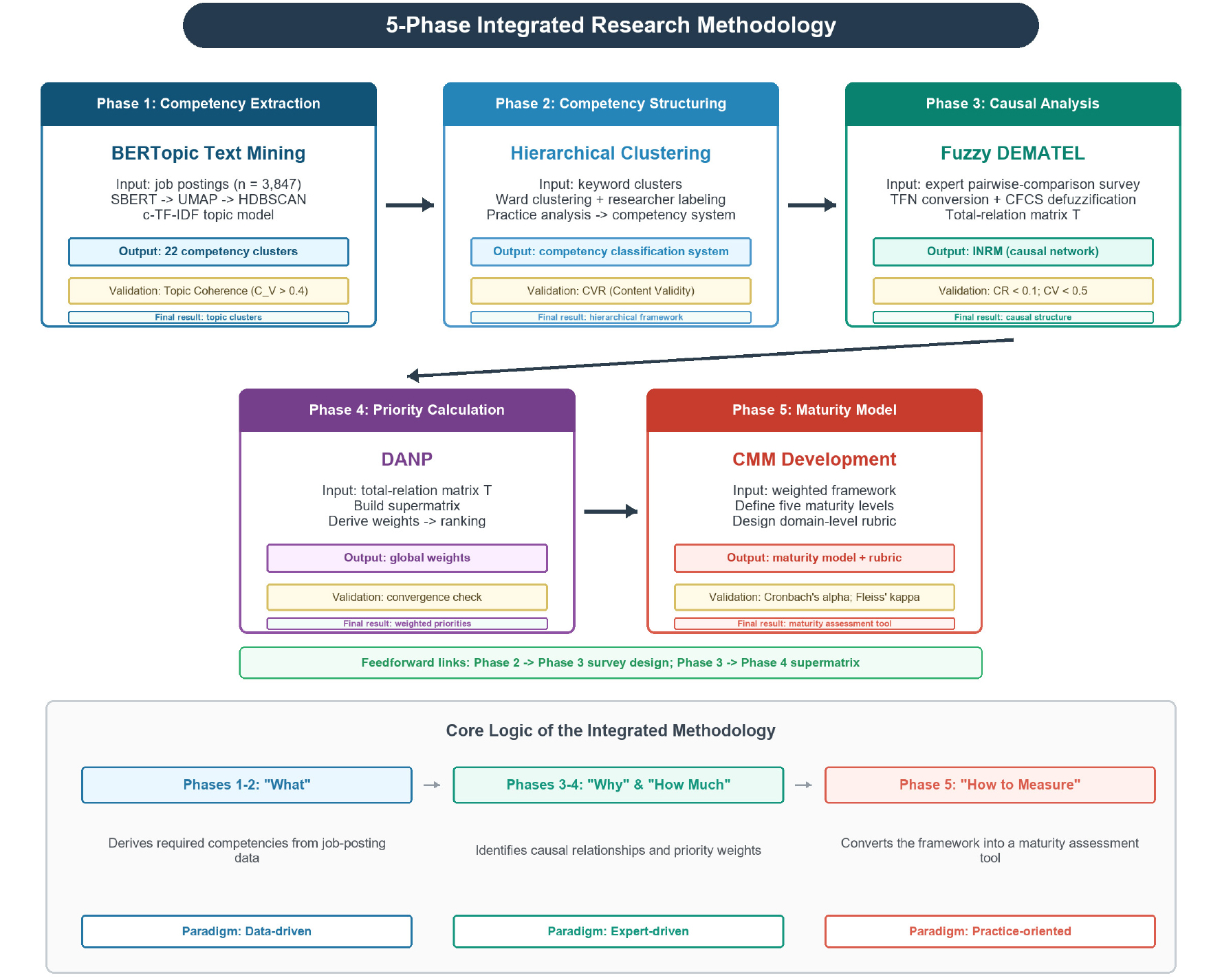
This study adopts a staged research design consisting of two completed empirical phases and three design- oriented extension phases. Phase 1 extracts competency signals from job posting text using BERTopic, and Phase 2 structures the extracted topics into a three-level competency framework through Ward hierarchical clustering, semantic refinement, and researcher naming. These two phases are completed as empirical analyses in the present manuscript. Phases 3-5 are not empirically executed here; instead, they define a planned pathway for future causal validation, expert-weighted prioritization, and maturity assessment through Fuzzy DEMATEL [33], DANP [34], and the competency maturity model. Accordingly, the priority and maturity structures reported later are presented as exploratory, design-oriented outputs rather than as completed expert-weighted results. The empirical data source consisted of online job postings related to modular construction, prefabricated construction, off-site construction, and design roles. The empirical design identifies eight countries: the United States, United Kingdom, Canada, Australia, Singapore, Hong Kong, New Zealand, and South Korea. These countries were selected because they have active modular or off-site construction markets and provide job postings in English or Korean. Country-specific terminology was used to reduce search bias, including PPVC and PBU in Singapore, MiC and Multi-trade integrated Mechanical, Electrical, and Plumbing (MiMEP) in Hong Kong, Modern Methods Of Construction (MMC) in the United Kingdom, and PC modular or industrialized construction terms in Korea.
Data collection was conducted using Python-based automation modules tailored to each platform. Each record included job title, job description, company, location, country, source, and collection date. The collection covered 15 job platforms and postings published after January 2023, with data collected from December 2025 to January 2026. A total of 21,935 raw postings were collected before cleaning and filtering. The analysis then separated the English corpus for topic modeling and used the Korean corpus for cross- validation, because the Korean market was found to have a smaller and less stable text base.
The country-specific collection strategy was important because modular construction is named and organized differently across markets. In the United States, search terms distinguished volumetric modular and panelized construction and drew from large platforms such as Indeed, ZipRecruiter, and SimplyHired. In the United Kingdom, MMC-related terminology was used because the national discourse commonly frames off-site construction through Modern Methods of Construction. In Singapore, PPVC, PBU, and DfMA terms were included to reflect regulatory and productivity policies. In Hong Kong, MiC and MiMEP terms were included to capture the local modular integrated construction vocabulary. In Korea, terms such as modular architecture, PC modular, Off-Site Construction (OSC), industrialized construction, and smart construction were combined with design-role keywords.
The preprocessing design was intended to solve two competing problems. On the one hand, a narrow keyword strategy would miss postings that describe modular or digital design without using a single standard term. On the other hand, a broad keyword strategy collects unrelated postings, such as software architects, military modular systems, nuclear facilities, medical equipment, or platform-generated metadata. The blacklist and Hybrid Whitelist strategy therefore operated as a domain boundary mechanism: it removed obvious contamination and then retained postings with sufficient industry, role, modular, or digital design signals.
Topic labeling followed a staged interpretation protocol. For each BERTopic result, the top c-TF-IDF keywords were reviewed first. Next, representative job postings were examined to determine how the keywords functioned in context. A tentative label was then assigned, and labels were revised when topics shared overlapping meanings or when representative documents showed that a topic was contaminated by metadata or non-design occupations. This process reduced the risk of treating statistical clusters as competencies without substantive interpretation.
The framework was designed as a three-level hierarchy because job postings contain information at different levels of abstraction. Domain names capture broad competency areas, such as BIM & Digital Design. Category names capture sub-areas, such as BIM Modeling & Clash Coordination or Digital Integration & Innovation. Performance statements translate keywords and document contexts into observable actions, such as developing integrated BIM models, applying BIM execution standards, or using AR/VR for spatial clash resolution. This hierarchy allows the framework to be used both for strategic workforce planning and for operational assessment.
The maturity model design was intentionally linked to the competency hierarchy. Domains and categories define what should be assessed, while performance statements define the behavioral evidence for assessment. The five maturity levels define how well the designer performs the competency. This separation is important because a competency name alone does not tell an evaluator whether a designer is aware of the concept, can perform under supervision, can lead multidisciplinary work, can manage performance quantitatively, or can optimize and innovate at the organizational level. The overall research design and the status of each phase are summarized in Table 2.
Table 2.
Five-phase research design and implementation status
The sequential logic of the five-phase methodology is illustrated in Figure 1. The search strategy deliberately excluded the word competency and related terms. This decision was made to avoid over-sampling postings that already used competency language and to allow competency signals to emerge from the data. English search terms combined industry terms such as modular construction, prefabricated construction, off-site construction, volumetric construction, industrialized construction, DfMA, and panelized construction with role terms such as designer, design engineer, BIM modeler, drafter, architect, structural engineer, MEP designer, design coordinator, and design manager. Korean search terms similarly combined modular, OSC, prefabricated, precast, industrialized construction, design, BIM modeler, structural design, architectural design, and smart construction terms.
Because broad modular and design keywords can collect irrelevant postings, the study used a two-stage domain filtering system. First, blacklist filtering removed titles clearly associated with unrelated domains such as nuclear, military, software, IT, medical, and pharmaceutical roles. Second, the Hybrid Whitelist combined an industry-role AND condition with a StrongSignal condition. The formal rule was defined as Hybrid Whitelist = (A intersection B) union ((A union B) intersection StrongSignal), where A is an industry keyword group, B is a role keyword group, and StrongSignal contains direct modular or digital design terms. The resulting preprocessing and filtering pipeline is summarized in Table 3.
Table 3.
Data preprocessing and filtering pipeline
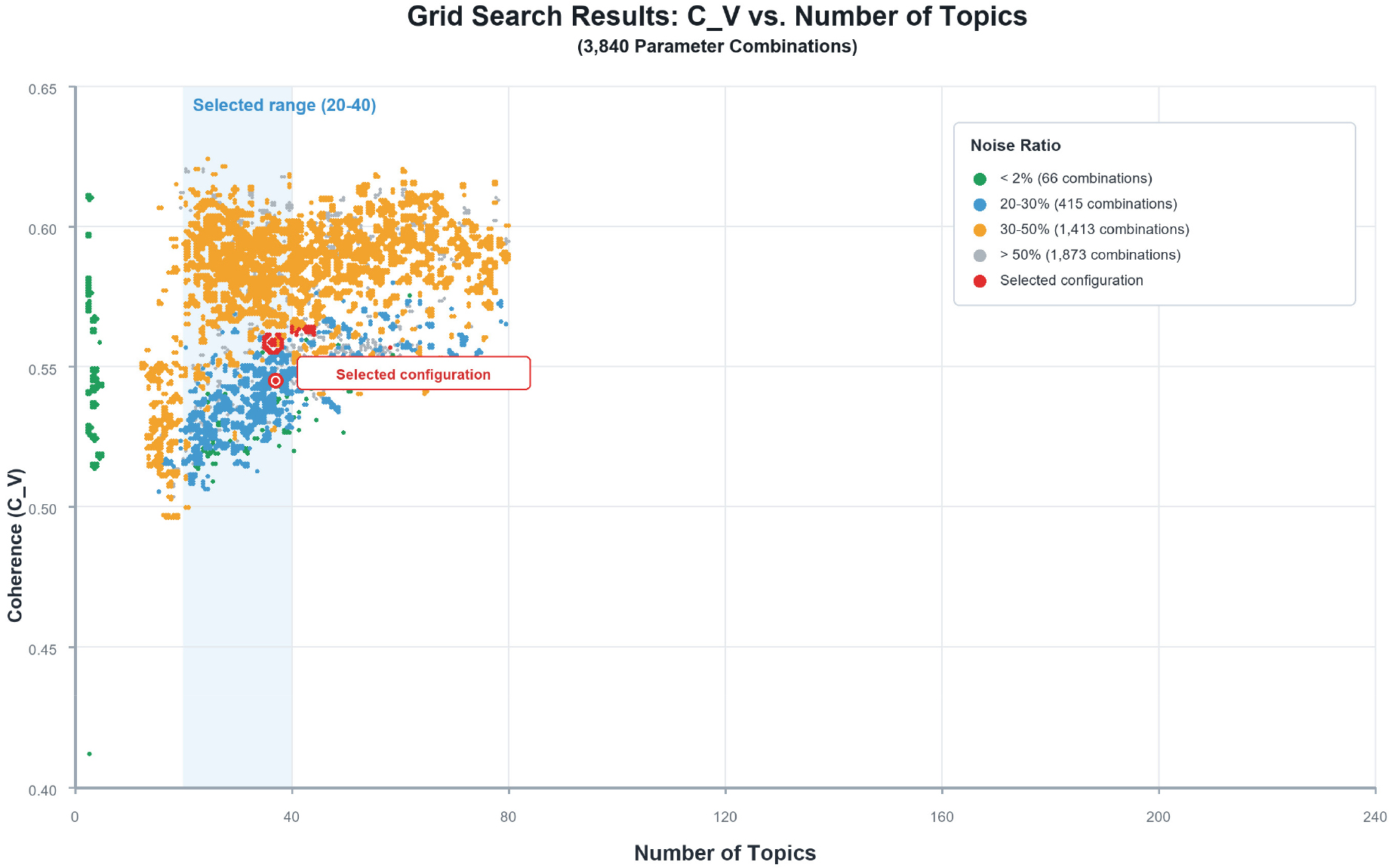
For the English corpus, the study used all-MiniLM- L6-v2 as the sentence embedding model. This model produces 384-dimensional embeddings and was selected for its balance between computational efficiency and semantic representation. For the Korean corpus, the study selected jhgan/ko-sroberta-multitask, a Korean Sentence-BERT model fine-tuned on Korean natural language inference and semantic textual similarity datasets. The different embedding choices reflect the need to preserve semantic quality across languages. A grid search was conducted over UMAP and HDBSCAN parameters for the final English corpus. The search examined 3,840 parameter combinations and evaluated topic coherence, topic diversity, topic count, and outlier ratio. The adopted configuration used UMAP n_neighbors = 15, n_components = 5, min_dist = 0.0, metric = cosine; HDBSCAN min_cluster_size = 15, min_samples = 15, cluster_selection_method = eom; and CountVectorizer ngram_range = (1, 2), min_df = 5, and English plus custom stop words. This configuration was selected because it balanced topic coherence with an acceptable outlier ratio. The grid-search distribution of topic coherence by topic count is presented in Figure 2.
The methodological steps described above provide the basis for reporting two types of outputs in the following section: empirically completed outputs from topic modeling and framework structuring, and exploratory design-oriented outputs for prioritization and maturity assessment.
Results
Applying the preprocessing and Hybrid Whitelist pipeline produced a primary English analysis corpus of 3,769 postings. Among these postings, 3,254 passed the industry-role AND condition and 515 were added through the StrongSignal condition. This indicates that 13.7% of the final corpus would have been missed by a strict AND filter, even though the postings contained direct modular or digital design signals. The Hybrid Whitelist therefore improved recall while preserving domain precision. BERTopic analysis produced 37 topics. The validation results met all predefined acceptance criteria. Topic coherence (C_V) was 0.5439, exceeding the threshold of 0.4. Topic diversity was 0.4757, also above the corpus-specific threshold of 0.4. The topic count fell within the acceptable range of 10 to 40 topics. The outlier ratio was 25.6% (966 of 3,769), remaining below the 30% threshold. This study interprets this outlier ratio as an appropriate result of HDBSCAN’s refusal to force low-density documents into unsuitable clusters. The BERTopic validation indices and acceptance decisions are summarized in Table 4.
Table 4.
BERTopic validation results
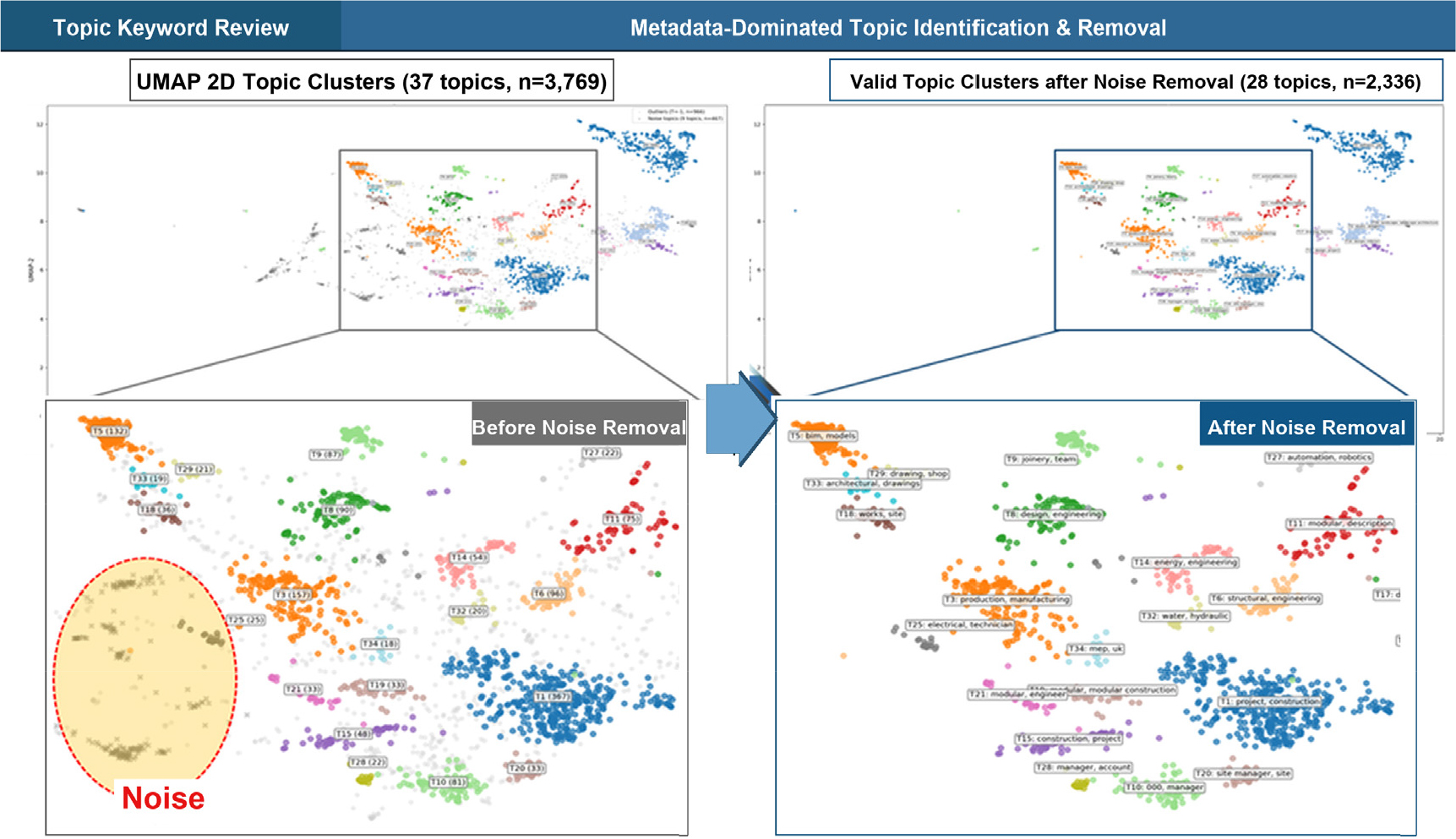
The 37 topics were refined through a progressive topic accounting process. To improve methodological transparency, each refinement decision was based on a combined review of top c-TF-IDF keywords, representative job postings, and role relevance to modular construction design. First, nine topics with 467 documents were removed before Ward clustering because they were dominated by platform metadata, benefits text, non-design functional roles, or unrelated job artifacts. Second, 28 valid topics were analyzed using Ward hierarchical clustering to identify broader semantic relationships among competency-relevant topics. Third, eight additional topics with 738 documents were excluded after Ward clustering because they represented interpretable but out-of-scope roles, such as IT/software, site management, maintenance, landscape architecture, account management, or water/infrastructure engineering. Representative refinement decisions are summarized in Table 5. The UMAP visualization in Figure 3 shows the removal of metadata-dominated noise topics and the retained valid topic clusters.
Table 5.
Representative examples of topic refinement decisions
After these removals, 20 base topics were refined through merging and semantic splitting. Topic merging was applied when multiple BERTopic clusters represented the same competency logic with different technical vocabulary. For example, four drafting-related topics were merged into Construction Drafting & Documentation because they shared CAD, AutoCAD, 2D/3D drawing, revision-control, and construction- documentation signals. Semantic splitting was applied when one statistical cluster contained more than one competency meaning in its representative documents. Accordingly, construction planning was separated from site coordination and quality; general drafting was separated from shop drawing and detailing; and architectural practice was separated from residential and building design. This process resulted in 17 competency domains directly assigned to 1,598 documents. The accounting was internally consistent: 467 pre-Ward removals + 738 post-Ward exclusions + 1,598 domain- assigned documents + 966 HDBSCAN outliers = 3,769 total postings. The relative document distribution across the final 17 competency domains is shown in Figure 4, and the domain-level counts are summarized in Table 6.
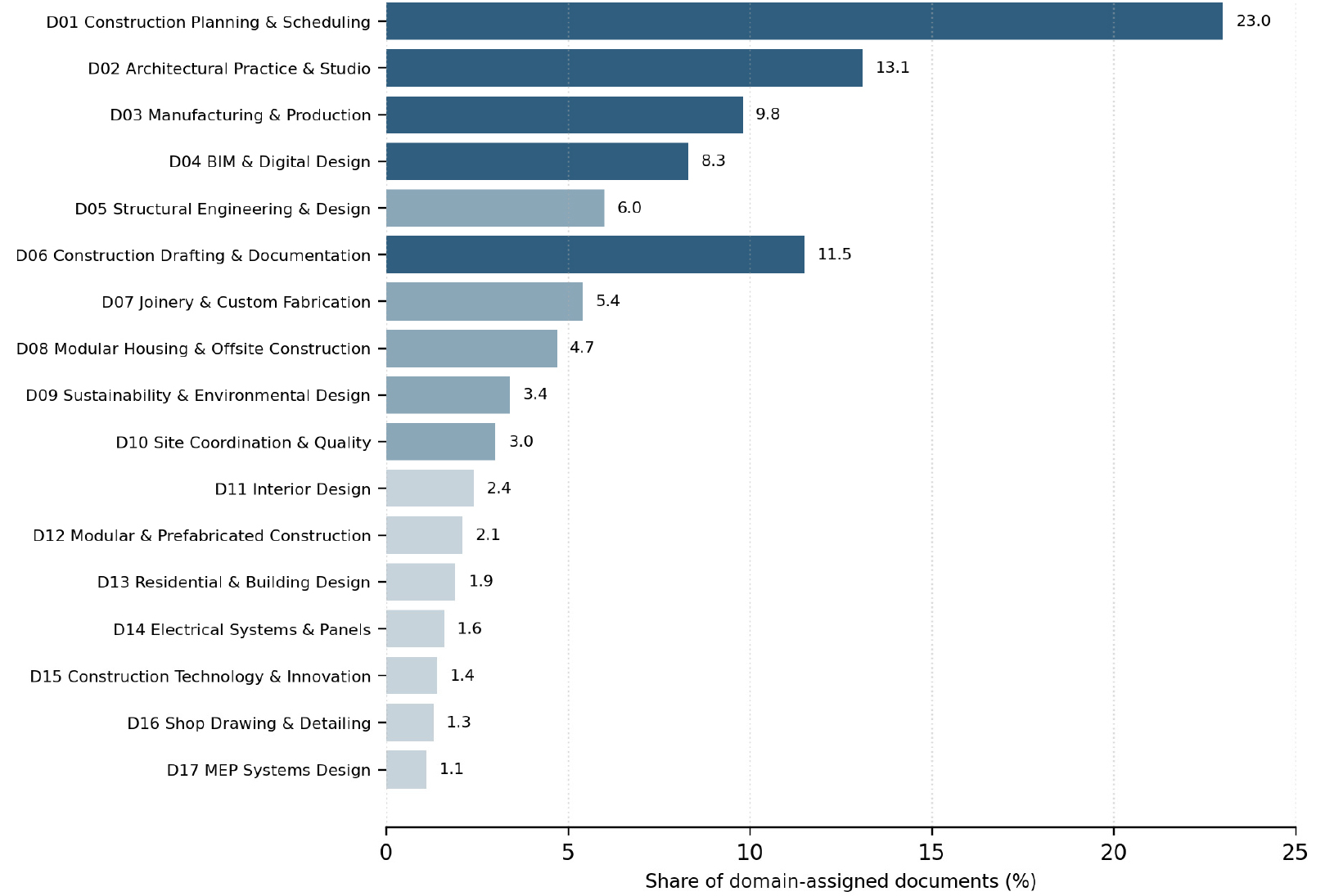
Table 6.
Distribution of final competency domains
Representative categories and the logic used to translate them into performance statements are provided in Table 7.
Table 7.
Representative categories and performance-statement logic by domain
The final framework has three levels. Level 1 consists of 17 competency domains. Level 2 consists of 43 categories. Level 3 consists of 98 observable performance statements. Of the 98 performance statements, 85 were derived directly from job posting keywords and representative document contexts, while 13 were added to reflect digital transformation competencies. These digital transformation statements were distributed across eight domains, including BIM and digital design, modular housing, modular and prefabricated construction, manufacturing and production, construction technology and innovation, construction drafting, MEP systems, and construction planning.
The resulting three-level competency framework is presented in Figure 5. At the domain level, the framework can be interpreted as a layered description of modular construction designer work. The first layer consists of broad project and architectural design capabilities, including planning, studio practice, structural engineering, and drafting. These domains appear frequently because job postings still describe designers using conventional architectural and engineering language. The second layer consists of production-facing capabilities, including manufacturing, modular housing, modular and prefabricated construction, shop drawing, electrical systems, and MEP coordination. These domains express the shift from design as representation to design as production planning. The third layer consists of digital and innovation capabilities, including BIM, construction technology, automation, digital twin, IoT, AR/VR, and data-driven planning.
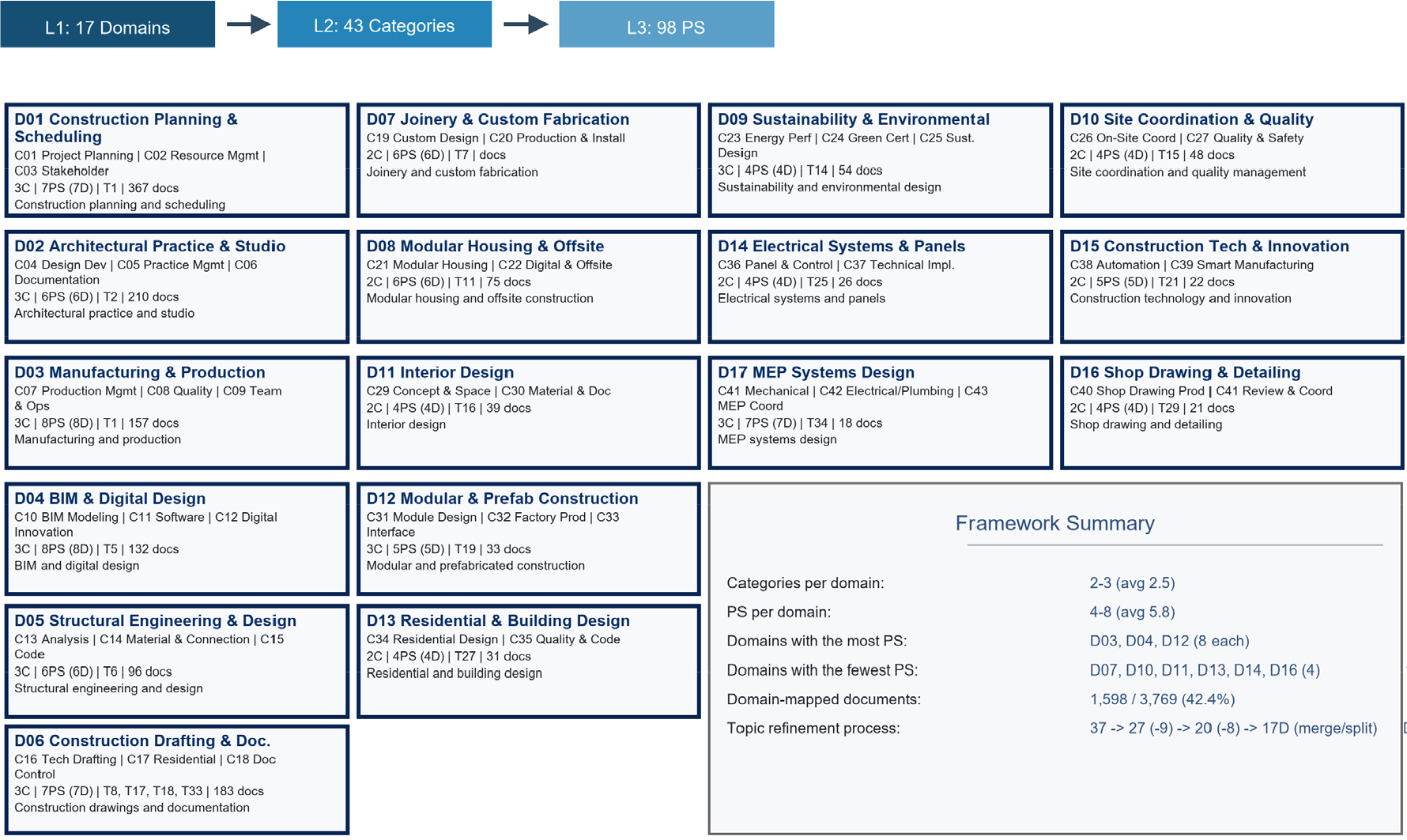
It should be clarified that, throughout this framework, a domain denotes a competency area rather than a job task. Because the domains were derived inductively from job-posting language, several labels retain the task-oriented vocabulary used by employers. Such labels denote the knowledge, skills, and abilities required to perform the associated work, not the activities themselves. The competency content is operationalized at the category and performance-statement levels, where each performance statement is expressed as an observable behavior that provides evidence of the underlying competency. We acknowledge that some labels still blend competency and task language; sharpening this distinction is an explicit objective for the subsequent expert-validation stage.
Several domains are conceptually adjacent, and their boundaries are defined as follows. D01 (Construction Planning & Scheduling) addresses pre-construction planning and scheduling, whereas D10 (Site Coordination & Quality) addresses on-site execution coordination and quality management. D02 (Architectural Practice & Studio) refers to general architectural and studio design practice, whereas D13 (Residential & Building Design) refers to building-type-specific residential design. D06 (Construction Drafting & Documentation) covers general design drawings and construction documentation, whereas D16 (Shop Drawing & Detailing) covers fabrication-level shop drawings and connection detailing prepared for off-site manufacturing. D08 (Modular Housing & Off-site Construction) concerns the design of modular housing units—optimizing habitability, transport logistics, and factory- production efficiency—together with off-site delivery, whereas D12 (Modular & Prefabricated Construction) concerns the broader modular and prefabricated construction methods, including module design and configuration applicable across building types. These distinctions reflect the differing competency emphases identified in the representative documents during semantic refinement.
The largest domain was Construction Planning & Scheduling (D01), representing 367 assigned documents and 23.0% of the domain-assigned corpus. Architectural Practice & Studio (D02) accounted for 210 documents and 13.1%. Construction Drafting & Documentation (D06), Manufacturing & Production (D03), and BIM & Digital Design (D04) also appeared as major domains, with 183, 157, and 132 documents, respectively. Together, these five domains indicate that the market demand for modular construction designers combines traditional planning and documentation capabilities with manufacturing and digital coordination capabilities.
D01 Construction Planning & Scheduling was the largest domain because many design roles in modular and off-site construction require designers to understand the sequencing of design, procurement, fabrication, and site installation. The performance statements in this domain include developing integrated project plans, monitoring progress against baseline schedules, identifying critical-path deviations, allocating resources, tracking cost forecasts, and preparing status reports or decision logs. Although some of these tasks may appear managerial, this study treats them as design-relevant because modular design decisions directly affect fabrication and installation schedules.
D03 Manufacturing & Production reveals the industrial character of modular design. It includes production management, quality and fabrication, and team operations. Representative performance statements address manufacturing schedules, lean production workflows, robotic fabrication, automated assembly, dimensional accuracy, quality assurance protocols, factory inspections, and digital production monitoring. These requirements show that modular construction designers are expected to understand how design information is converted into repeatable factory work, rather than handing off drawings to a separate production system without feedback.
D04 BIM & Digital Design is the most explicit digital design domain. It covers BIM modeling, clash coordination, software and standards, and digital integration. The empirical design identifies Revit, Navisworks, Tekla, LOD, IFC, 4D modeling, digital twins, IoT, AI-based analytics, and AR/VR visualization as representative signals. These tasks indicate that the designer’s digital competency is not limited to drafting software proficiency. It includes data integrity, version control, multidisciplinary model coordination, lifecycle data use, and immersive review techniques.
Several smaller domains are nevertheless strategically important. Modular Housing & Off-site construction (D08) and Modular & Prefabricated Construction (D12) had 75 and 33 assigned documents, respectively. Their document counts were lower than conventional design domains, but this study interprets this as a reflection of the still-emerging market rather than low strategic importance. These domains include the core modular competencies of DfMA, module configuration, factory production, interface design, transport constraints, off-site integration, parametric design, and modular quality control.
D08 and D12 are therefore treated as strategically central even though their document counts are lower than those of conventional design domains. D08 focuses on modular housing and off-site integration, including habitability, transport logistics, factory production efficiency, local code compliance, lifecycle data integration, and generative or parametric design for modular housing configurations. D12 focuses on modular and prefabricated construction more generally, including module configuration, factory production quality, interface design, standardization, dimensional tolerance, prototyping, robotic assembly, automated quality inspection, and DfMA. These domains define the distinctive technical identity of the modular construction designer.
Examples of the performance-statement logic clarify how the framework moves beyond keyword lists. In D04 BIM & Digital Design, performance statements include developing and maintaining integrated BIM models, performing multidisciplinary clash review, applying BIM execution plans and data exchange standards, producing 4D sequencing and quantity outputs, and exploring digital twin, IoT, AI analytics, and AR/ VR tools. In D12 Modular & Prefabricated Construction, performance statements include optimizing module layouts for transport and structural integrity, balancing customization and repeatability, supervising factory production, implementing quality control procedures, defining inter-module interface details, and applying DfMA and parametric design for automated factory production.
Other domains clarify the breadth of supporting competencies. D10 Site Coordination & Quality links off-site delivery with on-site installation by addressing module delivery sequence, crane operation, temporary works, quality assurance, tolerance control, and safety protocols. D17 MEP Systems Design addresses HVAC, electrical, plumbing, BIM-based spatial coordination, prefabricated service routing, and IoT-enabled building management systems [35]. D09 Sustainability & Environmental Design captures energy modeling, renewable integration, embodied carbon, environmental compliance, and green certification. Together, these domains show that modular design competence is multidisciplinary and lifecycle-oriented.
The Korean cross-validation provided an additional test of applicability. The study collected 1,283 Korean job postings from Saramin and applied a parallel cleaning and Hybrid Whitelist pipeline, reducing the Korean analysis corpus to 625 postings. Independent BERTopic analysis of the Korean corpus produced only two valid topics, failing the predefined inclusion criteria. This study attributes this instability to Korea’s early-stage modular design labor market, the smaller corpus size, and the large amount of standardized benefits or notice text in platform postings.
Because independent Korean topic modeling was not stable, the study mapped all 1,283 Korean postings to the 17 English-derived domains using Korean-English compound keyword sets. Each posting was assigned to the domain with the highest keyword matching score under a top-1 rule. The mapping succeeded for 1,143 postings, or 89.1%, while 140 postings, or 10.9%, remained unmapped. The result suggests that the English- derived domain structure has broad applicability to the Korean construction labor market, while still allowing national differences to be identified.
The Korean mapping results were not identical to the English corpus. Manufacturing & Production (D03) accounted for 598 Korean postings, or 46.6%, compared with 9.8% in the English domain-assigned corpus. Construction Drafting & Documentation (D06) accounted for 179 postings, or 14.0%. Construction Technology & Innovation (D15), Interior Design (D11), and BIM & Digital Design (D04) followed with 72, 59, and 55 postings, respectively. By contrast, the two explicitly modular domains, D08 and D12, together mapped only seven postings. This pattern indicates that the Korean market currently emphasizes manufacturing and production more strongly, while explicit modular design competency remains less mature in job posting language.
This difference has two interpretations. First, it may reflect industrial structure: Korea’s current modular activity is strongly connected to factory production, PC modular systems, and smart construction, so firms describe roles through manufacturing and production vocabulary. Second, it may reflect labor-market immaturity: firms may need modular design competencies but have not yet standardized how to describe them in job postings. The framework can therefore help Korean firms refine job descriptions by making hidden modular design requirements explicit. Because expert weighting was not conducted in the present manuscript, the five-tier structure should be interpreted as an exploratory organizing structure rather than a validated priority ranking. Based on document frequency, modular specificity, and digital transformation relevance, this exploratory structure is illustrated in Figure 6 and detailed in Table 8.
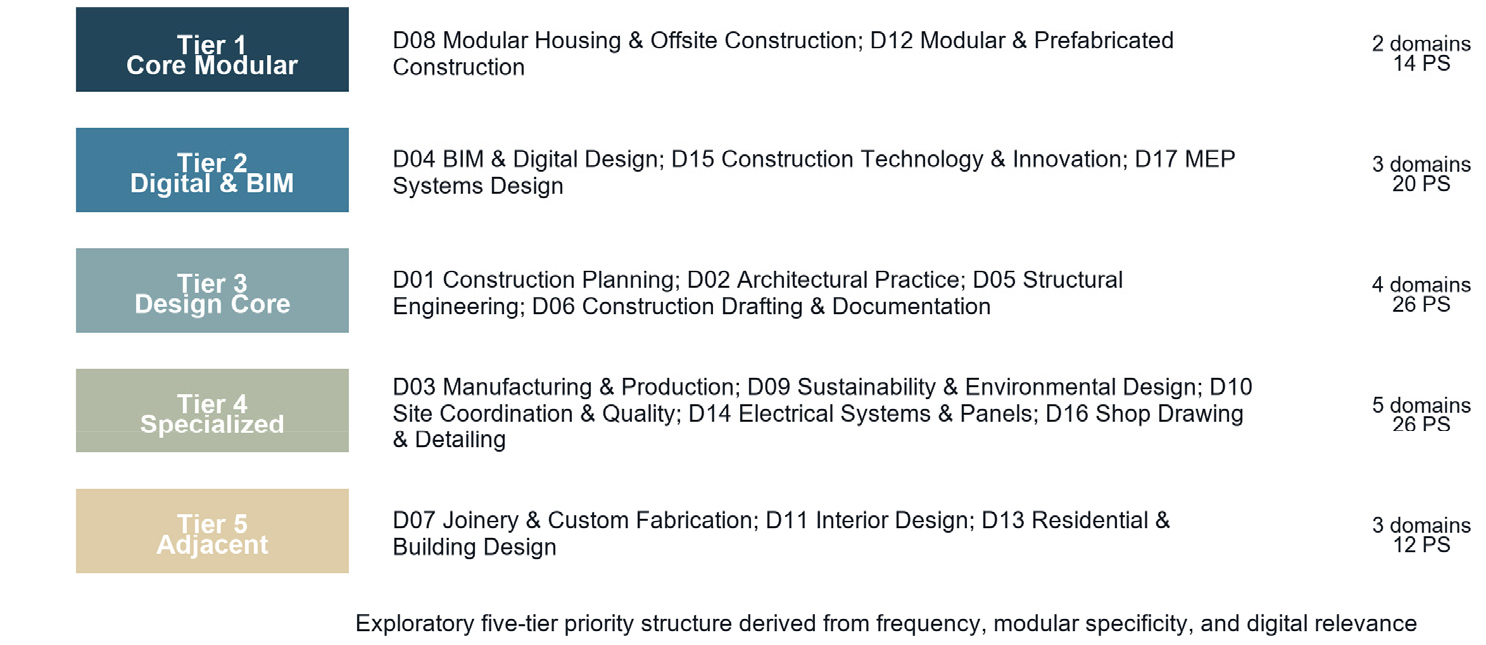
Table 8.
Exploratory five-tier priority structure based on document frequency, modular specificity, and digital transformation relevance
The tier structure was derived by jointly considering job posting frequency, modular construction specificity, and digital transformation relevance. Tier 1, Core Modular, includes D08 and D12 because they directly represent modular housing, off-site construction, prefabrication, module configuration, factory production, DfMA, interface standardization, and transport-oriented design. Tier 2, Digital & BIM, includes D04, D15, and D17 because these domains capture the digital foundation of modular construction, including BIM, automation, robotics, digital twins, IoT, smart manufacturing, and MEP data integration. Tier 3 contains the traditional design core required across construction projects. Tier 4 contains specialized but project-dependent domains. Tier 5 contains adjacent domains that are relevant but less central to the modular construction designer role.
The proposed maturity model design translates these domains into a practical assessment structure; however, it should be read as a rubric architecture for future validation rather than as a fully validated assessment instrument. Following the research design, the CMM uses five cumulative levels: Initial, Managed, Defined, Quantitatively Managed, and Optimizing. At Level 1, the designer understands basic concepts but cannot yet perform independently. At Level 2, the designer performs tasks under guidance and follows established procedures. At Level 3, the designer can perform independently and coordinate multidisciplinary work. At Level 4, the designer uses metrics and performance data to manage and improve processes. At Level 5, the designer leads innovation, adopts emerging technologies, and contributes to organizational competency development. The resulting five-level maturity model structure is summarized in Table 9.
Table 9.
Proposed five-level competency maturity model structure for future validation
For example, the study provides a BIM-based design coordination rubric. At Level 1, a designer understands basic BIM software functions but has difficulty modeling independently. At Level 2, the designer can create BIM models under guidance and perform basic clash detection. At Level 3, the designer independently produces BIM models at LOD 300 or above and leads multidisciplinary design coordination meetings. At Level 4, the designer links BIM to quantity takeoff, construction simulation, scheduling, and model quality indicators. At Level 5, the designer improves BIM processes, develops automation tools, and leads organization-wide BIM capability development. The same logic can be adapted to the other 16 domains using domain-specific behavioral descriptors.
The maturity model design can also be used at multiple decision levels after expert weighting and field validation. At the individual level, it enables self- assessment and targeted development planning. At the team level, it allows managers to compare competency profiles across designers and assign roles according to maturity. At the organizational level, it supports training investment by identifying whether a firm lacks core modular competency, digital competency, design- core competency, or specialized supporting competency. Once DANP weights are available, these assessments can be weighted so that strategic domains such as Core Modular and Digital & BIM receive appropriate priority. Taken together, the empirical domain structure, Korean cross-validation, exploratory tier structure, and proposed maturity model rubric show how market- derived competency signals can be translated into practical assessment and development tools. The following section discusses the methodological, conceptual, and practical implications of these findings.
Discussion and Conclusion
This study reconstructs modular construction designer competency from the perspective of real market demand. Rather than starting from a predefined expert taxonomy, it extracts competency signals from job postings and then structures them through topic modeling, hierarchical clustering, and semantic refinement. The resulting framework shows that modular construction designers require a hybrid profile: conventional design planning and documentation remain important, but they are increasingly intertwined with manufacturing, off-site production, BIM, digital coordination, automation, MEP integration, and interface standardization.
The first contribution is methodological. The study demonstrates a repeatable pipeline for deriving competencies from job-market text. The Hybrid Whitelist filtering strategy is especially useful because modular and digital design job postings often use inconsistent terminology. A strict industry-role AND condition alone would have discarded 515 relevant postings. By adding StrongSignal terms, the pipeline preserved postings with direct modular or digital relevance and improved recall without abandoning precision.
This methodological contribution is important because construction labor-market text is noisy. Job postings are not written for research purposes; they include repeated benefit statements, platform notices, legal disclaimers, salary fragments, and broad occupational labels. The empirical analysis shows that such artifacts formed several BERTopic clusters and had to be removed before competency interpretation. Treating those clusters as noise is not a weakness of the approach. Rather, it demonstrates that topic modeling can expose contamination patterns that would otherwise remain hidden in manual coding.
The second contribution is conceptual. The final 17 domains show that modular construction designer competency cannot be reduced to BIM skill or factory knowledge alone. It includes construction planning, architectural practice, manufacturing, BIM, structural engineering, drafting, custom fabrication, modular housing, sustainability, site coordination, interior design, prefabrication, residential design, electrical systems, construction technology, shop drawing, and MEP systems. This domain set reflects the cross-boundary nature of modular construction, where design decisions must satisfy spatial, structural, manufacturing, logistics, digital, and installation constraints simultaneously.
The framework also reframes the designer’s role in modular construction. Conventional role boundaries often separate designer, fabricator, contractor, BIM specialist, and project manager. In modular construction, those boundaries are porous because the cost of late coordination is high. The proposed domains therefore do not imply that every individual designer must master every task at Level 5. Instead, they describe the competency ecology that modular design teams must collectively possess and the maturity path by which individuals or organizations can strengthen weak areas.
The third contribution is practical. The framework can support recruitment by clarifying which competency domains should be reflected in job descriptions and evaluation criteria. It can support education and training by identifying domain-specific learning outcomes and performance statements. It can also support organizational competency development through the proposed maturity model design, which turns static competency domains into progressive behavioral levels. The Korean cross-validation suggests that the framework is broadly transferable, while also showing that national labor markets may emphasize different domains depending on industrial maturity and procurement structure.
For universities and training providers, the framework suggests a curriculum structure. Design studios can retain architectural concept development while adding module configuration, DfMA, tolerance design, and interface standardization. Digital courses can move beyond software commands toward BIM execution planning, data interoperability, 4D sequencing, digital twin logic, and AR/VR-supported design review. Construction management courses can incorporate factory production scheduling, quality gates, transport constraints, lifting strategy, and off-site/site coordination. The maturity model logic can then be used to define learning outcomes for beginner, intermediate, advanced, and innovation-oriented levels.
For firms, the framework can be translated into human-resource and project-delivery practices. Job descriptions can be mapped to the 17 domains to ensure that recruitment language does not under-specify modular-specific skills. Interview rubrics can use performance statements to ask for evidence of prior work. Training plans can compare current and target maturity levels by domain. Project teams can use the tier structure to ensure that Core Modular and Digital & BIM competencies are represented early in design, when changes are least costly and production decisions are still flexible.
The findings have particular implications for the Korean modular construction market. The high Korean mapping share for Manufacturing & Production and the low explicit mapping for modular-specific domains suggest that Korea’s job market currently frames modular construction more through production and smart- construction language than through specialized modular design language. This indicates a need for clearer modular design role definitions, education programs that include DfMA and interface design, and recruitment language that distinguishes modular design competency from general production or construction technology competency.
A further implication concerns data governance. If modular construction becomes more digital and productized, job-market signals will continue to change. The proposed pipeline can be repeated periodically to detect emerging competencies, such as generative design, automated code checking, robotics supervision, digital product libraries, carbon data management, or AI-assisted constructability review. In this sense, the framework is not a one-time taxonomy. It can become a living labor-market intelligence tool if new postings are collected and reanalyzed on a regular basis.
Several limitations should be acknowledged. First, the primary topic modeling was based on job postings rather than direct performance data, so the framework reflects expressed market demand rather than measured project outcomes. Second, the Korean corpus was not large or stable enough for independent topic modeling, although mapping validation showed substantial applicability. Third, the Fuzzy DEMATEL, DANP, and CMM validation stages are designed in this study but are not reported as completed expert- weighted results in the present manuscript. Accordingly, the five-tier structure should be interpreted as an exploratory priority structure until expert influence and weighting analyses are completed.
Additional limitations are related to language and platform coverage. English job postings were drawn from several countries, but job posting conventions differ by platform and country. Korean postings were available in smaller numbers and contained more standardized non-competency text, which reduced the stability of independent topic modeling. Moreover, job postings tend to describe employer demand, not necessarily the full set of competencies needed for excellent performance. Future validation should therefore compare the framework against expert judgment, project performance data, training outcomes, and actual designer career trajectories.
Future research should complete the expert survey, derive the influence-relation network among the 17 domains, compute DANP weights, and validate the maturity model through pilot applications in modular construction firms. Additional research should also compare domain weights across different modular systems, such as volumetric modular, panelized, steel modular, and PC modular construction. Such work would allow the framework to evolve from a general modular construction designer competency model into a type- specific workforce development tool.
In conclusion, this study proposes a data-driven competency framework and maturity model design for modular construction designers. The framework is grounded in 3,769 English job postings, refined through BERTopic and Ward clustering, and cross-validated against 1,283 Korean job postings. It identifies 17 domains, 43 categories, and 98 performance statements, and organizes them into an exploratory five-tier priority structure and a five-level maturity model design. The result provides a practical basis for defining, assessing, and developing the competencies required of modular construction designers in the digital transformation era.

